Ethics in Banking & Corporate Governance: IIBF 2026 Guide
Ethics in banking has shifted from a soft, optional topic to a core competency that the IIBF tests in real depth, and this guide gives you everything you need to score on it. The subject is not about quoting philosophers or reciting noble-sounding principles. It is about the everyday decisions a banker actually faces — disclosing a conflict, refusing to mis-sell a product, escalating a suspicious transaction — that protect customers and preserve the bank's licence to operate.
In this article we unpack the corporate governance architecture and the practical ethical frameworks that examiners expect you to apply, not just remember. By the end you will be able to take any short case scenario the IIBF throws at you and reason your way to the right answer with confidence.
Key takeaways
- Ethics in banking rests on trust — every depositor relies on the integrity of thousands of small decisions.
- Corporate governance has four pillars: accountability, transparency, fairness and responsibility.
- Conflicts of interest are managed by disclosure and recusal, never concealment.
- A whistle-blower policy is an early-warning system that routes concerns to the audit committee.
- Modern themes — ESG and data ethics — now sit firmly inside the syllabus.
- The IIBF rewards application to scenarios, so practise worked examples over rote definitions.
Why Ethics in Banking Matters More Than Ever
Banking runs entirely on trust. A depositor hands over money on the simple promise of safety and a fair return, and that promise rests on the integrity of countless individual choices made across the branch network every single day. When ethics in banking breaks down — through mis-selling, reckless lending or insider abuse — the damage rarely stays contained. It spreads from one customer to the institution, and in severe cases to the entire financial system, as past global financial crises have repeatedly shown.
There is also a hard commercial case here, not just a moral one. Institutions with strong ethical cultures suffer fewer frauds, attract lower regulatory penalties and protect their long-term reputation, which is the most expensive asset to rebuild once lost.
Regulators increasingly treat conduct risk — the risk of harm to customers from inappropriate behaviour — as a formal category demanding board-level oversight. For the exam, be ready to articulate why ethics is both a moral obligation and a commercial imperative, never merely a compliance checkbox to be ticked. You can pressure-test that conceptual grip with our timed ethics in banking practice tests.
The Four Pillars of Corporate Governance
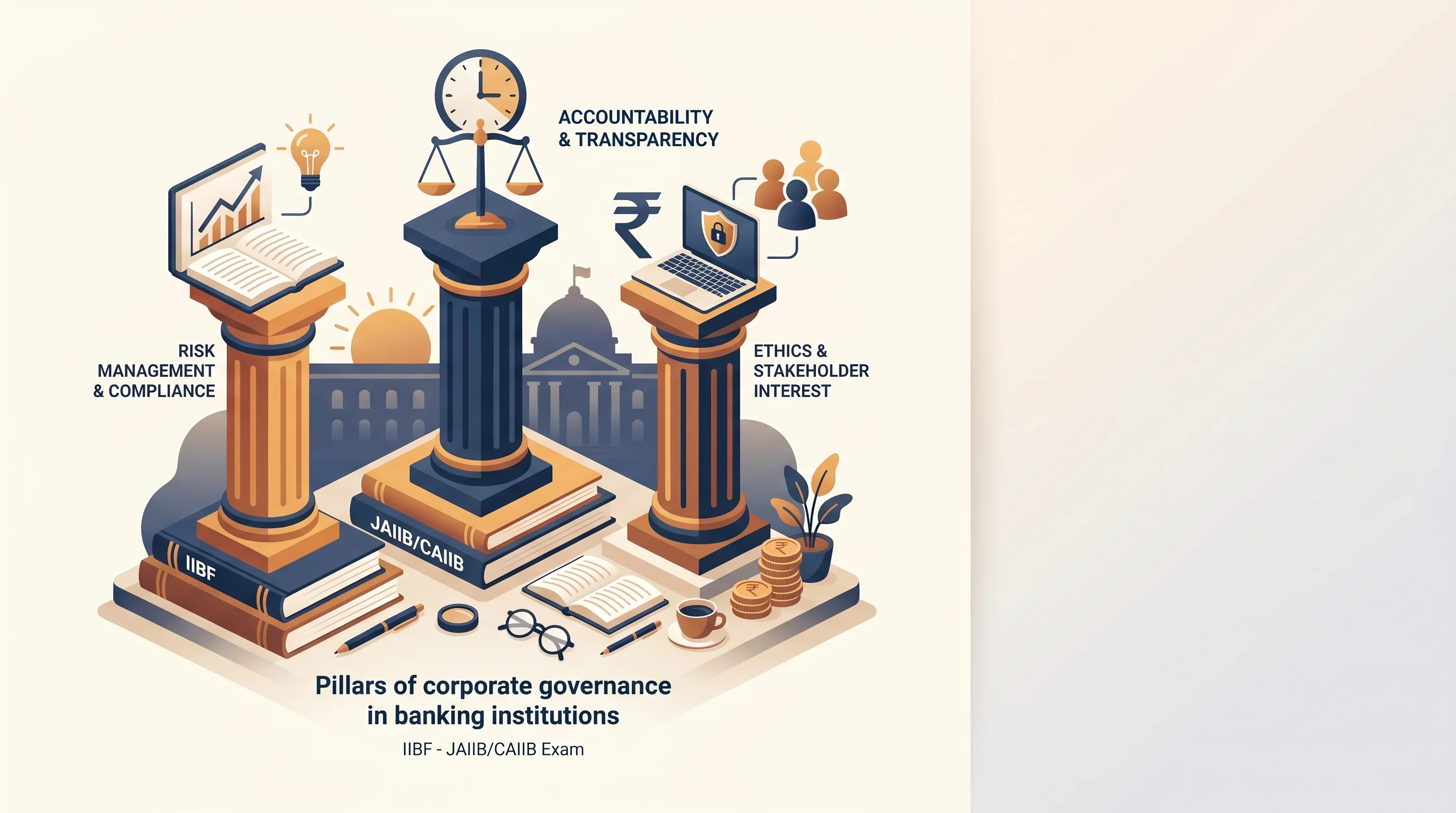
Corporate governance is the system by which a bank is directed and controlled, and it rests on four enduring pillars: accountability, transparency, fairness and responsibility. Strong ethics in banking is what gives these pillars their day-to-day meaning, turning abstract values into concrete checks and balances that actually change behaviour.
The Board of Directors sits at the apex. It sets strategy and risk appetite while remaining genuinely independent of day-to-day management. The structural features that make governance effective are well known to examiners: a meaningful presence of independent directors, a clear separation of the chair and chief executive roles, and well-resourced audit, risk and nomination committees that can challenge management without fear.
In Indian banking, this framework is shaped by the Banking Regulation Act, by RBI guidelines on board composition, and by the fit-and-proper criteria that directors must satisfy. For the exact current thresholds, tenures and committee mandates, always confirm against the latest released IIBF reading material and the official RBI notification, since these are periodically revised. The big three board committees you must map carefully are set out below.
Mapping the Key Board Committees
A favourite IIBF question asks which committee owns which function. Memorise the mapping until it is automatic, because the distinctions are easy to blur under exam pressure.
| Board Committee | Primary Mandate | Ethics Link |
|---|---|---|
| Audit Committee | Financial reporting integrity, internal controls, statutory and internal audit oversight. | Receives whistle-blower disclosures and investigates irregularities. |
| Risk Management Committee | Oversees credit, market, operational and conduct risk against the board's risk appetite. | Treats conduct risk as a formal, monitored category. |
| Nomination & Remuneration Committee | Applies fit-and-proper tests, board succession and pay aligned to long-term performance. | Discourages incentives that reward short-term mis-selling. |
Notice how every committee has an ethical dimension built in. Good governance is simply ethics in banking expressed as structure. Reinforce this mapping with our quick governance terms match game, which drills the committee-to-function pairings until recall is instant.
Codes of Conduct, Conflicts of Interest and Whistle-Blowing
Every bank adopts a code of conduct that translates broad values into specific do's and don'ts: maintaining customer confidentiality, avoiding insider trading, declaring outside interests, and treating customers fairly at every touchpoint. The code is the bridge between a lofty mission statement and the behaviour expected at the teller counter.
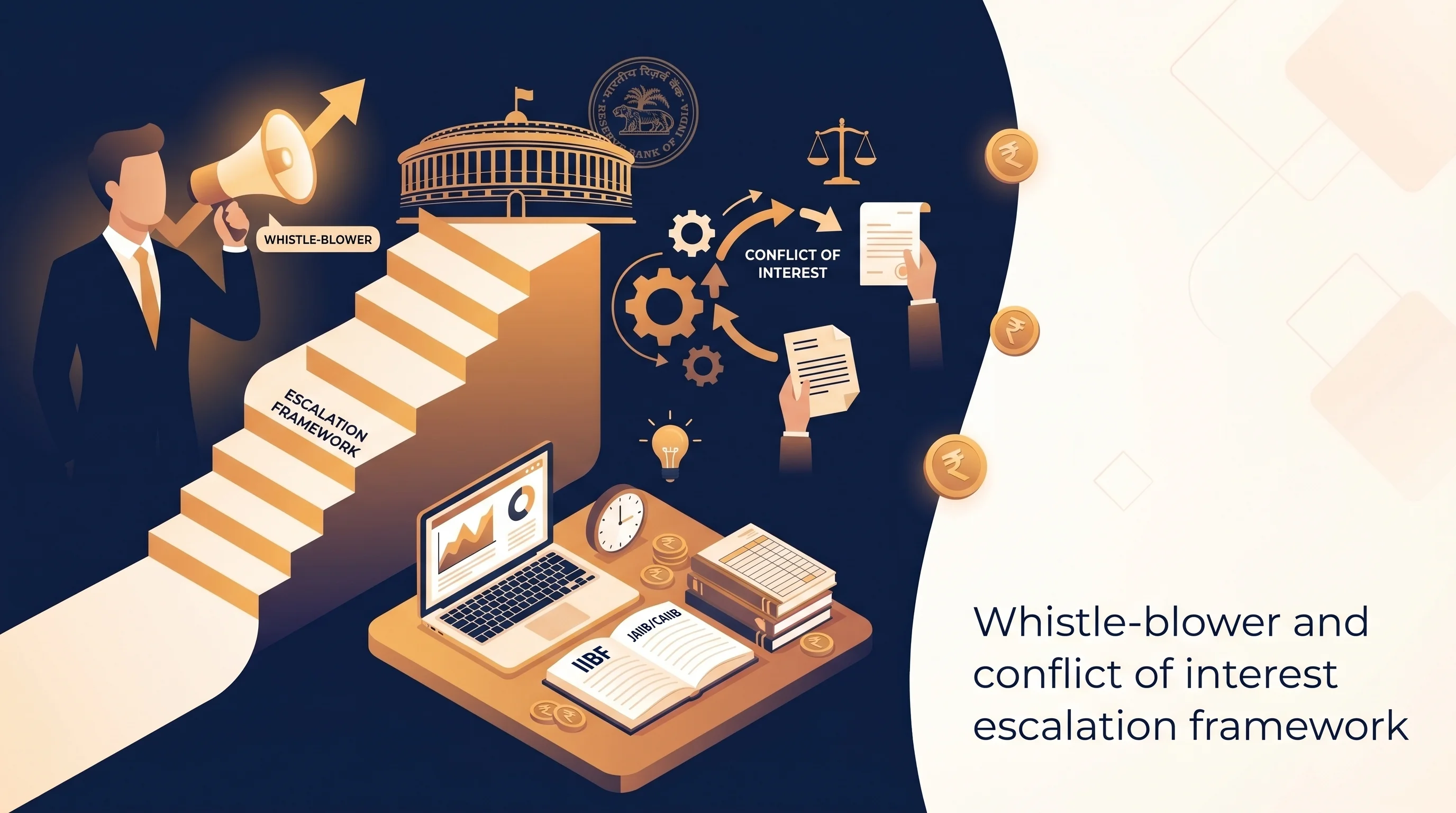
A central concept is the conflict of interest — any situation where a personal interest could improperly influence a professional duty. The ethical response is always disclosure and recusal: declare the interest in writing and step away from the decision, rather than quietly concealing it and hoping nobody notices. Concealment converts a manageable conflict into a disciplinary failure.
A robust whistle-blower (protected disclosure) policy lets employees report wrongdoing without fear of retaliation, channelling concerns to the audit committee for independent review. This is one of the most powerful early-warning mechanisms against fraud, and it is mandated for listed entities. Alongside it, the Banking Codes and Standards Board of India and the RBI's Charter of Customer Rights — covering fair treatment, transparency, suitability, privacy and grievance redress — give ethics in banking a clear customer-facing dimension. To see how these ideas connect, read our detailed IIBF ethics whistle-blower mechanism guide and the companion explainer on bank corporate governance for IIBF ethics.
Fraud Prevention, ESG and Data Ethics
Ethical banking has a strong preventive dimension that examiners love to probe. RBI's Master Directions on frauds require early detection, prompt reporting to the regulator and investigative agencies, and a culture where staff are actively encouraged to flag suspicious activity rather than look away. For the latest reporting timelines and thresholds, always confirm on the official RBI notification, as these are updated from time to time.
The classic fraud triangle — pressure, opportunity and rationalisation — is a useful analytical lens. Of the three corners, reducing opportunity is the most actionable, achieved through segregation of duties and maker-checker controls that no single person can override alone. Build your scenario-handling skills with our fraud prevention and whistle-blower guide.
Two modern themes round out the syllabus. Environmental, Social and Governance (ESG) considerations now influence lending decisions, with banks expected to weigh climate and social risks alongside credit risk. And data protection law places data ethics at the centre of the customer relationship, requiring consent, purpose limitation and security for personal data. A modern banker's ethics now stretches from the loan desk all the way to the data centre, and the exam reflects that breadth.
A Practical 4-Week Study Plan
Knowing the theory is only half the battle; you need a plan that converts reading into recall under timed conditions. Here is a simple, proven sequence you can adapt to the time you have left before the exam.
- Week 1 — Foundations. Master the four governance pillars and the board committee mapping. Write each concept on a flashcard with a one-line real-world example.
- Week 2 — Conduct and disclosure. Drill conflicts of interest, the code of conduct and the whistle-blower escalation path. Practise turning each into a short case answer.
- Week 3 — Prevention and modern themes. Lock in the fraud triangle, maker-checker controls, ESG and data ethics. Connect each to a recent banking development you have read about.
- Week 4 — Active recall. Attempt full-length mock tests under timed conditions, review every wrong answer, and revisit only the weak topics.
Throughout, lean on active recall over passive re-reading. Browse the full library of explainers for this paper in our ethics in banking guides hub, and anchor your structured revision around the Ethics in Banking course and its dedicated ethics module.
Common Mistakes to Avoid
Strong candidates still lose easy marks to a handful of recurring traps. Knowing them in advance is half the cure.
- Memorising without applying. The examiner wraps the pillars, the fraud triangle and the committees inside a short case. Practise translating each concept into a worked example instead of reciting it.
- Confusing closely related terms. Conflict of interest versus insider trading, or audit versus risk committee, are easy to mix up. Keep a running list of look-alike concepts and test yourself until the distinctions are automatic.
- Missing negatively-phrased questions. Options such as "which is NOT correct" trip up even well-prepared candidates. Read every stem twice before answering.
- Ignoring recent developments. The paper increasingly tests current regulatory themes alongside core theory, so weave fresh updates into your revision.
- Losing time on one hard item. Flag tough questions, move on, and return at the end rather than burning your clock early.
Exam tip
When a scenario looks unfamiliar, fall back on first principles: ask who is harmed, what duty is owed, and whether disclosure would fix it. That instinct answers most ethics in banking questions correctly.
Frequently Asked Questions
Why is ethics so central to banking?
Banking runs entirely on trust, because depositors hand over money on a promise of safety and fair dealing. Ethical lapses such as mis-selling, reckless lending or insider abuse erode that confidence quickly. In severe cases the damage spreads beyond one bank to the wider financial system.
What are the four pillars of corporate governance?
The four pillars are accountability, transparency, fairness and responsibility. They are supported in practice by an independent board and by well-resourced audit, risk and nomination committees. Together they convert ethical values into enforceable checks and balances.
How should a conflict of interest be handled ethically?
The correct response is disclosure and recusal: declare the personal interest in writing and step away from the relevant decision. Concealing the conflict turns a manageable situation into a disciplinary breach. Many institutions manage routine conflicts through standing written declarations.
What is the fraud triangle?
The fraud triangle explains fraud through three factors that usually appear together: pressure, opportunity and rationalisation. Of these, reducing opportunity is the most practical defence. Segregation of duties and maker-checker controls are the most effective tools for doing so.
Does the IIBF ethics paper cover ESG and data protection?
Yes. Environmental, Social and Governance factors now influence lending and risk decisions, and modern data-protection rules require consent, purpose limitation and security for customer data. Both are examinable as part of a banker's broader ethical responsibility. Always confirm the current syllabus weightage on the official IIBF notification.
How is the ethics paper best revised in the final week?
Prioritise active recall over passive reading by attempting full-length mocks under timed conditions. Review every incorrect answer and revisit only the topics where you stumble. Read each question stem twice to avoid being caught by negatively-phrased options.
Conclusion
Ethics in banking ties together governance structures, codes of conduct, whistle-blowing, fraud prevention and the newer frontiers of ESG and data protection into one coherent professional standard. Master the habit of applying these principles to short scenarios rather than memorising definitions, and the marks will follow naturally. Stay close to primary sources by checking the official IIBF website, keep your reasoning sharp, and you will walk into the exam hall calm, confident and well-prepared.
Related Guides
📚 Free Learning Sessions resources — connect & crack your exam
- 📝 Free mock tests — chapter-wise, exam-pattern, with instant solutions
- 🎮 Matching games — gamified revision of key terms & concepts
- 📄 Study notes & PDFs — downloadable chapter material
- 🎥 Video classes on YouTube — subscribe to @learningsessions
💬 Want the full course? WhatsApp your course name to 8360944207 and our team will set you up.
📱 Study on the go — get our iOS & Android app at iibf.store/app.
Quick quiz on this topic
5 exam-style questions from our free test bank — check yourself before you move on.
Practice this topic
Take a free mock test, download chapter PDFs, or watch a video class — all included on iibf.store.