Insider Trading in Banks: Rules Every Banker Must Know (2026)
Insider trading in banks is one of the most serious ethical and regulatory violations a bank employee can commit, because banks routinely sit on unpublished price-sensitive information (UPSI) about their own listed shares, corporate borrowers, and group companies. For IIBF Ethics in Banking candidates, understanding how the insider trading framework applies inside a bank — not just to brokers, promoters, or company insiders — is a recurring exam theme. This article breaks down the legal rules, the internal controls banks must run, and the real penalties employees face when they trade on information they were never meant to use.
📈 What Is Insider Trading in Banks — and Why It's an Ethics Issue
Insider trading occurs when a person who has access to unpublished price-sensitive information (UPSI) about a listed company trades in its securities, or shares that information with someone who trades on it, before the information becomes public. In a bank, UPSI is not limited to the bank's own quarterly results. A credit officer processing a large sanction to a listed borrower, a treasury dealer aware of an unannounced bond issue, a merger-and-acquisition advisory team member, or even an IT administrator with database access to board-meeting minutes can all be sitting on UPSI without realising it. This is exactly why the topic sits inside the IIBF module on ethics at the individual level — the temptation to act on privileged information is a personal, everyday ethical test, not an abstract compliance rule.
What separates insider trading from ordinary market speculation is the breach of trust: the employee gains an unfair advantage that ordinary shareholders never had, and the bank's credibility as a custodian of confidential information is damaged. Regulators and IIBF examiners both treat it as a form of dishonesty rather than a mere procedural lapse, and it is frequently discussed alongside other corruption, bribery and white-collar crime topics because the underlying motive — personal financial gain from a position of trust — is identical. Bankers preparing for the exam should be able to distinguish UPSI from ordinary market rumour, and identify which roles inside a bank are most exposed to it.
⚖️ SEBI PIT Regulations: The Legal Framework Bankers Must Know
The primary law governing insider trading in banks is the SEBI (Prohibition of Insider Trading) Regulations, 2015. It defines an "insider" as any "connected person" who has, or is reasonably expected to have, access to UPSI, and a "designated person" as an employee identified by the bank as more likely to have such access — typically those in treasury, investment banking, credit, compliance, company secretarial, and senior management roles. The regulations require every listed bank to maintain a Structured Digital Database (SDD) that logs every instance UPSI is shared internally, along with the name, PAN, and contact details of the recipient — this audit trail is what regulators examine first during an investigation, and it is a favourite exam reference point under ethics, financial services and regulation.
Banks are also required to enforce a "trading window closure" — a period during which designated persons cannot trade in the bank's own listed securities — typically opened only after quarterly results, major corporate announcements, or other UPSI events are made public. Designated persons must seek pre-clearance before trading beyond a threshold value, disclose their holdings periodically, and observe a minimum holding period before reversing a trade. For the authoritative text of these rules, bankers should refer directly to the Securities and Exchange Board of India (SEBI) website rather than relying on secondhand summaries.
💡 Exam Tip: If a question asks who qualifies as an "insider" under SEBI PIT Regulations, remember it covers connected persons with UPSI access — not only directors or promoters, but any employee in a position to receive confidential price-sensitive information.
🏦 How Banks Control Insider Trading Internally
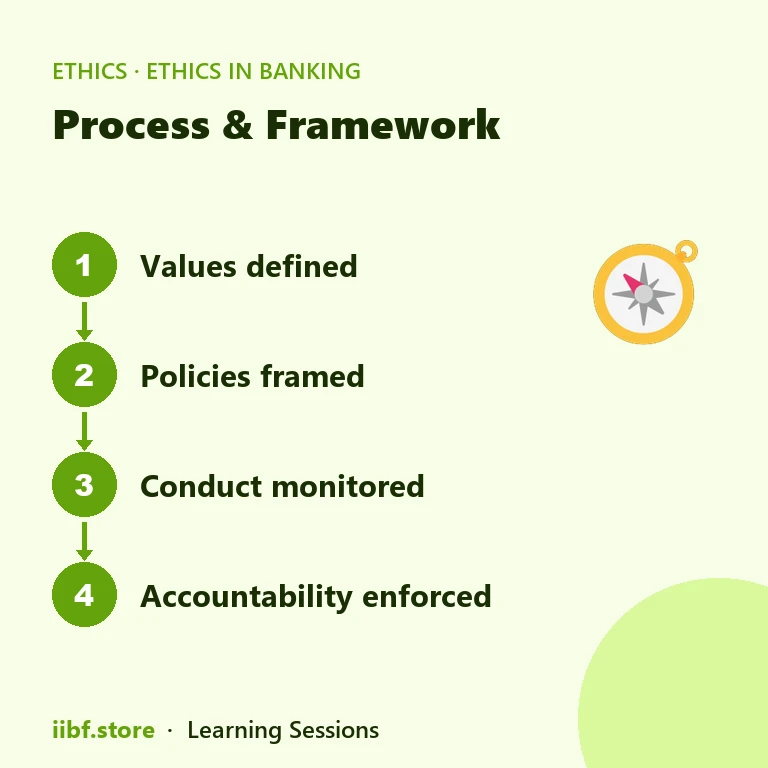
Beyond SEBI's regulations, every listed bank must adopt its own Code of Conduct for Prevention of Insider Trading, administered by a designated Compliance Officer. This code typically builds "Chinese walls" — information barriers — between departments such as treasury and investment banking that routinely handle UPSI, and the rest of the organisation. Employees who cross into a UPSI-restricted project are placed on a "restricted list" or "grey list," which automatically blocks their trading in the relevant security until the list is cleared. This internal architecture works alongside, and often overlaps with, a bank's broader fraud risk management framework in banks, since both are designed to detect misuse of privileged access before it causes financial or reputational harm.
These controls are not confined to the parent bank alone. Where a banking group runs a subsidiary or associate operating as one of the non-banking financial companies in India, employees moving between the bank and the NBFC who carry UPSI with them must still be tracked in the group's Structured Digital Database, and the same trading window and pre-clearance rules travel with them. Compliance teams also run periodic reconciliation of employee demat account statements against declared holdings, and cross-check trades executed just before major announcements — a pattern that regulators specifically look for during surveillance.
⚠️ Common Mistake: Many candidates assume insider trading rules apply only to a bank's own shares. In practice, UPSI can relate to a listed borrower, a client undergoing a merger, or any listed company the bank has confidential exposure to — the obligation is information-based, not limited to the bank's own stock.
| Requirement | Applies To | Bank Employee Obligation |
|---|---|---|
| Trading window closure | Designated persons | ✅ No trading until window reopens |
| Structured Digital Database entry | Any UPSI recipient | ✅ Mandatory logging by compliance |
| Pre-clearance above threshold | Designated persons | ✅ Approval before trade execution |
| Contra trade within 6 months | Designated persons | ❌ Not permitted without exemption |
| Casual/non-designated staff trading UPSI-free stock | General employees | ✅ Permitted, subject to code of conduct |
🚨 Penalties, Enforcement and Real Consequences for Bankers
SEBI's enforcement powers for insider trading are substantial. Under Section 15G of the SEBI Act, 1992, a person found guilty of insider trading can be penalised up to Rs 25 crore or three times the profit made from the trade, whichever is higher, in addition to disgorgement of the illegal gains. SEBI can also bar the individual from accessing the securities market for a specified period, and criminal prosecution remains a possibility in serious cases. Because the underlying conduct — profiting from confidential access obtained through employment — mirrors other forms of white-collar crime in banking, insider trading cases are frequently studied together with other financial crimes in the IIBF syllabus.
Separately from SEBI action, banks impose their own internal discipline — ranging from formal warnings and suspension to outright termination and reporting to regulators — regardless of whether SEBI ultimately prosecutes the case. Reputational damage to the bank can be significant, particularly when the employee involved held a position of seniority or customer trust. In several respects the ethical failure resembles cases of bribery and corruption in banking, where personal gain is extracted from a position that was meant to serve the institution and its customers — reinforcing why banks train staff on both topics together rather than in isolation.
📌 Remember: Disgorgement, monetary penalty, market debarment, and internal termination can all apply simultaneously to the same insider trading case — the consequences are not "either/or."
🧠 Practice MCQs: Insider Trading in Banks
Q1. Under SEBI (Prohibition of Insider Trading) Regulations, 2015, what does UPSI stand for? (a) Unified Public Sector Information (b) Unpublished Price Sensitive Information (c) Universal Price Setting Index (d) Unregistered Public Security Interest
Answer: (b) — UPSI refers to information about a listed company that is not generally available and, if published, is likely to materially affect the price of its securities.
Q2. A bank's "trading window" is closed for designated persons mainly during which period? (a) Festival holidays (b) Before declaration of financial results or other UPSI events (c) Every Monday (d) During RBI inspections
Answer: (b) — Trading window closure prevents designated persons from trading while they may possess UPSI ahead of results or major announcements.
Q3. Under SEBI PIT Regulations, what is the minimum period a designated person must generally wait before executing a contra trade after a transaction in the same security? (a) 24 hours (b) 7 days (c) 6 months (d) No restriction
Answer: (c) — Designated persons are generally barred from taking an opposite position in the same security within six months of the original trade.
Q4. Which internal record must banks maintain to log access to UPSI by employees and other insiders? (a) Suspicious Transaction Report (b) Structured Digital Database (SDD) (c) Know Your Customer register (d) Fixed Asset Register
Answer: (b) — The Structured Digital Database captures who accessed UPSI, when, and for what purpose, and is a key document during any SEBI investigation.
Q5. What is the maximum monetary penalty SEBI can impose for insider trading under the SEBI Act, 1992, aside from disgorgement? (a) Rs 1 lakh (b) Rs 1 crore (c) Rs 25 crore or three times the profit made, whichever is higher (d) There is no monetary penalty, only imprisonment
Answer: (c) — Section 15G of the SEBI Act prescribes a penalty of up to Rs 25 crore or three times the profit made from the violation, whichever is higher.
Want chapter-wise mock tests with 100+ MCQs? Start practising free →
Does the SEBI insider trading law apply to bank employees, not just company promoters?
Yes. Any "connected person" or "insider" with access to UPSI — including bank employees in treasury, credit, investment banking, or IT with system access — falls under SEBI's insider trading framework, not just promoters or directors.
What is a "trading window closure" and why do banks use it?
A trading window closure is a period during which designated employees are barred from trading in the bank's own listed securities, typically applied ahead of board meetings, financial results, or other UPSI-generating events, to prevent trades based on unpublished information.
Can a bank employee be punished internally even if SEBI does not take action?
Yes. Banks maintain their own Code of Conduct for Prevention of Insider Trading, and violations can lead to disciplinary action, including suspension or termination, independent of any SEBI enforcement proceedings.
How is insider trading different from other ethical violations covered in IIBF's Ethics in Banking module, like bribery or mis-selling?
Insider trading specifically involves misuse of unpublished price-sensitive information for trading gain, whereas bribery involves illicit payments for favours and mis-selling involves misrepresenting products to customers — all are ethics violations but governed by distinct legal frameworks.
🎯 Final Word: Turn Insider Trading in Banks Into an Exam Strength
Insider trading in banks sits at the intersection of law, compliance, and personal ethics, which is exactly why IIBF examiners keep returning to it. Candidates who can explain UPSI, connected persons, trading window closures, the Structured Digital Database, and SEBI's penalty structure — rather than memorising isolated definitions — will handle both exam questions and real workplace dilemmas with confidence. For more coverage of this theme, browse the ethics in banking tag hub, and when you are ready to test yourself under exam conditions, take a free mock test to see how well these concepts have stuck.
Prefer revising from a printed book?
Chapter-wise books with MCQs after every chapter — minimal pages, complete coverage, delivered anywhere in India. Every book has a free sample to read first.
































Quick quiz on this topic
5 exam-style questions from our free test bank — check yourself before you move on.
Practice this topic
Take a free mock test, download chapter PDFs, or watch a video class — all included on iibf.store.