Organizational Ethics in Banks: A Complete IIBF Guide
Every bank runs on trust, and trust is built or broken at the level of daily decisions, not in a mission statement. That is why organizational ethics in banks has become a core IIBF exam theme: it asks how a bank treats customers, employees, small borrowers and society once the policy manual is closed. This article breaks the topic into the groups that matter most and shows how examiners frame questions around each one.
We will look at customer-facing conduct, employee culture, fair dealing with MSE borrowers, and the pressure globalization adds to all three. Along the way you get a comparison table, exam-style MCQs and quick revision callouts, so you can move straight from concept to practice.
🏦 What Organizational Ethics Means for a Bank
Organizational ethics is not one rule. It is the sum of how a bank behaves toward every group it touches: customers, staff, regulators, small businesses and the wider community. A bank can have a spotless code of conduct on paper and still fail this test if branch-level behaviour does not match it.
The IIBF chapter on ethics at the organizational level splits this into four stakeholder lenses: customers, marketing, MSEs and employees. Each lens has its own pressure points and its own failure modes, and exam questions usually test whether you can tell them apart.
Think of organizational ethics as the plumbing behind good governance. Corporate governance sets the rules at the board level; organizational ethics is whether those rules actually reach the teller counter and the loan desk. Both matter, but they are tested separately.
🤝 Ethics Toward Customers and Marketing
Customer-facing ethics covers honest advice, clear pricing and marketing that does not oversell. A bank that pushes a product because it earns a higher commission, rather than because it fits the customer, is crossing this line even if no law is technically broken.
Marketing ethics adds another layer. Advertisements must not exaggerate returns, hide charges in fine print, or create urgency that pressures a customer into a decision they have not understood. IIBF exams often present a short scenario and ask whether the marketing approach described is ethical, borderline, or clearly wrong.
💡 Exam Tip: When a case study mentions commission-linked targets pushing a product onto an unsuitable customer, the ethical breach is almost always in the incentive design, not just the individual employee.
Grievance redress is the safety valve here. A bank that makes complaints hard to file, or slow to resolve, signals that customer ethics is not really a priority, whatever the brochure says. Fast, transparent complaint handling is one of the few things examiners treat as a reliable positive indicator.
🧾 Fair Dealing With MSE Borrowers
Micro and small enterprises depend on banks in a way large corporates do not; they usually have no alternative lender and little bargaining power. That imbalance is exactly why ethical lending to MSEs gets its own place in the syllabus.
Common lapses include asking for collateral far beyond the loan value, delaying disbursal without explanation, or bundling insurance products the borrower did not ask for. None of these may violate a specific clause, but all of them violate the spirit of organizational ethics in banks toward a vulnerable customer segment.
Good practice looks the opposite: clear turnaround-time commitments, plain-language loan documents, and a genuine effort to explain rejection reasons instead of a generic form letter. Bankers preparing for this topic should also revisit the broader ethics, financial services and regulation chapter, which links MSE conduct back to the regulatory framework it sits inside.
⚠️ Common Mistake: Students often treat MSE ethics as identical to retail customer ethics. The syllabus treats them separately because MSE borrowers face a different power imbalance and different documentation gaps.
👥 Ethics Inside the Workplace
Organizational ethics also runs inward, toward the bank's own staff. A workplace where promotions depend on favouritism, where targets are set without regard for how they are achieved, or where junior staff fear reporting a senior colleague, is an ethical failure even if the bank's external face looks clean.
The work ethics and the workplace chapter covers this ground in detail: respect, fairness in appraisal, safety, and freedom from harassment. These are not soft add-ons; IIBF treats them as measurable parts of an organization's ethical health.
A related and frequently tested angle is how a bank responds when an employee raises a concern. The mechanism a bank uses to let staff report wrongdoing without fear of retaliation is examined in detail in a companion piece on the whistle blower mechanism in banks, which sits under the broader compliance function rather than ethics alone, but the two topics overlap heavily in practice.
🌍 How Globalization Raises the Stakes
Indian banks no longer operate in a closed system. Cross-border lending, foreign correspondent relationships and international remittance networks mean an ethical lapse in one branch can surface as a reputational problem overseas within days.
The ethics and globalization chapter explains why global operations demand higher, not lower, ethical consistency. A practice that is locally tolerated but internationally unacceptable, such as loose documentation on beneficial ownership, can trigger correspondent-banking penalties far larger than the original saving.
This is also where organizational ethics in banks intersects with financial crime prevention. Weak internal ethics culture tends to correlate with weaker fraud detection, which is why topics like the pattern of conduct explored in white-collar crime in banking and the incentives behind bribery and corruption in banking keep appearing alongside organizational ethics questions in mock tests.
📌 Remember: Globalization does not create new ethical principles; it raises the cost of ignoring the old ones.
🧩 Building an Ethical Organization
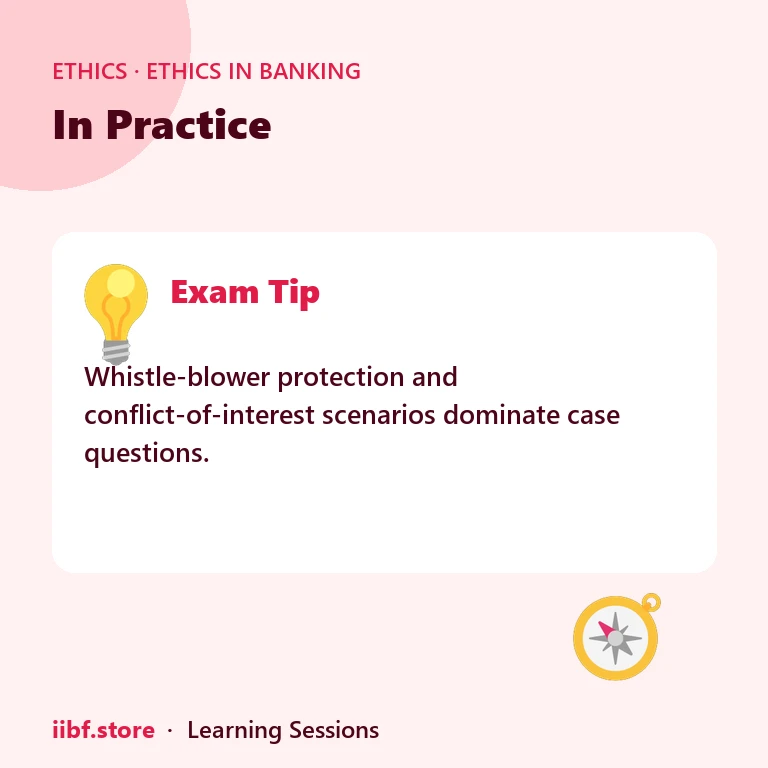
None of the stakeholder-level fixes above work without structure behind them. A bank needs a board-level ethics or conduct committee, a channel for staff to raise concerns safely, regular training, and consequences that apply the same way to a branch manager and a new recruit.
The building an ethical organization chapter ties these pieces together and is one of the most exam-relevant sections in the whole subject, because it is where scenario-based questions usually land. Examiners like to describe a bank with good policies but poor enforcement and ask what is missing.
Internal complaints handling deserves special mention here. A bank that has a workplace grievance policy but takes months to act on a complaint has, in practice, no policy at all. The topics covered in a related piece on POSH Act compliance in banks show how strict, time-bound processes are what actually make an ethics policy credible rather than decorative.
Finally, organizational ethics in banks needs measurement, not just intention. Boards increasingly track ethics-linked metrics such as complaint resolution time, whistle-blower case closure rates and employee survey scores on fairness, folding them into the same governance dashboard used for financial performance.
| Stakeholder Group | What They Expect From the Bank | Common Ethical Lapse | Has a Dedicated RBI/Board Policy? |
|---|---|---|---|
| Customers | Fair treatment, transparent pricing | Mis-selling, hidden charges | ✅ |
| Employees | Safe, respectful, fair workplace | Favouritism, harassment, unsafe targets | ✅ |
| MSE Borrowers | Honest disclosure, timely turnaround | Excess collateral, unexplained delays | ✅ |
| Society & Community | Responsible, inclusive lending | Ignoring social or environmental cost | ❌ |
| Shareholders/Investors | Accurate disclosure, sound governance | Concealed risk, weak internal controls | ✅ |
Regulators expect banks to go beyond the minimum here. The Reserve Bank of India publishes supervisory expectations on fair conduct and internal controls at rbi.org.in, and candidates should treat that as the primary reference whenever an exam question hinges on a current regulatory position rather than a textbook definition.
🧠 Practice MCQs: Organizational Ethics in Banks
Q1. A bank's marketing team pushes an insurance add-on to loan customers because it carries a high commission, regardless of customer need. This is best described as a failure of: (a) Corporate tax planning (b) Customer-facing organizational ethics (c) Foreign exchange management (d) Balance sheet reconciliation
Answer: (b) — Selling driven by staff incentives rather than customer fit is a classic customer ethics lapse, not a technical or accounting issue.
Q2. Why does the IIBF syllabus treat MSE borrower ethics as distinct from general retail customer ethics? (a) MSEs are exempt from all banking regulation (b) MSE borrowers have less bargaining power and fewer alternative lenders (c) MSE loans are always unsecured (d) MSE borrowers cannot file complaints
Answer: (b) — The power imbalance and limited access to alternative credit make MSE ethical treatment a distinct concern, not merely a smaller version of retail ethics.
Q3. A bank has a written code of conduct but takes several months to act on internal harassment complaints. This situation best illustrates: (a) Strong organizational ethics with a minor delay (b) A structure-versus-enforcement gap in organizational ethics (c) A purely legal issue with no ethical dimension (d) An issue only relevant to marketing ethics
Answer: (b) — Good policy language without timely enforcement is a textbook example of the enforcement gap examiners test for.
Q4. How does globalization typically affect the demands of organizational ethics on an Indian bank? (a) It lowers ethical expectations because oversight is diluted across borders (b) It has no effect since ethics rules are purely domestic (c) It raises the cost and visibility of ethical lapses through cross-border exposure (d) It only affects marketing, not lending practices
Answer: (c) — Cross-border operations amplify the consequences of an ethical lapse, making consistent global conduct standards more important, not less.
Q5. Which of the following is the most reliable indicator that a bank's organizational ethics is more than a policy document? (a) The length of its code-of-conduct booklet (b) The number of ethics training slides issued (c) Measured outcomes such as complaint resolution time and whistle-blower case closure rates (d) The seniority of the officer who signs the ethics policy
Answer: (c) — Outcome metrics show whether ethical commitments translate into behaviour, unlike document length or signatory seniority.
Want chapter-wise mock tests with 100+ MCQs? Start practising free →
❓ Frequently Asked Questions
What is organizational ethics in banking?
It is how a bank actually behaves toward customers, employees, MSE borrowers and society, as opposed to what its written policies say. It is measured through outcomes like complaint handling, fair lending and workplace fairness.
How is organizational ethics different from corporate governance?
Corporate governance sets rules and oversight at the board level. Organizational ethics is whether those rules actually shape day-to-day behaviour at branches and departments across the bank.
Why do MSE borrowers get separate ethical treatment in the syllabus?
MSE borrowers typically have limited access to alternative lenders and weaker bargaining power than large corporate clients, so unfair treatment has a much sharper impact on them.
Does globalization make banking ethics harder to enforce?
It makes lapses more visible and more costly rather than harder to define. Cross-border operations mean a local ethical failure can quickly become an international reputational or regulatory problem.
Organizational ethics in banks is ultimately tested through outcomes, not intentions: how fast a complaint is resolved, how fairly a promotion is decided, how honestly an MSE loan is explained. Revisit the Ethics in Banking topic hub for the full chapter sequence, then move on to full-length practice at the JAIIB course page to see how these concepts are framed across mock exams.
Prefer revising from a printed book?
Chapter-wise books with MCQs after every chapter — minimal pages, complete coverage, delivered anywhere in India. Every book has a free sample to read first.









Quick quiz on this topic
5 exam-style questions from our free test bank — check yourself before you move on.
Practice this topic
Take a free mock test, download chapter PDFs, or watch a video class — all included on iibf.store.