Is the FEFI Exam Preparation Book Right for You? Honest Guide
It is 9:40 pm. The branch has finally gone quiet, your tiffin is cold, and you are staring at a syllabus that mixes FEMA, remittances, NRE and FCNR accounts and the Liberalised Remittance Scheme. You have a full-time job, a family, and probably one failed or postponed attempt behind you. Before you spend money on anything, you deserve a straight answer to one question: will the FEFI exam preparation book actually help someone like you?
This guide does not try to sell you. It describes four kinds of readers, tells you how to use the book in each case, and says plainly when a book alone is not enough. If you decide the book is not for you, the free resources linked below still give you a good start.
What the book actually is
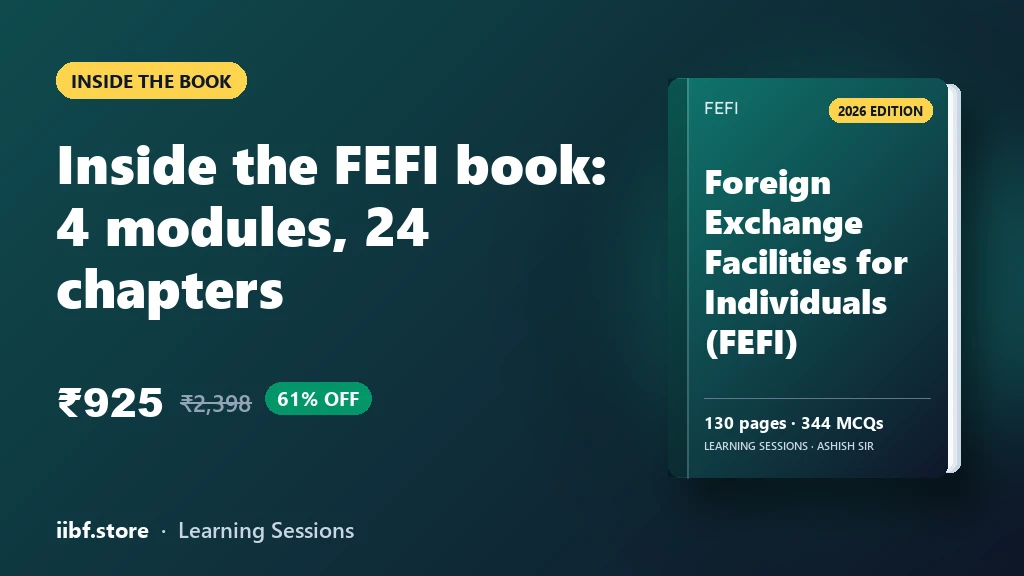
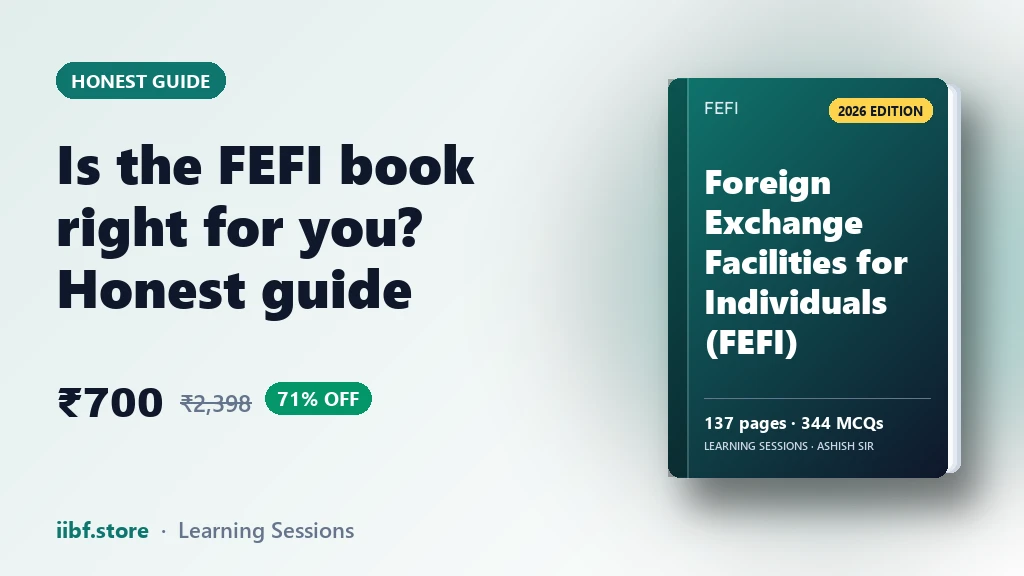
Start with facts, not adjectives. The Foreign Exchange Facilities for Individuals (FEFI) printed book is the 2026 edition. It runs to 137 pages across 24 chapters and carries 344 practice questions. The chapters are grouped into four modules:
- Module A: Introduction to Foreign Exchange Management (the evolution of FEMA).
- Module B: Inward and Outward Remittances, including the Liberalised Remittance Scheme, the Indo-Nepal Remittance Scheme and the Foreign Contributions Regulation Act.
- Module C: Foreign Currency Accounts of Residents, such as EEFC and RFC accounts.
- Module D: Facilities and Regulations for Non-Resident Individuals, from NRE/NRO accounts to FCNR(B) deposits, property repatriation and NRI debt investment.
The book page also lists two extras: 40 case studies (160 questions) and 5 mega tests (500 questions). Check the book page for exactly how they are delivered before you order.
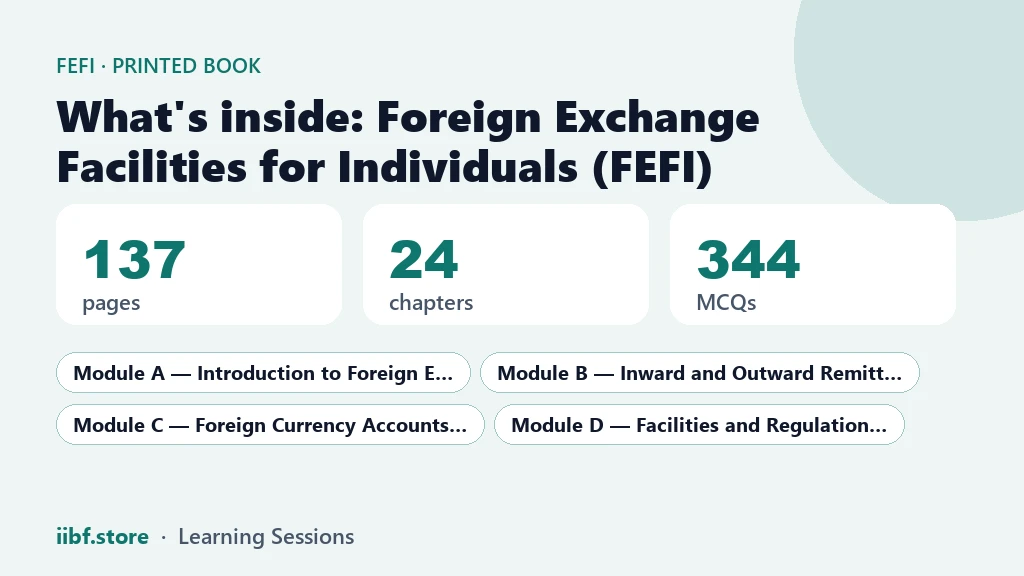
At 137 pages it is compact. That is a strength if you are tired and short of time, and a limit if you expect a reference work for every FEMA circular. Keep that in mind through the profiles below.
Profile 1: Your first attempt
If this is your first try at a certificate paper, your main risk is not difficulty. It is drifting. Foreign exchange is full of terms that sound alike: resident versus non-resident, NRE versus NRO, FCNR(B) versus RFC. A first-timer who reads randomly ends up confused by week two.
How to use the book
- Read in module order. Module A is short and gives you the FEMA vocabulary that everything else leans on.
- Take Module B slowly. It holds eight chapters, which is a third of the book, and remittances are where candidates mix up limits and conditions.
- After each chapter, attempt that chapter's questions closed-book, then re-read only what you got wrong.
When it is not enough
A first-timer often feels ready after reading and then freezes in a timed paper. The FEFI exam preparation book teaches you the content; it will not give you exam-hall speed. Pair it with timed practice from the free mock tests in the last two weeks.
Profile 2: You have attempted before
If you have failed once, you do not need to start from page one. You need to find out where marks leaked. Most repeat candidates know the headline rules but lose marks on the details inside them: who is eligible, which account, what happens on a change of residential status.
How to use the book
- Do a diagnostic first. Attempt a full mock test before opening the book, and note which topics you missed.
- Use the module structure to go straight to your weak areas. If non-resident accounts hurt you, work through Module D chapter by chapter.
- Use the case studies listed on the book page to practise applying a rule to a customer situation, not just recalling it.
Here is the honest limit: if you failed because of nerves, time management or reading questions carelessly, no book will fix that. Fix it with more timed papers, and review each wrong answer by asking why you chose it.
Profile 3: You are short on time
Many bank employees come to a certificate paper with three or four weeks, not three months. For them, a 137-page book is realistic in a way that a thick multi-volume set is not. But short time demands a ruthless method.
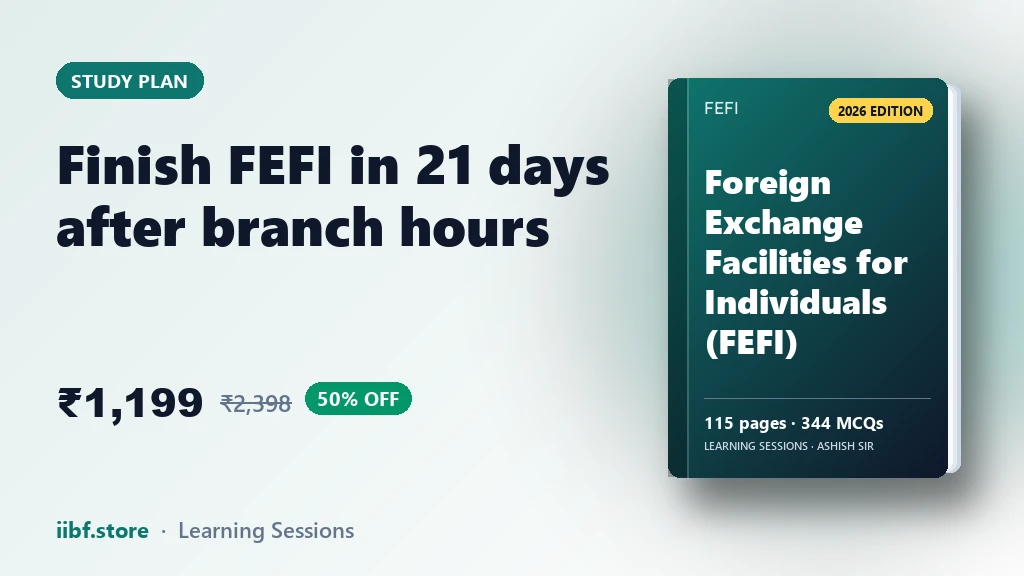
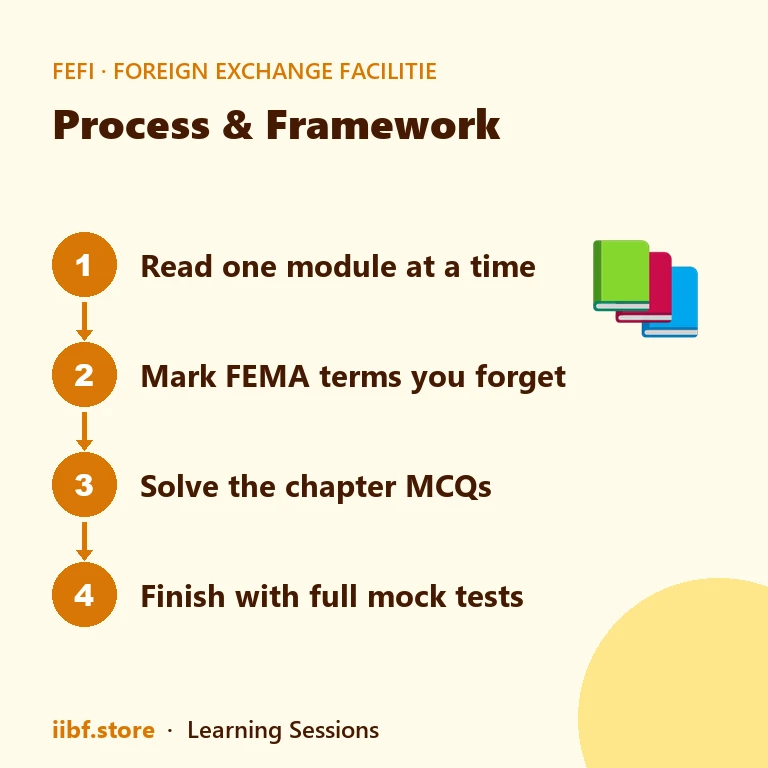
Here is how the same FEFI exam preparation book can be used in a compressed schedule:
| Stage | What to do | Purpose |
|---|---|---|
| Days 1-2 | Module A and skim Module B | Get the FEMA vocabulary |
| Days 3-8 | Module B in detail, with chapter questions | Remittances carry many chapters |
| Days 9-11 | Module C, then start Module D | Resident foreign currency accounts |
| Days 12-18 | Finish Module D, mark weak chapters | Non-resident rules are detail-heavy |
| Days 19-21 | Full mock tests, then fix errors | Build speed and stamina |
If you have even less time, do not try to read everything. Read each chapter once, attempt its questions, and spend your remaining hours on the chapters where you scored lowest. Short on time also means you should skip making fresh notes. Underline in the book instead.
When it is not enough
With three weeks, you will not be able to absorb every nuance of a regulation that changes. Check the official site at www.iibf.org.in for the syllabus and the upcoming exam cycle, and treat the printed book as your base layer, not the last word.
Profile 4: You prefer paper over screens
Be honest about this one, because it is a real preference and not a weakness. After eight hours at a terminal, many of us cannot face another screen. Paper lets you underline, fold a page, write a doubt in the margin, and study on the train or in the last half hour of lunch without a charger.
How to use the book
- Keep a pencil with you and mark three kinds of lines: definitions, limits and conditions, and anything you got wrong in a question.
- Use the module headings as your mental map: introduction, remittances, resident accounts, non-resident facilities.
- Revise only the marked lines in the final week. That turns 137 pages into a quick revision tool.
When it is not enough
Paper cannot time you. If you study only from print, you may reach the exam never having sat a timed digital paper. Use the free mock tests and free PDFs on your phone for at least a few full sittings, even if you read the book on paper.
Who should probably not buy it
Being useful means saying this too. The FEFI exam preparation book may not be the right pick if:
- You want a legal commentary on every FEMA notification. A 137-page exam-focused book is not that.
- You are not willing to practise questions. Reading alone rarely clears a certificate paper.
- You only study on screens and want an instant download. This is a printed book, so you should check the delivery details on the book page.
If you are unsure, start free. Browse the free study material, read the free sample on the book page, and take one mock test. If the sample reads clearly to you, that is a better signal than any review.
Price and what to check before you order
The book is listed at ₹700 against an MRP of ₹2,398, which the page shows as 71% off. Prices and offers may change, so the book page is always the current source. You can see all titles at the books section.
Before ordering, check three things: that you have read the free sample, that you know which of the four profiles above sounds like you, and that you have set aside time for mock tests. A book you read once and shelve will not help, however good it is.
The short version
The FEFI exam preparation book is a compact, module-wise companion that suits first-timers who need structure, repeat candidates who need to target weak chapters, busy employees who can only manage a few weeks, and readers who simply think better on paper. It is not a substitute for timed practice, and it is not a legal reference. Combine it with mock tests, check the official schedule at the Institute's website, and give yourself a fixed daily slot, even if it is only forty minutes.
You are already doing the hard part: studying after a full day at the branch. Choose the tool that fits how you actually study.
Frequently asked questions
Is the book enough to pass FEFI on its own?
For most people, no single book is enough on its own. Use it to learn the content, then add timed mock tests so you can practise speed and question patterns. Check the official syllabus on the IIBF website too.
How many chapters and questions does it have?
The 2026 edition has 137 pages, 24 chapters in four modules, and 344 questions. The page also lists 40 case studies (160 questions) and 5 mega tests (500 questions) as extras.
Can I try before buying?
Yes. The book page offers a free sample, and the free mock tests and PDFs on the site let you judge your level before you order.
Where do I find the exam date and fees?
Always use the official website, www.iibf.org.in, for the schedule, fees and eligibility for the upcoming exam cycle.
Prefer revising from a printed book?
Chapter-wise books with MCQs after every chapter — minimal pages, complete coverage, delivered anywhere in India. Every book has a free sample to read first.





Quick quiz on this topic
5 exam-style questions from our free test bank — check yourself before you move on.
Practice this topic
Take a free mock test, download chapter PDFs, or watch a video class — all included on iibf.store.