Inside the FEFI Exam Preparation Book: Modules, Chapters, MCQs
It is 9:30 at night. You have reached home after a full day of counter work, loan files and a reconciliation that refused to tally. Somewhere in your bag is a syllabus on foreign exchange facilities for individuals, and it looks endless: remittances, resident accounts, NRI accounts, schemes with long names. Before you decide whether you need a FEFI exam preparation book at all, it helps to know what a good one should look like on the inside.
So this article is a guided tour. We will look at how the subject is naturally divided, what one chapter session should feel like, and how to use the practice material so that your limited evenings turn into marks. You can use the method below with any material you already own. If you want to see how one particular book is built, we will walk through it too.
Why a foreign exchange paper feels harder than it is
Most working bankers meet foreign exchange only in slices. A branch officer may handle an inward remittance once a week and an NRO account request once a month, but rarely sees the whole picture. That is why the paper feels scattered. The truth is that the subject is a set of neat boxes, and the problem is only that nobody has shown you the boxes.
A tired candidate usually makes three mistakes:
- Reading in the order of the circular, not the order of the question. Exams ask what a person is allowed to do, not which notification said it.
- Mixing the resident and non-resident rules. Two accounts with similar names can follow very different conditions.
- Doing MCQs too late. Questions are left for the last week, when there is no time to learn from the mistakes.
Fix these three and the paper becomes manageable, even on 45 minutes a day. For the official syllabus and the current exam schedule, always check the IIBF website; nothing in this article replaces it.
The four-module map of the subject
The easiest way to stop feeling lost is to put the subject on one page. The Foreign Exchange Facilities for Individuals (FEFI) book divides its 24 chapters into four modules. Here is the map, taken straight from its contents.
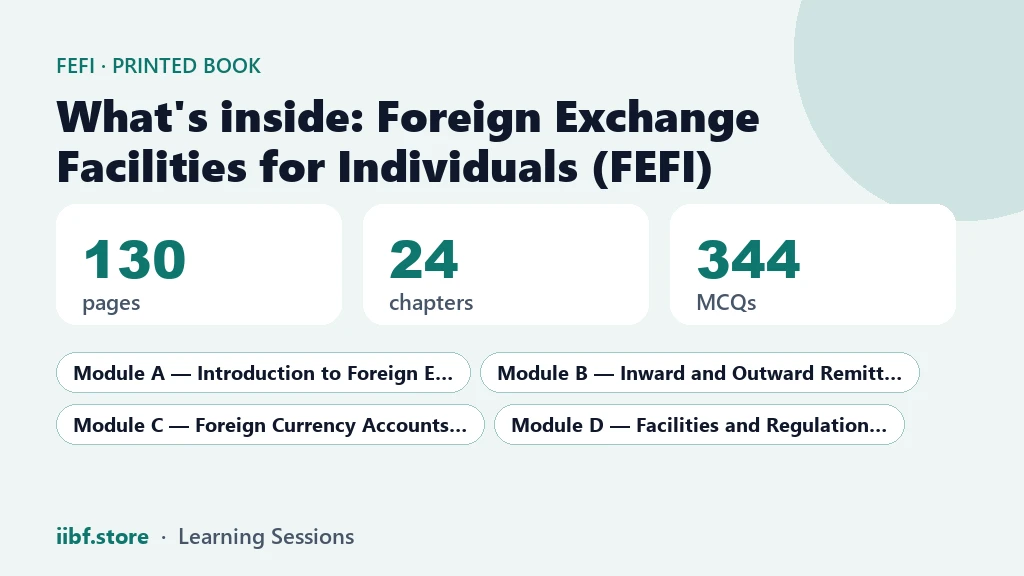
| Module | Theme | Chapters |
|---|---|---|
| Module A | Introduction to Foreign Exchange Management | 1 |
| Module B | Inward and Outward Remittances | 8 |
| Module C | Foreign Currency Accounts of Residents | 2 |
| Module D | Facilities and Regulations for Non-Resident Individuals | 13 |
Notice the shape. Module A is a single foundation chapter on the evolution of FEMA, the thread that explains why the later rules exist. Module B, on money moving in and out, and Module D, on non-resident individuals, carry most of the chapters. Module C is small but exam-friendly, because it deals with two resident foreign currency account types that are easy to confuse unless you study them side by side.
A closer look at each module
Module A: one chapter, read it twice
Evolution of FEMA is a short chapter, and it is tempting to skip it. Do not. Read it once at the start and once just before the exam. It gives you the vocabulary that every other module assumes.
Module B: remittances in and out
This module has eight chapters: inward remittances, the Foreign Contributions Regulation Act, outward remittances, internet and web services, the Indo-Nepal Remittance Scheme, the Liberalised Remittance Scheme and miscellaneous remittance provisions. It is where the daily branch experience helps you most, because you have seen some of these transactions for real. Use that. When a chapter describes a remittance, try to recall a customer who actually made one.
Module C: resident foreign currency accounts
Two chapters, Exchange Earners Foreign Currency Account and Resident Foreign Currency Accounts. Because there are only two, make a small comparison grid in your notebook: who can open, what can be credited, what can be debited. Ten minutes on this grid saves several marks.
Module D: the non-resident side
Thirteen chapters, from non-resident account eligibility and operations to FCNR(B) tenor, interest and withdrawal, NRO tax deduction and treaties, equity and debt investment, property and asset repatriation, travellers cheques, guarantees and reporting, and gift exports with current declaration rules. This is the heaviest module, so spread it over your longest stretch of weeks and do not leave it to the end.
What one chapter looks like in practice
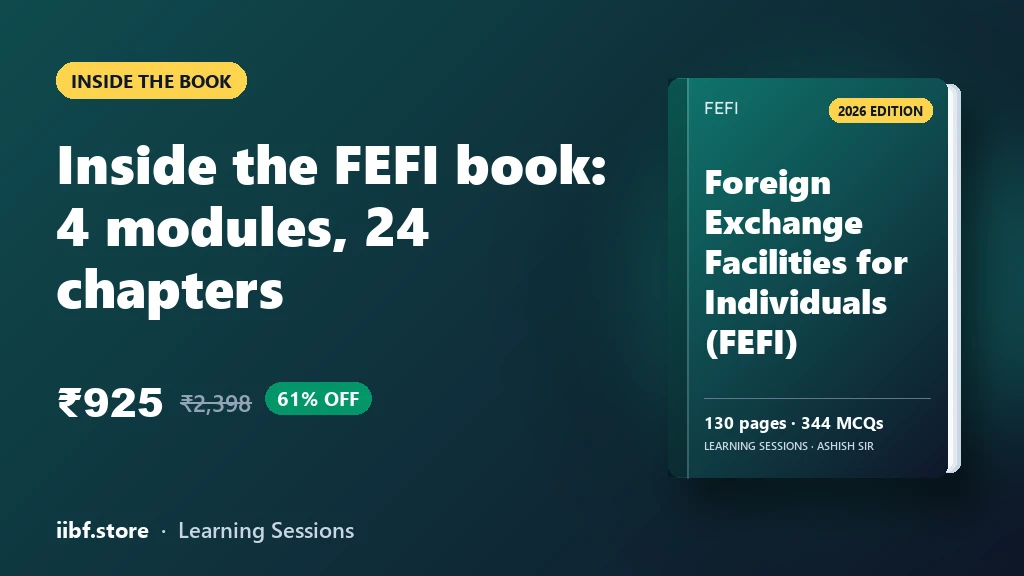
A book of 130 pages across 24 chapters cannot be a textbook in the old sense, and it is not meant to be. The idea is that every chapter follows the same three-step rhythm: concise notes first, then key points to fix the important rules in memory, then MCQs to test whether you really absorbed them. Because every chapter looks the same, you stop wasting energy on figuring out how to study and simply start.
Here is how a single evening can run with this structure, whichever FEFI exam preparation book you pick:
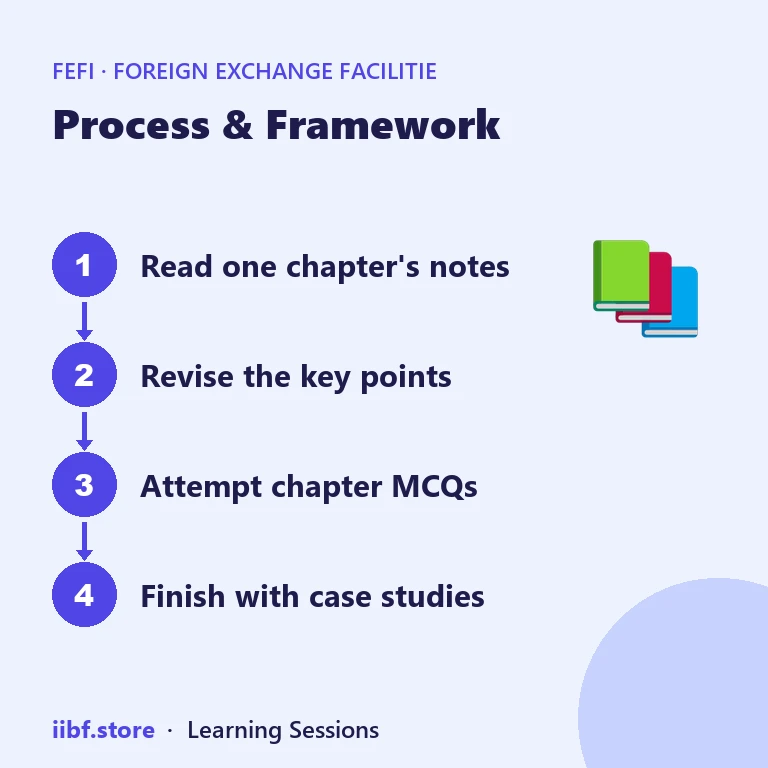
- Notes (20 minutes). Read one chapter slowly. Underline only what you did not know before.
- Key points (10 minutes). Re-read the key points and say them aloud without looking, the way you would explain them to a junior colleague.
- MCQs (15 minutes). Attempt the chapter questions straight away, while the rules are fresh. The book carries 344 MCQs in total, which works out to a handful per chapter on average.
- Mistake log (5 minutes). Write down every wrong answer with the correct rule in one line. This log is your last-week revision sheet.
That is about 50 minutes. It fits between dinner and sleep, and it is realistic even after a bad day at the branch.
The extras: case studies and mega tests
Beyond the chapters, the FEFI book lists two extras: 40 case studies carrying 160 questions, and 5 mega tests carrying 500 questions. They serve different purposes.
- Case studies give you a short situation, such as a customer with a particular status wanting a particular facility, followed by questions on it. They train you to read a scenario, spot the person's status and pick the right rule. Attempt them after you finish a module, not before.
- Mega tests mix everything. They are for the last few weeks, when you must prove to yourself that Module B and Module D do not blur together under time pressure.
Be honest with yourself on one point: a book, however well organised, will not give you exam-hall speed on its own. Speed comes from timed practice. Pair your reading with the free mock tests at iibf.store/tests, and pick up free PDFs from the free material section for extra revision.
A six-week way to use it
If you have roughly six weeks and about an hour on weekdays, this split works for most employed candidates:
| Week | Focus | Output |
|---|---|---|
| 1 | Module A and the first half of Module B | Chapter MCQs done, mistake log started |
| 2 | Rest of Module B | One case-study set, short revision of Week 1 |
| 3 | Module C and the first third of Module D | Resident vs non-resident comparison grid |
| 4 | Middle of Module D | Case studies for Modules C and D |
| 5 | End of Module D, then full revision of key points | First two mega tests |
| 6 | Mistake log, remaining mega tests, free mocks | Timed practice only |
Adjust it freely. If you already work on foreign exchange at your branch, compress Module B. If you have never touched an NRI account, give Module D an extra week. The structure matters more than the exact dates.
Who gets the most out of it
A FEFI exam preparation book like this suits you best if:
- you are working full time and need one organised source instead of scattered circulars;
- you prefer to hold paper, mark it up and revise from your own highlights;
- you learn by testing yourself, so chapter MCQs and mock-style tests matter to you;
- you have postponed this paper before because the syllabus felt shapeless.
It is probably not the right pick if you only want free reading and have the time to read regulations in their original form. In that case, start with the free resources linked above and see how far they take you. If you do want the printed route, the 2026 edition is listed at ₹925 against an MRP of ₹2,398 at the time of writing. Prices can change, so the book page is always the current reference, and it also has a free sample you can read before deciding. You can browse other titles on the books page too.
The one thing to do tonight
You do not need to commit to a purchase or a six-week plan tonight. Open the contents of whichever material you have, count its chapters, and write the four module names on a sheet of paper. That single act turns a shapeless syllabus into four boxes. Then read the first chapter and attempt its questions. A FEFI exam preparation book, or any good set of notes, only works when it is used a little every day, so choose the evening, not the perfect moment.
Frequently asked questions
How many chapters and questions does the FEFI book have?
It has 24 chapters in four modules, 130 pages and 344 MCQs, plus 40 case studies (160 questions) and 5 mega tests (500 questions).
Can I study FEFI while working full time?
Yes. Because the chapters are short and follow one pattern, a single chapter loop of notes, key points and MCQs fits in about 50 minutes. Consistency over several weeks matters more than long weekend marathons.
Is a book enough to clear the paper?
A book gives you structure and practice questions, but exam-hall speed needs timed mocks. Combine it with the free tests at iibf.store/tests and check the official IIBF site for the latest syllabus and exam schedule.
Can I preview the book before ordering?
Yes, the book page offers a free sample. Read it to judge the style of notes and questions before you decide.
Prefer revising from a printed book?
Chapter-wise books with MCQs after every chapter — minimal pages, complete coverage, delivered anywhere in India. Every book has a free sample to read first.











Quick quiz on this topic
5 exam-style questions from our free test bank — check yourself before you move on.
Practice this topic
Take a free mock test, download chapter PDFs, or watch a video class — all included on iibf.store.