FEFI Study Plan for Working Bankers: A 21-Day Routine
You reach home at eight, the branch was short-staffed again, and the Foreign Exchange Facilities for Individuals paper is still sitting on your list. The syllabus looks like a maze of remittances, resident accounts and NRI rules, and every evening you tell yourself you will start tomorrow. If that sounds familiar, this FEFI study plan is written for you: a calm, day-wise routine that fits around a full-time bank job.
I am not going to promise miracles or a magic shortcut. What I can give you is a sequence, a daily time budget and a way to check yourself, so that you stop wondering what to read next and simply follow the page.
Why FEFI feels harder than it is
Most people struggle with this paper for one reason: they read it like a story. Foreign exchange rules for individuals are not a story, they are a set of who, what, how much and under which facility questions. When you read chapter after chapter without testing yourself, everything blurs together by the end of the week, and the NRO account starts to sound like the FCNR(B) deposit.
The three mistakes tired candidates make
- Reading everything first, practising later. By the time you reach the MCQs, the early chapters have faded.
- Studying in long, irregular bursts. A four-hour Sunday session does not replace forty-five calm minutes on five evenings.
- Skipping the wrong answers. The questions you get wrong are the most valuable part of your preparation, because they show exactly where you are weak.
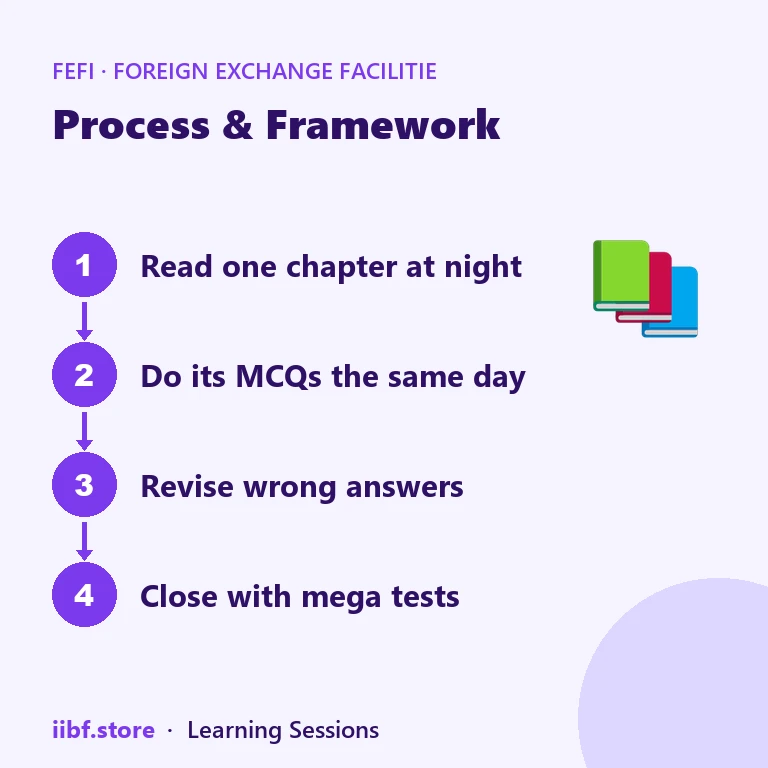
The fix is simple: study in small units, test the same day, and keep a short list of what you got wrong. The rest of this article turns that into a calendar. You can also use the free practice material on our free material page to warm up before you commit to anything.
Know your material before you plan
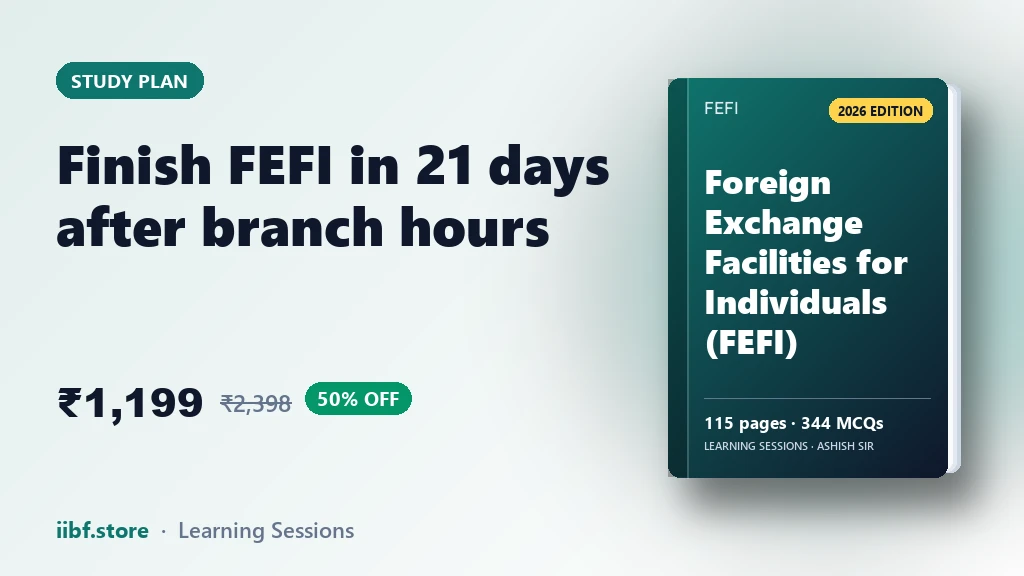
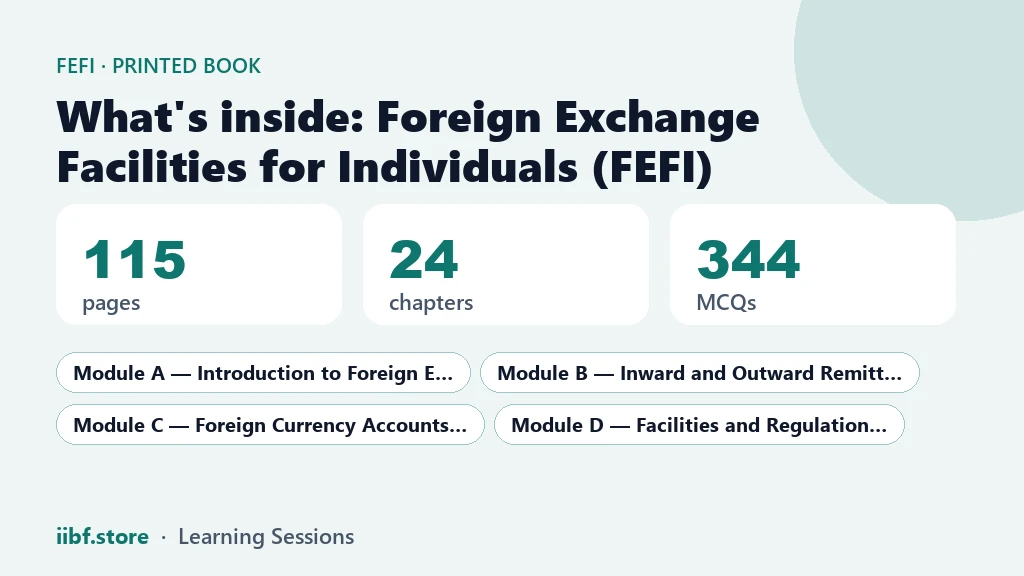
A plan only works if it matches the size of what you are studying. The FEFI printed book is a 115-page, 2026 edition, divided into 24 chapters and 4 modules, with 344 questions at the end of the chapters. That is a manageable size for someone with limited evenings, which is exactly why a three-week plan is realistic.
The four modules at a glance
- Module A, Introduction to Foreign Exchange Management: one chapter, the evolution of FEMA. It sets the vocabulary for everything after it.
- Module B, Inward and Outward Remittances: eight chapters covering inward remittances, the Foreign Contributions Regulation Act, outward remittances, internet and web services, the Indo-Nepal remittance scheme, the Liberalised Remittance Scheme and miscellaneous provisions.
- Module C, Foreign Currency Accounts of Residents: two chapters, on the Exchange Earners Foreign Currency account and Resident Foreign Currency accounts.
- Module D, Facilities and Regulations for Non-Resident Individuals: thirteen chapters on nonresident accounts, borrowing and lending, equity investment, taxation and treaties, exchange risk, NRI deposits, FCNR(B), overseas investment by residents, travellers cheques, property and asset repatriation, debt investment, guarantees and reporting, and gift exports.
Notice that Module D alone is more than half the book. That tells you where to protect your time. A good FEFI study plan gives the non-resident module the largest block of days, not an afterthought at the end when you are already tired.
The book also carries 40 case studies (160 questions) and 5 mega tests (500 questions). We will use those in the final stretch rather than at the start.
The 21-day FEFI study plan, evening by evening
Assume about 60 to 90 minutes on a working day and a little more on weekends. Each day follows the same rhythm: read the chapter once with a pencil, attempt that chapter's MCQs immediately, then write down every wrong answer in a notebook with the correct rule beside it. Do not move on until you understand why you missed it.
| Days | What to read | What to practise |
|---|---|---|
| Day 1 | Module A: Evolution of FEMA | Its chapter MCQs; start the wrong-answer notebook |
| Days 2-3 | Module B: the two Inward Remittances chapters | MCQs after each chapter, same night |
| Days 4-5 | Module B: Foreign Contributions Regulation Act, Outward Remittances | MCQs after each chapter |
| Days 6-7 | Module B: Internet and Web Services, Indo-Nepal Remittance Scheme, Liberalised Remittance Scheme, Miscellaneous Provisions | MCQs after each chapter; weekend, so do two chapters a day |
| Days 8-9 | Module C: both resident foreign currency account chapters | MCQs, then re-read your wrong-answer notebook for Modules A to C |
| Days 10-12 | Module D: nonresident accounts, borrowing and lending, equity investment, NRO tax and treaties | MCQs after each chapter |
| Days 13-15 | Module D: exchange risk management, nonbank deposits, FCNR(B), overseas investment by residents, travellers cheques | MCQs after each chapter |
| Days 16-17 | Module D: property and asset repatriation, debt investment, guarantees and reporting, gift exports | MCQs after each chapter |
| Day 18 | Revision of the wrong-answer notebook, all four modules | Re-attempt only the questions you got wrong |
| Days 19-20 | The 40 case studies (160 questions) | Treat each case as a mini exam; note the rule it tests |
| Day 21 | Mega tests | Attempt one mega test in a single sitting, then review |
The plan is intentionally light on days 1 to 9 so that the habit forms before the heavy non-resident chapters arrive. If you miss a day, do not try to double up. Slide the whole calendar by one day. A FEFI study plan that punishes you for a missed evening will not survive a real branch week.
How to use the MCQs properly
With 344 questions in the book, you have roughly fourteen per chapter on average. Do not treat them as a final test. Treat them as part of reading. After each chapter, attempt the questions without looking back at the text, mark what you were unsure about even if you guessed correctly, and only then check the answers. Guessed-right questions are as important as wrong ones, because on exam day luck may not repeat.
Making each study session count after a long day
Tiredness is the real enemy, not the syllabus. A few habits make a big difference.
- Same time, same place. A fixed slot after dinner beats a vague plan to study when free.
- Read the chapter heading first and guess the rule. If you can predict what the rule will say, you remember it better.
- Build small comparison tables. Non-resident accounts, FCNR(B) deposits and resident foreign currency accounts are easy to confuse. Write one line for each: who can open it, what currency it is held in, and whether the balance is freely repatriable.
- Never carry a doubt to the next day. Mark it, and settle it before your next session begins.
If you want extra practice that does not cost anything, the free mock tests are a useful way to check your speed once the first pass is done.
The last stretch: revision and mock discipline
Days 18 to 21 are where most of your marks are made. By now you should have a notebook full of corrected answers. Read it twice, in two different sittings. Then move to the case studies, because they force you to apply a rule to a person's situation, which is exactly how many questions in this paper are framed.
The mega tests are best attempted under exam conditions: phone away, a timer running, no peeking. Score yourself honestly, then spend more time reviewing the test than taking it. A short, honest review after each attempt is worth more than another fresh paper.
An honest word about limits
A book on its own will not give you exam-hall speed. You get speed from repeated timed practice, so pair the reading with mocks. And because rules for individuals change from time to time, always cross-check the latest circulars and the official schedule on the IIBF website for the upcoming exam cycle. Treat the book as your structured starting point, not the last word on the regulations.
Is the book worth it for your FEFI study plan?
If you like having a printed copy you can mark up on a metro ride or in the staff room, the FEFI book is currently listed at ₹1,199 against an MRP of ₹2,398, though prices may change, so the book page is always the current source. A free sample is available there, which is the sensible way to judge whether the style suits you before ordering. You can also browse the wider range on the books page if you are preparing for more than one certificate.
Whatever you choose, the principle holds: small daily units, same-day MCQs, a wrong-answer notebook and a calm final week. Start tonight with Module A and just one chapter. Twenty-one evenings from now, this FEFI study plan will have turned a vague worry into a paper you have already practised.
Frequently asked questions
Can I finish the FEFI syllabus in 21 days while working full-time?
For many candidates, yes, because the book is 115 pages across 24 chapters. At 60 to 90 minutes a day, roughly one chapter per evening is realistic. If your branch work is heavy, stretch the calendar to four weeks instead of rushing.
Which module should I give the most time?
Module D, on facilities and regulations for non-resident individuals, has 13 of the 24 chapters. Give it the largest block of days and keep your comparison tables for it.
When should I attempt the mega tests?
Keep them for the final days, after you have completed all four modules and revised your wrong answers. Taking them too early only tells you what you have not yet read.
Where do I find the official exam schedule?
Check the IIBF website at www.iibf.org.in for the upcoming exam cycle, since dates and rules can change.
Prefer revising from a printed book?
Chapter-wise books with MCQs after every chapter — minimal pages, complete coverage, delivered anywhere in India. Every book has a free sample to read first.
115 pages · 344 MCQs
Learning Sessions · Ashish Sir
132 pages · 225 MCQs
Learning Sessions · Ashish Sir
188 pages · 435 MCQs
Learning Sessions · Ashish Sir
117 pages · 236 MCQs
Learning Sessions · Ashish Sir
Learning Sessions · Ashish Sir
118 pages · 299 MCQs
Learning Sessions · Ashish Sir
Learning Sessions · Ashish Sir
Learning Sessions · Ashish Sir
Learning Sessions · Ashish Sir
115 pages · 255 MCQs
Learning Sessions · Ashish Sir
Learning Sessions · Ashish Sir
334 pages · 936 MCQs
Learning Sessions · Ashish Sir
Learning Sessions · Ashish Sir
107 pages · 240 MCQs
Learning Sessions · Ashish Sir
90 pages · 150 MCQs
Learning Sessions · Ashish Sir
Learning Sessions · Ashish Sir
131 pages · 672 MCQs
Learning Sessions · Ashish Sir
221 pages · 831 MCQs
Learning Sessions · Ashish Sir
128 pages · 524 MCQs
Learning Sessions · Ashish Sir
107 pages · 445 MCQs
Learning Sessions · Ashish Sir
148 pages · 478 MCQs
Learning Sessions · Ashish Sir
151 pages · 465 MCQs
Learning Sessions · Ashish Sir
148 pages · 375 MCQs
Learning Sessions · Ashish Sir
216 pages · 895 MCQs
Learning Sessions · Ashish Sir
109 pages · 300 MCQs
Learning Sessions · Ashish Sir
104 pages · 360 MCQs
Learning Sessions · Ashish Sir
82 pages · 297 MCQs
Learning Sessions · Ashish Sir
151 pages · 600 MCQs
Learning Sessions · Ashish Sir
98 pages · 282 MCQs
Learning Sessions · Ashish Sir
Quick quiz on this topic
5 exam-style questions from our free test bank — check yourself before you move on.
Practice this topic
Take a free mock test, download chapter PDFs, or watch a video class — all included on iibf.store.
Keep reading