Is the Risk Management exam book right for you? An honest guide
You reach home after a full day at the branch. Customers, targets, a reconciliation that would not tally. Now you are supposed to open a Risk Management syllabus that runs from Basel norms to swaps, and your brain says tomorrow. If that sounds familiar, you are exactly who this article is for.
Before you spend money on anything, ask a simple question: is the Risk Management exam book the right tool for your situation? Sometimes it is. Sometimes you need something else, or something in addition. This guide helps you decide, and the planning sections are useful even if you never buy anything from us.
Start with your situation, not the syllabus
Most working bankers fail or postpone not because the subject is too hard, but because the method does not fit their life. A method that needs three clear hours every evening will collapse by the second week of a busy month-end.
So before choosing any material, answer three questions honestly:
- How many focused minutes can you really give on a weekday? Not what you wish, but what happened last week.
- Is this your first serious attempt or a repeat? The two need very different material.
- Do you retain better from paper or from a screen? After a day at a monitor, many people simply cannot read more pixels.
Write those answers down. They decide everything that follows. The official syllabus and exam schedule always sit with the institute, so keep the official IIBF website open for the upcoming exam cycle details and never rely on a forwarded message for dates.
What is actually inside the book
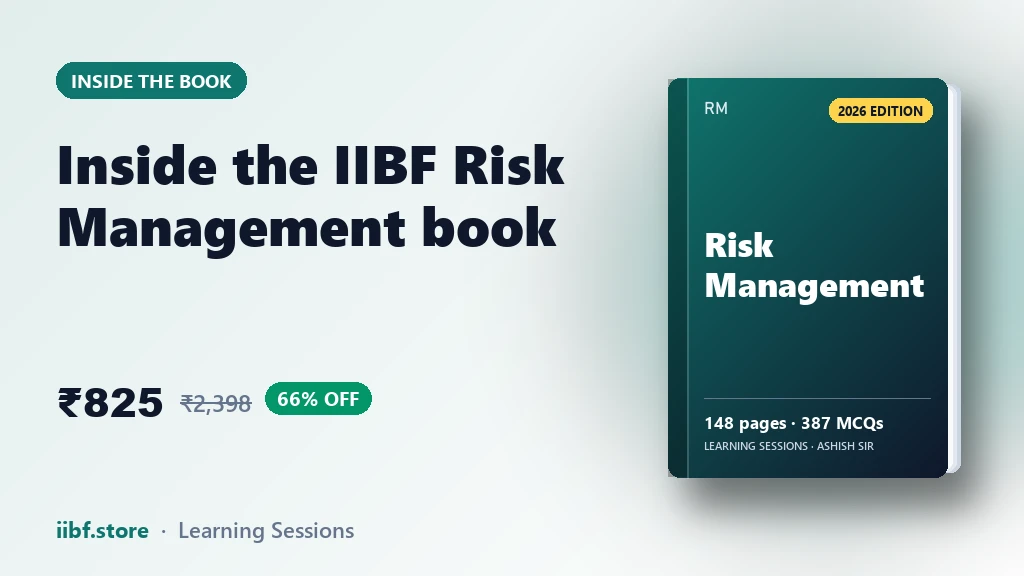
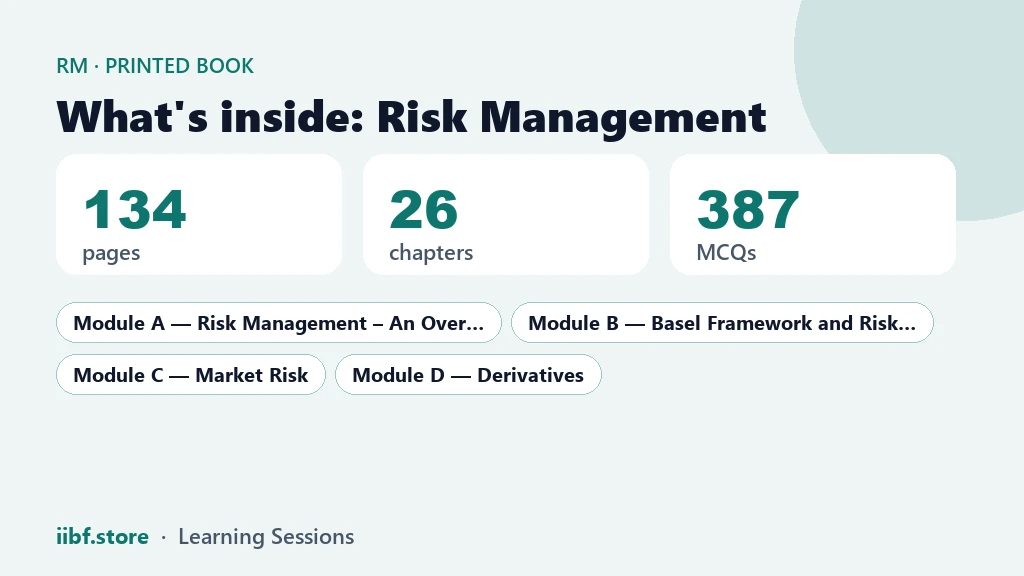
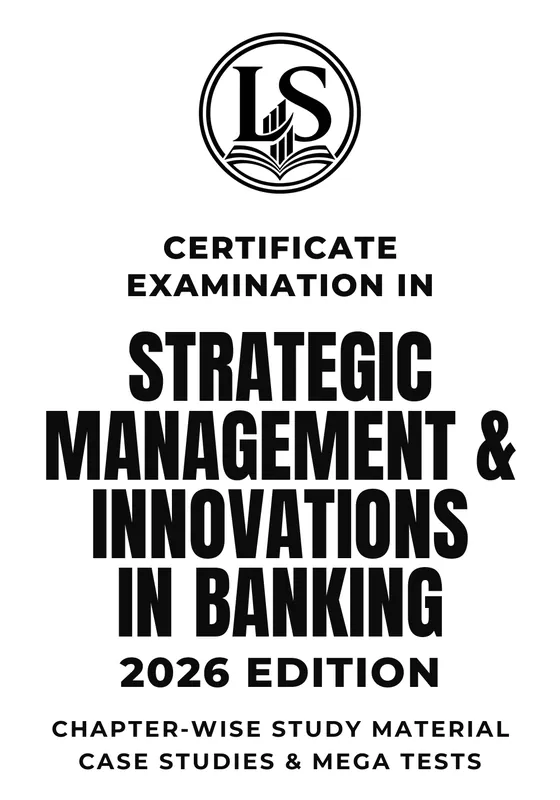
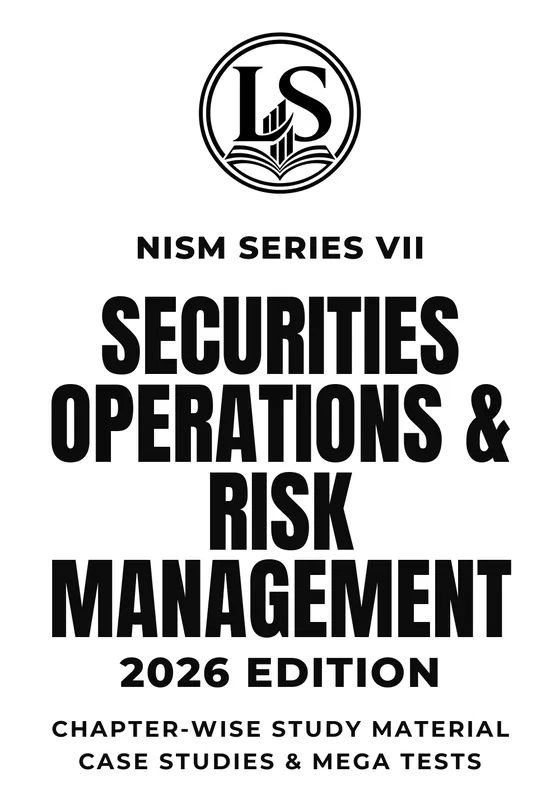
Let us describe the book by its facts, so you can judge it yourself. The Risk Management exam book is the 2026 edition, 134 pages, organised into 26 chapters across four modules, with 387 practice questions.
The four modules
- Module A, Risk Management: An Overview. Why banks are special, the risk management framework, asset liability management and IRRBB, and liquidity risk (5 chapters).
- Module B, Basel Framework and Risk Regulation. The largest block: regulatory capital, credit, market and operational risk charges, ICAAP, stress testing and PCA, market discipline, Basel III buffers and ratios, risk based supervision and risk based internal audit (12 chapters).
- Module C, Market Risk. Market risk, fixed income, interest rate measurement and Value at Risk (4 chapters).
- Module D, Derivatives. Derivatives, forwards, futures, options and swaps (5 chapters).
The extras listed with it
Alongside the chapters, the book lists 36 case studies carrying 144 questions, and 5 mega tests carrying 500 questions. Those are the numbers on the book page; check the page for exactly how they are delivered before you order.
At 134 pages it is deliberately compact. That is a strength if you are short on time and a limit if you expect a textbook-sized reference. Be clear about which one you want.
Profile 1: You are attempting for the first time
A first attempt has one big risk: drifting. The syllabus feels endless, so you read whatever you find, in whatever order, and never build a picture of the whole subject.
A compact book helps here because it gives you the whole map early. Read it module by module in the order given. Module A is gentle and builds vocabulary that Modules B and C reuse constantly. Do not skip ahead to derivatives because they sound scary; they are five short chapters.
How to use the book
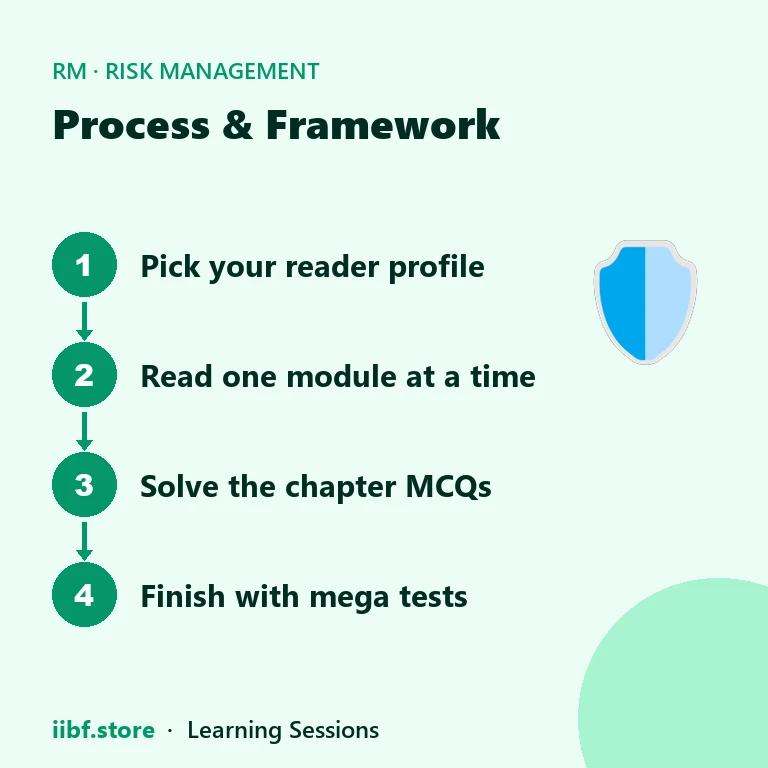
- Read one chapter, then close the book and write three lines from memory.
- Solve that chapter's questions the same day, while the explanation is fresh.
- Mark every question you got right by guessing. Treat those as wrong.
When it is not enough alone
A book teaches you the concepts. It does not train you to sit through a timed paper. Before the exam, take full-length timed tests. You can start with the free mock tests at iibf.store/tests and see where your speed breaks down.
Profile 2: You have attempted before and need to fix gaps
If you have already sat the paper once, you do not need another long first read. You need to find out where marks leaked. Usually it is three or four chapters, often the numerical ones: capital adequacy, Value at Risk, interest rate measurement, option payoffs.
Use the Risk Management exam book as a diagnostic. Go straight to the practice questions of each module, attempt them cold, and read the chapter text only where you miss. The case studies are useful for repeat candidates because they force you to apply a concept to a situation rather than recall a definition.
Here is a simple way to sort your weak areas:
| Signal | What it usually means | What to do |
|---|---|---|
| You knew the topic but ran out of time | Speed problem, not knowledge | Timed mock tests, not more reading |
| You mixed up Basel terms | Weak vocabulary in Module B | Re-read the chapter, make a one-page glossary |
| Numerical questions felt impossible | Formulas not practised | Solve every Module C and D numerical by hand |
| Case-based questions confused you | Concepts learned but not applied | Work through the case studies slowly |
One honest limit: if your repeated failure is because of exam-hall nerves or time management, no book will fix that. Practice under timed conditions will.
Profile 3: You are short on time
Maybe the exam is close, or your branch is short-staffed and evenings are gone. Be realistic: you will not finish a deep study of every topic. You need a triage.
Module B carries the biggest chapter count (12 of 26), so a large share of your preparation effort belongs there. After that, give attention to Module C, because its numerical topics reward practice. Derivatives are compact, but they need a clear head, so keep them for a weekend rather than a tired Tuesday night.
A plan that fits around branch hours
- Weekdays, 30 to 40 minutes: one short chapter plus its questions. Nothing more.
- Saturday: revise the week's chapters and redo the questions you missed.
- Sunday: one timed mock test, then a review of every wrong answer.
A book is fine for this if you are disciplined, but the honest warning is that short time plus a vast subject means you must choose. Do not try to cover everything; cover the high-yield chapters thoroughly and the rest lightly.
Profile 4: You prefer paper over screens
This one needs no apology. Many bankers spend eight hours at a screen and cannot face another. Paper lets you underline, fold a page, scribble a formula in the margin, and study on a train or a bus without worrying about battery or network.
The printed Risk Management book suits you if you will actually write in it. Use a pencil for definitions, a colour pen for formulas, and keep a list of page numbers for things you keep forgetting. Your own markings become the fastest revision tool you will have in the last week.
The limit: paper cannot update itself. Regulatory norms change, so before the exam, check the institute's site and recent circulars for anything new. For free supporting reading, browse the free material library and the study blog, and see the wider list of titles at iibf.store/books.
So who should skip this book?
Being honest builds more trust than selling to everyone. You may not need it if:
- You already have good notes from a classroom or video course and only need practice. In that case, free mock tests may be enough.
- You want a deep, reference-style textbook with long theoretical discussions. A 134-page book is a focused companion, not an encyclopedia.
- You expect any single book to guarantee a pass. Nothing does. The result depends on what you do with it.
The price is shown as ₹700 against an MRP of ₹2,398 on the book page. Prices can change, so treat the book page as the current source. If you decide to buy, the Risk Management exam book works best when you commit to a start date before it arrives.
The short version
Pick the profile closest to yours. First attempt: read in order and test yourself daily. Repeat attempt: use the questions to find your leaks. Short on time: triage by module and protect your weekend mock. Paper lover: mark it up and revise from your own marks. In every case, pair reading with timed practice, because that is what the exam hall actually tests. If you want a compact paper companion for this paper, the Risk Management exam book is one reasonable choice, and for wider preparation you can explore the JAIIB course page or the other options on the store.
Frequently asked questions
Can I pass using only this book?
It can carry your concept learning and give you plenty of practice questions, but no book alone guarantees a result. Add timed mock tests and revise your mistakes, since exam-hall speed is a separate skill.
Is it too short for a subject this big?
At 134 pages across 26 chapters it is compact by design. It suits readers who want a focused map and lots of practice. If you want long theoretical depth, you may need extra reading on topics you find hard.
Is there a free sample before I buy?
Yes, the book page has a free sample, so you can judge the writing style and the way questions are presented before ordering.
Where do I find the official exam schedule?
Always check the institute's own website at iibf.org.in for the upcoming exam cycle. Do not rely on messages forwarded in groups.
Prefer revising from a printed book?
Chapter-wise books with MCQs after every chapter — minimal pages, complete coverage, delivered anywhere in India. Every book has a free sample to read first.







Practice this topic
Take a free mock test, download chapter PDFs, or watch a video class — all included on iibf.store.
Keep reading