Is the DRA Exam Preparation Book Right for You? An Honest Guide
It is 9:40 pm. You have closed the branch, reached home, eaten something quick, and now a syllabus is waiting for you. If you are thinking about the Debt Recovery Agent certificate, you have probably already seen three or four "complete packages" that promise everything. Before you spend money on any of them, ask one plain question: will this DRA exam preparation book actually suit the way I study?
This guide is written like a conversation with a senior colleague, not a sales pitch. We will go through four types of readers, say how each should use the book, and say clearly when a book alone is not enough. If at the end you decide it is not for you, you will still leave with a plan you can use.
What the DRA certificate actually asks of you
The Debt Recovery Agent certificate from IIBF is a practical, basics-first paper. It does not expect you to be a banking scholar. It expects you to understand how a bank account and a loan work, what security and documentation mean, what the law says about recovery, and how a recovery agent should behave with a borrower.
That is why the topics fall naturally into four blocks: banking basics, loans and securities, the agent's own role and soft skills, and a short additional reading on NBFCs. Most candidates who find this exam hard do not struggle with any single idea. They struggle because the ideas are scattered across many sources, and their study hours are scattered too.
- Breadth, not depth: many small topics, each asked in simple, direct language.
- Scenario thinking: questions often describe a situation and ask what an agent should do.
- Conduct matters: fair practices and respectful recovery are not side topics; they are part of the paper.
For the official syllabus, eligibility and the schedule of the upcoming exam cycle, always check the IIBF website. Nothing in this article replaces that.
What is inside the book, in plain numbers
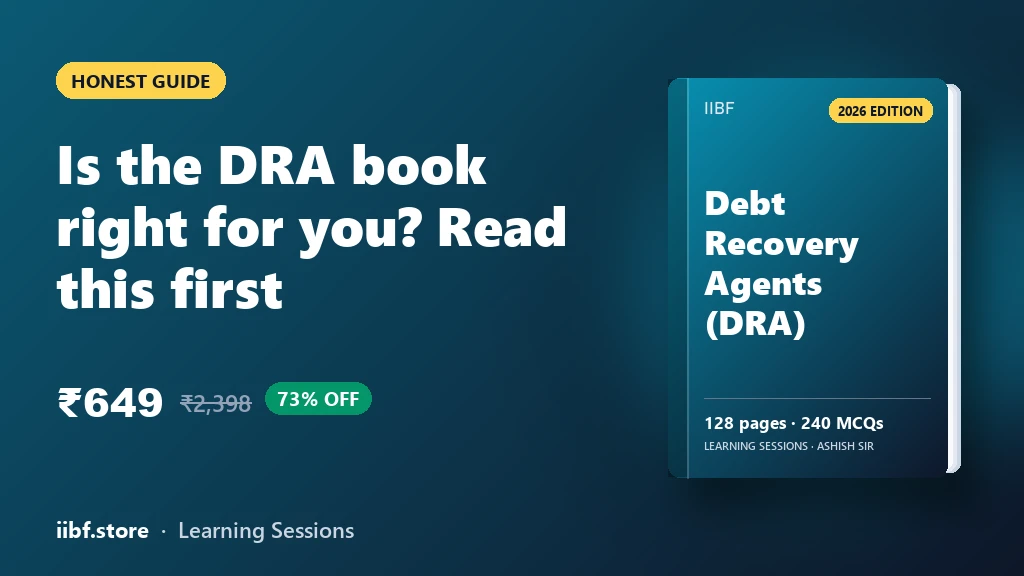
Here are the facts about the DRA printed book, without adjectives. It is the 2026 edition, with 128 pages, 16 chapters and 240 questions, organised into four modules.
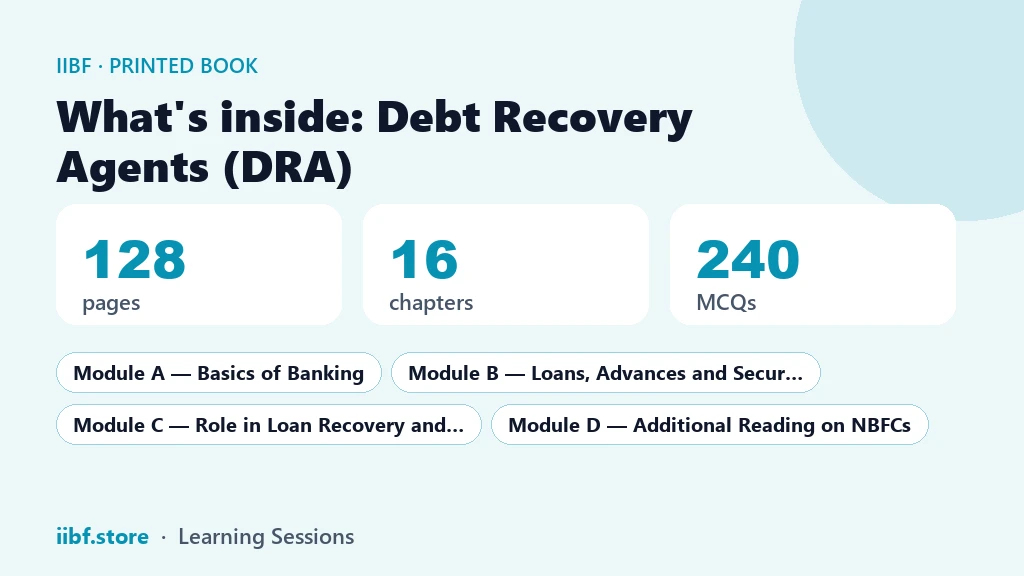
The four modules
- Module A, Basics of Banking: general banking, the banker-customer relationship, account opening and operations, deposit schemes and services, and the NI Act provisions for payment and collection of cheques.
- Module B, Loans, Advances and Securities: debit and credit cards, types of loans and advances, securities and modes of charging them, loan documentation and asset classification, and the legal aspects of loan recovery.
- Module C, Role in Loan Recovery and Soft Skills: the debt recovery agent's role, functions and procedures, international best practices, and soft skills and strategies.
- Module D, Additional Reading on NBFCs: NBFC types, framework and loans, and the Fair Practices Code for NBFCs.
Along with the book, the listing mentions 40 case studies (160 questions) and 5 mega tests (500 questions). The current price is ₹649 against an MRP of ₹2,398, which the page shows as 73% off. Prices can change, so the book page is always the current source.
Profile 1: You are attempting for the first time
First-attempt candidates usually make one of two mistakes. Either they read too widely and never finish, or they jump into mock tests without a base and get discouraged by a low score. A single, structured DRA exam preparation book solves the first problem: you know exactly where the syllabus starts and ends.
How to use it
- Read one module at a time, in order. Module A is the foundation for everything after it.
- After each chapter, close the book and write three lines from memory. If you cannot, read it again tomorrow.
- Do the chapter questions the same day. Do not postpone them to the weekend.
When it is not enough
A book gives you understanding, not exam-hall speed. Once you finish the modules, you must practise under a clock. Use the free mock tests at iibf.store/tests to find out how you behave when time is limited.
Profile 2: You have attempted before and want a cleaner restart
If you have failed or postponed once, your problem is rarely a lack of effort. It is usually a lack of a clear map. You studied, but you cannot say which topics are solid and which are shaky.
How to use it
- Do not restart from page one. Start with the chapter questions and the case studies, and mark every question you get wrong.
- Go back to the chapters behind those wrong answers only. This is far faster than rereading everything.
- Keep a one-page error log: the topic, why you got it wrong, and the correct idea in one sentence.
When it is not enough
If you keep losing marks on the same type of question, the issue may be reading the question, not knowing the content. Timed mock tests will expose this faster than any book. The five mega tests listed with the book are meant for exactly this kind of final check.
Profile 3: You are short on time
Maybe the exam is close, or your branch has month-end pressure. You do not have the luxury of a long study plan. Here is a compact way to use the DRA exam preparation book when hours are limited.
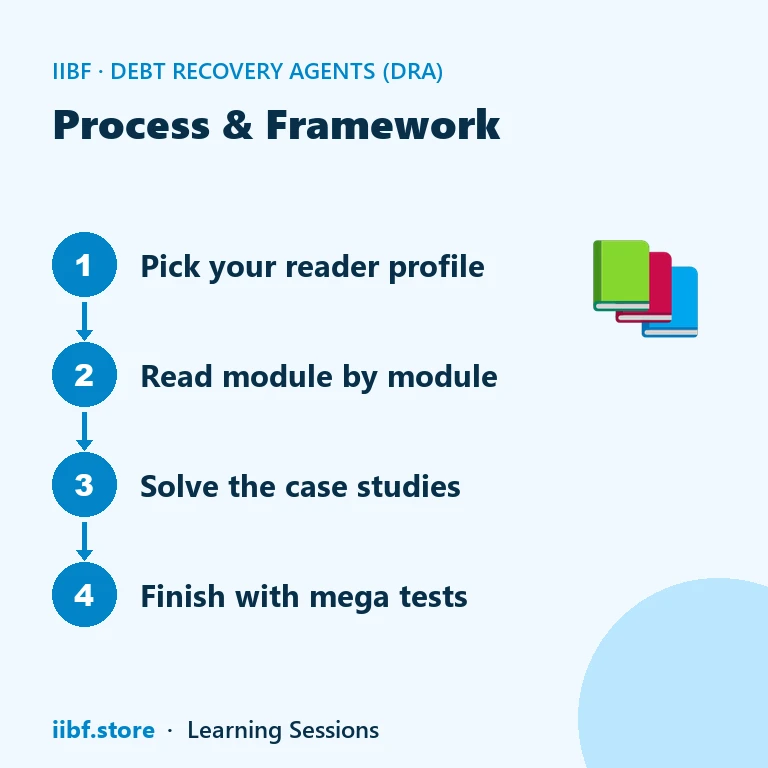
A tight schedule that respects a full-time job
- Week 1: Modules A and B, about 30 to 45 minutes on weekdays and a longer block on the weekend.
- Week 2: Modules C and D, then all chapter questions.
- Week 3: case studies, then mock tests, then a revision of only your error-log topics.
With 16 chapters, one chapter a day is a realistic pace for most people, and it leaves a few spare days for revision. Treat Module D as lighter reading unless your own practice shows it is costing you marks.
When it is not enough
Be honest with yourself: if you can give only a few hours in total, no book will make a difference on its own. In that case, prioritise Modules B and C and as many practice questions as you can attempt, and consider whether the upcoming exam cycle is the right one or the next is.
Profile 4: You prefer paper over a screen
Many bank colleagues spend the whole day on a screen. By evening, the last thing they want is another one. For them, a printed, 128-page book is a real advantage: it can sit in a bag, be read during a commute or lunch break, and be marked with a pencil.
How to use it
- Keep a pencil and three colours of sticky flags: one for "know", one for "shaky", one for "must revise".
- Write short margin notes. The act of writing helps recall more than highlighting does.
- Carry it for the small gaps in the day: ten minutes in a queue is one page of revision.
When it is not enough
Paper does not give you instant feedback. Pair it with online practice so you see your score and your weak areas, and use the free PDFs at iibf.store/free-material for extra reading when you want it.
Quick comparison: which profile are you?
| Your situation | Start with | Pair it with |
|---|---|---|
| First attempt | Modules A to D in order | Free mock tests after each module |
| Repeat attempt | Questions and case studies first | Mega tests and an error log |
| Short on time | Modules B and C, then questions | One timed mock every few days |
| Prefers paper | One chapter a day, with flags | Online practice for feedback |
Who should probably skip it
A good guide also tells you when to save your money. This DRA exam preparation book may not be the right pick if you already have notes you trust and finish on time, or if you learn best from live classes and discussion. It is also a poor fit if you hope to pass on reading alone without ever attempting a timed test. If you are unsure, look through the free sample on the book page and see whether the explanations match how you think.
You can also browse other titles at iibf.store/books, or read more study guides on the blog.
The bottom line
A DRA exam preparation book is a tool, not a result. It gives you one clear path through 16 chapters, a way to practise on 240 questions, and a paper copy that fits a tired evening. What turns it into a pass is your routine: reading in order, writing from memory, logging errors, and then testing yourself against the clock.
Choose the profile that sounds most like you, follow the matching steps, and check the official dates on the IIBF website. If a book fits that plan, use it. If it does not, use the plan anyway.
Frequently asked questions
Is the DRA book enough to pass on its own?
It covers the syllabus structure in four modules and gives you practice questions, but nobody can promise a result. Pair it with timed mock tests so you build speed and learn where you lose marks.
How many chapters and questions does the book have?
The 2026 edition has 128 pages, 16 chapters and 240 questions, arranged in four modules. The listing also mentions 40 case studies and 5 mega tests.
What does the book cost?
At the time of writing it is ₹649 against an MRP of ₹2,398. Prices can change, so check the book page for the current figure.
Where do I find the exam dates and rules?
Only the official source is reliable. Visit the IIBF website for the schedule of the upcoming exam cycle, eligibility and the latest syllabus.
Prefer revising from a printed book?
Chapter-wise books with MCQs after every chapter — minimal pages, complete coverage, delivered anywhere in India. Every book has a free sample to read first.




Practice this topic
Take a free mock test, download chapter PDFs, or watch a video class — all included on iibf.store.