CAAP Study Plan: 35 Days Alongside a Full-Time Bank Job
You reached home at eight, the day's cash balancing is still ringing in your head, and the syllabus of Certified Accounting and Audit Professional looks like two exams stacked on top of each other. That is exactly the feeling a good CAAP study plan has to solve. Not with motivation, but with arithmetic: how many chapters, how many evenings, how many questions per night.
This article gives you that arithmetic. Even if you never buy anything from us, you can copy the 35-day schedule below onto a sheet of paper and start tonight. Where it helps, we show how the plan maps onto one specific printed book, so you can judge for yourself whether it fits the way you study.
Why a working banker needs a different kind of plan
Most study plans online assume four free hours a day. You do not have that. A realistic banker has perhaps ninety minutes on weekdays, three or four hours on a Sunday, and a few dead days when a branch audit, a month-end or a transfer eats everything. A plan that ignores this collapses by day six, and then you feel guilty and quietly postpone the exam.
So build the plan on three honest assumptions:
- One chapter per weekday evening, not three. Small, finishable units beat heroic targets.
- Questions the same night. Solving MCQs while the chapter is fresh turns reading into recall, and recall is what the exam measures.
- A buffer built in. Five of the 35 days below are deliberately light so one bad week does not wreck the schedule.
If you are coming off a failed or postponed attempt, this matters even more. The earlier attempt probably did not fail because you are weak; it failed because the plan assumed a life you do not have.
Understand what you are actually preparing
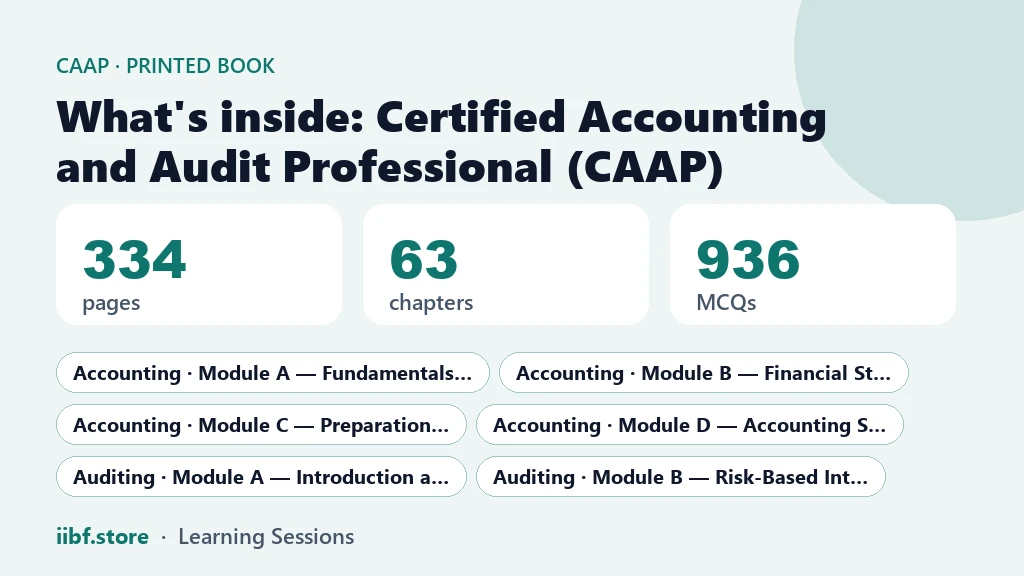
CAAP has two halves, Accounting and Auditing, and each is split into four modules. Before you plan a single evening, know the shape of the load. In the CAAP printed book the 63 chapters fall like this:
Accounting half (38 chapters)
- Module A, Fundamentals of Accounting: 8 chapters, from the accounting process and vouchers to bank reconciliation and depreciation.
- Module B, Financial Statements of Banks and Taxation: 15 chapters, covering advances, asset classification and provisioning, the profit and loss account, disclosures and consolidation.
- Module C, Preparation of Financial Statements of Banks and Taxation: 8 chapters, including final accounts, cash flow, MIS and direct and indirect tax.
- Module D, Accounting Standards (Ind AS): 7 chapters on scope, applicability to banks, consolidation and disclosures.
Auditing half (25 chapters)
- Module A, Introduction and Types of Audit: 5 chapters, including bank audit, risk-based supervision and internal audit.
- Module B, Risk-Based Internal Audit, Risk Management and Data Analytics: 3 chapters.
- Module C, Audit in Computerized Information System Environment: 2 chapters.
- Module D, Bank Audit and Special Audit Areas: 15 chapters, from audit aspects of advances and treasury to long form audit reports, Basel III, database security audit and remote auditing.
Notice the imbalance. Accounting Module B and Auditing Module D together are 30 of the 63 chapters, almost half the paper. Those two modules deserve your best weekends. Auditing Modules B and C are short; treat them as quick wins to rebuild confidence.
The numbers behind the book, and why they suit a tired reader
The 2026 edition of this book runs to 334 pages across two volumes, one for Accounting and one for Auditing. That is 63 chapters and 936 end-of-chapter MCQs, which works out to roughly 15 questions per chapter on average, and about five pages of reading for each. Five pages and fifteen questions is a unit you can finish in an evening without dreading it.
Beyond the chapters, the book carries 120 case studies (480 questions) and 10 mega tests (1000 questions). The case studies matter because audit and accounting papers love scenarios: a loan that slips to NPA, a reconciliation that does not tie, a branch consolidation entry. The mega tests give you full-length practice near the end.
A fair word on limits: a book alone will not give you exam-hall speed. Reading builds understanding; only timed questions build speed. That is why the plan below keeps questions in every single session, and why you should also take the free mock tests at iibf.store/tests before the exam.
The 35-day CAAP study plan, module by module
Here is the schedule. The MCQ column is approximate, using the book's average of about 15 questions per chapter. Treat it as a target, not a law.
| Days | What to read | Chapters | MCQ target (approx.) |
|---|---|---|---|
| 1-4 | Accounting Module A, Fundamentals of Accounting | 8 (two per evening) | about 120 |
| 5-11 | Accounting Module B, Financial Statements of Banks | 15 (two per evening, one Sunday catch-up) | about 225 |
| 12-15 | Accounting Module C, Preparation of Financial Statements | 8 | about 120 |
| 16-18 | Accounting Module D, Ind AS | 7 | about 105 |
| 19-21 | Auditing Module A, Introduction and Types of Audit | 5 | about 75 |
| 22-24 | Auditing Modules B and C, Risk-Based Audit and CIS Audit | 5 | about 75 |
| 25-31 | Auditing Module D, Bank Audit and Special Audit Areas | 15 | about 225 |
| 32-35 | Case studies, then mega tests, then weak-chapter revision | revision | case-study questions plus mega tests |
Two chapters on a weekday sounds heavy, but several chapters in Accounting Module A and Module C are short or procedural. If a chapter is dense, such as Asset Classification, Income Recognition and Provisioning, give it a full evening on its own and let the lighter ones double up.
How to run a single evening
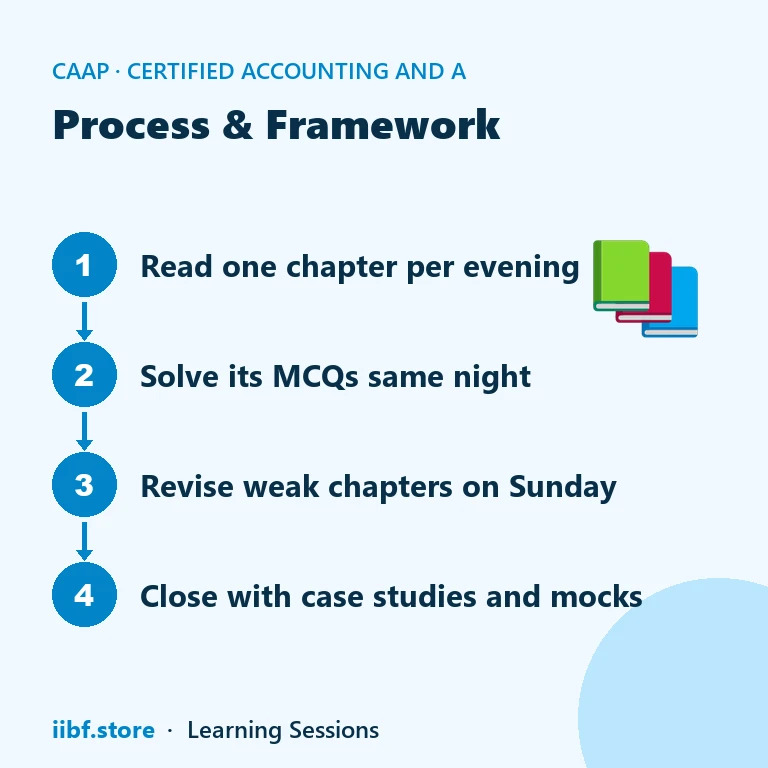
Whatever the chapter, run every session the same way, so you never waste energy deciding what to do.
- Ten minutes: skim. Read the headings and any tables first. Know the shape before the detail.
- Forty minutes: read properly. Pen in hand. Mark definitions, formulae and anything with a number attached.
- Thirty minutes: solve the chapter's MCQs. Do not peek at the answers until you have attempted all of them.
- Ten minutes: review mistakes. Write each wrong answer and the reason on one line in a small notebook. This notebook becomes your final-week revision sheet.
That is ninety minutes, which is the budget we started with. On a bad day, do steps 3 and 4 only for the previous chapter; the reading can wait, the recall cannot.
Sundays are for repair, not for new material
Resist the urge to use Sunday to race ahead. Use it to repair. Re-attempt the questions you got wrong during the week, re-read the two or three chapters that felt shaky, and redo your mistake notebook. Retention comes from returning to material, not from passing over it once.
In Accounting, the usual leaks are provisioning percentages, the layout of the profit and loss account, and the mechanics of consolidation. In Auditing, they are the distinctions between types of audit, and the long form audit reports. Whatever your own leaks are, your notebook will show them by week two.
The last four days: case studies and mega tests
Days 32 to 35 are where the book's extras earn their place. Start with the case studies, because scenario questions test whether you can apply a concept, not merely recognise it. Then attempt the mega tests under time pressure, ideally in one sitting with your phone away. After each, spend more time on the review than on the test itself.
If your score in a mega test is lower than you hoped, do not panic on day 34. Go back to the chapters your notebook flagged, fix those, and attempt the next test. The plan has room for exactly this. For the official schedule, eligibility and exam pattern for the upcoming exam cycle, always check the IIBF website, because we do not want you relying on a blog for dates.
Using free material alongside the book
You do not have to spend anything to follow the schedule. The free PDFs at iibf.store/free-material and the practice tests at iibf.store/tests are enough to run a basic version of this plan. The printed book adds a single, ordered source in the sequence the plan follows, and it works even when your phone battery or your patience is low at eleven at night.
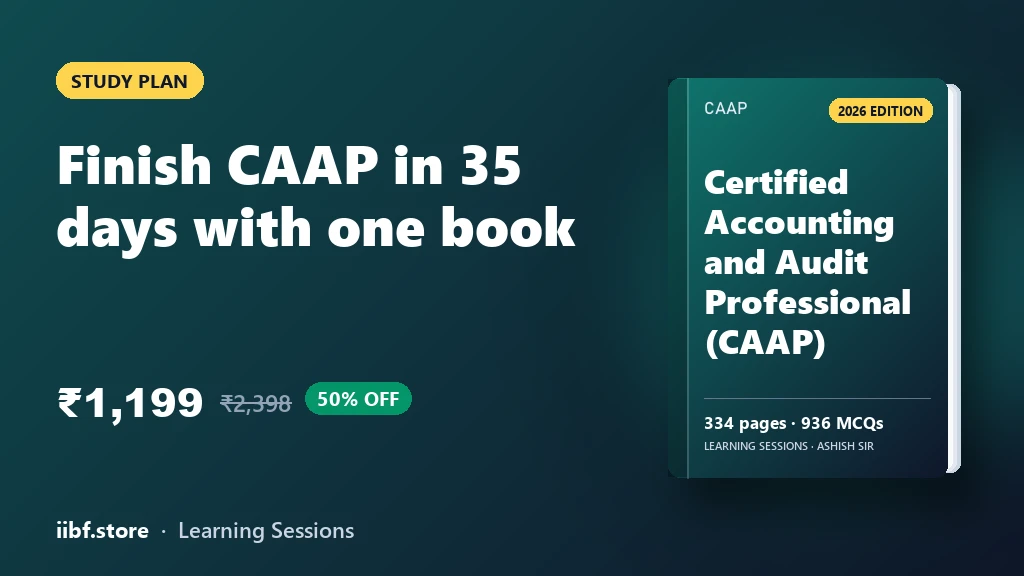
If you want to look before deciding, the book page has a free sample. At the time of writing the price is ₹1,199 against an MRP of ₹2,398, but prices can change, so treat the book page as the current source. You can also browse the rest of the range at iibf.store/books.
Final thoughts: a plan you can actually keep
A CAAP study plan succeeds when it survives a bad week. That is why this one is built on small units, same-night questions, Sunday repair and a short closing sprint. Print the table, stick it above your desk, and tick off each day. If you miss two days, do not restart; slide the schedule and use your buffer.
Thirty-five evenings is not long. Start with Accounting Module A tonight, solve the questions before you sleep, and let the rest follow one chapter at a time. More study guides are on our blog whenever you want another method.
Frequently asked questions
Can I really finish CAAP in 35 days while working full time?
It is possible if you commit about ninety minutes on weekdays and a longer Sunday block. The plan assumes roughly one to two chapters per evening and builds in buffer days. If your branch workload is heavier, stretch the same sequence to 45 or 50 days rather than skipping the MCQs.
Which half of CAAP should I start with, Accounting or Auditing?
Start with Accounting. Auditing Module D leans on accounting concepts such as advances, provisioning and consolidation, so understanding the accounting side first makes the audit chapters much easier to follow.
Will the book alone be enough to pass?
No book can promise that. The printed book gives you structured chapters, 936 MCQs, 120 case studies and 10 mega tests, but exam-hall speed comes from timed practice. Pair it with free mock tests and check the official IIBF site for the current syllabus and schedule.
What if I fall behind by a week?
Do not restart. Drop the lighter chapters from the weekday queue, protect the heavy modules, Accounting Module B and Auditing Module D, and use the last four days to compress revision. Missing a week is normal; abandoning the plan is the real risk.
Prefer revising from a printed book?
Chapter-wise books with MCQs after every chapter — minimal pages, complete coverage, delivered anywhere in India. Every book has a free sample to read first.
334 pages · 936 MCQs
Learning Sessions · Ashish Sir
132 pages · 225 MCQs
Learning Sessions · Ashish Sir
188 pages · 435 MCQs
Learning Sessions · Ashish Sir
117 pages · 236 MCQs
Learning Sessions · Ashish Sir
Learning Sessions · Ashish Sir
118 pages · 299 MCQs
Learning Sessions · Ashish Sir
Learning Sessions · Ashish Sir
Learning Sessions · Ashish Sir
Learning Sessions · Ashish Sir
115 pages · 255 MCQs
Learning Sessions · Ashish Sir
Learning Sessions · Ashish Sir
Learning Sessions · Ashish Sir
115 pages · 344 MCQs
Learning Sessions · Ashish Sir
107 pages · 240 MCQs
Learning Sessions · Ashish Sir
90 pages · 150 MCQs
Learning Sessions · Ashish Sir
Learning Sessions · Ashish Sir
131 pages · 672 MCQs
Learning Sessions · Ashish Sir
221 pages · 831 MCQs
Learning Sessions · Ashish Sir
128 pages · 524 MCQs
Learning Sessions · Ashish Sir
107 pages · 445 MCQs
Learning Sessions · Ashish Sir
148 pages · 478 MCQs
Learning Sessions · Ashish Sir
151 pages · 465 MCQs
Learning Sessions · Ashish Sir
148 pages · 375 MCQs
Learning Sessions · Ashish Sir
216 pages · 895 MCQs
Learning Sessions · Ashish Sir
109 pages · 300 MCQs
Learning Sessions · Ashish Sir
104 pages · 360 MCQs
Learning Sessions · Ashish Sir
82 pages · 297 MCQs
Learning Sessions · Ashish Sir
151 pages · 600 MCQs
Learning Sessions · Ashish Sir
98 pages · 282 MCQs
Learning Sessions · Ashish Sir
Practice this topic
Take a free mock test, download chapter PDFs, or watch a video class — all included on iibf.store.