DRA Exam Study Plan: Finish the Syllabus in 14 Evenings
It is 9:30 in the evening. You have closed the branch, answered the last call from the recovery desk, and reached home to a plate of cold dinner. The syllabus on your phone looks endless: banking basics, loans, securities, the NI Act, soft skills, even NBFCs. You tell yourself you will start on Saturday. Then Saturday goes to a family function.
If that is you, this DRA exam study plan is written for your actual life, not for a full-time student. The Debt Recovery Agents certificate looks big on paper, but it is built from 16 chapters in four modules. That is a very finishable amount of reading if you stop trying to "cover everything" and start working chapter by chapter, with questions after each one.
Below you will find the plan, the reasoning behind it, and a table you can copy into your diary. Everything here works even if you never buy a single book from us.
Why most working bankers fail to finish the syllabus
Having spoken to many candidates over the years, the same three patterns repeat.
- Starting too big. Planning four hours every night, managing one, then feeling guilty and quitting.
- Reading without testing. You finish a chapter, feel good, and forget it by Thursday because nothing forced you to recall it.
- Too many sources. Notes from a colleague, a YouTube playlist, an old PDF, a guide from 2019. Half the energy goes into deciding what to read.
A sound DRA exam study plan fixes all three: small daily blocks, a fixed question set after every chapter, and one main source that you finish.
Know the shape of the paper before you plan
The Debt Recovery Agents syllabus is easier to plan when you see it as four blocks. This is the module structure used in our book:
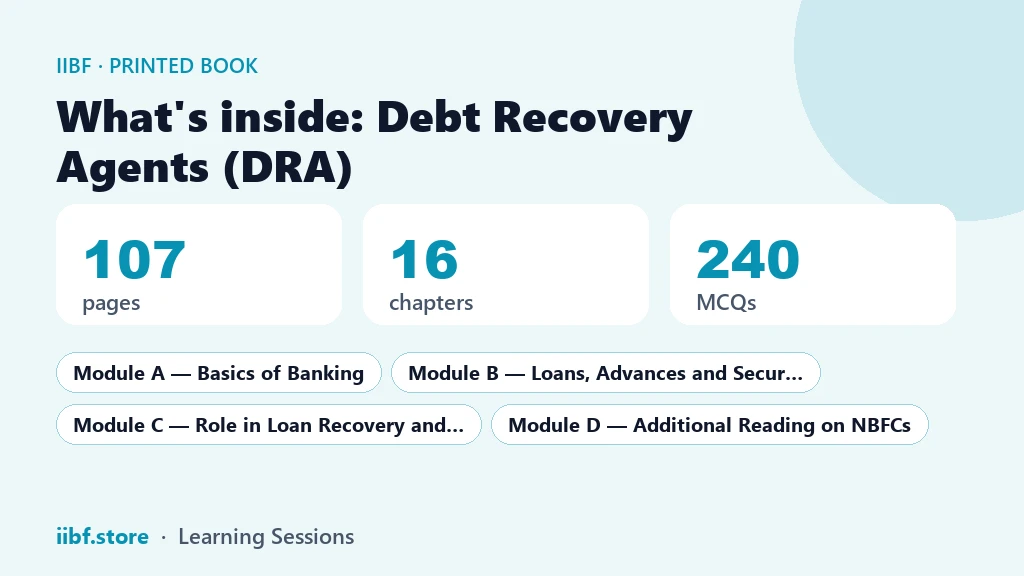
- Module A, Basics of Banking: General Banking, Banker Customer Relationship, Accounts Opening and Operations in Accounts, Various Deposit Schemes and Other Services, and Provisions of NI Act for Payment and Collection of Cheque.
- Module B, Loans, Advances and Securities: Debit Card and Credit Card, Various Types of Loans and Advances, Securities and Modes of Charging Them, Loan Documentation and Asset Classification, and Legal Aspects of Loan Recovery.
- Module C, Role in Loan Recovery and Soft Skills: Debt Recovery Agent, Functions and Procedures of Debt Recovery Agent, International Best Practices on Debt Recovery, and Soft Skills and Strategies for Debt Recovery.
- Module D, Additional Reading on NBFCs: NBFCs Types, Framework and Loans, and Fair Practices Code for NBFCs.
As a working banker, Module A will feel familiar, since you handle accounts and cheques daily. That is good news: it is your fastest block, and it builds momentum in the first few evenings. Module C is where people with a branch background usually lose marks, because it asks how a recovery agent should behave, not just what the rules say. Give it real time.
The tool: one book, one set of questions
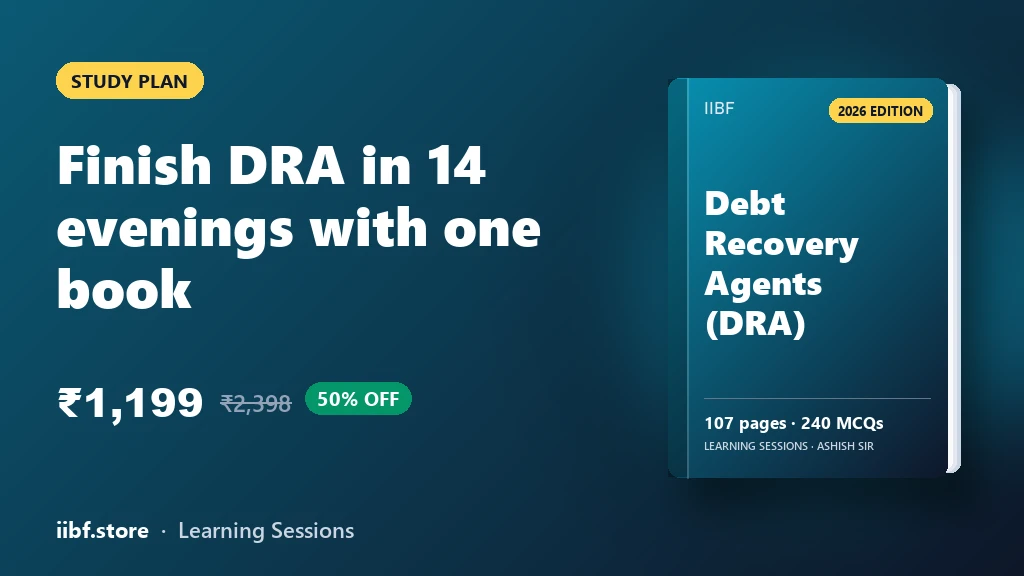
Our Debt Recovery Agents (DRA) book follows exactly the 16-chapter, four-module order above. It runs to 107 pages, which is deliberately compact: you are meant to finish it, not admire it on a shelf. It carries 240 MCQs across the chapters, which works out to an average of about 15 questions per chapter, so every chapter ends with a self-check. The 2026 edition is the one currently listed, and there is also a free sample you can read before deciding.
Beyond the chapters, the book adds two practice extras: 40 case studies (160 questions) and 5 mega tests (500 questions). The case studies suit Module C particularly well, because recovery behaviour is tested through situations. The mega tests are for the last stretch, when you want to feel what a full paper is like.
The book is priced at ₹1,199 against an MRP of ₹2,398 (50% off at the time of writing). Prices can change, so please treat the book page as the current source. Be honest with yourself too: a book alone will not give you exam-hall speed. Pair it with timed practice from the free mock tests.
The 14-evening method: four steps on repeat
The method is boringly simple, and that is why it survives a tiring week. Each evening you run the same loop, in 60 to 90 minutes.
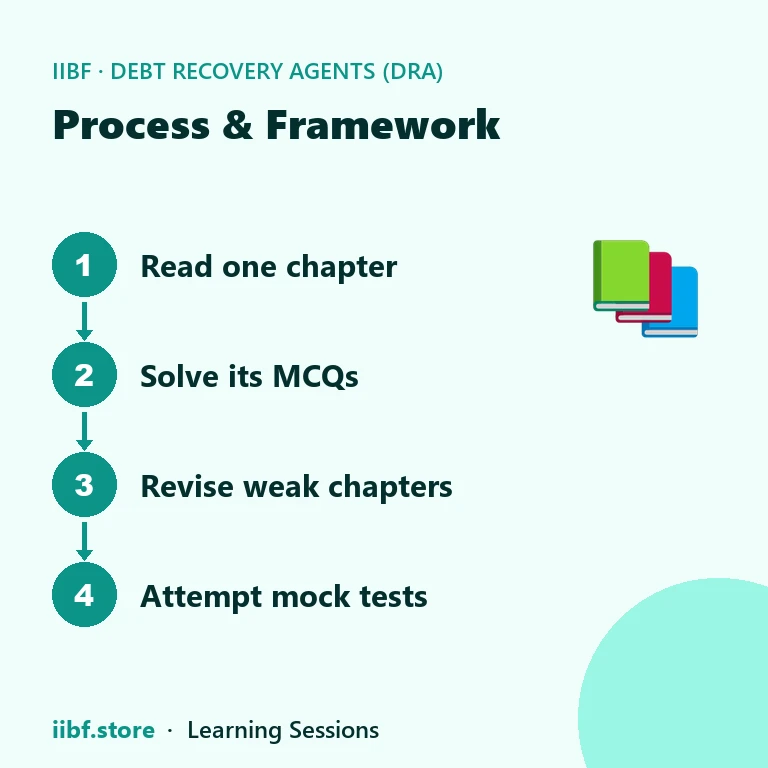
Step 1: Read one chapter, once, with a pencil
Do not highlight everything. Underline only definitions, lists and anything that surprises you. If a chapter is Module A material you already use at work, skim the parts you know and slow down on the parts you do not, such as the exact formalities in the NI Act chapter.
Step 2: Solve that chapter's MCQs the same night
Do this before sleeping, without looking at the text. Mark each wrong answer. These wrong answers are your real syllabus, because they show you what your memory does not yet hold.
Step 3: Revise only the wrong ones next morning
Ten minutes on the train or at your desk before the branch opens. Re-read the lines behind the questions you missed. Nothing more.
Step 4: Switch to mocks in the final days
Once the chapters are done, move to case studies and mega tests. Aim to finish questions in a fixed time and review every miss. You can pull free practice from our test section and extra reading from the free material library.
The day-wise table
Here is the schedule as a table. Use it as a template: if a day is lost to an audit or a festival, slide everything down by one day rather than abandoning the plan. This table is the core of the DRA exam study plan.
| Day | What to read | What to solve |
|---|---|---|
| Day 1 | Module A: General Banking; Banker Customer Relationship | End-of-chapter MCQs for both chapters |
| Day 2 | Module A: Accounts Opening and Operations in Accounts | Chapter MCQs; redo Day 1 misses |
| Day 3 | Module A: Various Deposit Schemes and Other Services | Chapter MCQs; redo Day 2 misses |
| Day 4 | Module A: Provisions of NI Act for Payment and Collection of Cheque | Chapter MCQs; short review of all Module A misses |
| Day 5 | Module B: Debit Card and Credit Card; Various Types of Loans and Advances | Chapter MCQs for both chapters |
| Day 6 | Module B: Securities and Modes of Charging Them | Chapter MCQs; redo Day 5 misses |
| Day 7 | Module B: Loan Documentation and Asset Classification | Chapter MCQs; redo Day 6 misses |
| Day 8 | Module B: Legal Aspects of Loan Recovery | Chapter MCQs; review all Module B misses |
| Day 9 | Module C: Debt Recovery Agent; Functions and Procedures of Debt Recovery Agent | Chapter MCQs for both chapters |
| Day 10 | Module C: International Best Practices; Soft Skills and Strategies | Chapter MCQs; begin case studies |
| Day 11 | Module D: NBFCs Types, Framework and Loans; Fair Practices Code for NBFCs | Chapter MCQs for both chapters |
| Day 12 | Revision of all wrong-answer notes, Modules A and B | Case studies from the book |
| Day 13 | Revision of all wrong-answer notes, Modules C and D | Case studies; first mega test |
| Day 14 | Light revision only | One more mega test, timed |
The plan deliberately gives the heaviest chapters, such as securities and the NI Act, their own evenings. Pairing two chapters happens only where they are short or familiar.
Making the plan survive a tired week
- Fix a start time, not a finish time. Open the book at 9:15 every night. Even on a bad day, 30 minutes counts.
- Keep one wrong-answer notebook. A single page per module. It becomes your revision sheet for the last three days.
- Use weekends for Module C. Soft skills and recovery conduct are better absorbed when you are not exhausted, and the case studies reward slow thinking.
- Do not skip Module D. It is labelled additional reading, but NBFC fair practices connect directly to how recovery is carried out, so questions from it are fair game.
- Stop adding resources. Choose your book, your tests and your notebook. That is the whole kit.
Check the official details before you book your date
This article deliberately does not quote exam dates, fees or eligibility rules, because they are revised by the institute. Please check the upcoming exam cycle, the syllabus and the application process on the official site of IIBF. Work backwards from the date you choose: if you have three weeks, this 14-evening plan leaves a full week of buffer.
Conclusion: start tonight with one chapter
You do not need a perfect month or a free weekend. You need 14 ordinary evenings and a loop you can repeat when you are tired: read, solve, revise, test. That is the entire DRA exam study plan. If you want a compact, chapter-ordered companion for it, the DRA book is built for this exact schedule, and you can browse more titles at iibf.store/books. For more preparation guides written for working bankers, visit the blog.
Frequently asked questions
Can I really finish the DRA syllabus in 14 evenings?
If you can give 60 to 90 minutes a night, yes. The book is 107 pages across 16 chapters, so the reading itself is modest. Most of the time goes into solving MCQs and revising mistakes. If your schedule is heavier, stretch the same table over three or four weeks.
Which module should I start with?
Start with Module A. It covers banking basics you already meet at work, so it builds confidence and a daily habit before you reach the heavier loan and legal chapters in Module B.
Is one book enough to prepare?
The book gives you structured reading and chapter-wise MCQs, plus case studies and mega tests. For exam-hall speed you should also practise timed papers, for example the free mocks on our tests page, and check the official IIBF site for the latest syllabus.
What should I do if I miss a day?
Slide the whole table down by one day. Do not try to double up, because tired double sessions produce poor recall. The buffer built into the last days is there for exactly this.
Prefer revising from a printed book?
Chapter-wise books with MCQs after every chapter — minimal pages, complete coverage, delivered anywhere in India. Every book has a free sample to read first.
107 pages · 240 MCQs
Learning Sessions · Ashish Sir
132 pages · 225 MCQs
Learning Sessions · Ashish Sir
188 pages · 435 MCQs
Learning Sessions · Ashish Sir
117 pages · 236 MCQs
Learning Sessions · Ashish Sir
Learning Sessions · Ashish Sir
118 pages · 299 MCQs
Learning Sessions · Ashish Sir
Learning Sessions · Ashish Sir
Learning Sessions · Ashish Sir
Learning Sessions · Ashish Sir
115 pages · 255 MCQs
Learning Sessions · Ashish Sir
Learning Sessions · Ashish Sir
334 pages · 936 MCQs
Learning Sessions · Ashish Sir
Learning Sessions · Ashish Sir
115 pages · 344 MCQs
Learning Sessions · Ashish Sir
90 pages · 150 MCQs
Learning Sessions · Ashish Sir
Learning Sessions · Ashish Sir
131 pages · 672 MCQs
Learning Sessions · Ashish Sir
221 pages · 831 MCQs
Learning Sessions · Ashish Sir
128 pages · 524 MCQs
Learning Sessions · Ashish Sir
107 pages · 445 MCQs
Learning Sessions · Ashish Sir
148 pages · 478 MCQs
Learning Sessions · Ashish Sir
151 pages · 465 MCQs
Learning Sessions · Ashish Sir
148 pages · 375 MCQs
Learning Sessions · Ashish Sir
216 pages · 895 MCQs
Learning Sessions · Ashish Sir
109 pages · 300 MCQs
Learning Sessions · Ashish Sir
104 pages · 360 MCQs
Learning Sessions · Ashish Sir
82 pages · 297 MCQs
Learning Sessions · Ashish Sir
151 pages · 600 MCQs
Learning Sessions · Ashish Sir
98 pages · 282 MCQs
Learning Sessions · Ashish Sir
Practice this topic
Take a free mock test, download chapter PDFs, or watch a video class — all included on iibf.store.
Keep reading