Financial Literacy for the Unbanked: Outreach, Content and Outcomes
Access to a savings account no longer guarantees a Small Finance Bank customer stays active. Financial literacy for the unbanked is what converts a first-time account opener into someone who saves regularly, borrows responsibly and uses digital rails safely — and it is the gap between a portfolio that stays current and one that slides into delinquency and dormancy. For SFB exam candidates, this topic sits at the intersection of the financial inclusion mandate and everyday branch and BC operations: RBI's Centres for Financial Literacy, the annual Financial Literacy Week, and the outreach an SFB runs through business correspondents and self help groups all feed into it. This article maps the content, the delivery channels, and — most importantly — how outcomes are actually measured.
📚 Why Literacy, Not Just Access, Drives Usage
The financial inclusion push over the last decade solved the access problem: basic savings accounts, Aadhaar-linked KYC and BC touchpoints put a formal account within reach of most households. What it did not automatically solve is usage. An account opened under a drive and never explained to the holder tends to go dormant within months, and a small loan disbursed without a clear repayment conversation tends to slip into arrears. This is the exact gap financial literacy work is designed to close.
RBI's approach runs through Centres for Financial Literacy (CFLs), set up at the block level across states in partnership with banks — including Small Finance Banks in their operating districts — under the National Strategy for Financial Education. Alongside year-round CFL camps, RBI anchors an annual Financial Literacy Week that gives banks a common calendar and standard content themes to run outreach against. For an SFB, whose customer base skews toward first-time borrowers and account holders, plugging into this calendar is not a CSR add-on; it is a portfolio-quality tool.
💡 Exam Tip: In the SFB paper, financial literacy is tested as an inclusion-quality theme linked to portfolio outcomes, not as a standalone CSR topic — expect questions that connect literacy gaps directly to dormancy and delinquency.
💰 Core Content: Savings, Credit Discipline and Digital Payment Safety
Effective literacy content for the unbanked is narrow and practical rather than broad and theoretical. Three pillars dominate. The first is the savings habit — why to keep money in an account rather than cash at home, how interest accrues, and how to read a passbook or SMS alert. The second is credit discipline: what an EMI means, why a missed instalment costs more than the missed amount, and how a poor repayment record affects future borrowing. This is the same ground covered from the lender's side in the Principles of Lending chapter, and candidates should be able to connect both sides of that relationship.
The third pillar is digital payment safety — recognising phishing calls, never sharing OTP or PIN, verifying a UPI collect request before approving it, and using only registered channels. This ties directly into the KYC and fraud-prevention material in the KYC and AML chapter, since weak customer understanding of KYC updates and re-KYC prompts is itself a common fraud vector.
Every digital safety module must close with a grievance route the customer can actually recall. As of August 2026, the Reserve Bank Integrated Ombudsman Scheme 2026 governs this escalation path, with a filing window and monetary compensation ceilings raised over the earlier 2021 scheme — literacy content should state this route exists rather than lean on outdated figures.
📌 Remember: Every digital payment safety module must end with a clear, memorised grievance route — the SFB's internal grievance/nodal officer first, and the Reserve Bank Integrated Ombudsman Scheme if the complaint stays unresolved beyond the prescribed period.
🤝 Delivery Channels: Business Correspondents, SHGs and Camps
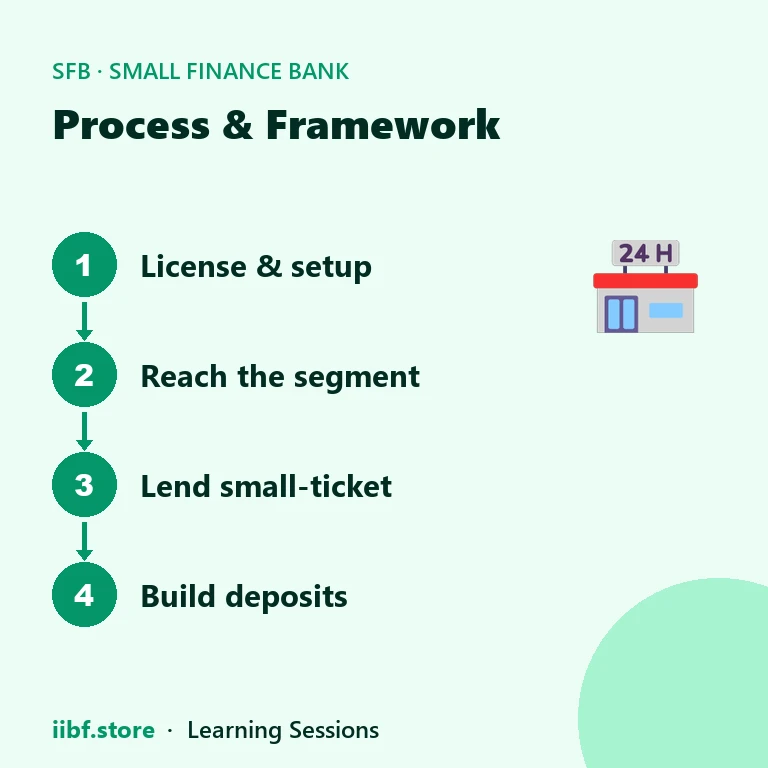
Content only works if the delivery channel matches the audience. Small Finance Banks reach the unbanked and under-banked mainly through three routes. Business correspondents, covered in depth in the sibling piece on agent banking through business correspondents, are the front-line channel for existing account holders — every cash-in, cash-out or bill-pay visit is a natural moment to reinforce a savings or digital-safety message, since the BC already has the customer's attention.
Self help groups carry credit discipline messaging to group-guaranteed micro-borrowers, where peer accountability makes repayment calendars stick better than one-way lectures. SHG meetings are also where rural literacy content sometimes has to cover collateral basics — for instance, borrowers using land as security need to understand how land records establish and verify a charge, a theme detailed in agricultural land records in rural banking. Getting this segment right matters because it defines much of who an SFB actually serves — see the sibling explainer on the target segment of small finance banks for the fuller profile.
Camps and Financial Literacy Week events are the mass-reach layer — useful for awareness but weakest on follow-through unless paired with a BC or SHG touchpoint afterwards. Basic account operations knowledge, covered in the Operations of Banks chapter, underpins all three channels since every literacy conversation eventually touches how an account or loan actually operates day to day.
📈 Measuring Outcomes, Not Attendance
The most exam-relevant shift in financial literacy practice is away from headcount metrics. A camp that draws two hundred attendees but changes no behaviour has not moved the needle an SFB actually cares about: account dormancy rate before versus after outreach, on-time repayment trend for borrowers who attended SHG sessions, digital transaction frequency after a payment-safety module, and complaint patterns at the grievance cell. These are behaviour and outcome measures, not footfall measures.
| Delivery Channel | Best Reaches | Content Emphasis | Outcome Tracked (not headcount) |
|---|---|---|---|
| RBI-linked Centres for Financial Literacy (CFL) camps | Rural and semi-urban unbanked households | Savings habit, basic banking, grievance route | ✅ Post-camp account activity and follow-up recall survey |
| Business correspondent (BC) touchpoints | Existing BSBDA / Jan Dhan customers | Digital payment safety, OTP/PIN hygiene | ✅ Digital transaction frequency after training |
| Self help group (SHG) meetings | Group-guaranteed micro-borrowers | Credit discipline, repayment calendar | ✅ Days-past-due trend on group loans |
| One-off mass camps / Financial Literacy Week events | General walk-in footfall | Broad awareness messaging | ❌ Attendance count only, unless paired with follow-up |
Practically, this means an SFB's literacy unit should report to the same portfolio-quality dashboard as collections, not sit as a separate outreach statistic. When dormancy and delinquency trends are tracked against literacy exposure, the business case for sustained (rather than one-off) content delivery becomes self-evident.
⚠️ Common Mistake: Candidates confuse "more camps held" with "better literacy outcomes." RBI's own framing stresses knowledge and behaviour change, not footfall, as the true measure of a literacy programme's success.
🎯 Building This Into Exam-Ready Understanding
Tie the pieces together before you sit the SFB paper: literacy content (savings, credit discipline, digital safety and grievance routes) is delivered through specific channels (BCs, SHGs, camps), each suited to a different customer moment, and success is judged by dormancy and delinquency trends rather than attendance registers. Candidates who can name the RBI institutional layer (CFLs, Financial Literacy Week), the content pillars, the channel-to-audience fit, and the outcome-versus-attendance distinction cover this topic completely.
Cross-check every figure and scheme name against a primary source before exam day — RBI's own site at rbi.org.in carries the current financial education and ombudsman scheme material. Once the concepts are clear, test yourself against exam-pattern questions and browse the wider Small Finance Bank topic hub for related chapters.
🧠 Practice MCQs: Financial Literacy for the Unbanked
Q1. What is the primary objective of RBI's Centres for Financial Literacy (CFL) project? (a) To sell insurance products to SFB customers (b) To build basic financial knowledge and behaviour change among under-served communities (c) To replace business correspondents entirely (d) To conduct KYC verification for new accounts
Answer: (b) — CFLs exist to build practical financial knowledge and behaviour change, not to sell products or replace other channels.
Q2. Why is measuring dormancy and delinquency important for evaluating financial literacy programmes at a Small Finance Bank? (a) They are unrelated to literacy outcomes (b) They reflect real customer behaviour after training, unlike attendance counts (c) They are only relevant for corporate credit (d) They measure staff performance, not customer outcomes
Answer: (b) — Dormancy and delinquency trends show whether literacy content actually changed behaviour, which attendance figures cannot.
Q3. Which channel is best suited for reinforcing credit discipline among group-guaranteed micro-borrowers? (a) Mass financial literacy week camps (b) Self help group (SHG) meetings (c) ATM signage (d) Annual report disclosures
Answer: (b) — SHG meetings use peer accountability to reinforce repayment discipline among group-guaranteed borrowers more effectively than one-way mass messaging.
Q4. A customer unable to resolve a digital payment fraud complaint with the SFB's internal grievance cell should next approach: (a) The local police station only (b) The Reserve Bank Integrated Ombudsman Scheme (c) The credit information company (d) SEBI
Answer: (b) — Unresolved banking grievances escalate to the Reserve Bank Integrated Ombudsman Scheme after the internal grievance route is exhausted.
Q5. What is the key weakness of using only attendance figures to judge a financial literacy camp's success? (a) Attendance is expensive to record (b) It does not show whether knowledge or behaviour actually changed (c) Attendance figures are confidential (d) RBI does not permit attendance tracking
Answer: (b) — Attendance shows footfall, not whether the customer's savings habit, credit discipline or digital safety behaviour actually improved.
Want chapter-wise mock tests with 100+ MCQs? Start practising free →
❓ Frequently Asked Questions
What does "financial literacy for the unbanked" mean in the SFB context?
It refers to structured content and outreach that builds savings habits, credit discipline and digital payment safety awareness among first-time and under-served banking customers, so that access to an account converts into sustained, responsible usage.
How does RBI support financial literacy delivery?
Through Centres for Financial Literacy set up in partnership with banks, including Small Finance Banks in their operating districts, and through an annual Financial Literacy Week that gives banks a common outreach calendar and content themes.
Why do SFBs prioritise financial literacy over pure account-opening targets?
Untrained customers are more likely to let accounts go dormant or default on small loans. Literacy investment upfront reduces delinquency and dormancy costs later and protects portfolio quality.
What is the correct escalation route for an unresolved digital banking grievance?
The customer should first approach the SFB's internal grievance or nodal officer, and if the complaint stays unresolved within the prescribed period, escalate it to the Reserve Bank Integrated Ombudsman Scheme.
Practice this topic
Take a free mock test, download chapter PDFs, or watch a video class — all included on iibf.store.
Keep reading