HTM Portfolio Sale Limit: RBI's 5% Rule for Bank Treasuries
Every bank treasury desk lives with one quiet but powerful constraint: the HTM portfolio sale limit. Held to Maturity securities are supposed to sit untouched on the books at cost, so RBI caps how much of that book a bank can sell in a year before supervisors start asking questions. Get this rule wrong in the exam — or in real treasury operations — and you either misread a bank's balance-sheet flexibility or breach a prudential condition without realising it.
This article covers how the cap works under RBI's Regulations Supervision And Compliance framework, how the 5% threshold is calculated, which sales RBI exempts, and what happens when a bank crosses the line.
📜 What the HTM Portfolio Sale Limit Actually Says
The rule sits in the Master Direction – Classification, Valuation and Operation of Investment Portfolio of Commercial Banks (Directions), 2023, issued by RBI on September 12, 2023 and effective for accounting periods from April 1, 2024 (updated as on April 1, 2025). It replaced the older 2021 framework and moved the whole investment book to a principle-based structure of three categories — Held to Maturity (HTM), Available for Sale (AFS), and Fair Value Through Profit or Loss (FVTPL).
Within that structure, the direction states plainly: in any financial year, the carrying value of investments sold out of HTM shall not exceed five per cent of the opening carrying value of the HTM portfolio. Cross that line without cover, and the bank needs prior clearance from RBI's Department of Supervision before the sale goes through.
The logic is straightforward. HTM securities are carried at cost and never marked to market, so a bank could, in theory, sit on unrealised gains and cherry-pick which HTM holdings to sell whenever it wanted to flatter profit. The 5% cap keeps HTM genuinely a "hold" book rather than a disguised trading book, and it protects the integrity of the bank's reported earnings.
📌 Remember: the ceiling is calculated on the opening carrying value of the HTM portfolio for that financial year — not the closing balance, not an average of quarterly balances.
🧮 How the 5% Ceiling Is Actually Calculated
Take a bank whose HTM portfolio carries an opening value of ₹40,000 crore on April 1 of a given year. Five per cent of that figure is ₹2,000 crore — the maximum carrying value of HTM securities the bank can sell during that financial year without needing prior RBI clearance. Every eligible sale during the year, at its carrying (book) value on the date of sale, is added up against this running ₹2,000 crore ceiling until the financial year resets on the next April 1.
Two details trip up exam candidates. First, the base is fixed at the start of the year — a bank cannot "reset" its headroom mid-year even if fresh securities are added to HTM. Second, the comparison uses carrying value, the amortised-cost book value, not the market or face value of the securities sold — a nuance that connects directly to how banks handle premium amortisation on HTM securities in the first place.
If a bank's treasury front office wants to sell beyond the ₹2,000 crore threshold in this example, the transaction must first be routed for Department of Supervision approval, with the Board recording why the breach is necessary. Treasury officers should be comfortable with the underlying mechanics covered in A TREASURY MANAGMENT, since this rule sits inside day-to-day portfolio operations, not as a one-off compliance footnote.
✅ Which Sales RBI Exempts From the Cap
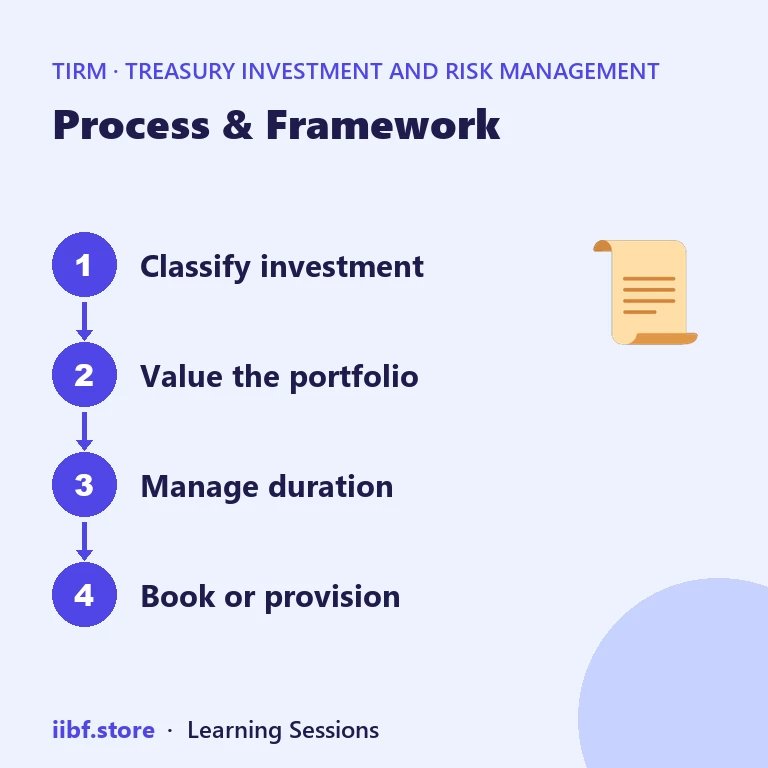
Not every sale out of HTM eats into the 5% headroom. RBI carves out specific, low-discretion categories of transactions that are excluded from the cap entirely, because they are not driven by a bank chasing trading gains:
| Sale Scenario | Counted Toward the 5% Cap? (✅ Yes / ❌ No) |
|---|---|
| Discretionary market sale for treasury/trading purposes | Yes |
| Sale to RBI under Open Market Operations (OMO) or GSAP | No |
| Government buyback or switch of G-Secs / State Development Loans | No |
| Issuer-initiated repurchase, buyback or call on non-SLR securities | No |
| Sale after a credit rating downgrade or counterparty default | No |
| Sale under the Prudential Framework for Resolution of Stressed Assets | No |
The common thread is simple: exempt sales are triggered by policy operations, sovereign action, or credit events — not by a treasury desk timing the market. A bank moving a security out of HTM for any other reason should instead work through the ordinary shifting of investment categories process, which carries its own separate conditions and disclosure requirements distinct from a straightforward sale.
This distinction matters operationally too: a bank cannot simply relabel a discretionary sale as an "exempt" transaction after the fact to dodge the cap. RBI expects the exemption to arise from the nature of the transaction itself — a liquidity operation, a sovereign buyback, a credit event, or a resolution sale — not from how the sale is documented after the trade.
💡 Exam Tip: if a question describes a sale to RBI, a government buyback, a rating downgrade, or a stressed-asset resolution sale, it is exempt from the 5% cap — everything else counts against it.
⚠️ What Happens When a Bank Breaches the Limit
A large share of candidates assume that breaching the 5% cap automatically forces the bank to reclassify its entire HTM portfolio into AFS or FVTPL, with all the mark-to-market pain that implies. That is not how the current framework works.
Instead, exceeding the threshold triggers a supervisory-approval mechanism: the bank must obtain prior clearance from RBI's Department of Supervision before proceeding, the Board must record a documented rationale for the breach, and the bank is required to report the excess sales and the reasons for them to the Board on a half-yearly basis. Enforcement runs through ongoing supervisory review of the bank rather than an automatic, mechanical reclassification of the book, which is a meaningful distinction for candidates comparing this rule with reclassification norms.
⚠️ Common Mistake: treating a breach of the 5% cap as an automatic trigger for reclassifying the whole HTM book. The rule is a supervisory checkpoint, not a self-executing reclassification switch.
That said, treasury risk officers still treat the 5% line as a hard internal limit, because unplanned DoS approval requests invite closer scrutiny of the bank's broader investment policy and treasury risk limits. In practice, most banks build an internal amber threshold — well below the regulatory 5% — into their ALCO dashboards so that treasury never gets close enough to the actual ceiling to need a last-minute approval request.
🎯 Why This Matters for Treasury and SLR Portfolio Management
For a bank's SLR portfolio — the government securities and other approved securities it holds to meet the Statutory Liquidity Ratio — HTM classification offers accounting stability by avoiding daily mark-to-market swings. The 5% sale-limit rule is what keeps that stability honest: it stops HTM from quietly becoming a parking spot that a treasury desk empties opportunistically whenever bond yields move in its favour.
This is why the rule belongs squarely inside Risk Exposure Analysis And Important Concepts for TIRM candidates — it links accounting classification directly to treasury risk governance, ALCO oversight, and the bank's investment policy. It also sits next to, but is distinct from, market-risk hedging concepts such as bilateral netting of derivatives, which manages counterparty exposure rather than portfolio classification.
Examiners frequently combine this topic with SLR mechanics because HTM is where the bulk of a bank's SLR-eligible government securities usually sit. A candidate who can explain both why HTM exists and where its sale flexibility ends demonstrates a far more complete grasp of treasury governance than one who only memorises the classification labels.
Understanding this cap also sharpens your reading of related valuation topics, including how banks compute the clean price and dirty price of bonds when a sale does go through — the carrying value used against the 5% ceiling and the settlement price a counterparty pays are two different numbers.
🧠 Practice MCQs: HTM Portfolio Sale Limit
Q1. Under RBI's Master Direction on Classification, Valuation and Operation of Investment Portfolio of Commercial Banks, what percentage of the opening carrying value of the HTM portfolio can a bank sell in a financial year without prior RBI approval? (a) 2% (b) 5% (c) 10% (d) 25%
Answer: (b) — The Direction caps annual sales out of HTM at 5% of the opening carrying value of the HTM portfolio.
Q2. Which RBI department's prior approval is required before a bank sells more than the permitted limit from its HTM portfolio? (a) Department of Supervision (b) Department of Payment and Settlement Systems (c) Financial Markets Regulation Department (d) Department of Communication
Answer: (a) — Prior approval must come from RBI's Department of Supervision (DoS) before the excess sale is executed.
Q3. The 5% HTM sale-limit ceiling is computed on which base? (a) Closing carrying value of the HTM portfolio for the year (b) Opening carrying value of the HTM portfolio for the financial year (c) Face value of all SLR securities held (d) Average of quarterly HTM balances
Answer: (b) — The cap is fixed against the HTM portfolio's opening carrying value at the start of the financial year, not a closing or average figure.
Q4. Which of the following sales is EXEMPT from the 5% HTM sale-limit cap? (a) A discretionary sale purely to book trading profit (b) A sale to RBI under open market operations (c) A negotiated sale to a sister bank (d) A sale driven solely by ALCO's view on interest rates
Answer: (b) — Sales to RBI under liquidity operations like OMO or GSAP are explicitly excluded from the 5% cap.
Q5. If a bank breaches the 5% HTM sale-limit cap without prior approval, what is the regulatory consequence under the current Master Direction? (a) Automatic reclassification of the entire HTM portfolio to AFS (b) A requirement for Board-documented justification and supervisory approval/reporting, not automatic reclassification (c) Immediate suspension of the bank's SLR eligibility (d) Mandatory closure of the treasury desk
Answer: (b) — Breach triggers a supervisory approval and reporting mechanism through the Department of Supervision, not an automatic reclassification of the whole HTM book.
Want chapter-wise mock tests with 100+ MCQs? Start practising free →
❓ Frequently Asked Questions
What is the HTM category in a bank's investment portfolio?
Held to Maturity (HTM) is one of three classification buckets — alongside AFS and FVTPL — for securities a bank intends and is able to hold until redemption. HTM securities are carried at cost or amortised cost and are not marked to market after initial recognition.
Why did RBI cap sales out of HTM at 5% a year?
Because HTM securities skip mark-to-market accounting, an uncapped ability to sell them would let a bank pick and choose which gains to realise whenever it suited reported profit. The 5% ceiling keeps HTM a genuine hold-to-maturity book rather than a disguised trading portfolio.
Does exceeding the 5% limit force a bank to move its entire HTM book to AFS?
No. Exceeding the limit requires prior approval from RBI's Department of Supervision, a Board-documented justification, and half-yearly reporting of the excess sales — it does not automatically trigger reclassification of the whole HTM portfolio.
Which RBI direction currently governs this rule, and when did it take effect?
The Master Direction – Classification, Valuation and Operation of Investment Portfolio of Commercial Banks (Directions), 2023, issued September 12, 2023, governs the rule. It applies to accounting periods starting April 1, 2024, and was last updated as on April 1, 2025.
Keep this rule handy for your next TIRM revision round
The HTM sale-limit rule is a small clause with outsized exam weight because it ties classification, valuation, and treasury governance together in one place. For the full regulatory text and RBI's exemption list, see the RBI Master Direction on Classification, Valuation and Operation of Investment Portfolio. Browse more chapter notes on the Treasury Investment and Risk Management blog tag, and check current benchmark rates on the RBI rates resource page before your next mock test.
Prefer revising from a printed book?
Chapter-wise books with MCQs after every chapter — minimal pages, complete coverage, delivered anywhere in India. Every book has a free sample to read first.
Learning Sessions · Ashish Sir
132 pages · 225 MCQs
Learning Sessions · Ashish Sir
188 pages · 435 MCQs
Learning Sessions · Ashish Sir
117 pages · 236 MCQs
Learning Sessions · Ashish Sir
118 pages · 299 MCQs
Learning Sessions · Ashish Sir
Learning Sessions · Ashish Sir
Learning Sessions · Ashish Sir
Learning Sessions · Ashish Sir
115 pages · 255 MCQs
Learning Sessions · Ashish Sir
Learning Sessions · Ashish Sir
334 pages · 936 MCQs
Learning Sessions · Ashish Sir
Learning Sessions · Ashish Sir
115 pages · 344 MCQs
Learning Sessions · Ashish Sir
107 pages · 240 MCQs
Learning Sessions · Ashish Sir
90 pages · 150 MCQs
Learning Sessions · Ashish Sir
Learning Sessions · Ashish Sir
131 pages · 672 MCQs
Learning Sessions · Ashish Sir
221 pages · 831 MCQs
Learning Sessions · Ashish Sir
128 pages · 524 MCQs
Learning Sessions · Ashish Sir
107 pages · 445 MCQs
Learning Sessions · Ashish Sir
148 pages · 478 MCQs
Learning Sessions · Ashish Sir
151 pages · 465 MCQs
Learning Sessions · Ashish Sir
148 pages · 375 MCQs
Learning Sessions · Ashish Sir
216 pages · 895 MCQs
Learning Sessions · Ashish Sir
109 pages · 300 MCQs
Learning Sessions · Ashish Sir
104 pages · 360 MCQs
Learning Sessions · Ashish Sir
82 pages · 297 MCQs
Learning Sessions · Ashish Sir
151 pages · 600 MCQs
Learning Sessions · Ashish Sir
98 pages · 282 MCQs
Learning Sessions · Ashish Sir
Practice this topic
Take a free mock test, download chapter PDFs, or watch a video class — all included on iibf.store.