CAIIB BFM Study Plan: 6 Weeks While Working Full-Time
It is 9:40 pm. You have closed the branch, the cash has tallied, and a customer's last-minute demand draft has eaten another half hour. The BFM syllabus is still sitting on your table, and it looks endless: forex, risk, treasury, Basel, provisioning. Most bankers in this position do one of two things. They either promise themselves a marathon weekend that never happens, or they keep "starting Monday" for six months.
This article offers a third option: a realistic CAIIB BFM study plan that assumes you are tired, that you have only 60 to 90 minutes on weekdays, and that you want to reach the exam hall without having burnt out in week two. You can follow it with any good material. If you want one compact book to anchor it, I will show how the CAIIB BFM printed book fits in, using only its facts.
Why most CAIIB BFM plans collapse in week two
Bank Financial Management is a paper with four very different personalities. Forex and international banking is vocabulary-heavy. Risk management is concept-heavy. Treasury is product-heavy. Balance sheet management is number-heavy. A plan that treats all four the same way, "read 30 pages a day", breaks the first time a Basel chapter takes twice as long as a letter of credit chapter.
Three things usually go wrong:
- The plan is built on pages, not chapters. You miss a day, the page target slips, and the whole schedule feels lost. A chapter is a small, finishable unit. Finish one and you have a win.
- Practice is postponed to the end. Reading for five weeks and attempting questions in the last week means you discover your weak areas when there is no time left to fix them.
- There is no buffer. A branch audit, a month-end rush or a family function will cost you at least four study days over six weeks. If the plan has no slack, it fails.
So a good CAIIB BFM study plan is chapter-based, practice-linked and has built-in buffer days. That is what we will build below.
First, map the paper: four modules, 31 chapters
Before you plan time, plan the territory. The CAIIB BFM book is organised in four modules, and the chapter counts are very uneven, which is exactly why a flat "one chapter per day" plan does not work.
Module A: International Banking (10 chapters)
Exchange rates and forex business, the Liberalised Remittance Scheme and other remittance facilities, correspondent banking and NRI accounts, documentary letters of credit, facilities for exporters and importers, external commercial borrowings and foreign investments, risks in foreign trade and the role of ECGC, the roles of EXIM Bank, RBI, FEMA and FEDAI, IFSC and GIFT City, and technology in international banking. Treat this as a vocabulary module: terms, forms, who-does-what.
Module B: Risk Management (8 chapters)
The risk management framework, risks in banking business, risk regulations, market risk, credit risk, operational and integrated risk, liquidity risk management, and the Basel III framework on liquidity standards. Here the aim is to understand the logic first and the definitions second.
Module C: Treasury Management (7 chapters)
Introduction to treasury, treasury products, international equity and debt products, funding and regulatory aspects, treasury risk management, derivative products, and treasury with asset-liability management.
Module D: Balance Sheet Management (6 chapters)
Components of assets and liabilities, capital adequacy under the Basel norms, asset classification and provisioning, liquidity management, interest rate risk management, and RAROC with profit planning. These six chapters are fewer but denser, and they reward slow, repeated reading.
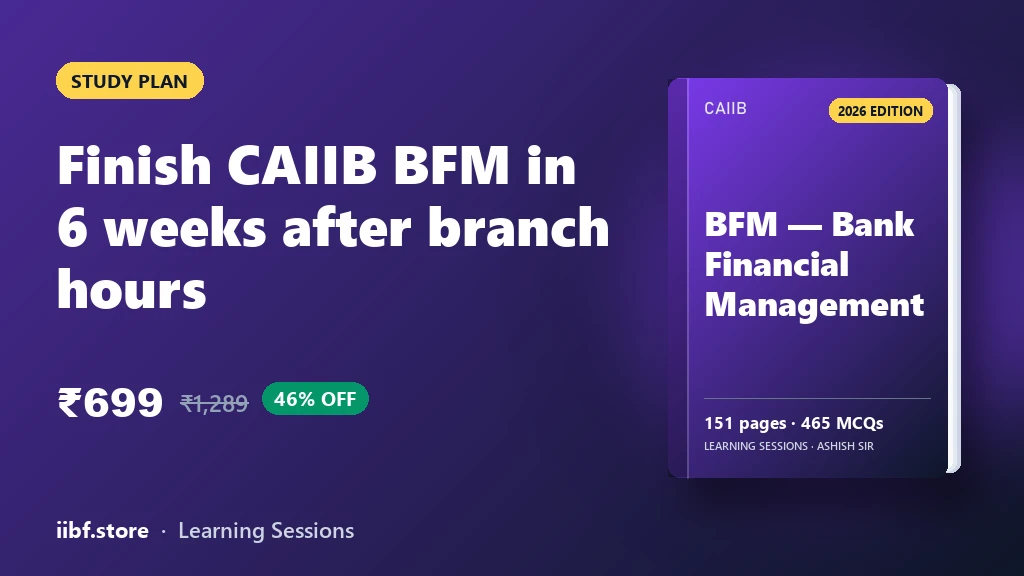
Here is the book that follows this exact structure. The CAIIB BFM printed book runs to 151 pages across 31 chapters, with 465 questions inside, so every module above is covered in a form you can finish.
What is inside the book you will plan around
A plan is only as good as the material under it, so here are the plain facts of the CAIIB BFM book, with nothing added:
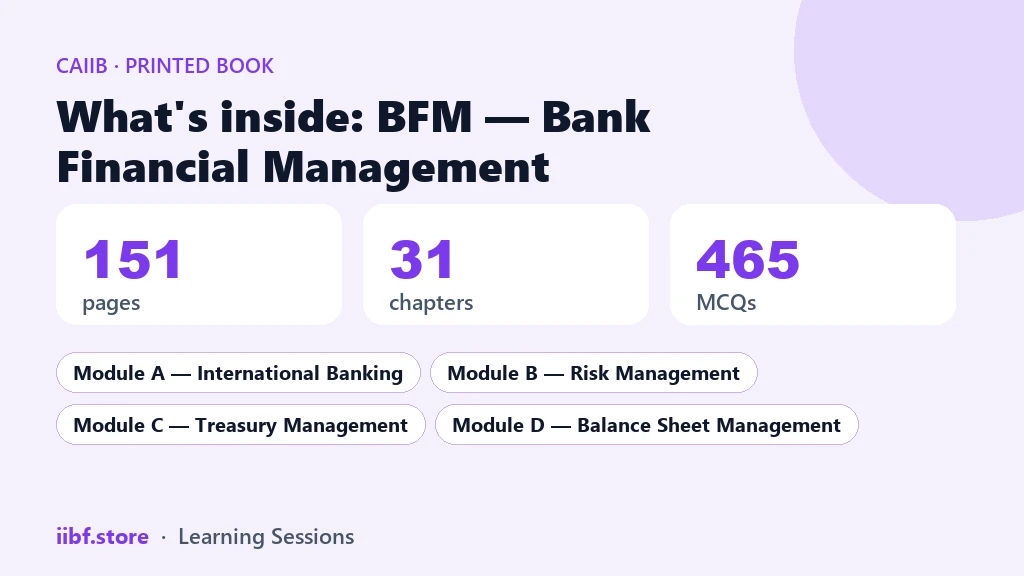
- 151 pages in the 2026 edition, short enough to read through more than once.
- 31 chapters across Modules A to D, matching the map above.
- 465 questions, which works out to about 15 per chapter on average.
- 100 case studies (400 questions) as an extra, useful for the final revision phase.
The current price is ₹699 against an MRP of ₹1,289 (46% off), though prices can change, so check the book page for the current figure. If you want to see the writing style before deciding anything, there is a free sample on the same page. And if you are still choosing between papers or formats, the full range is at iibf.store/books.
One honest limit: a book gives you content and practice, but it will not give you exam-hall speed on its own. For that you need timed mocks, and you can start with the free ones at iibf.store/tests.
The six-week CAIIB BFM study plan, day by day
The plan below covers all 31 chapters in 42 days, which includes buffer and revision. It assumes weekdays of about 75 minutes and weekends of two to three hours. Do not copy it blindly: if your branch is quiet in the first fortnight, front-load the heavy modules.
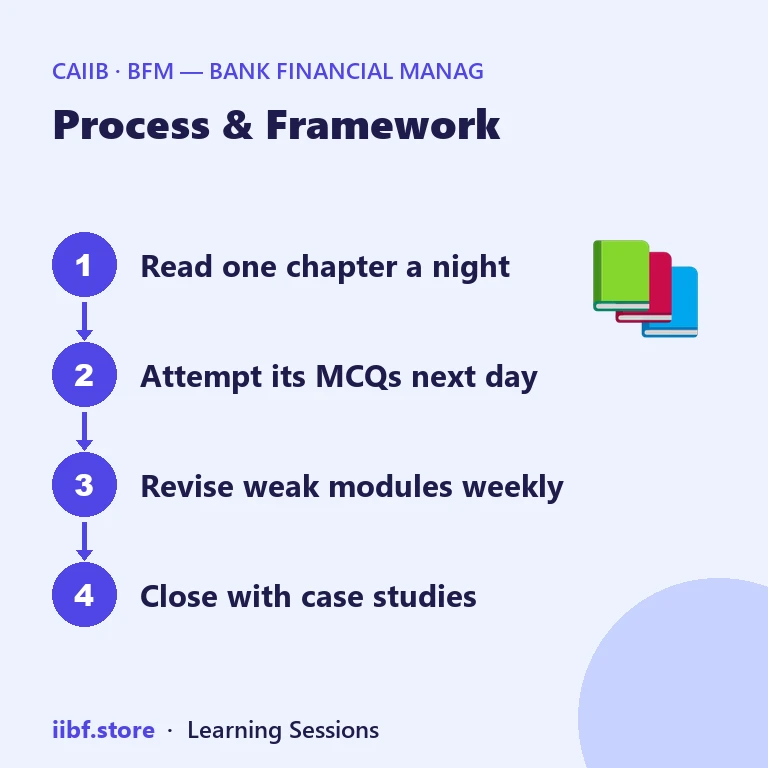
The four-step rhythm
- Read one chapter in the evening. Underline only definitions, limits and formulas. Do not rewrite notes.
- Attempt that chapter's questions the next day. Doing it after a night's sleep tells you what actually stuck.
- Revise weak modules on Sunday. Look only at the questions you got wrong.
- Close with case studies. The last phase is for application, not new reading.
| Days | What to read | Questions to attempt |
|---|---|---|
| 1-4 | Module A: Exchange rates, LRS and remittances, correspondent banking and NRI accounts | about 45 |
| 5-8 | Module A: Documentary letters of credit, exporters and importers, ECB and foreign investments | about 45 |
| 9-12 | Module A: ECGC, EXIM Bank/RBI/FEMA/FEDAI, IFSC and GIFT City, technology | about 60 |
| 13-16 | Module B: Risk framework, risks in banking, risk regulations | about 45 |
| 17-20 | Module B: Market risk, credit risk | about 30 |
| 21-23 | Module B: Operational and integrated risk, liquidity risk, Basel III liquidity | about 45 |
| 24-27 | Module C: Introduction, treasury products, equity and debt products, funding | about 60 |
| 28-30 | Module C: Treasury risk, derivatives, treasury and ALM | about 45 |
| 31-34 | Module D: Balance sheet components, capital adequacy, asset classification and provisioning | about 45 |
| 35-38 | Module D: Liquidity management, interest rate risk, RAROC and profit planning | about 45 |
| 39-42 | Revision of wrong answers, case studies, one full mock | case studies and mocks |
Notice that the day ranges are wider where the chapters are heavier (credit risk, capital adequacy) and tighter where they are lighter. Module A gets 12 days because ten chapters is a lot of vocabulary, but each chapter is quick once you have the terms.
How to run each evening without burning out
A CAIIB BFM study plan only works if a bad day does not wreck it. Use these rules:
- Minimum viable day: 30 minutes. On a terrible day, read half a chapter. Zero days are what kill momentum, not short ones.
- Study at the same time: after dinner or before the commute. Pick one and protect it.
- Weekends are for the heavy chapters: keep Basel norms, provisioning and derivatives for Saturday and Sunday, when you have two clear hours.
- One buffer day per week: if a week goes perfectly, use it to attempt extra questions. If it does not, it absorbs the slip.
What to do with wrong answers
Keep a one-page list titled "Things I keep getting wrong". Every time you miss a question, write the concept, not the question. By week four this single page is your most valuable revision material, far more useful than re-reading the book from page one.
Which modules deserve extra time
Not all four modules are equal in how much they trip people up. As a working rule, give the extra time to the areas where logic and numbers combine. In practice this means Module B (market, credit and liquidity risk) and Module D (capital adequacy, provisioning and interest rate risk). Module A is mostly about remembering who does what and which form or facility applies, so it responds well to quick, repeated passes through the questions.
Module C, treasury, sits in the middle. Products and derivatives are easy to confuse, so make a small comparison sheet as you go: what the instrument is, who uses it, and what risk it carries. If you are also reading around the paper, the free PDFs at iibf.store/free-material are a handy supplement for revision notes.
The last week: where the CAIIB BFM study plan turns into exam practice
Days 39 to 42 are not for new reading. First, go through your "things I keep getting wrong" page. Second, work through the 100 case studies in the book, which carry 400 questions, because application-style questions are where a prepared candidate separates from one who has only memorised. Third, take at least one full timed mock and check how your pace holds up.
Keep the official source in view for anything that can change. Exam dates, fees, eligibility and the syllabus are decided by the Institute, so check the upcoming exam cycle and the current syllabus at the IIBF website before you finalise your timeline. If you are also preparing other papers, the CAIIB course page and the iibf.store blog have more preparation guides.
Putting it together
Six weeks is enough for a working banker to cover 31 chapters if the plan is chapter-based, linked to practice and padded with buffer. The shape of the CAIIB BFM study plan is simple: read one chapter, attempt its questions the next day, revise weak spots on Sunday, and keep the final four days for case studies and a mock.
If you would like one compact book to hang that plan on, the CAIIB BFM book has the 151 pages, 31 chapters and 465 questions to do it, and there is a free sample to check the fit. But the method matters more than the material. Start tonight with the first chapter and a 30-minute minimum, and let the habit carry you.
Frequently asked questions
Can I finish BFM in six weeks while working full-time?
Yes, if you study around 75 minutes on weekdays and two to three hours on weekends, and you keep to a chapter-wise plan with buffer days. If your work is heavier, stretch the same plan to eight weeks rather than skipping the practice questions.
Should I read the whole book first and practise later?
No. Attempt each chapter's questions the day after you read it. Practising early shows you what is not sticking while there is still time to fix it.
How many questions does the book contain?
The CAIIB BFM book has 465 questions across 31 chapters, plus 100 case studies carrying 400 questions as an extra. Check the book page for the latest details and current price.
Is a book enough, or do I need mock tests too?
A book builds understanding and gives practice, but timed mocks build exam-hall speed. Use both: the book for the six weeks, and mocks from the free tests page for the final stretch.
Prefer revising from a printed book?
Chapter-wise books with MCQs after every chapter — minimal pages, complete coverage, delivered anywhere in India. Every book has a free sample to read first.
151 pages · 465 MCQs
Learning Sessions · Ashish Sir
148 pages · 478 MCQs
Learning Sessions · Ashish Sir
148 pages · 375 MCQs
Learning Sessions · Ashish Sir
216 pages · 895 MCQs
Learning Sessions · Ashish Sir
109 pages · 300 MCQs
Learning Sessions · Ashish Sir
104 pages · 360 MCQs
Learning Sessions · Ashish Sir
82 pages · 297 MCQs
Learning Sessions · Ashish Sir
151 pages · 600 MCQs
Learning Sessions · Ashish Sir
98 pages · 282 MCQs
Learning Sessions · Ashish Sir
131 pages · 672 MCQs
Learning Sessions · Ashish Sir
221 pages · 831 MCQs
Learning Sessions · Ashish Sir
128 pages · 524 MCQs
Learning Sessions · Ashish Sir
107 pages · 445 MCQs
Learning Sessions · Ashish Sir
132 pages · 225 MCQs
Learning Sessions · Ashish Sir
188 pages · 435 MCQs
Learning Sessions · Ashish Sir
117 pages · 236 MCQs
Learning Sessions · Ashish Sir
Learning Sessions · Ashish Sir
118 pages · 299 MCQs
Learning Sessions · Ashish Sir
Learning Sessions · Ashish Sir
Learning Sessions · Ashish Sir
Learning Sessions · Ashish Sir
115 pages · 255 MCQs
Learning Sessions · Ashish Sir
Learning Sessions · Ashish Sir
334 pages · 936 MCQs
Learning Sessions · Ashish Sir
Learning Sessions · Ashish Sir
115 pages · 344 MCQs
Learning Sessions · Ashish Sir
107 pages · 240 MCQs
Learning Sessions · Ashish Sir
90 pages · 150 MCQs
Learning Sessions · Ashish Sir
Learning Sessions · Ashish Sir
Quick quiz on this topic
5 exam-style questions from our free test bank — check yourself before you move on.
Practice this topic
Take a free mock test, download chapter PDFs, or watch a video class — all included on iibf.store.
Keep reading