ICAAP in Risk Management: CAIIB Pillar 2 Capital Guide
The ICAAP in Risk Management framework is one of the most heavily tested areas of the CAIIB Risk Management (RM) elective. Because it sits at the heart of how a bank proves it holds enough capital to survive the risks it actually runs. Where Pillar 1 of Basel prescribes a one-size-fits-all minimum. The Internal Capital Adequacy Assessment Process forces each bank to look in the mirror, count all its material risks, and decide for itself how much capital is truly adequate.
For candidates preparing the CAIIB elective, understanding ICAAP in Risk Management means connecting capital, risk appetite, stress testing and governance into a single coherent story. This guide walks through the regulatory basis. The building blocks, the capital-planning mechanics and the supervisory review, with exam-ready tables and pointers you can revise quickly the night before.

What ICAAP Is and Why Pillar 2 Exists
ICAAP stands for the Internal Capital Adequacy Assessment Process. It is the bank's own. Board-owned process for ensuring it has adequate capital to support all material risks on an ongoing basis, both today and under stress. It is the core of Pillar 2 of the Basel framework. Which the Reserve Bank of India implements through its Master Circular on Basel III Capital Regulations.
Why is Pillar 2 needed at all? Pillar 1 only captures three risks with standardised formulae: credit risk, market risk and operational risk. But banks face many risks that Pillar 1 ignores or under-measures, such as:
- Interest Rate Risk in the Banking Book (IRRBB) — repricing and yield-curve risk on the non-trading book.
- Concentration risk — large exposures to single borrowers, groups, sectors or geographies.
- Liquidity risk, reputational risk and strategic/business risk.
- Residual risk from credit-risk mitigation techniques that do not work perfectly.
ICAAP requires the bank to identify, measure and hold capital (or take other mitigating action) for these Pillar 2 risks. The whole point of ICAAP in Risk Management is that capital adequacy becomes a forward-looking, bank-specific judgement rather than a regulatory minimum. If you want to build the underlying capital and Basel fundamentals first, the CAIIB course bundles these into structured classes.
The Four Building Blocks of a Sound ICAAP
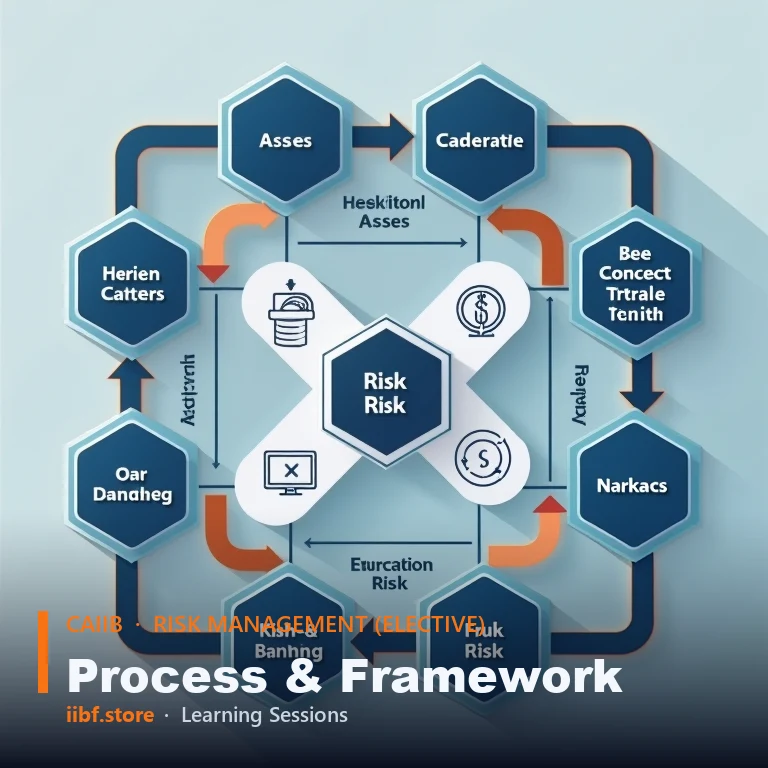
The RBI and the Basel Committee describe a sound ICAAP through a set of core components. For the exam, remember these four building blocks because questions often ask you to match a description to the correct element.
| Building block | What it covers |
|---|---|
| Board & senior management oversight | The board approves the risk appetite, capital plan and ICAAP policy; management implements it. |
| Sound capital assessment | Identifying all material risks and quantifying the internal (economic) capital needed for each. |
| Comprehensive risk assessment | Covering credit, market, operational, IRRBB, liquidity, concentration and other material risks. |
| Monitoring & reporting | Ongoing measurement, MIS, and reporting of the capital position against limits. |
Two further features run through all of these. First, internal controls and independent review: the ICAAP must be periodically validated, often by internal audit, to confirm it is comprehensive and credible. Second, proportionality: a small co-operative bank is not expected to run the same sophisticated economic-capital models as a large internationally active bank.
The depth of ICAAP in Risk Management should scale with the size, complexity and risk profile of the institution. Candidates frequently lose marks by forgetting that ICAAP is a process. Not a single document or a one-off calculation — it is repeated at least annually and refreshed whenever the risk profile changes materially.
Capital Planning, Risk Appetite and Stress Testing
The output of ICAAP is an internal capital target — the level of capital the bank decides it needs, which is generally above the regulatory minimum. This target is anchored to the bank's risk appetite: a board-approved statement of how much and what types of risk the bank is willing to accept in pursuit of its strategy.
Capital planning under ICAAP is forward-looking, usually over a three-to-five-year horizon, and must answer questions such as:
- How will capital ratios evolve under the business plan (the base case)?
- What happens to capital under a severe but plausible stress scenario — a recession, a sharp rise in NPAs, or a market shock?
- What management actions (raising capital, cutting dividends, de-risking) are available if buffers erode?
This is where stress testing becomes central to ICAAP in Risk Management. Stress tests translate hypothetical adverse conditions into a numerical impact on earnings, provisions and capital, letting the board see whether the bank can stay above its minimum even in bad times. The RBI expects banks to integrate stress-test results directly into capital planning and the setting of internal buffers. You can sharpen scenario-analysis intuition by practising on the CAIIB mock tests and reinforcing terminology with the risk concept match game. Knowing how the policy rates that feed these scenarios move also helps — keep an eye on the latest RBI rates.
SREP: How Supervisors Review Your ICAAP
ICAAP is only half of Pillar 2. Its mirror image is the Supervisory Review and Evaluation Process (SREP), carried out by the regulator. Under SREP. The RBI reviews and challenges the bank's ICAAP, assesses whether the internal capital is genuinely adequate, and can require the bank to hold capital above the Pillar 1 minimum or to strengthen its risk management.
The interaction works like this:
- The bank prepares and submits its ICAAP document to the supervisor, typically annually.
- The supervisor evaluates governance, risk measurement, capital planning and stress testing through SREP.
- Where gaps exist, the supervisor may impose a capital add-on, set higher trigger ratios, or demand remedial action.
For the exam, remember the simple pairing: ICAAP is the bank's internal view; SREP is the supervisor's external review. Together they ensure capital adequacy is judged on a risk-specific basis rather than purely by formula. A robust ICAAP in Risk Management also reduces the chance of unpleasant supervisory add-ons, because the bank has already done the honest self-assessment. The original international standards behind all of this come from the Basel Committee at the Bank for International Settlements, while the Indian implementation, formats and timelines are laid out by the Reserve Bank of India. For broader certification context, the IIBF syllabus maps these themes directly to the RM paper.

Exam Tips and Common Pitfalls
Examiners love to test the boundaries of ICAAP in Risk Management, so keep these points sharp:
- Pillar mapping: Pillar 1 = minimum capital (credit, market, operational risk); Pillar 2 = ICAAP + SREP; Pillar 3 = market discipline / disclosure. Mixing these up is the most common error.
- Material risks: ICAAP must cover risks beyond Pillar 1 — IRRBB, concentration, liquidity, residual, strategic and reputational risk.
- Ownership: the board owns ICAAP and the risk appetite; it cannot be delegated entirely to the risk function.
- Output: the internal capital target normally exceeds the regulatory minimum because of the Pillar 2 add-ons.
Strengthen your fundamentals on capital, NPAs and Basel ratios through the JAIIB foundation before tackling the heavier RM elective content, and keep current with regulatory changes via IIBF news updates and the wider exam blog.
What is the difference between ICAAP and Pillar 1 capital?
Pillar 1 sets a standardised minimum capital for credit, market and operational risk using fixed regulatory formulae. ICAAP is the bank's own assessment under Pillar 2 of all material risks. Including those Pillar 1 ignores, such as interest-rate risk in the banking book and concentration risk. ICAAP usually produces an internal capital target above the Pillar 1 minimum.
Who is responsible for ICAAP in a bank?
The board of directors owns ICAAP. It approves the risk appetite, the capital plan and the ICAAP policy, while senior management implements the process day to day. The risk and finance functions perform the measurement and analysis. And internal audit independently validates it, but ultimate accountability for an adequate, credible ICAAP rests with the board.
How does stress testing relate to ICAAP?
Stress testing is a core input to ICAAP. It estimates how earnings, provisions and capital would behave under severe but plausible adverse scenarios, such as a recession or a spike in NPAs. Banks must integrate these results into capital planning so the internal capital target and buffers are large enough to keep ratios above the minimum even in stressed conditions.
What is SREP and how is it linked to ICAAP?
SREP is the Supervisory Review and Evaluation Process. It is the regulator's review of a bank's ICAAP, governance and risk management. Under SREP, the RBI challenges the bank's internal capital assessment and can require additional capital or remedial action. In short, ICAAP is the bank's internal view, and SREP is the supervisor's external review of that view.
Conclusion: Make ICAAP an Easy Mark
Done well, ICAAP in Risk Management is one of the most scoring chapters of the CAIIB RM elective because the logic is consistent: identify every material risk, quantify the capital it needs, stress it, plan ahead, and let the supervisor challenge your work through SREP. Lock in the pillar mapping, the four building blocks and the ICAAP-versus-SREP distinction, and the multiple-choice questions become predictable. Ready to test yourself? Jump into a full-length CAIIB Risk Management class and mock test and turn this topic into guaranteed marks.
Practice this topic
Take a free mock test, download chapter PDFs, or watch a video class — all included on iibf.store.
Keep reading