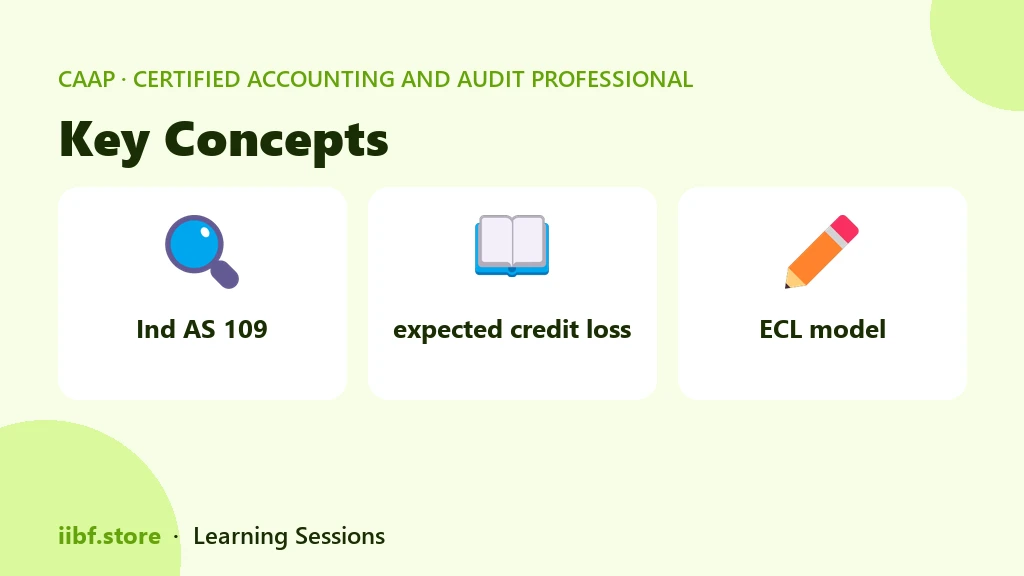
Ind AS 109 Expected Credit Loss: ECL Framework for CAAP
For students preparing the Certified Accounting and Audit Professional (CAAP) paper, Ind AS 109 expected credit loss is no longer a footnote topic — it is fast becoming a core examiner favourite. Even though the Reserve Bank of India has repeatedly deferred full Ind AS adoption for commercial banks, the framework is tested heavily because it is the direction Indian bank accounting is headed, and because NBFCs, many corporates, and several small finance banks already report under it. This article walks through the three-stage ECL model, contrasts it with the IRAC provisioning regime you already know from your accounting chapters, and flags the exact spots where examiners like to plant a trap option.
📊 What Is Expected Credit Loss Under Ind AS 109
Ind AS 109, Financial Instruments, replaced the old incurred-loss model (under AS 30/IAS 39) with a forward-looking expected credit loss approach. Under the incurred-loss method, a bank recognised a loss only after an actual triggering event — a missed instalment, a restructuring, a default. Under ECL, an entity must estimate losses that are expected over the life of a financial asset the moment it is originated, using reasonable and supportable information about past events, current conditions, and forecasts of future economic conditions. This is a big conceptual shift for anyone coming from a pure IRAC background, and it is exactly the kind of conceptual contrast the CAAP exam likes to probe. If you are still building your foundation in this area, revisit the basics in Accounting: An Introduction before layering the ECL mechanics on top.
The ECL calculation itself rests on three familiar credit-risk inputs: probability of default (PD), loss given default (LGD), and exposure at default (EAD). Multiplying these three components, discounted to present value, gives the expected credit loss for a given exposure or pool of exposures. Ind AS 109 applies this to financial assets measured at amortised cost and fair value through other comprehensive income (FVOCI), plus loan commitments and financial guarantee contracts that are not measured at fair value through profit or loss.
🔍 The Three-Stage ECL Model Explained
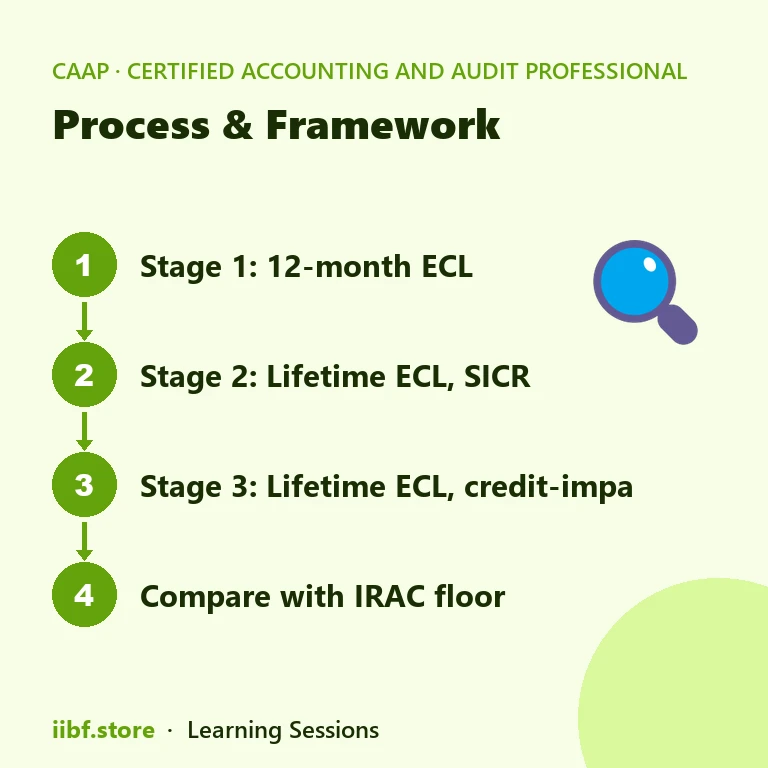
Ind AS 109 buckets every financial asset into one of three stages, and the stage decides how much loss to provide for. Stage 1 covers assets that are performing normally, with no significant increase in credit risk since origination; here the entity recognises only a 12-month ECL — the portion of lifetime losses expected to arise from default events possible within the next twelve months. Stage 2 covers assets where credit risk has risen significantly since initial recognition, even though no default has actually happened yet; here the entity must step up to a full lifetime ECL. Stage 3 covers assets that are credit-impaired — broadly comparable to what you already know as an NPA — and again lifetime ECL applies, but now interest income is also computed on the net carrying amount rather than the gross exposure.
The trigger for moving an asset from Stage 1 to Stage 2 is called a "significant increase in credit risk" (SICR), and Ind AS 109 gives a rebuttable presumption that SICR has occurred once a payment is more than 30 days past due. Entities can rebut this using reasonable supportable evidence, but in practice most banks and NBFCs build their staging logic around a combination of days-past-due, external rating downgrades, and qualitative watchlist triggers together. This staging logic — and knowing which stage attracts which measurement basis — is one of the highest-yield areas for CAAP numerical and conceptual questions alike.
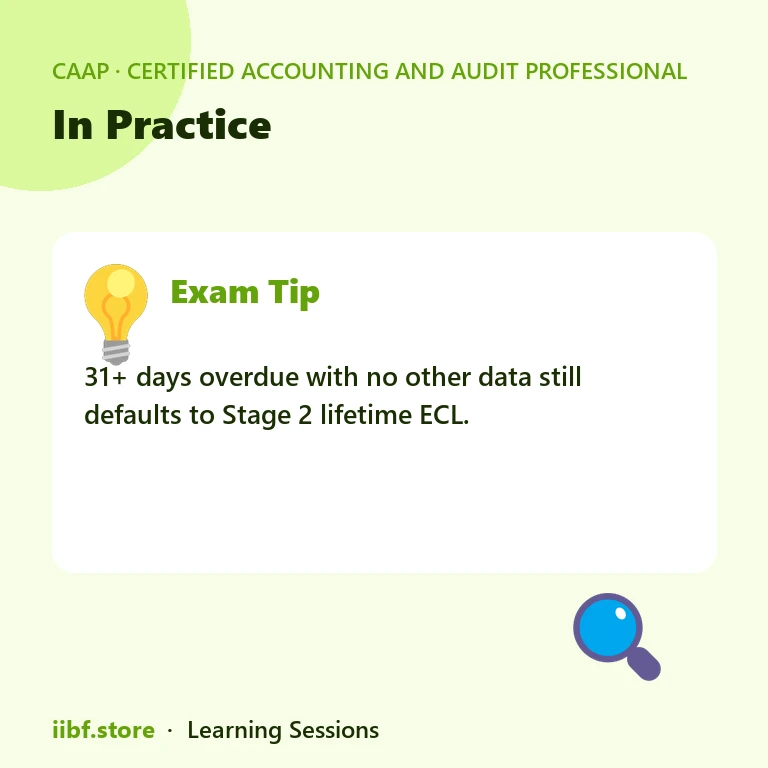
💡 Exam Tip: If a question gives you "31 days overdue" with no other information, default to Stage 2 and lifetime ECL — the 30-day rebuttable presumption is the examiner's favourite trigger.
⚖️ Ind AS 109 vs IRAC Norms: Where They Differ
CAAP candidates almost always come to ECL after they have already mastered IRAC-based classification and provisioning, so the exam frequently asks you to compare the two frameworks directly rather than test either one in isolation. The core difference is philosophical: IRAC is an incurred-loss, backward-looking regime built around asset classification (standard, sub-standard, doubtful, loss) and prescribed provisioning percentages, while Ind AS 109 is a forward-looking, model-based regime built around staging and statistically estimated loss parameters. For a deeper refresher on the IRAC side before you compare, revisit provisioning norms for bank advances, which lays out the classification categories and rate bands you will need to contrast against ECL stages.
| Parameter | Ind AS 109 ECL | RBI IRAC Norms |
|---|---|---|
| Underlying philosophy | Forward-looking, expected loss | Backward-looking, incurred loss |
| Trigger for higher provisioning | Significant increase in credit risk (SICR) | Days-past-due based NPA classification |
| Uses statistical models (PD/LGD/EAD) | ✅ Yes | ❌ No |
| Provisioning on standard/performing assets | ✅ Always (12-month ECL) | ✅ Yes, but a flat prescribed rate |
| Currently mandatory for commercial banks | ❌ Deferred by RBI | ✅ Yes |
| Mandatory for most NBFCs | ✅ Yes | ❌ No |
⚠️ Common Mistake: Do not assume ECL and IRAC provisioning are simply added together for banks reporting under both — RBI's transition guidance requires a comparison of the two and recognition of only the incremental shortfall, not a straight sum.
🏦 RBI's Roadmap and Implementation Challenges for Banks
The Reserve Bank of India has, over successive years, deferred mandatory Ind AS implementation for scheduled commercial banks, largely because moving the entire banking system to an expected-credit-loss framework carries significant capital, data, and governance implications. In its discussion paper on introducing an expected credit loss based framework for provisioning by banks, the RBI itself signalled an eventual move away from the current incurred-loss IRAC regime toward a principle-based ECL approach, while stressing a calibrated glide path and a prudential floor so provisions do not fall below existing levels during transition. For the authoritative and most current position, always cross-check with the Reserve Bank of India's official website rather than relying on older textbook dates.
The practical implementation challenges are exactly what statutory and concurrent auditors are trained to probe. Banks need reliable historical loss data to build PD and LGD models, robust model validation and governance frameworks, IT systems capable of running stage-wise calculations across millions of accounts, and audit trails that satisfy both the statutory auditor and the regulator. These are the same audit skills covered under Bank Audit and Various Types of Audits in Banks, and they connect directly to the audit-standard discipline in standards on auditing for bank audits and the ongoing monitoring role covered under concurrent audit in banks. A sudden jump in provisioning under ECL also feeds directly into a bank's capital adequacy assessment, which is why the topic sits close to the supervisory review and evaluation process under Basel Pillar 2 — examiners occasionally link the two in scenario-based questions.
📌 Remember: ECL is a measurement framework for financial reporting; IRAC is a regulatory provisioning framework. A bank can be required to compute both in parallel during transition, and the CAAP exam tests whether you know which one drives the balance sheet provision at any given point.
🧠 Practice MCQs: Ind AS 109 ECL Framework
Q1. Under Ind AS 109, which loss recognition model replaced the earlier incurred-loss approach? (a) Fair value model (b) Expected credit loss model (c) Historical cost model (d) Net realisable value model
Answer: (b) — Ind AS 109 introduced the forward-looking expected credit loss (ECL) model in place of the incurred-loss approach.
Q2. A loan account is 45 days past due and shows no other adverse indicator. Under the standard rebuttable presumption, which stage does it fall into? (a) Stage 1 (b) Stage 2 (c) Stage 3 (d) It cannot be staged without a credit rating
Answer: (b) — Ind AS 109 presumes a significant increase in credit risk once a payment is more than 30 days past due, moving the asset to Stage 2 and lifetime ECL.
Q3. Which combination of inputs is used to compute expected credit loss? (a) PD, LGD, EAD (b) NPA, SMA, write-off (c) CRAR, RWA, Tier I (d) EMI, tenure, moratorium
Answer: (a) — ECL is derived from probability of default (PD), loss given default (LGD), and exposure at default (EAD), discounted to present value.
Q4. For a Stage 3 asset under Ind AS 109, interest income is recognised on which base? (a) Gross carrying amount (b) Net carrying amount, after deducting the loss allowance (c) Original principal only (d) No interest income is recognised
Answer: (b) — Once an asset is credit-impaired (Stage 3), interest income is calculated on the net carrying amount, i.e. gross exposure minus the ECL allowance.
Q5. Is mandatory Ind AS implementation currently applicable to Indian scheduled commercial banks? (a) Yes, fully implemented since 2018 (b) No, RBI has repeatedly deferred it for commercial banks (c) Only applicable to foreign banks operating in India (d) Only applicable to cooperative banks
Answer: (b) — The RBI has deferred Ind AS implementation for commercial banks multiple times, even though NBFCs largely report under it already.
Want chapter-wise mock tests with 100+ MCQs? Start practising free →
❓ Frequently Asked Questions
Is Ind AS 109 currently mandatory for Indian commercial banks?
No. The RBI has deferred mandatory Ind AS implementation for scheduled commercial banks several times, though it remains mandatory for most NBFCs and several other regulated entities.
What is the difference between 12-month ECL and lifetime ECL?
12-month ECL captures only the portion of lifetime losses expected from default events possible within the next twelve months (Stage 1 assets). Lifetime ECL captures losses expected over the entire remaining life of the asset and applies once an asset moves to Stage 2 or Stage 3.
Does a bank need to apply both IRAC norms and Ind AS 109 at the same time?
During any transition period, a bank reporting under Ind AS while remaining subject to RBI's regulatory floor must compare the ECL provision against the IRAC-based provision and hold the higher of the two through a regulatory adjustment, rather than simply adding both figures.
How does the ECL framework affect statutory and concurrent audit work?
Auditors must test the reasonableness of PD/LGD/EAD models, the staging logic and SICR triggers, and management's forward-looking macroeconomic assumptions, in addition to the traditional checks performed under IRAC-based provisioning verification.
🎯 Conclusion
For the CAAP exam, treat Ind AS 109 expected credit loss as a comparison topic first and a computation topic second: know the three stages cold, know the 30-day SICR presumption, and know precisely where ECL diverges from the IRAC provisioning rules you already studied. Explore more subject-focused reads on the Certified Accounting and Audit Professional tag hub, and when you are ready to test yourself under exam conditions, take a free chapter-wise mock test to see how well the staging logic has actually stuck.
Practice this topic
Take a free mock test, download chapter PDFs, or watch a video class — all included on iibf.store.