Indian Banking History Since 1947: RBI, SBI and Nationalisation Timeline
On 15 August 1947 the largest bank in India was not the State Bank of India — it did not exist. For nearly a year after independence, the Reserve Bank of India also served as the central bank of Pakistan. Neither fact is trivia: both sit inside the JAIIB syllabus, and both are the kind of detail an examiner reaches for. This is a short walk through Indian banking history from independence to now, built around a clip that makes the same point rather more briskly.
Indian bank history — Happy Independence Day · Watch on YouTube
The bank that came before the country
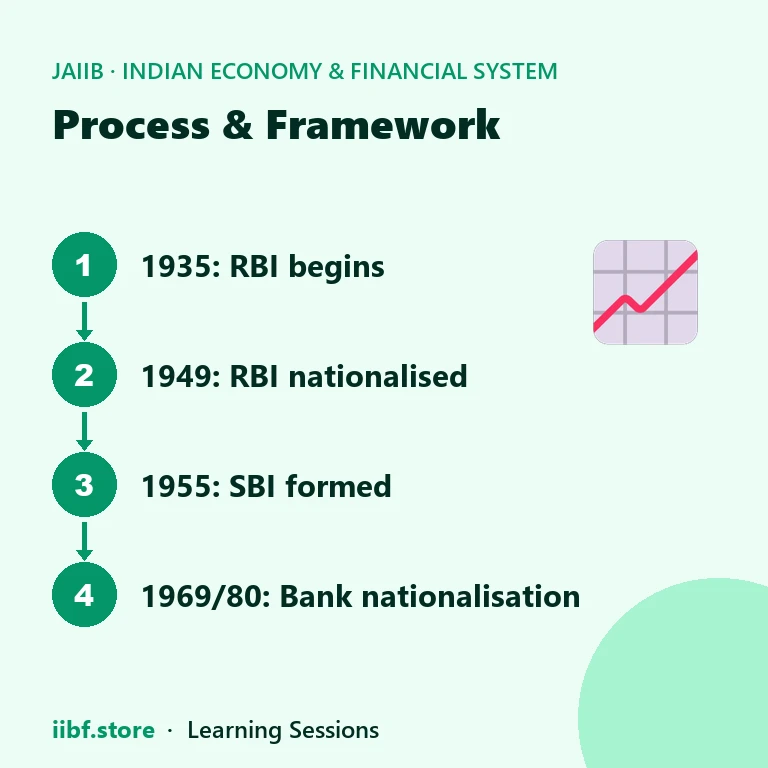
The Reserve Bank of India commenced operations on 1 April 1935, twelve years before independence. The detail people forget is ownership: the RBI was not a government institution at the start. It was a privately owned shareholders' bank, and it stayed that way through independence itself.
What did change early was who ran it. C. D. Deshmukh became the first Indian Governor of the Reserve Bank, which meant that on the day the country became independent, its central bank was already led by an Indian. In a period when almost every institution was still being handed over, that one had a head start.
Nationalisation of the RBI followed on 1 January 1949, bringing the central bank into government ownership. Any account of Indian banking history that skips this two-step — privately held in 1947, government-owned from 1949 — misses why the 1949 date matters at all.
The central bank of two countries
Partition created a problem nobody had time to solve properly. Two countries existed; two central banks did not. Pakistan's own central bank was not ready to function, so through the transition the Reserve Bank of India carried out central banking functions for Pakistan as well.
That arrangement ran until the end of June 1948. The State Bank of Pakistan began functioning on 1 July 1948, and the RBI's brief second mandate ended. It is a favourite question precisely because it sounds implausible until you think about what a partition actually requires: currency, reserves, and someone to manage both while a new institution is built.
From Imperial Bank to State Bank of India
In 1947 the country's largest bank was the Imperial Bank of India, itself formed from the amalgamation of the three Presidency Banks. It was a commercial bank that also performed some quasi-central-banking functions, and its branch network was concentrated where commerce already was.
That was the problem. There was banking in India, but not banking for Indians in any broad sense. Branches clustered in cities and served organised business; large parts of rural India were effectively outside the banking system altogether.
The response was the State Bank of India Act, under which the Imperial Bank of India was transformed into the State Bank of India on 1 July 1955. The intent was explicit: a state-backed institution with a mandate to take banking where commercial logic alone would not take it.
| Date | Event | Why it matters |
|---|---|---|
| 1 April 1935 | Reserve Bank of India commences operations | Privately owned at inception, not a government body |
| 15 August 1947 | Independence | Largest bank was the Imperial Bank of India; RBI already had an Indian Governor |
| 30 June 1948 | RBI ceases central banking functions for Pakistan | State Bank of Pakistan began operating from 1 July 1948 |
| 1 January 1949 | RBI nationalised | Central bank passes into government ownership |
| 1 July 1955 | Imperial Bank becomes State Bank of India | First deliberate push toward banking beyond the cities |
| 19 July 1969 | 14 major commercial banks nationalised | The real turn toward mass banking |
| 1980 | Six more banks nationalised | Extends the 1969 policy |
Nationalisation: the change that actually reached people
The decisive break came on 19 July 1969, when fourteen major commercial banks were nationalised, followed by six more in 1980. Strip away the politics and the operating idea was simple: bank deposits were being collected from the public but lent overwhelmingly to established business, and credit needed to reach agriculture, small industry, weaker sections and regions that no commercial branch plan would ever prioritise.
You can argue about the costs — and the exam does not ask you to — but the branch expansion that followed is the reason priority sector lending, rural banking and financial inclusion exist as syllabus topics at all. Nationalisation is the hinge that connects Indian banking history to almost everything in the modern JAIIB syllabus.
From ledger entries to UPI
The last stretch of Indian banking history is the one you have lived through. Stand in 2026 and look back at the operating reality. Entries were made in physical ledgers by hand. A customer belonged to a branch, not to a bank — your account lived at one location and so did you, functionally. Cash was the system, and crores of Indians were outside it entirely.
Today core banking has severed the account from the branch, UPI has made a ten-rupee payment work without a note changing hands, and direct benefit transfers move government money into accounts without an intermediary. The distance travelled is not really technological. It is a shift from banking as a privilege to banking as infrastructure — the same direction 1969 pointed in, executed with tools that did not exist then.
For the exam, hold the dates and the reasons together. Dates alone get you the recall questions; reasons get you the ones that ask what a change was for. Our JAIIB course covers this in the Indian financial system module, the practice tests will tell you quickly whether the dates have actually stuck, and the matching game is a decent way to drill a timeline. For anything on the RBI's own account of its history, the Reserve Bank of India site is the primary source.
Was the RBI really the central bank of Pakistan?
Yes, temporarily. Because Pakistan's own central bank was not ready to function immediately after partition, the Reserve Bank of India performed central banking functions for Pakistan during the transition. The arrangement ended on 30 June 1948, and the State Bank of Pakistan began functioning on 1 July 1948.
When was the Reserve Bank of India nationalised?
On 1 January 1949. The RBI had commenced operations on 1 April 1935 as a privately owned shareholders' institution, and it remained privately held through independence until the 1949 nationalisation brought it into government ownership.
Which bank became the State Bank of India?
The Imperial Bank of India, which was itself formed from the amalgamation of the three Presidency Banks. It was transformed into the State Bank of India on 1 July 1955, with the explicit aim of extending banking beyond the major commercial centres.
How many banks were nationalised in 1969 and 1980?
Fourteen major commercial banks were nationalised on 19 July 1969, and six more were nationalised in 1980. The stated purpose was to direct bank credit toward agriculture, small business, weaker sections and underserved regions rather than established large borrowers.
Quick quiz on this topic
5 exam-style questions from our free test bank — check yourself before you move on.
Practice this topic
Take a free mock test, download chapter PDFs, or watch a video class — all included on iibf.store.
Keep reading