Inside the NISM Series VIII Book: A Chapter-by-Chapter Tour
It is 10 pm. You have closed the day's cash, answered the last customer query, and finally sat down with your laptop. In front of you is a thick pile of derivatives material: futures, options, Greeks, margins, clearing, taxation. You feel the same question every working candidate feels: where do I even start, and how much of this actually matters for the exam?
This article is a guided tour of the NISM Series VIII book from iibf.store, written for people who are studying around a full-time job. You will see how it is organised, what a single chapter looks like when you sit down with it, and how to turn it into a routine you can actually keep. Even if you never buy it, the method here works with any material you choose.
Why equity derivatives feels harder than it is
Most candidates who struggle with Series VIII do not struggle because the ideas are impossible. They struggle because the subject arrives all at once. Futures, options, pricing, strategies, clearing, regulation and tax are all different flavours of thinking, and the exam expects you to move between them quickly.
The fix is to stop treating it as one subject. Treat it as four smaller blocks, learn each in order, and test yourself after every chapter. That is exactly the shape of the NISM Series VIII book, which is why a tour of its structure is also a tour of a sensible study order.
Three habits that help before you open any book
- Study in short, fixed slots. Thirty to forty-five minutes after dinner beats a three-hour Sunday session you keep postponing.
- Write down one formula or rule per sitting. A single index card per chapter is enough for last-week revision.
- Do MCQs the same day you read. Recall right after reading shows you what you only thought you understood.
Check the official exam pattern and the schedule for the upcoming exam cycle on the IIBF website before you fix your dates, because those details are set by the institute and can change.
How the book is organised: four modules, eighteen chapters
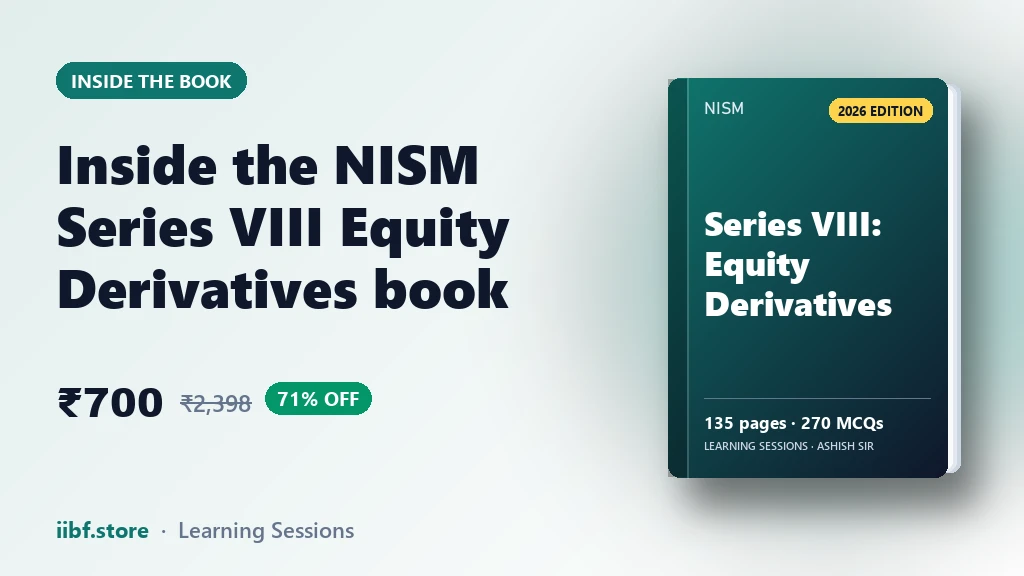
The printed edition (2026) runs to 135 pages across 18 chapters, grouped into four modules. It also carries 270 questions. Here is the full map, so you can picture the whole journey before you start.
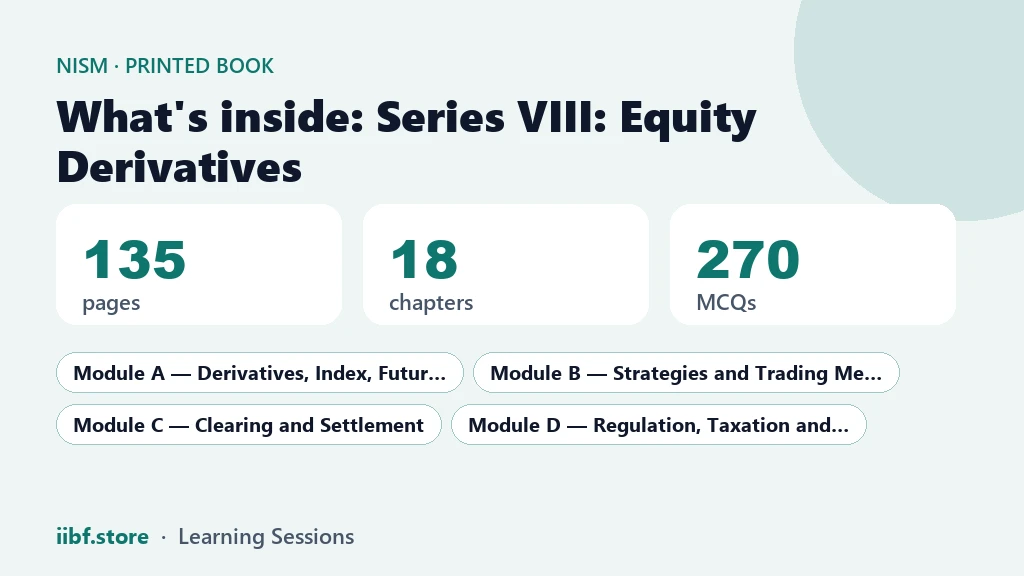
Module A: Derivatives, Index, Futures and Options (6 chapters)
This is your foundation. It begins with the basics of derivatives, then moves to understanding an index, since index products are central to this paper. After that come forwards and futures, split into two parts, and options, again in two parts. If you are new to the subject, give this module the most patience; everything later stands on it.
Module B: Strategies and Trading Mechanism (5 chapters)
Here the book turns practical. Two chapters cover strategies using equity futures and options, first hedging and speculation, then option strategies. A separate chapter handles option pricing, put-call parity, the Greeks and open interest. The module closes with trading mechanism in two parts: the trading system, eligibility and order types, then corporate actions, charges and STT.
Module C: Clearing and Settlement (3 chapters)
Three chapters on the clearing and settlement system, taken in sequence as Part 1, Part 2 and Part 3. Candidates often skim this module and then lose easy marks. It is procedural, which means it rewards steady repetition rather than cleverness.
Module D: Regulation, Taxation and Investor Protection (4 chapters)
The last module covers the legal and regulatory environment in two parts, accounting and taxation, and sales practices and investor protection services. Many bankers find this the most familiar ground, so it is a good place to bank confidence late in your preparation.
| Module | Theme | Chapters |
|---|---|---|
| A | Derivatives, Index, Futures and Options | 6 |
| B | Strategies and Trading Mechanism | 5 |
| C | Clearing and Settlement | 3 |
| D | Regulation, Taxation and Investor Protection | 4 |
What one chapter actually looks like
Every chapter in the NISM Series VIII book follows the same three-step rhythm, and that sameness is a feature. When you are tired, you do not want to decide how to study; you want a pattern you can follow on autopilot.
- Concise notes. The chapter's ideas are written out in short, readable form rather than long textbook paragraphs. You read these first, with a pencil in hand.
- Key points. The essentials are pulled together so you can see at a glance what the examiner is likely to test. This is also your quick-revision layer.
- MCQs. Questions at the end of the chapter let you check yourself immediately.
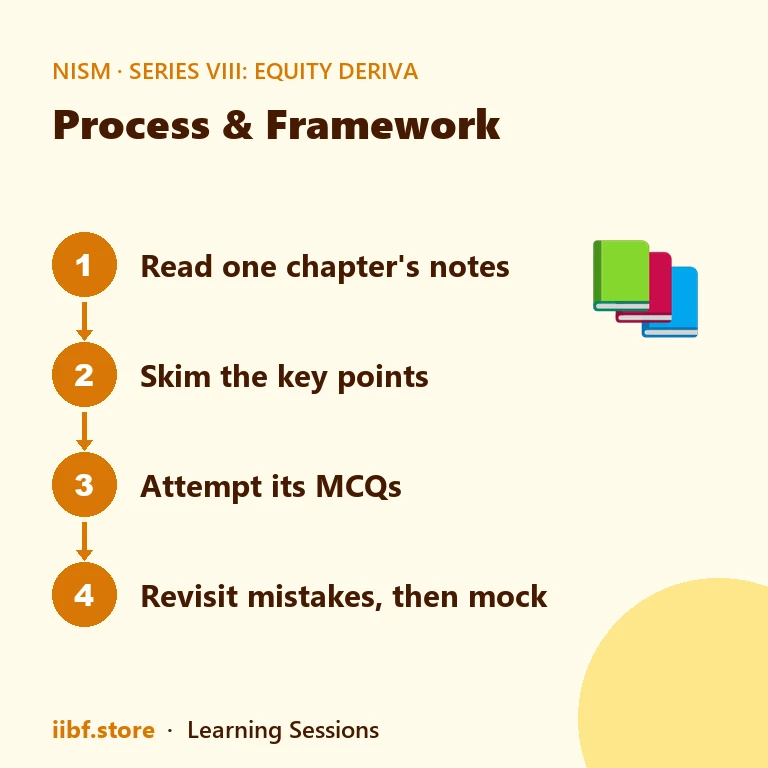
Take the chapter on option pricing, put-call parity, Greeks and open interest as an example. You read the notes once, slowly. You scan the key points and write the two or three relationships you keep forgetting on a card. Then you attempt the questions without looking back. Whatever you get wrong is exactly what to revisit tomorrow, and nothing else.
With 270 questions spread over 18 chapters, you will meet a steady supply of practice as you go, rather than saving all the testing for the final week.
The extras: case studies and mega tests
Beyond the chapters, the book lists two extras:
- 30 Case Studies (120 questions), useful for the scenario-style thinking that derivatives questions tend to need.
- 5 Mega Tests (500 questions), for the stage when you want to practise across the whole syllabus under time pressure.
Use the case studies once you have finished a module, and keep the mega tests for the last stretch. Doing a mega test too early only teaches you how much you have not covered yet, which is demoralising when you are already tired.
If you want extra practice outside the book, the free mock tests at iibf.store/tests and the free PDFs at iibf.store/free-material are worth a look before you spend anything.
A study method you can run after work
Here is the loop to repeat for each chapter. It is deliberately small, because small things survive a bad week at the branch.
A rough pace for working candidates
If you can give five evenings a week, aim for one chapter on most evenings and use the weekend to revisit your marked mistakes. At that pace the 18 chapters become a few weeks of steady work, not a mountain. Stretch it if your month-end is heavy; consistency matters more than speed.
| Day | What you do |
|---|---|
| Mon-Thu | One chapter: notes, key points, MCQs |
| Friday | Light day: re-read your index cards |
| Saturday | Redo the questions you got wrong |
| Sunday | Rest, or one case study if you feel fresh |
Keep your own list of weak spots. After finishing a module, go back to only those items. This is faster than rereading everything, and it is where most of your marks will come from.
Who gets the most out of this book
A printed, chapter-wise book like this suits you if:
- You prefer paper, or you lose focus on a screen after a full day of screen work at the branch.
- You want one structured path through the syllabus instead of jumping between scattered notes.
- You learn best by reading short notes and then testing yourself straight away.
- You are new to derivatives and need the topics laid out in a sensible order, from basics to regulation.
It is less ideal if you already work daily on a derivatives desk and only need a quick brush-up, or if you learn best from video. In that case, combine it with the free resources linked above.
One honest limit: a book alone will not give you exam-hall speed. Pair it with timed mock tests in the final stretch so that reading accuracy turns into answering speed.
The book is priced at ₹700 against an MRP of ₹2,398 (71% off). Prices can change, so treat the book page as the current source. You can also browse the full range at iibf.store/books, and there is a free sample so you can judge the style before ordering. For more preparation notes, see the iibf.store blog.
Putting it together
Equity derivatives rewards order. Learn the foundation in Module A, apply it in Module B, respect the procedures in Module C, and finish with the rules in Module D. Whichever material you choose, use the same loop: notes, key points, questions, mistakes. A NISM Series VIII book is a good tool for that loop precisely because it keeps every chapter in the same shape, so on your most tired evening you only have to open it and begin.
Frequently asked questions
How many chapters and questions does this book have?
It has 18 chapters in four modules, 135 pages in the 2026 edition, and 270 questions. It also lists 30 case studies (120 questions) and 5 mega tests (500 questions) as extras.
Can I check the style before buying?
Yes. A free sample is available on the book page, so you can see how the notes, key points and MCQs are laid out before you decide.
Is the book enough on its own?
It gives you a structured path through the syllabus, but you should add timed mock tests close to the exam for speed. The free tests on iibf.store are a good start. Always confirm the current exam details on the official IIBF site.
Where do I find the current price and order?
The live price and ordering option are on the book page. Prices may change, so always check there.
Prefer revising from a printed book?
Chapter-wise books with MCQs after every chapter — minimal pages, complete coverage, delivered anywhere in India. Every book has a free sample to read first.
































Practice this topic
Take a free mock test, download chapter PDFs, or watch a video class — all included on iibf.store.