Inside the NISM Series VII Book: Modules, Chapters and MCQs
You reach home after a full day at the branch, the dinner is cold, and the securities operations syllabus is still waiting on the table. Clearing, settlement, margins, arbitration: none of it feels like what you do between nine and six. If that is your week, the NISM Series VII book question is simple. Will this thing fit into the forty minutes you actually have, or will it become one more thick volume that makes you feel guilty?
This article is a guided tour. We will open the book, walk through its four modules, look at what a single chapter feels like, and then talk about how to use it on a tired weeknight. Even if you never buy it, the method here works with whatever material you pick.
Why a tired candidate needs a map before a book
Most people who postpone a certification do not fail because the content is too hard. They postpone because they never see the whole shape of it. A syllabus that looks endless drains motivation before you read page one.
So before reading anything, do this on a single sheet of paper:
- Write the four big areas of the paper as four boxes.
- Under each box, list the topics you already touch at work (account opening, KYC, contract notes, settlement dates) and the ones that are completely new to you.
- Mark new topics in red. Those get your fresh, early-evening hours; familiar topics can be revised when you are tired.
Securities operations is unusual because many candidates know one corner very well and have never seen the others. A broking-desk employee may know settlement cold but have only a hazy idea of how investor grievances and arbitration are handled. A bank officer may be the reverse. The map shows you where you are the beginner.
What is inside the NISM Series VII book
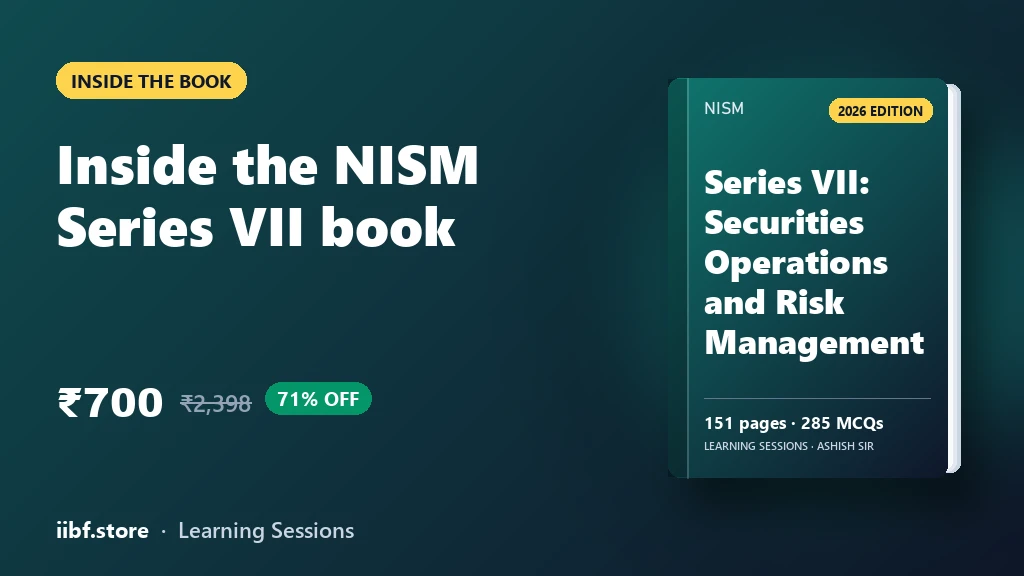
The NISM Series VII book (Securities Operations and Risk Management, 2026 edition) runs to 151 pages and is split into 19 chapters across four modules. It carries 285 practice questions. Prices change from time to time, so check the book page for the current figure: at the time of writing it is listed at ₹700 against an MRP of ₹2,398.
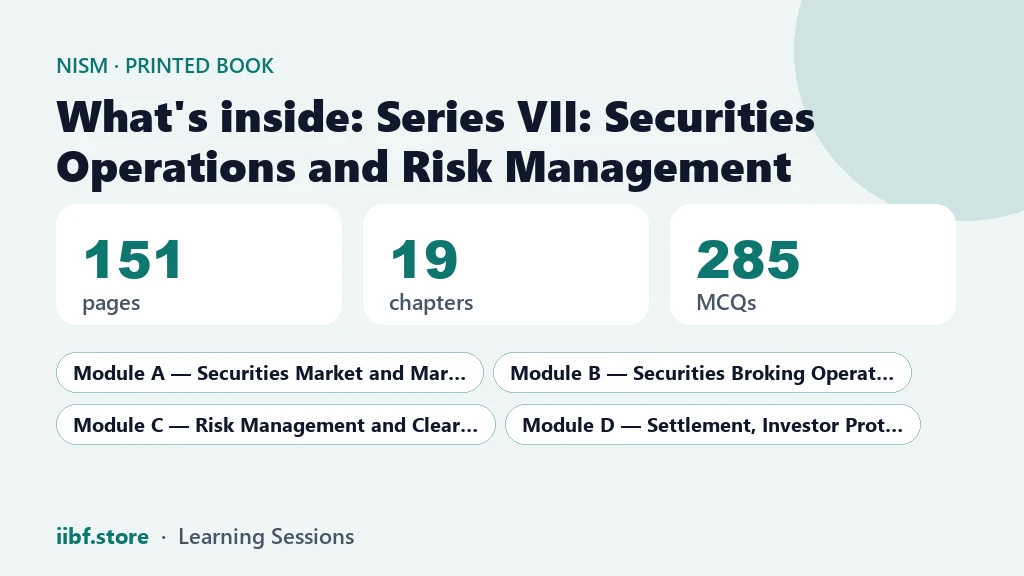
Here is how those modules are laid out, in the order you meet them.
Module A: Securities Market and Market Participants
Five chapters. Two parts of the introduction to the securities market, then three parts on market participants. This is your foundation: who the players are and how the market is structured. If you already work in a bank or broking house, you will move quickly through some of it, which is exactly why it comes first. It builds vocabulary that every later module assumes.
Module B: Securities Broking Operations
Three chapters, all on introduction to securities broking operations. This is where the paper starts to feel like a real job. Expect the everyday mechanics of how a broker operates, which is useful whether you sit in operations or simply want to understand what happens after you press the buy button.
Module C: Risk Management and Clearing
Five chapters: four on risk management and one on the clearing process. Of all the modules, this is the one candidates tend to find heaviest, because it is the most conceptual. Giving it four chapters instead of one dense block means you can take it in short sittings. That matters when your study slot is a single hour.
Module D: Settlement, Investor Protection and Other Broker Services
Six chapters: two on settlement, two on investor grievances and arbitration, and two on other services provided by brokers. It closes the loop from trade to settlement to what happens when something goes wrong, and ends with the wider services a broker offers.
Notice that big topics such as risk management are broken into parts, each its own chapter. That is a deliberate choice for part-time students: you can finish a chapter in one evening and tick it off, which is a small psychological win that keeps you coming back.
What one chapter looks like
Every chapter follows the same three-beat rhythm, so you never have to relearn how to read it:
- Concise notes. The concept explained in plain language, trimmed to what the exam is likely to ask rather than everything a reference manual would say.
- Key points. A short recap you can scan in a couple of minutes. This is the part you will re-read on the metro or in the lunch break.
- MCQs. Practice questions on that chapter, so you test yourself while the material is still warm.
Predictability is a feature. On a tired night you do not want to decide how to study; you want to open the page and begin. If you want to see this rhythm for yourself, the book page has a free sample you can read first, and it is worth ten minutes before you decide anything.
The extras: case studies and mega tests
Beyond the 19 chapters, the book lists two extras: 30 case studies carrying 120 questions, and 5 mega tests carrying 500 questions. Think of them as the second and third stages of preparation.
| Part of the book | What it is | When to use it |
|---|---|---|
| 19 chapters in 4 modules | Notes, key points and MCQs | First pass, one chapter per sitting |
| 285 questions | Chapter-level practice | Right after reading each chapter |
| 30 case studies (120 questions) | Scenario-style practice | After finishing a full module |
| 5 mega tests (500 questions) | Full-length practice | Final weeks, timed |
Case studies deserve a special mention. Operations and risk questions are rarely about reciting a definition; they ask what happens in a given situation. Practising on scenarios trains the habit of reading a short story carefully and picking out the one fact that decides the answer.
A four-step plan for a working evening
Here is a method that suits a person with one or two hours on weekdays and a longer block on Sunday. It works with any study material, and it is how we would use the NISM Series VII book if we were in your chair.
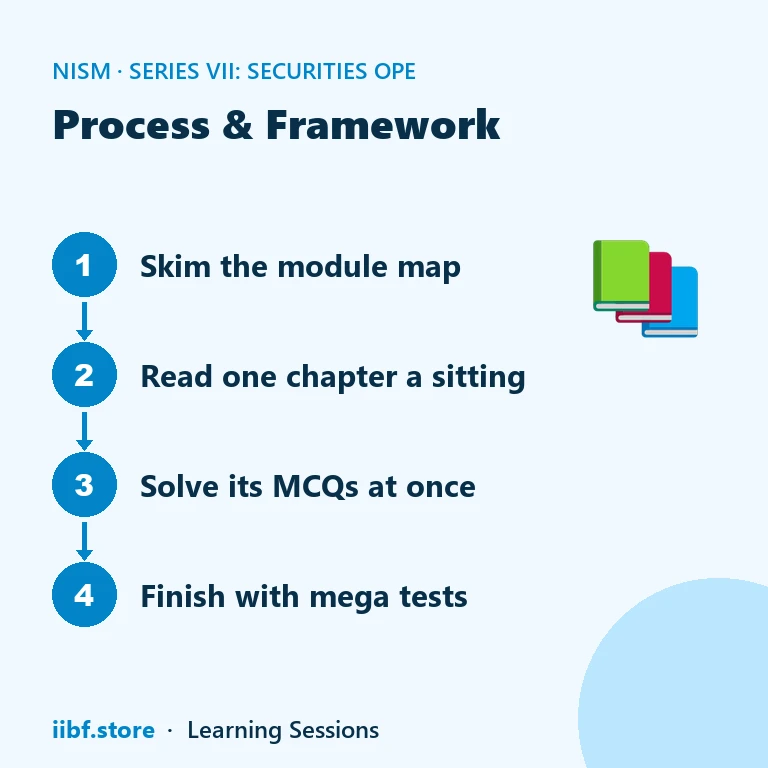
Step 1: Skim the module map
Spend your first evening only on the contents page and the module names. Do not read yet. Mark which chapters feel familiar and which feel foreign.
Step 2: Read one chapter per sitting
Take the notes and key points of a single chapter. Stop when it ends, even if you have energy left. Finishing small things regularly beats starting big things and abandoning them.
Step 3: Solve its MCQs immediately
Attempt the chapter questions straight after reading, and note every mistake in a small notebook. Wrong answers are the most valuable pages you will ever write.
Step 4: Finish with mega tests
Leave the case studies for the end of each module and the mega tests for the final stretch, taken in one sitting without peeking. That is how you build the stamina to sit through a real paper.
With 19 chapters, a steady rhythm of three or four chapters a week finishes the first pass in about five weeks, leaving the rest of your time for questions and revision. Adjust that to your own shifts; the point is a rhythm you can keep, not a heroic schedule you will drop by the second week.
Where this book helps, and where it will not
A book is a tool, and it is honest to say what it does not do. A compact printed book will give you structure and practice material, but it will not give you exam-hall speed on its own. For that you need timed practice, so pair it with the free mock tests on iibf.store/tests and browse the downloadable notes on iibf.store/free-material to see whether the style suits you. For the official syllabus, schedule and notices, always rely on the exam body's website at www.iibf.org.in and wait for the upcoming exam cycle's announcement rather than trusting forwarded messages.
Also keep in mind that securities rules and processes get updated. Use the book to understand the concepts and the flow, and cross-check any rule that looks time-sensitive with the latest official circulars before the exam.
Who gets the most out of this book
- Bank and broking staff in operations or back office who know their own corner and need the rest of the picture.
- Relationship managers and dealers who deal with clients daily but never studied clearing and settlement properly.
- Career-changers and fresh graduates who want a single structured path through a new field.
- People who have postponed once and need small, finishable chapters instead of a wall of text.
If you prefer to read everything on a screen with video explanations, you may do better with a different format, and browsing the wider book range is a fair way to compare. If you like paper, short chapters and constant self-testing, the NISM Series VII book is built for how you actually study.
Final thoughts
Securities operations looks intimidating mostly because nobody shows you the whole map. Four modules, 19 chapters, a clear rhythm of notes, key points and MCQs: once you see it that way, the paper is a series of small evenings, not one mountain. Read the free sample, decide calmly, and start with chapter one this week. The NISM Series VII book can carry the content; the evenings are yours to give.
Frequently asked questions
How many chapters and questions does the NISM Series VII book have?
It has 19 chapters in four modules, 151 pages in the 2026 edition, and 285 practice questions. It also lists 30 case studies (120 questions) and 5 mega tests (500 questions) as extras.
Can I read a sample before buying?
Yes. The book page offers a free sample, so you can judge the writing style and chapter format before you order. Prices can change, so the book page always shows the current price.
Is one book enough to clear the paper?
A book gives you structure and practice, but exam-hall speed comes from timed mocks. Use it together with free mock tests and check the official website for the latest syllabus and exam schedule.
How long should the first pass take?
With 19 chapters, three or four chapters a week finishes a first pass in roughly five weeks, leaving time for MCQs, case studies and mega tests. Adjust to your own work schedule.
Prefer revising from a printed book?
Chapter-wise books with MCQs after every chapter — minimal pages, complete coverage, delivered anywhere in India. Every book has a free sample to read first.











Practice this topic
Take a free mock test, download chapter PDFs, or watch a video class — all included on iibf.store.
Keep reading