Inside the NISM X-B Study Book: 24 Chapters, 4 Modules
It is 9:40 pm. You have closed the branch, travelled home, eaten something quickly, and now you have maybe an hour of attention left. The Investment Adviser (Level 2) syllabus covers insurance, retirement, tax, estate planning and behavioural finance, and it feels like four different subjects glued together. If you have ever opened a thick reference text on a weeknight and closed it ten minutes later, this article is for you.
We will walk through how the NISM X-B study book is organised, what a single chapter looks like when you sit down with it, and who is likely to get the most out of it. Even if you never buy it, the method below works with any material you choose. For the official exam schedule and eligibility, always check the IIBF website for the upcoming exam cycle.
Why a NISM X-B study book needs a different reading style
Most banking exams you have given reward recall. Series X-B rewards application. You are expected to look at a client's situation and decide which insurance cover, which retirement product and which tax treatment fits. That means you cannot read it the way you read a circular, once from start to end.
For a working professional this creates two problems. First, the syllabus is wide, so it is easy to over-study the module you already know (many bankers are comfortable with insurance and mutual funds) and neglect the one you do not (usually tax and estate law). Second, long reading sessions do not survive a tiring day.
The fix is small and boring: study in modules, one chapter per sitting, and test yourself the same evening. A good NISM X-B study book should make that easy by keeping chapters short and self-contained. That is the lens we will use for the tour below.
A quick self-check before you start
- Which of the four areas (insurance, retirement, tax, estate and advice) can you explain to a customer today without notes?
- Which one makes you change the topic when a customer raises it?
- How many evenings a week can you honestly give? Be realistic, not hopeful.
Write the answers on a sticky note. The weakest area decides where you start, not the order printed in the contents page.
The layout: 157 pages, 24 chapters, 4 modules
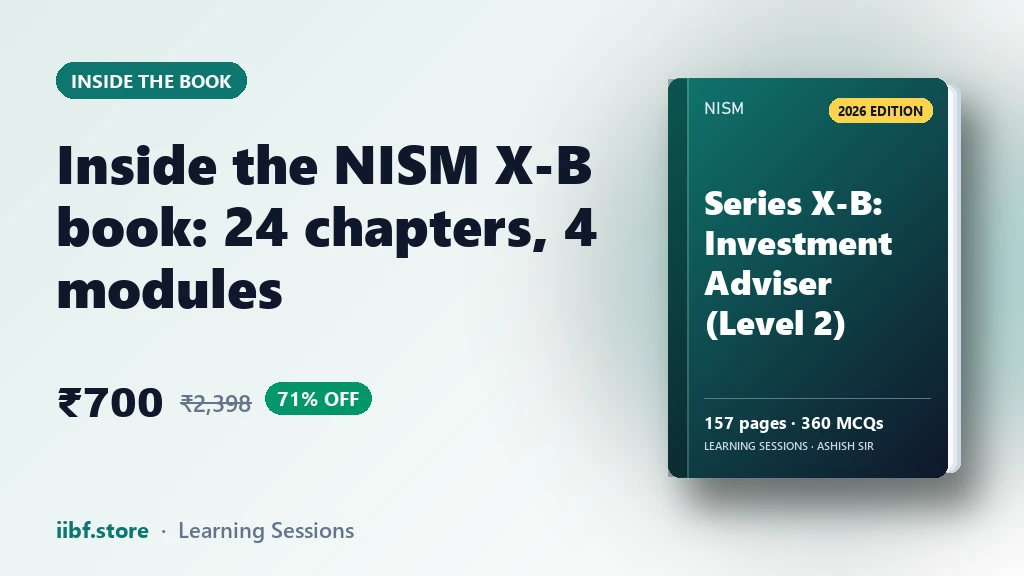
The Series X-B Investment Adviser (Level 2) book (2026 edition) runs to 157 pages and 24 chapters, divided into four modules. It also carries 360 practice questions. Here is the full map, taken straight from the book.
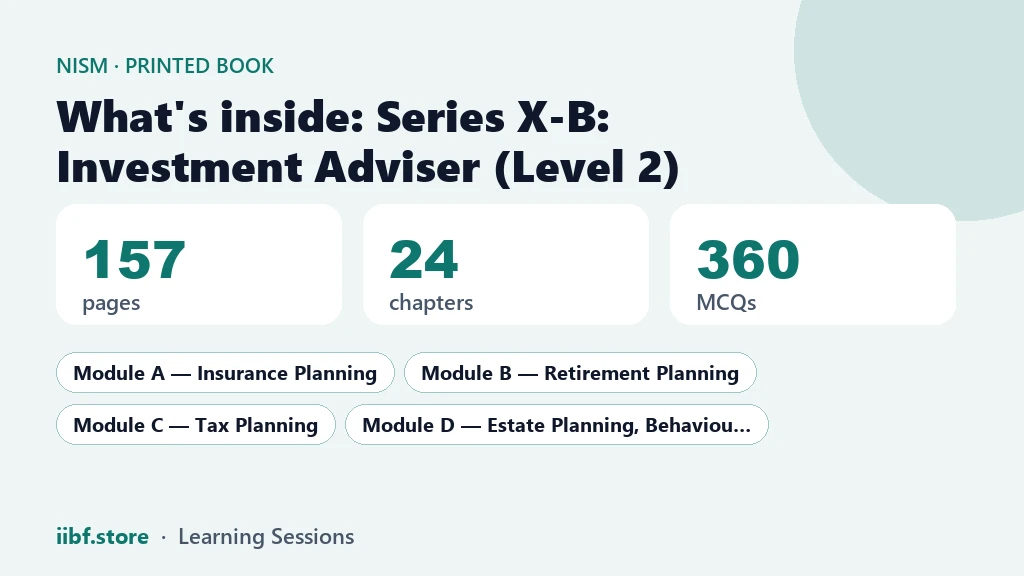
| Module | Chapters | What it covers |
|---|---|---|
| A - Insurance Planning | 3 | Basics of insurance, life insurance products, non-life insurance products |
| B - Retirement Planning | 4 | Retirement process and needs, accumulation products and schemes (two parts), miscellaneous aspects |
| C - Tax Planning | 9 | Taxation concepts, capital gains, other sources, debt, equity and mutual funds, derivatives, other products and virtual digital assets, special cases |
| D - Estate Planning, Behavioural Finance and Advice | 8 | Succession laws, wills and probate, trusts and powers of attorney, behavioural finance, risk profiling, product comparison, case studies |
Two things stand out. Tax planning is the largest module with nine chapters, which matches what most candidates find hardest. And Module D ends with product comparison and comprehensive case studies, which is where everything from the earlier modules gets used together.
Module A: Insurance Planning (3 chapters)
This module opens with the basics of insurance, then separates life insurance products from non-life products. If you handle insurance referrals at your branch, this is your warm-up module. Finish it first to build momentum.
Module B: Retirement Planning (4 chapters)
Retirement needs estimation comes first, then the accumulation products and schemes are split over two chapters so that no single sitting is overloaded, followed by a chapter on miscellaneous aspects. The split into Part 1 and Part 2 is helpful: it gives you a natural stopping point on a bad night.
Module C: Tax Planning (9 chapters)
Concepts in taxation run over two parts, followed by capital gains and income from other sources. Then comes taxation by product type: debt, equity and mutual funds, derivatives and business income from securities, and other products including virtual digital assets. The module closes with tax provisions for special cases. Because the chapters are organised by product, you can tie each one to something a customer actually holds.
Module D: Estate Planning, Behavioural Finance and Advice (8 chapters)
Succession laws, wills and probate, then trusts, guardianship and powers of attorney. After that, two chapters on behavioural finance, one on risk profiling for investors, one on comparing products across categories, and a closing chapter of case studies in comprehensive financial advice.
What one chapter looks like in this NISM X-B study book
Every chapter follows the same rhythm, which is what makes a tired-evening routine possible: concise notes first, then key points, then multiple-choice questions on that chapter. You do not have to guess how to approach it each time.
- Concise notes: the concept explained without padding. Read these once, slowly, with a pencil.
- Key points: the compressed version. These are what you re-read on the metro, in a lunch break or the night before a mock.
- MCQs: the check. If you cannot answer a question, you know exactly which paragraph to go back to.
The 360 questions in the book are spread through the chapters, so you practise while the topic is fresh instead of leaving all testing to the end. That alone fixes the common mistake of reading three modules and then discovering you remember none of them.
A realistic 45-minute sitting
Fifteen to twenty minutes on the notes, ten on the key points, and the remaining time on the chapter MCQs. Mark the questions you missed. Next evening, before starting a new chapter, redo only those. That is the entire method, and it costs nothing to try, even with whatever material you currently have.
The extras: case studies and mega tests
Beyond the chapters, the book includes two practice components listed on its page:
- 30 Case Studies (120 questions): client situations with questions attached. These train the application skill the exam is built on.
- 5 Mega Tests (500 questions): full-length practice sets for the final weeks.
Save these for after you have finished at least two modules. Attempting a case study before you know the tax chapters only produces frustration. Attempting it after, and then going back to the relevant chapter for every wrong answer, is where real learning happens.
How to use the NISM X-B study book in four steps
Here is the plan in its simplest form. It fits one chapter per evening and works whether you have three weeks or three months.
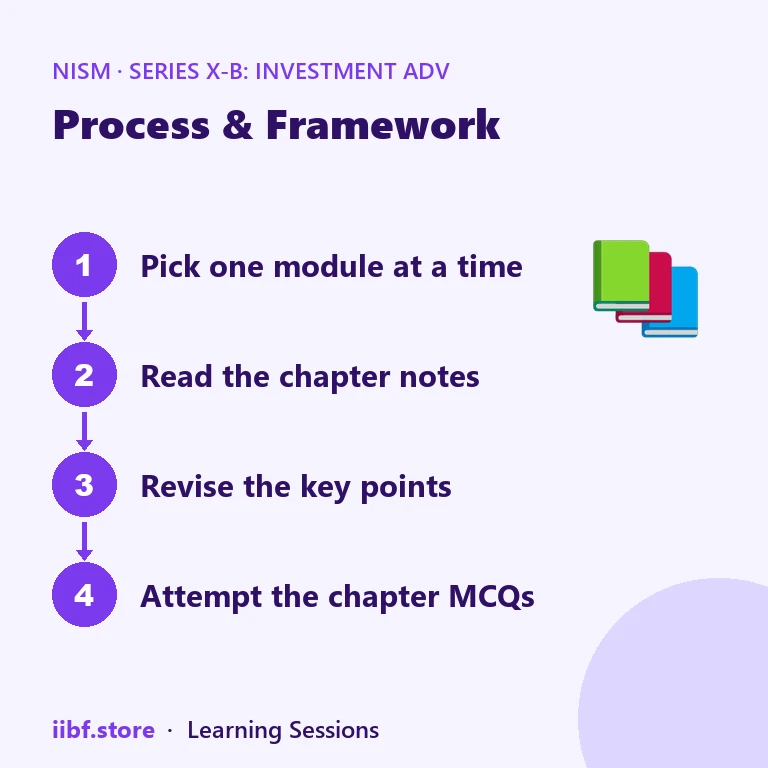
- Pick one module at a time. Start with your weakest one or your strongest one, depending on your confidence. Do not hop between modules.
- Read the chapter notes. One chapter, one sitting. Stop when the chapter ends, even if you feel you could continue.
- Revise the key points. Close the book and try to recall them before reading again.
- Attempt the chapter MCQs. Log your score. Revisit wrong answers the next evening.
With 24 chapters, this is 24 sittings. Add case studies and mega tests and you have a clear finish line you can write on a calendar. Weekends can absorb the two-part chapters in Modules B and C.
Who gets the most out of this NISM X-B study book
- Bankers who sell or support wealth and insurance products and want a structured path through retirement, tax and estate topics.
- Candidates who prefer a printed book they can mark, fold and carry over screens.
- Anyone who has postponed the paper because the syllabus felt shapeless. A fixed 24-chapter map removes that feeling.
It is less ideal if you want a deep legal reference on tax or succession law. This is an exam-oriented book, and an honest limit applies: a book alone will not give you exam-hall speed. Pair it with timed mock tests, and use the free mock tests on iibf.store to check your pace. You can also browse free study material and the full books catalogue before deciding anything.
Price and sample
At the time of writing the book is listed at ₹700 against an MRP of ₹2,398 (about 71 percent off). Prices can change, so the book page is always the current reference, and a free sample is available there so you can judge the writing before ordering.
Wrapping up: start with one chapter tonight
You do not need a perfect schedule to begin. You need one chapter, one pencil and forty-five minutes. Whichever material you pick, the sequence of notes, key points and questions is what turns tired evenings into progress. If you want that sequence already built into a single volume, the NISM X-B study book is designed around it. Read the sample, decide calmly, and keep the official IIBF and NISM notices handy for dates.
Frequently asked questions
How many chapters and questions does the book have?
It has 24 chapters across four modules, 157 pages and 360 questions, plus 30 case studies (120 questions) and 5 mega tests (500 questions) listed as extras.
Which module should I start with?
Start where you are weakest if you have time, or with your strongest module if you need early momentum. Many bankers find Module A (insurance) easier and Module C (tax, nine chapters) the heaviest.
Can I preview the book before buying?
Yes, a free sample is available on the book page. Prices and availability shown there are always the latest.
Is the book enough on its own?
It covers the syllabus in a structured way, but timed practice matters too. Combine it with mock tests and check the official IIBF site for the exam schedule.
Prefer revising from a printed book?
Chapter-wise books with MCQs after every chapter — minimal pages, complete coverage, delivered anywhere in India. Every book has a free sample to read first.

















Practice this topic
Take a free mock test, download chapter PDFs, or watch a video class — all included on iibf.store.