Inside the NISM Series III-A Book: Modules, Chapters and MCQs
It is 9:30 at night. You have closed the branch, reached home, eaten something quickly, and now there is a thick set of SEBI regulations waiting for you. Compliance papers feel endless because the rulebook really is long: Acts, Regulations, Schedules, amendments. If you are a working professional, the real problem is rarely intelligence. It is that you cannot see the shape of the syllabus, so every study session starts with confusion about where to begin.
This article is a guided tour of the NISM Series III-A book from our store, so you can picture exactly how it is organised and how a single chapter reads before you decide anything. Even if you never buy it, the method of studying a regulation-heavy paper by module, then chapter, then question will help you. Official exam details always come from the source, so keep https://www.iibf.org.in open for the schedule of the upcoming exam cycle.
Why compliance papers feel harder than they are
Securities intermediaries compliance is not one subject. It is a bundle of separate rulebooks that all talk to each other: the SEBI Act, the Securities Contracts (Regulation) Act, the Intermediaries Regulations, insider trading rules, money laundering rules, and then regulations for each kind of intermediary. Most candidates fail to retain this not because the content is difficult, but because it arrives in a random order.
Three habits make it worse for a tired learner:
- Reading the full regulation text start to finish, without knowing which parts are likely to be tested.
- Jumping between topics, so a stock broker rule gets mixed up with a depository rule.
- Reading for days and attempting questions only at the end, when it is too late to fix gaps.
The cure is structure. Group what belongs together, read it in small pieces, and test yourself straight away. That is exactly how the book below has been laid out.
The four-module map of the book
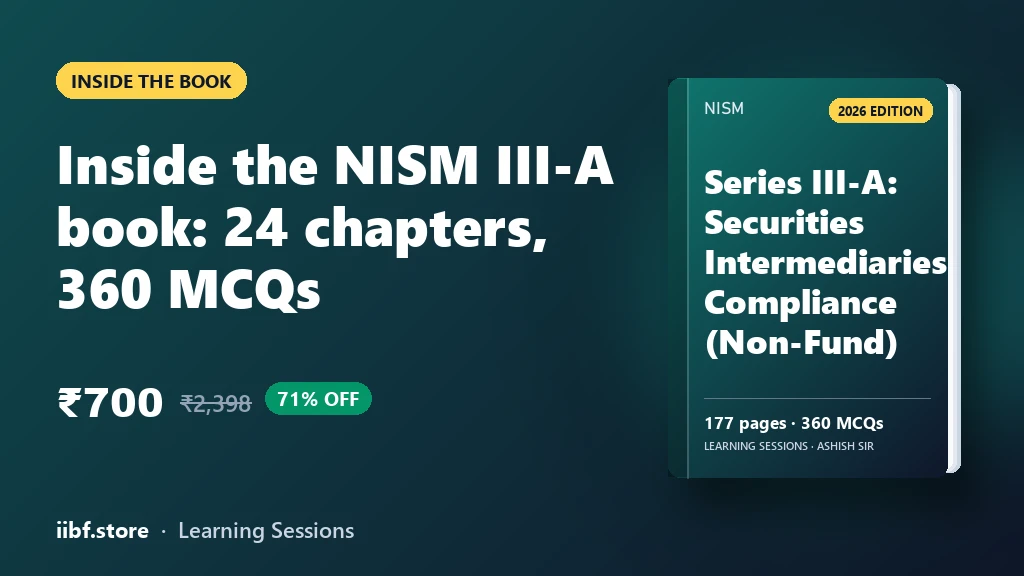
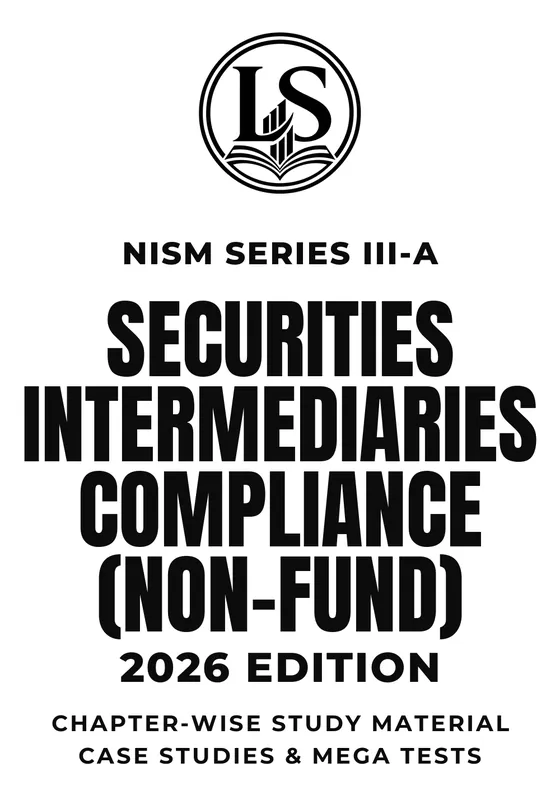
The NISM Series III-A book runs to 177 pages, 24 chapters, and 360 practice questions in the 2026 edition. The 24 chapters are grouped into four modules, and the grouping itself is useful, because it tells you the logic of the subject.
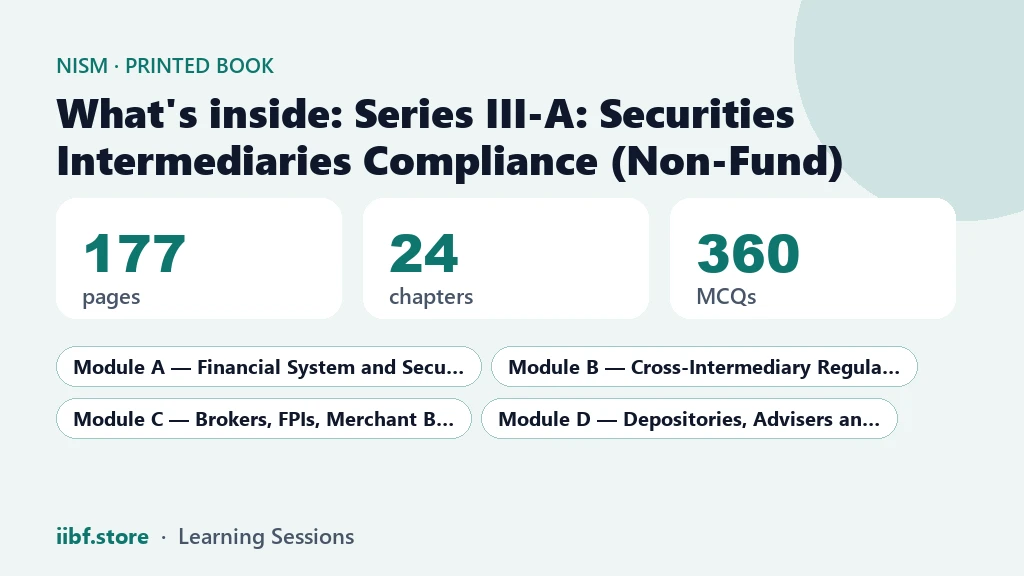
Module A: Financial System and Securities Laws (5 chapters)
This is your foundation. It opens with the financial system and the regulatory framework, moves to what compliance actually means, and then covers the two parent laws: the Securities and Exchange Board of India Act, 1992, and the Securities Contracts (Regulation) Act, 1956 with its Rules, 1957. If you are short of time, do not skip this module. Every later regulation makes more sense once you know who the regulator is and where its powers come from.
Module B: Cross-Intermediary Regulations (5 chapters)
These rules apply to almost every intermediary, whatever its business: the SEBI (Intermediaries) Regulations, 2008, the Prohibition of Insider Trading Regulations, 2015, the Prohibition of Fraudulent and Unfair Trade Practices Regulations, 2003, the Prevention of Money Laundering Act with the SEBI AML/CFT guidelines, and the KYC Registration Agency Regulations, 2011. For a compliance officer these are the daily-use chapters.
Module C: Brokers, FPIs, Merchant Bankers and Issues (7 chapters)
The biggest module. It starts with Foreign Portfolio Investors, covers Stock Brokers in two parts (including trading facilities, authorised persons and portfolio managers), Merchant Bankers in two parts (including takeovers, delisting, buyback and bankers to an issue), and ends with the ICDR Regulations, 2018 in two parts. The two-part split matters: it keeps each sitting short enough for a weeknight.
Module D: Depositories, Advisers and Other Intermediaries (7 chapters)
Here you meet the Depositories Act, 1996 and the Depositories and Participants Regulations, 2018, then Registrars to an Issue and Share Transfer Agents, Research Analysts, Investment Advisers, Debenture Trustees, Credit Rating Agencies, and finally Custodians along with Proxy Advisors. Each chapter is a separate regulation, so you can finish one in a single evening and feel real progress.
Notice the arithmetic: 5 + 5 + 7 + 7 gives 24 chapters. If you can manage roughly one chapter per study day, the whole book is a matter of weeks, not months. Adjust it to your own pace, and pad in a few revision days.
What a single chapter looks like
A book is only as good as its chapter. Here is how each chapter in the NISM Series III-A book is built, in the order you meet it:
- Concise notes. The regulation is boiled down to what you need: definitions, who is covered, conditions, obligations, and penalties. No legal essays.
- Key points. The items most worth memorising are pulled out so that your last-minute revision is a quick scan, not a re-read.
- MCQs. Practice questions at the end of the chapter, so you can check whether the material actually stuck while it is still fresh.
This notes, key points, questions cycle is the heart of efficient study. You read a small piece, you recall it, and you get immediate feedback. Across the book there are 360 questions, so you are not starved of practice even before you reach the extras.
The extras: case studies and mega tests
Knowing a regulation and applying it to a situation are different skills, and exams increasingly test the second. That is why the book carries two additions beyond the chapters:
- 30 Case Studies (120 questions): short scenarios where you have to decide which rule applies. Treat these as rehearsal for real compliance judgement.
- 5 Mega Tests (500 questions): full-length mixed practice that takes you across all four modules, which is where you find out whether Module B is quietly leaking marks into Module C.
Keep one honest limit in mind: a book alone will not give you exam-hall speed. Mixed-topic timing only comes from repeated timed practice, so pair your reading with the free mock tests at https://iibf.store/tests, and pick up free reference PDFs at https://iibf.store/free-material.
A four-step plan to use the book while working full time
You do not need a perfect routine. You need a repeatable one that survives a heavy branch day. Here is a simple loop for the NISM Series III-A book that you can run in 45 to 60 minutes.
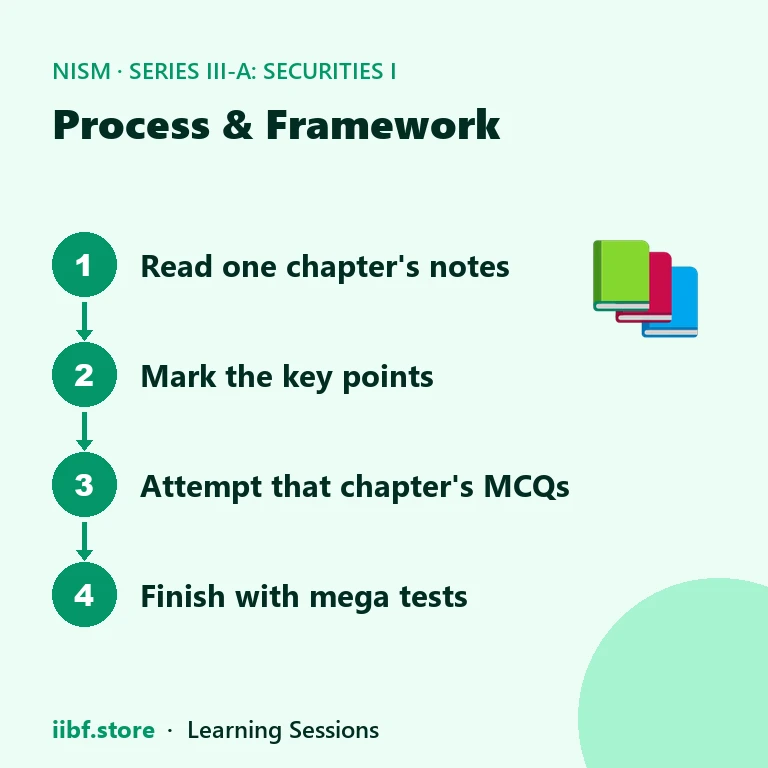
Step 1: Read one chapter's notes
One chapter only. Do not try to be a hero and read three. When you stop, you should be able to say in one sentence what that regulation is for.
Step 2: Mark the key points
Use the key points section and underline the figures, time limits, and who-must-do-what lines. These are exactly the items that confuse people between similar regulations.
Step 3: Attempt that chapter's MCQs
Do the questions the same day. Note every wrong answer in a small notebook with the reason, not just the correct option.
Step 4: Finish with the mega tests
After a module, and again after the whole book, attempt a mega test. Review mistakes by module so you know which part to reopen.
| Day | Task | Time |
|---|---|---|
| Mon to Thu | One chapter: notes, key points, MCQs | 45 to 60 minutes |
| Friday | Redo wrong MCQs from the week | 30 minutes |
| Saturday | Case studies from the extras | 1 hour |
| Sunday | Rest, or one mock from the free tests | Optional |
Who gets the most out of this book
The NISM Series III-A book suits some readers better than others, so here is a plain answer:
- Compliance and operations staff at brokers, depositories, advisers or merchant bankers who want to cover the whole regulatory map in an organised way.
- Working candidates short on time who prefer short chapters with built-in questions to heavy legal text.
- Anyone who has put the paper off because the syllabus looked shapeless. Four modules and 24 chapters make it countable.
It is less suited to someone who wants the full original text of every Act and circular. This is a prepared study book, not a legal commentary. Always check the latest regulations on official websites for anything you rely on professionally.
The book is priced at ₹700 against an MRP of ₹2,398 (71% off), though prices may change, so the book page always shows the current figure. A free sample is available there, which is the best way to judge the chapter style for yourself. You can also browse other titles at https://iibf.store/books and more study guidance on the blog.
Final word before you start
Compliance papers reward steady, structured effort far more than late-night cramming. Whether you use this book or another, keep the same discipline: one chapter, key points, questions, then mixed tests. If you want to see the structure for yourself, read the sample and decide. A good NISM Series III-A book should make the syllabus feel smaller, not bigger.
Frequently asked questions
How many chapters and questions does the book have?
The 2026 edition has 177 pages and 24 chapters in four modules, with 360 practice questions, 30 case studies (120 questions) and 5 mega tests (500 questions).
Can I preview the book before ordering?
Yes. A free sample is available on the book page, so you can check the notes, key points and MCQ style before you decide.
Is the book enough on its own?
It gives you organised notes and plenty of practice, but exam-hall speed needs timed mocks as well. Pair it with the free tests on the store and check official updates at the IIBF site.
How long should I plan for the whole book?
With 24 chapters, one chapter on each study day finishes the reading in about four weeks, plus revision and mega tests. Adjust it to your own shifts and energy.
Prefer revising from a printed book?
Chapter-wise books with MCQs after every chapter — minimal pages, complete coverage, delivered anywhere in India. Every book has a free sample to read first.














Practice this topic
Take a free mock test, download chapter PDFs, or watch a video class — all included on iibf.store.
Keep reading