Inside the NISM X-A Study Book: 24 Chapters, 4 Modules
It is 9:40 pm. The branch has finally gone quiet, your lunch was a samosa at the counter, and you have decided that this is the month you start on the Investment Adviser certification. Then you open a syllabus that runs from the time value of money to portfolio theory to SEBI regulations, and the energy drains out of you. If that sounds familiar, this guided tour of the NISM X-A study book is for you. The aim is simple: show you exactly how the material is laid out, so that you can picture a normal study night with it before you decide anything.
Whether or not you ever buy this book, the method below works for any large, multi-topic certification. Break the syllabus into modules, give every chapter one sitting, test yourself straight away, and revise in short loops. Read on and take whatever is useful.
Why a big syllabus feels heavier than it is
Most working bankers do not fail certifications because the content is beyond them. They struggle because the syllabus arrives as one giant block. Investment Adviser (Level 1) touches financial planning, markets, products, portfolio management, operations and regulation. Looked at together, it feels like four exams stacked on top of one another.
Looked at in pieces, it is far kinder. The trick is to stop thinking about "the syllabus" and start thinking about "tonight's chapter". A chapter is something you can finish. A syllabus is something you can only postpone.
The three habits that matter most
- Fixed small blocks. Forty-five to sixty minutes on weekdays beats a heroic six-hour Sunday that you then skip twice.
- Test before you feel ready. Questions show you what you actually know, not what you recognise.
- One structure for every chapter. When every chapter looks the same, you spend your energy on learning, not on working out how to study.
A printed book helps with the third habit more than most people expect. There is no tab to switch, no notification, and no temptation to watch "just one reel" when you are tired.
How the NISM X-A study book is organised
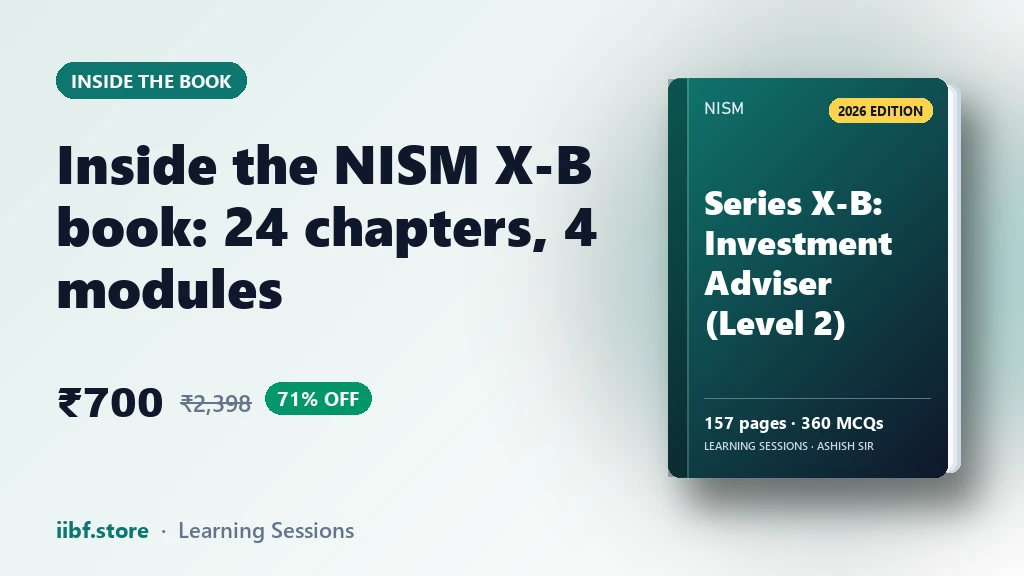
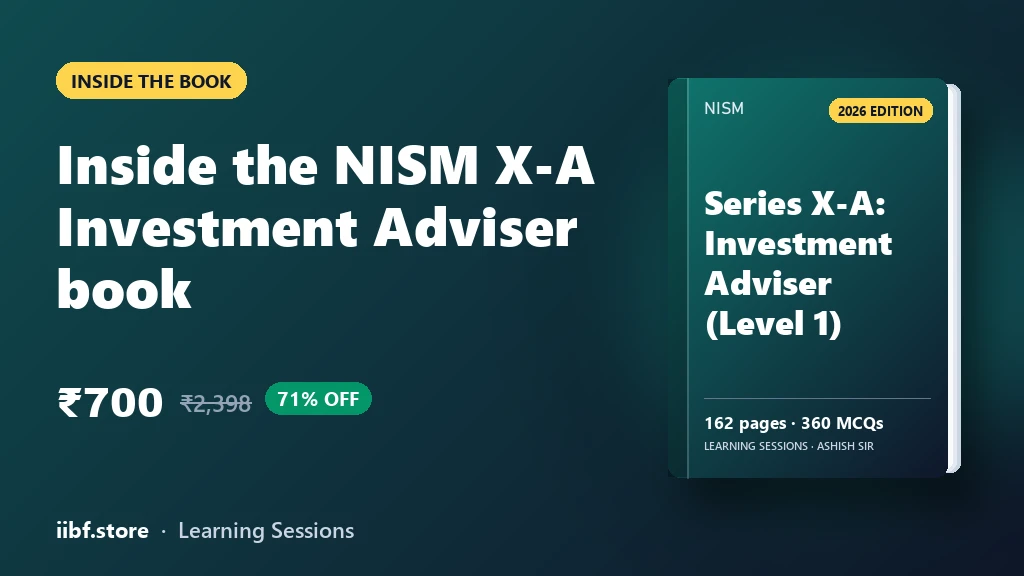
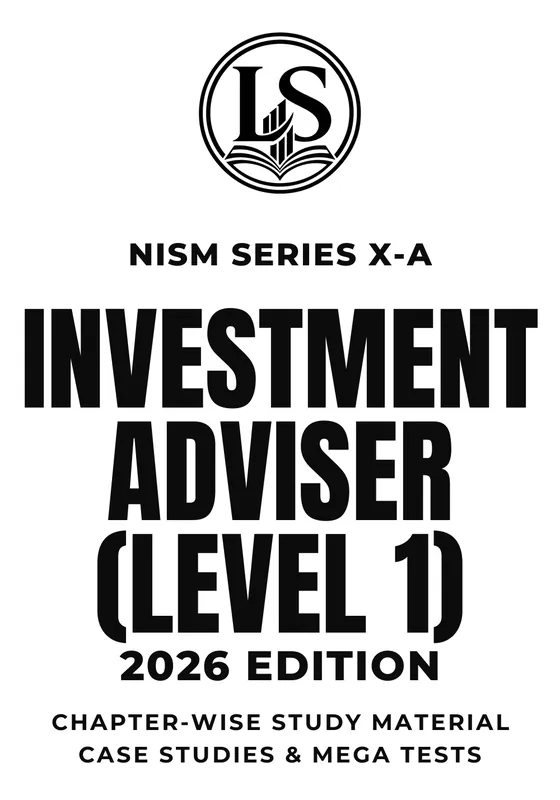
The NISM Series X-A Investment Adviser (Level 1) book runs to 162 pages across 24 chapters, edition 2026. Those chapters are grouped into four modules, and the grouping is the first thing worth understanding because it tells you the order in which ideas build on each other.
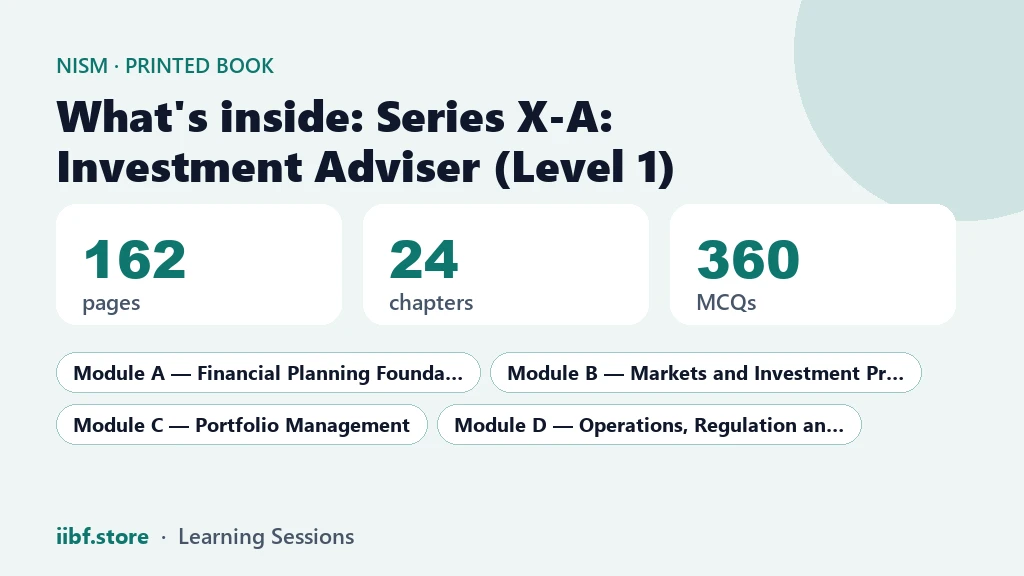
Module A: Financial planning foundations (5 chapters)
This is where the adviser's job begins: Introduction to Personal Financial Planning, Time Value of Money, Cash Flow Management and Budgeting, and Debt Management and Loans in two parts. If you work in a branch, loans and cash flow will feel familiar. Time value of money is the one to slow down on, because everything later (bond pricing, returns, goal planning) quietly depends on it.
Module B: Markets and investment products (9 chapters)
The largest module. It covers Indian financial markets, securities market segments, an introduction to investments, stocks, fixed income securities in two parts, derivatives, mutual funds, and the Portfolio Manager and AIF overview. Nine chapters is a lot, so treat it as three mini-blocks: markets (first three chapters), cash products (stocks and fixed income), and structured or pooled products (derivatives, mutual funds, PMS and AIFs).
Module C: Portfolio management (4 chapters)
Introduction to Modern Portfolio Theory, the Portfolio Construction Process, and Portfolio Performance Measurement and Evaluation in two parts. This is the most numerical stretch for many candidates, so keep your calculator beside the book and do the worked examples with a pencil, not just your eyes.
Module D: Operations, regulation and ethics (6 chapters)
Operational Aspects of Investment Management in two parts, Key Regulations in three parts, and finally Ethical Issues and the Grievance Redress Mechanism. These chapters are heavy on definitions and rules, which makes them ideal for repeated short revision sessions rather than one long read.
| Module | Theme | Chapters |
|---|---|---|
| Module A | Financial Planning Foundations | 5 |
| Module B | Markets and Investment Products | 9 |
| Module C | Portfolio Management | 4 |
| Module D | Operations, Regulation and Ethics | 6 |
| Total | 24 |
What a single chapter looks like
Every chapter follows the same three-step rhythm, and this is the part that makes the book easy to live with on a tired evening.
- Concise notes. The concept is explained in plain language, trimmed to what you need rather than the full length of a regulator's manual.
- Key points. The things you must be able to recall without looking, pulled together so that revision does not mean re-reading everything.
- MCQs. Practice questions to check the chapter immediately. Across the book there are 360 of them.
Picture it concretely. Say tonight is "Time Value of Money". You read the notes for thirty minutes, skim the key points, then attempt the questions with the book closed on your notes. Anything you get wrong, you mark in the margin. Tomorrow's first ten minutes go on those marked items. That is the entire system. It is not clever, and that is why it survives a stressful week at work.
The extras listed with the book
- 30 Case Studies (120 questions)
- 5 Mega Tests (500 questions)
Case studies are where the Investment Adviser paper tends to feel different from a plain theory exam, because you apply a concept to a client situation. The mega tests are for the final stretch, once you have finished the modules and want to see how you hold up over a long paper.
A four-step plan for using the book after work
Here is a plan you can follow, with the book or without it. It is written for someone with a job and perhaps ninety usable minutes on a good day.
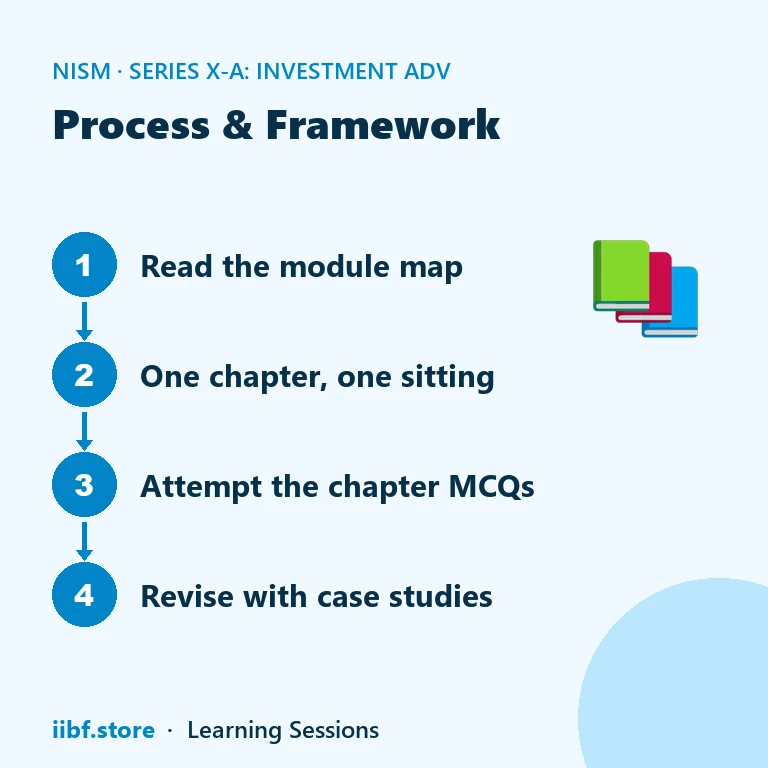
Step 1: Read the module map first
Spend your first evening only on the contents page. Write the four module names on a sheet and pin it near your desk. Knowing where a chapter sits tells you why it matters and what it leads to.
Step 2: One chapter, one sitting
Resist the urge to read half of one chapter and half of another. With the NISM X-A study book, the chapters are short enough to finish in a single session, and finishing gives you a small win that makes tomorrow easier. For the two-part chapters, such as Debt Management or Fixed Income, treat each part as its own sitting.
Step 3: Attempt the MCQs the same day
Do not postpone the questions to "after I finish the module". The gap between reading and testing is where recall leaks away. Aim for the questions while the chapter is still fresh, then correct yourself honestly.
Step 4: Revise in short loops
At the end of each module, spend one session going through only your marked mistakes and the key points. Later, move to the case studies and finally the mega tests. For extra practice, the free mock tests at iibf.store/tests are a useful way to check your speed, and the free PDFs at iibf.store/free-material are worth a look for additional reading.
A realistic pace with this plan is a few chapters a week, which means the 24 chapters fit comfortably into a couple of months of evenings. Adjust it to your own shifts. Do not copy someone else's timetable.
Who gets the most out of this book
Be honest with yourself about where you stand, because the best study material is the one that matches your starting point.
- Bankers moving towards advisory or wealth roles who know loans and deposits but feel less sure about derivatives, mutual funds and portfolio theory.
- First-time NISM candidates who want a single, structured source in a fixed order instead of scattered notes.
- Busy professionals who prefer a printed book they can carry, mark up and read without a screen.
- Repeat candidates who need a cleaner structure and plenty of questions to find their weak modules.
It is probably not the right pick if you already work daily in portfolio management and only need a quick regulation refresh. In that case, the free material and mock tests may be enough on their own.
One honest limit: a book, however well organised, will not give you exam-hall speed by itself. Pair it with timed mock tests in the last few weeks. If you want to see how the book is written before spending anything, the book page has a free sample you can read first. Prices can change, so treat the book page as the current source: at the time of writing it is listed at ₹700 against an MRP of ₹2,398.
Putting it together: your next three evenings
You do not need a perfect plan. You need a start that is small enough to happen tonight. Here is a way to begin that costs you nothing:
- Evening 1: Read the four module names and the chapter list. Decide a target date for finishing Module A.
- Evening 2: Take "Introduction to Personal Financial Planning" and finish it, including its questions.
- Evening 3: Do "Time Value of Money" slowly, with a pencil and calculator.
After three evenings you will know whether this rhythm suits you. If you want the whole 24-chapter set in one place, the NISM X-A study book page has the full details, and more titles are listed at iibf.store/books. For the official schedule and eligibility of the upcoming exam cycle, always check the IIBF website and the certifying body's notices, not a blog post.
Frequently asked questions
How many chapters and questions does the book have?
The book has 24 chapters across four modules, 162 pages in the 2026 edition, and 360 MCQs. Separately, the extras include 30 case studies with 120 questions and 5 mega tests with 500 questions.
Can I read a sample before I order?
Yes. The book page offers a free sample, so you can judge the writing style and chapter layout before deciding.
Is one book enough to prepare while working full time?
It gives you a structured syllabus walk-through and plenty of practice, but speed comes from timed tests. Pair it with mock tests and revise your marked mistakes regularly.
Where do I find official exam dates and fees?
Use the official sources. Dates, fees and eligibility change, so check the IIBF website and the certifying body for the upcoming exam cycle rather than relying on any third-party page.
Prefer revising from a printed book?
Chapter-wise books with MCQs after every chapter — minimal pages, complete coverage, delivered anywhere in India. Every book has a free sample to read first.







Practice this topic
Take a free mock test, download chapter PDFs, or watch a video class — all included on iibf.store.