Inside the Operational Risk Management Book: 24 Chapters
It is 9:40 pm. You reached home late, the branch audit report is still in your head, and you have promised yourself one hour of study. Then you open the syllabus for operational risk and it looks endless: frameworks, loss data, scenario analysis, capital, resilience, cyber, climate. Most people in this position do not fail for lack of ability. They fail because they cannot see the shape of the subject.
This article is a guided tour of our operational risk management book for the IIBF certification. You will see how it is organised, what one chapter looks like, and how to use it in short evening sessions. Even if you never buy it, the module map and the plan below will help you study operational risk with less panic.
Why operational risk feels bigger than it is
Credit risk has a clean story: a borrower, a loan, a default. Market risk has numbers and curves. Operational risk is different, because it hides inside everything a bank does: people, processes, systems and external events. That is why candidates feel the topic has no boundary.
The way out is to stop reading it as one big subject. It is really four smaller questions, asked in order:
- What is operational risk, and how did banks come to manage it formally?
- Who owns it, and how do we find and assess it?
- How do we control it, track it, measure it and hold capital against it?
- How does the bank keep running when something breaks?
Notice that none of these questions needs a night-long marathon. Each one maps to a group of chapters you can finish over a few weeks of ordinary evenings. That is exactly how the book is laid out.
A useful habit before you read anything
Write those four questions on a sticky note and keep it on your study table. When a chapter confuses you, ask which of the four questions it is answering. Half the confusion in this subject disappears once you know where a topic sits.
The four-module map of the book
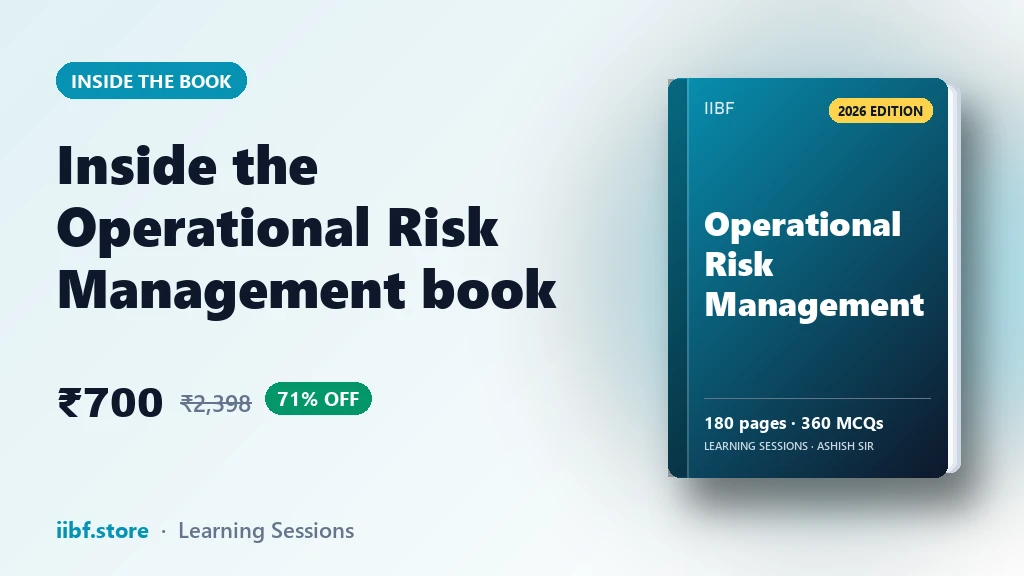
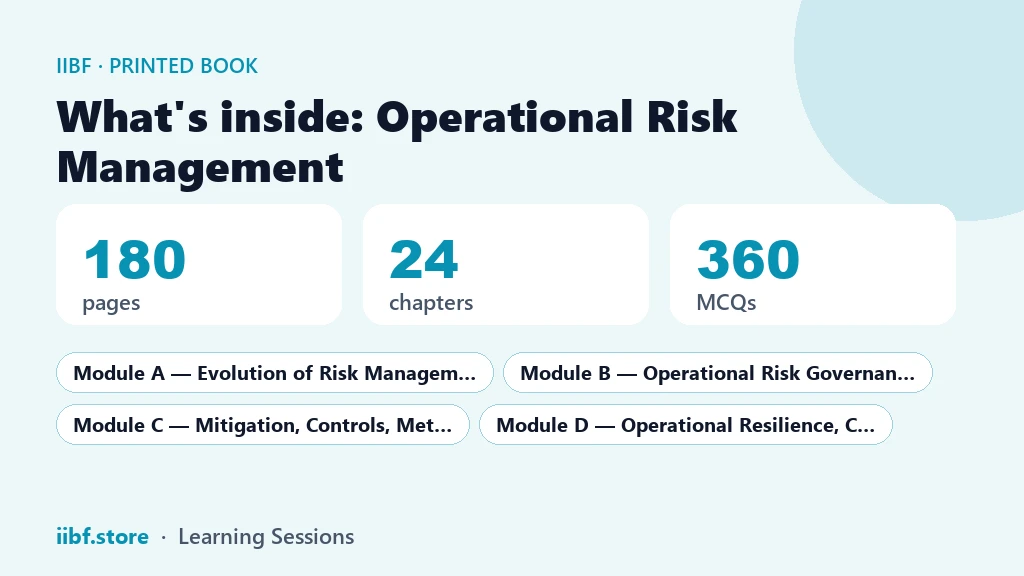
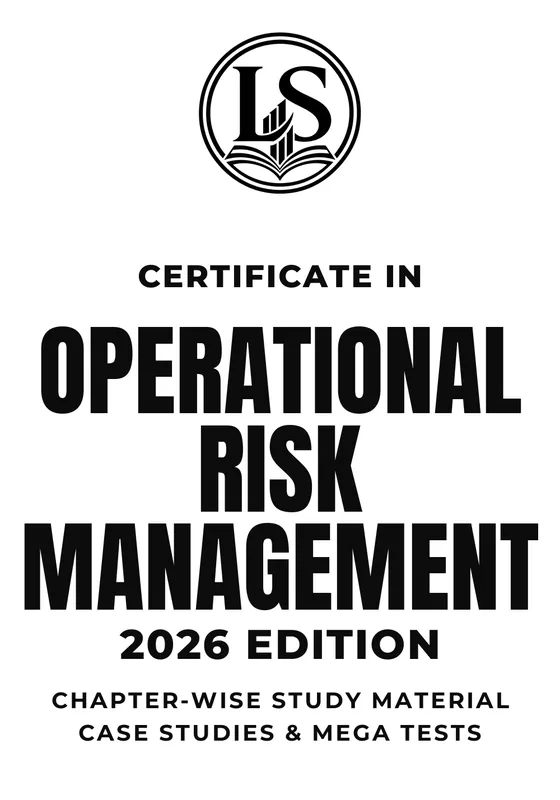
The Operational Risk Management book has 4 modules and 24 chapters, with six chapters in each module. It runs to 180 pages in the 2026 edition, so it is a book you can carry in a bag and finish, not a shelf decoration.
Module A: Evolution of risk management and operational risk frameworks
This is your foundation. It starts with how risk management evolved in Indian banking, then moves to the nature of risk, the definition of operational risk and its challenges, the regulatory response and resilience, the Operational Risk Management Framework (ORMF), and how operational risk fits into Enterprise Risk Management (ERM). If you read only one module in your first week, make it this one, because every later term hangs on these six chapters.
Module B: Governance, identification and assessment
Here the book moves from definitions to practice: governance and culture, identification and event classification, internal and external loss data with root cause analysis, the Risk and Control Self-Assessment (RCSA), risk appetite and scenario analysis. These chapters are the ones closest to what you may already see in your branch or department, so they often feel familiar and quick.
Module C: Mitigation, controls, metrics, measurement and capital
This module covers mitigation of operational risk and major non-financial risks, the internal control system and Risk Focused Internal Audit (RFIA), metrics (KRI, KPI and KCI), change management, measurement of operational risk and the capital charge. It is the most technical stretch of the book, so give it your freshest evenings.
Module D: Resilience, continuity, third-party, ICT and climate risk
The last module deals with the operational resilience framework, the Business Continuity Plan (BCP), the incident management framework, third-party dependency management, ICT including cyber security, and climate risk with operational resilience. These are the newer themes, and they are where candidates who studied only older material are most likely to feel unprepared.
For the official list of certifications and the current syllabus, always check the IIBF website. Exam schedules and rules change, and the institute is the only source you should trust for them.
What one chapter looks like
A book you dread opening does not get read. So the chapters are built the same way every time, and that sameness is a feature. Once you know the pattern, you stop spending energy on how to read and spend it on what you are reading.
- Concise notes. The chapter explains the concept in plain language, without padding. The aim is that you can finish a chapter in a single sitting after work.
- Key points. The essentials are pulled out so you can revise later without re-reading the whole chapter. These become your late-night and commute revision lines.
- MCQs. Questions follow so you can test yourself while the chapter is fresh. Across the book there are 360 MCQs.
Take the chapter on the Risk and Control Self-Assessment as an example. You read the notes to understand what an RCSA is for, scan the key points to fix the vocabulary, then attempt the questions. If you get several wrong, you know to re-read that chapter before moving on. That feedback loop is worth more than another hour of passive reading.
The extras: case studies and mega tests
Beyond the chapters, the operational risk management book carries two sets of practice material:
- 30 Case Studies, with 120 questions, to practise applying concepts to realistic situations.
- 5 Mega Tests, with 500 questions, to practise covering the whole subject in one go.
Case studies matter in a subject like this because operational risk is about judgement: spotting the root cause, the control gap, the right escalation. Reading definitions is not enough. The mega tests come last, once you have finished the modules.
A four-step plan for tired evenings
You do not need a heroic timetable. You need a routine you can repeat on a bad day. Here is a plan built around the structure above.
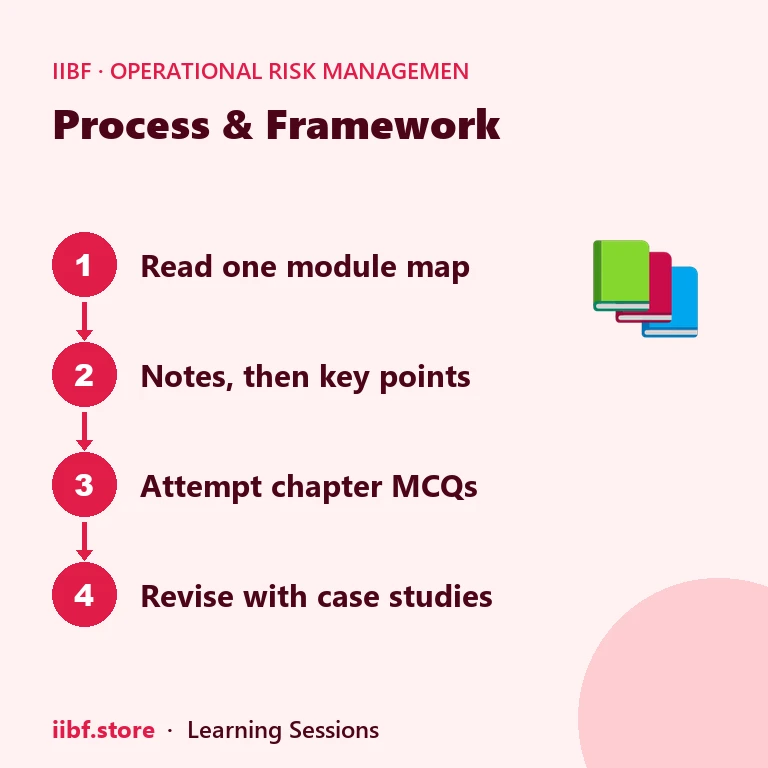
Step 1: read the module map first
Before starting a module, spend five minutes on its chapter list. Know the six titles. This gives your brain a frame to hang the details on.
Step 2: notes, then key points
Read one chapter's notes, then immediately read its key points. If you cannot explain the key points in your own words, go back once. Do not move on with a half-understood chapter.
Step 3: attempt the chapter MCQs
Do the questions on the same day. Mark the ones you got wrong or guessed. Those are your revision list.
Step 4: revise with case studies and mega tests
After each module, try a few case studies. Once all four modules are done, move to the mega tests. If you want more practice from outside the book, the free mock tests and free study material on our site are a good supplement.
| Phase | What you cover | Evening routine |
|---|---|---|
| Foundation | Module A (6 chapters) | One chapter, then its MCQs |
| Practice | Module B (6 chapters) | One chapter, then its MCQs |
| Technical | Module C (6 chapters) | One chapter on fresh evenings, MCQs next day |
| Current themes | Module D (6 chapters) | One chapter, then its MCQs |
| Test phase | Case studies and mega tests | Timed practice on weekends |
With one chapter per evening on four evenings a week, you cover the 24 chapters in about six weeks, leaving room for the case studies and mega tests. If your job eats your evenings, stretch it. The order matters more than the speed.
What this book will not do for you
Honesty first: a book alone will not give you exam-hall speed. Reading and answering MCQs at home is different from sitting in a timed test. Pair the book with regular timed mocks, and keep an eye on the official IIBF updates for the upcoming exam cycle.
Also, no single book replaces your own workplace knowledge. If your daily work touches audit, compliance, risk or operations, use it. Connect each chapter to a real incident, a control you have seen fail, a process you have worked on. Examples you can recall are examples you can write in an exam.
Who gets the most out of it
- Working bankers preparing for the IIBF Operational Risk Management certification who need a structured path rather than scattered notes.
- Candidates who learn best by testing themselves, since every chapter ends with questions and the book adds case studies and mega tests.
- People returning to study after a gap, who need short chapters and a clear map to rebuild momentum.
- Officers in risk, audit, compliance or operations who want to connect the daily job to the framework language.
If that sounds like you, you can see the full details, including the free sample, on the operational risk management book page. It is listed at ₹700 against an MRP of ₹2,398; prices may change, so the book page always shows the current price. You can also browse our other IIBF and bank exam books, and read more preparation guides on the blog.
The takeaway
Operational risk looks endless only until you see the four-module map. Learn the map, follow the notes, key points and MCQs loop, and keep your timed practice honest. Whether you use our operational risk management book or build your own plan, that routine will take you further than another unplanned late night.
Frequently asked questions
How many chapters and modules are in the book?
The book has 24 chapters across 4 modules, six chapters in each, in 180 pages. The 2026 edition also includes 360 MCQs, 30 case studies with 120 questions, and 5 mega tests with 500 questions.
Can I look at a sample before ordering?
Yes. The book page has a free sample you can read first, so you can judge the writing style and chapter layout yourself.
Is this book enough on its own?
It gives you a structured path through the subject with practice questions, but you should still attempt timed mock tests and check the official IIBF website for the latest exam information.
How should I start if I have only an hour a day?
Begin with Module A, one chapter per sitting: notes, key points, then the MCQs. Do not skip the questions, since they show you what you have actually retained.
Prefer revising from a printed book?
Chapter-wise books with MCQs after every chapter — minimal pages, complete coverage, delivered anywhere in India. Every book has a free sample to read first.














Practice this topic
Take a free mock test, download chapter PDFs, or watch a video class — all included on iibf.store.
Keep reading