Inside the IIBF Microfinance Book: Chapters, MCQs and How to Use It
It is 9:40 pm. The branch has finally gone quiet, your tiffin is cold, and the Microfinance syllabus looks like a mountain you will never climb after a full day at the counter. If you are looking for an IIBF Microfinance book that you can realistically finish in the gaps of a working life, this guided tour is for you.
We will not hype anything. We will simply open the book, walk through how it is organised, show you what a single chapter feels like, and then give you a routine that works even if you never buy it. Use whatever helps.
Why the Microfinance paper feels heavier than it is
Most bankers who postpone this certificate do so for one reason: the subject is wide. It starts with poverty and rural credit, moves through regulation, then lands on accounting, risk and compliance. Each topic sounds familiar, yet none of it is exactly what you do daily at your desk.
That mismatch creates the feeling of an endless syllabus. The cure is not more hours. The cure is a clear map, so every study session has a small, finishable target. Here is what tired candidates usually struggle with:
- Not knowing which topics belong together, so revision feels random.
- Reading long source material and forgetting it by the weekend.
- Practising questions only at the very end, when little time is left.
A well-organised IIBF Microfinance book fixes the first two problems by cutting the subject into short, ordered chapters. The third problem is fixed by you, with a habit we describe below.
How the book is organised: two modules, 18 chapters
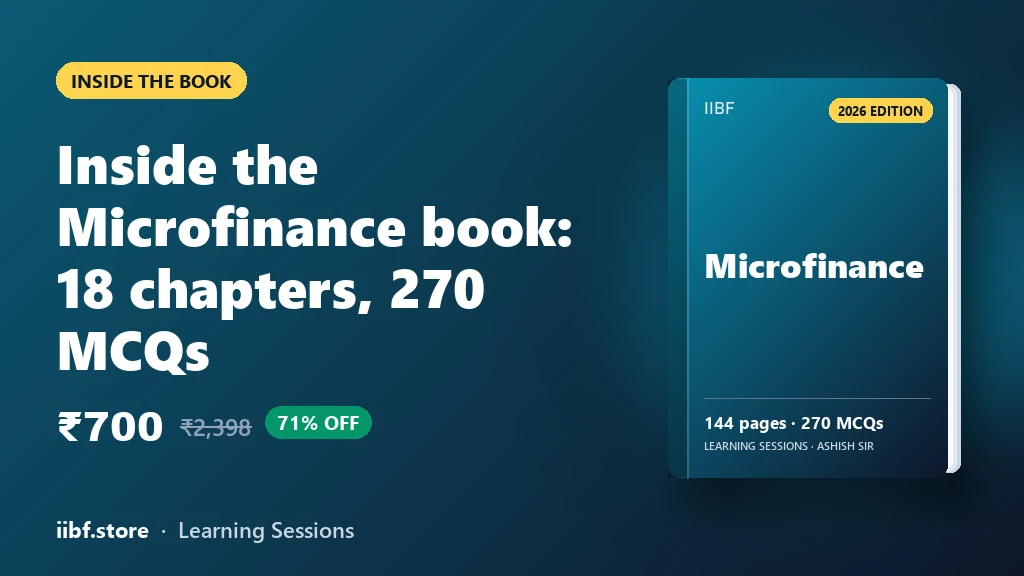
The Microfinance book runs to 144 pages (2026 edition) and is divided into two modules with 18 chapters in all. Think of Module I as the background and Module II as the working machinery.
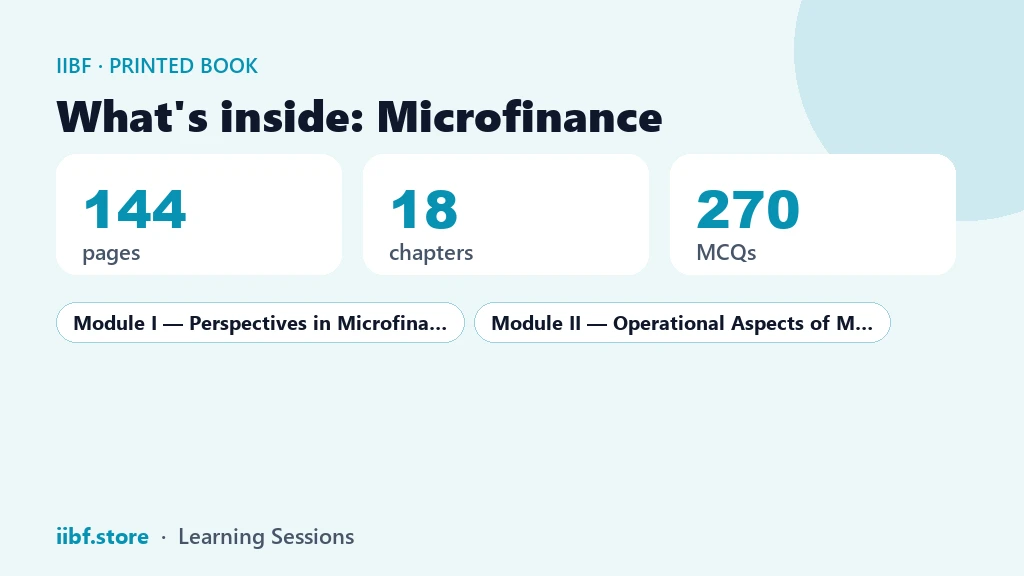
Module I: Perspectives in Microfinance (10 chapters)
This module builds the big picture. The chapters, in order, are:
- Poverty and Rural Credit
- Basics of Banking
- Why and What is Microfinance?
- Microfinance Delivery Methodologies
- Regulatory Framework: Evolution and Development
- Evolution and Characteristics of Microfinance in India
- Recent Developments of Microfinance in India
- Financial Inclusion: Concept and Measurement (Part 1)
- Financial Inclusion: Concept and Measurement (Part 2)
- Financial Inclusion through Banks and Measuring Impact of Microfinance
If you work in a rural or semi-urban branch, much of this will feel like putting names to things you already see. Use that advantage: read these chapters first and let your own branch experience anchor the definitions.
Module II: Operational Aspects of Microfinance (8 chapters)
This is where the exam gets more technical:
- Financial Products and Services (Part 1 and Part 2)
- Financial Accounting and Reporting (Part 1 and Part 2)
- Revenue Models of Microfinance, Profitability, Efficiency and Productivity (Part 1 and Part 2)
- Risk Management
- Compliance to Various Regulations
Notice that three topics are split into Part 1 and Part 2. That is useful for you: a long topic becomes two shorter sittings instead of one exhausting evening.
For a quick overview, here is the structure at a glance.
| Module | Chapters | What it covers |
|---|---|---|
| Module I: Perspectives in Microfinance | 10 | Poverty, banking basics, delivery methods, regulation, financial inclusion |
| Module II: Operational Aspects of Microfinance | 8 | Products, accounting, revenue models, risk, compliance |
What one chapter looks like
A book is only useful if you can picture yourself using it at 10 pm. So here is the rhythm of a typical chapter: concise notes first, then the key points you must remember, then MCQs on that same chapter.
That order matters. The notes give you the idea in plain language. The key points are what you flip back to during revision, so you do not have to re-read every page. The MCQs then tell you honestly whether the idea stuck. In total, the book carries 270 questions, so you test yourself as you go instead of waiting for a mock test at the end.
Short chapters also suit tired minds. You can finish one chapter in a single evening, tick it off, and sleep with a small win instead of a pile of guilt.
The extras: case studies and mega tests
Beyond the 18 chapters, the book lists two extras:
- 30 Case Studies carrying 120 questions.
- 5 Mega Tests carrying 500 questions.
Case studies are valuable because applied questions are where many candidates lose marks. Knowing a definition is one thing; reading a short scenario about a self-help group or a lending situation and picking the right answer is another. Treat the case studies as your bridge between theory and the exam hall.
The mega tests are for the last stretch. Take them after you have finished all 18 chapters, ideally with a timer running. Be honest about one limit here: a book alone will not give you exam-hall speed. Pair it with timed practice, and try the free mock tests at iibf.store/tests as well.
A four-step routine to study each chapter
Whichever material you use, this routine keeps a full-time job and a certificate exam from crushing each other. It takes about 45 to 60 minutes per chapter for most people, so two or three chapters a week is a calm pace.
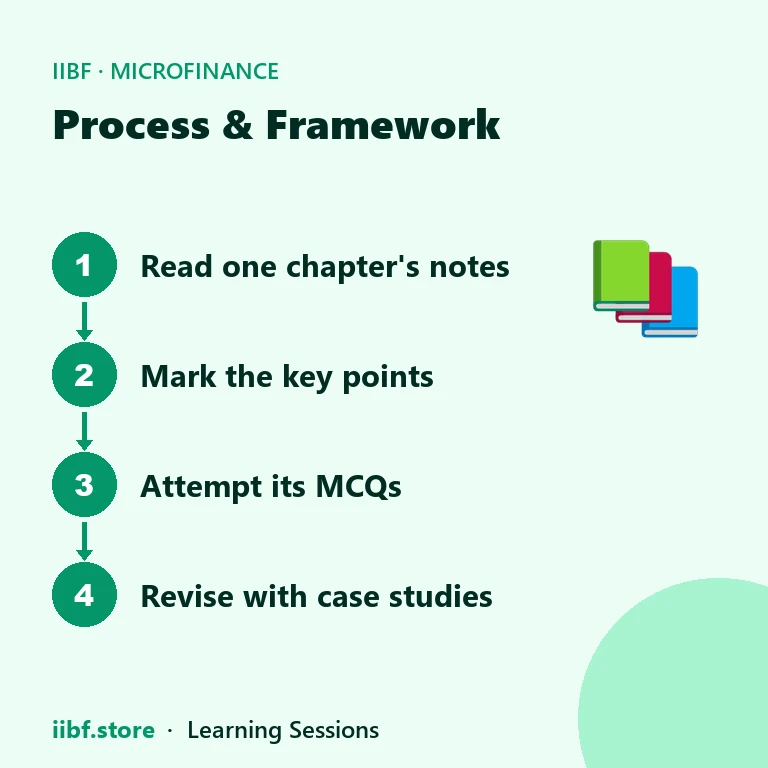
- Read the notes once, slowly. No highlighting yet. Just understand the idea.
- Mark the key points. Write three or four of them on a sticky note or your phone. This is your revision sheet.
- Attempt the chapter's MCQs the same day. Memory fades fast, so test while it is fresh. Note every wrong answer.
- Revise through the case studies. Come back to applied questions at the weekend, and again in the last fortnight.
This routine works with any decent study material. The advantage of a single IIBF Microfinance book that keeps notes, key points and MCQs in one place is simply that you do not waste energy hunting for the next thing to read.
A sample week for a working banker
- Monday to Thursday: one chapter, about an hour, after dinner.
- Friday: rest, or only re-read the key points.
- Saturday: attempt case studies and redo wrong MCQs.
- Sunday: a light recap, and plan the next week.
At that pace, Module I alone fits comfortably into a few weeks. You do not need heroic study sessions; you need consistency.
Who gets the most out of this book
Be realistic about whether a printed book suits you. It tends to help most if:
- You work full time and need small, finishable chunks rather than a thick reference text.
- You like a pen in your hand and a physical page you can carry in your bag.
- You want questions placed right next to the theory they test.
- You are appearing for the Microfinance certificate and want one organised IIBF Microfinance book to keep your preparation in order.
It may suit you less if you prefer only videos or only screen-based reading. In that case, start with the free PDFs at iibf.store/free-material and see what format your brain prefers.
See it before you decide
You do not have to take our word for any of this. The book page has a free sample, so you can check the writing style and the chapter layout yourself. Visit the Microfinance book page to read the sample. The current price shown there is ₹700 against an MRP of ₹2,398, but prices may change, so the book page is always the latest word. You can also browse all titles at iibf.store/books.
For the official syllabus, exam schedule and eligibility for the upcoming exam cycle, always check the Indian Institute of Banking and Finance website. Nothing in this article replaces that source.
Final word
The Microfinance certificate is not impossible; it is just wide. Cut it into 18 chapters, give each a notes-key points-MCQs pass, save the case studies and mega tests for the end, and add timed practice. Whether you use this IIBF Microfinance book or another resource, that structure is what carries you through.
Frequently asked questions
How many chapters and pages does the book have?
It has 18 chapters in two modules over 144 pages, in the 2026 edition. Module I has 10 chapters and Module II has 8.
How many questions are included?
The chapters carry 270 MCQs. In addition, the book lists 30 case studies with 120 questions and 5 mega tests with 500 questions.
Is there a free sample I can read first?
Yes. The book page offers a free sample so you can judge the style before ordering. You can also try the free resources at iibf.store/free-material.
Is a book alone enough to pass?
A book gives you structure and practice, but exam-hall speed comes from timed mock tests. Use the book for learning and the mega tests plus free mocks for speed.
Prefer revising from a printed book?
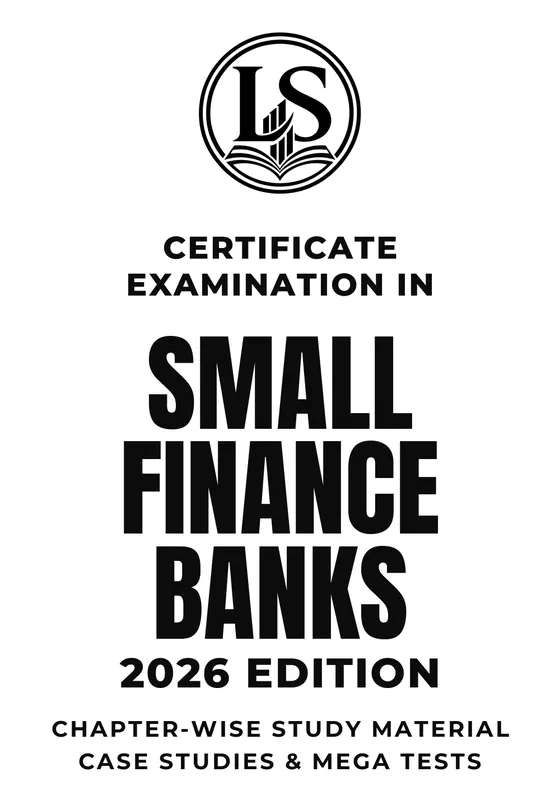
Chapter-wise books with MCQs after every chapter — minimal pages, complete coverage, delivered anywhere in India. Every book has a free sample to read first.



















Practice this topic
Take a free mock test, download chapter PDFs, or watch a video class — all included on iibf.store.