Inside the Emerging Technologies Book: 20 Chapters, 5 Modules
It is 9:30 at night. You have finished a day of counter queries, reconciliations and a branch target that never quite goes away. Now you open the syllabus for a paper on data analytics, blockchain, machine learning and AI, and it feels like four different subjects thrown into one. If that sounds familiar, this article is for you. We will walk through the Emerging Technologies book page by page, so you can picture exactly how a study session with it would go before you spend a rupee.
Even if you never buy it, you will leave with a way to break an intimidating technology paper into small, finishable pieces. That is the real problem for most working bankers: not intelligence, but the feeling that the syllabus has no edges.
Why technology papers feel harder than they are
Most bank employees did not grow up writing code or reading research papers. Words like MapReduce, Byzantine agreement, K-means or LSTM sound like they belong to an engineering degree. The fear is understandable. But an IIBF certification paper does not expect you to build a model. It expects you to recognise the idea, know where it fits, and answer objective questions about it, including how it is used in banking.
That changes how you should study. You do not need to master the mathematics line by line. You need a clear, plain-language first pass of each topic, then repeated exposure through questions. Three habits help straight away:
- Study by module, not by random topic. Your brain stores related ideas together, so finish one theme before you jump to the next.
- Anchor every concept to a banking use. A fraud-detection example sticks far longer than an abstract definition.
- Test early. Ten questions after each chapter tell you more than an hour of re-reading.
Keep the official syllabus and notices from IIBF open as your reference for the upcoming exam cycle. This article describes the book, not the schedule.
The map: five modules, twenty chapters
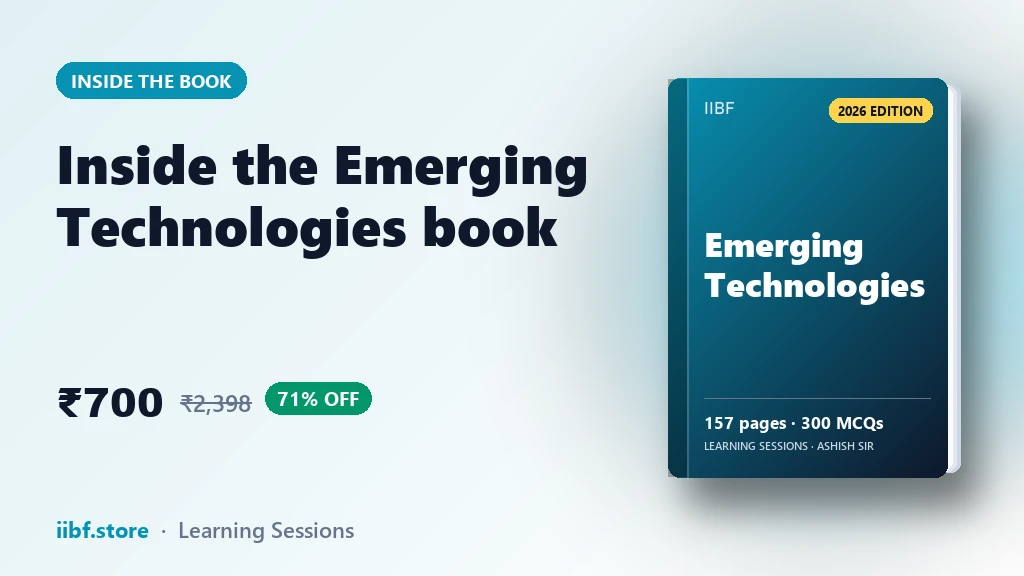
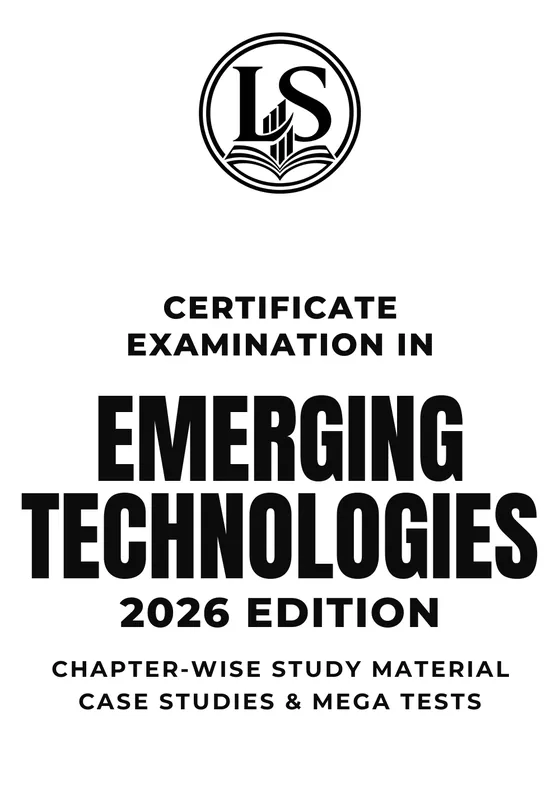
The Emerging Technologies book is a 2026 edition of 157 pages, organised into 5 modules and 20 chapters, with 300 MCQs. Here is how the modules are laid out, taken directly from the contents.
| Module | Chapters | What you cover |
|---|---|---|
| A - Introduction to Data Analytics | 4 | Information value chain and sources of data; storage, extraction and types of analytics; reporting, data visualization, AR and VR; analytics tools and use in banking |
| B - Big Data | 3 | Big data, MapReduce and the Hadoop ecosystem; SQL, advanced SQL and in-database analytics; Apache Spark and big data in banking |
| C - Blockchain | 3 | Byzantine agreement, dynamics and types; forks, side chains and distributed ledger technologies; smart contracts, trust algorithms and blockchain in banking |
| D - Machine Learning | 6 | Mathematical foundations; linear models; decision trees and SVM; clustering; dimensionality reduction; graphical models, HMM, CRF and ML in banking |
| E - Artificial Intelligence | 4 | AI basics and neural networks; CNNs and emerging architectures; RNNs, LSTM and forecasting; NLP, expert systems, knowledge management and AI in banking |
Table: the module structure of the Emerging Technologies book (4 + 3 + 3 + 6 + 4 = 20 chapters).
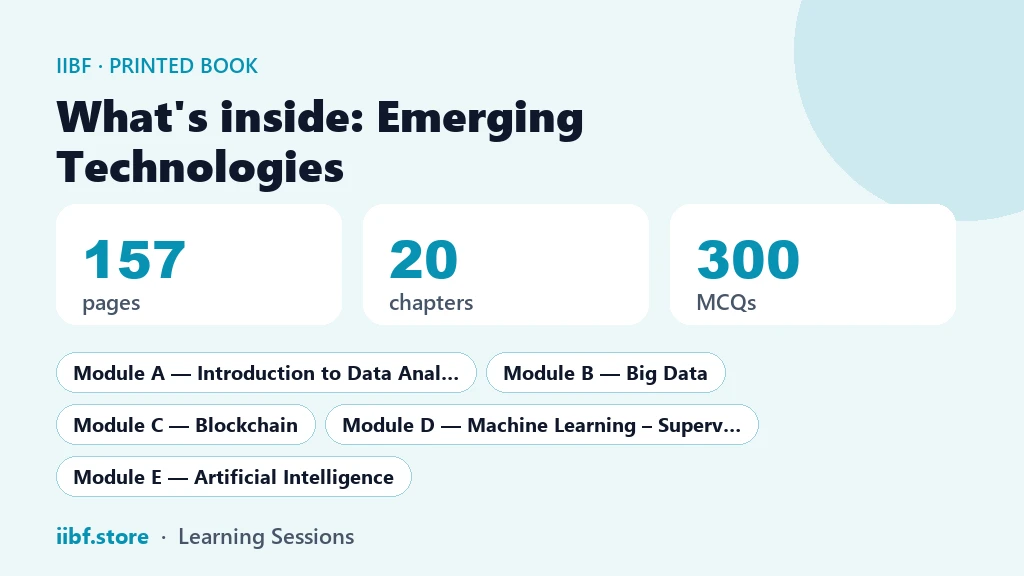
Notice the pattern. Modules A, B, C and E each end with a chapter on how the technology is used in banking. Module D, the largest at six chapters, closes the same way. That is deliberate and useful: wherever the theory gets heavy, the book brings you back to the branch, the loan book and the payment system you already know.
How one chapter reads: notes, key points, questions
Every chapter follows the same rhythm, so after the first one you know what to expect. That predictability matters when you are tired. You do not waste energy figuring out the format; you just start.
Step one: concise notes
Each chapter opens with short notes that explain the topic in plain language. Take Chapter 1 of Module B, on big data and the Hadoop ecosystem. The aim is not to turn you into a data engineer. It is to make sure that when a question mentions MapReduce, you immediately know what problem it solves and where it sits.
Step two: key points
After the notes come the key points: the compact list you revise the night before a test or during a lunch break. Treat these as your personal flash cards. If you can explain each point aloud in one sentence, you are ready for the questions.
Step three: MCQs
Then come the multiple-choice questions. Across the book there are 300 of them, which averages out to roughly fifteen per chapter. Do them without peeking, mark the ones you got wrong, and go back to the notes only for those. This loop of read, recall, test and repair is what turns a first pass into retention.
The extras: case studies and mega tests
Beyond the 20 chapters, the book carries two practice layers that go further than chapter-end questions:
- 30 Case Studies (120 questions). Scenario-style questions built around a situation, which is how technology often shows up in banking exams. These train you to apply an idea rather than just define it.
- 5 Mega Tests (500 questions). Full-length practice once you have covered the modules, useful for checking stamina and spotting weak modules.
Be realistic about one thing. Reading a book, however well organised, will not give you exam-hall speed on its own. Pair the Emerging Technologies book with timed practice, and use the free mock tests on iibf.store to get used to the clock. If you want to warm up with no spending at all, the free material library has PDFs you can read first.
A four-step routine for a tired weeknight
Here is a simple way to use the Emerging Technologies book when you only have forty-five minutes to an hour, which is the honest reality for most branch employees. It works whichever resource you finally pick, because it is built on how memory works.
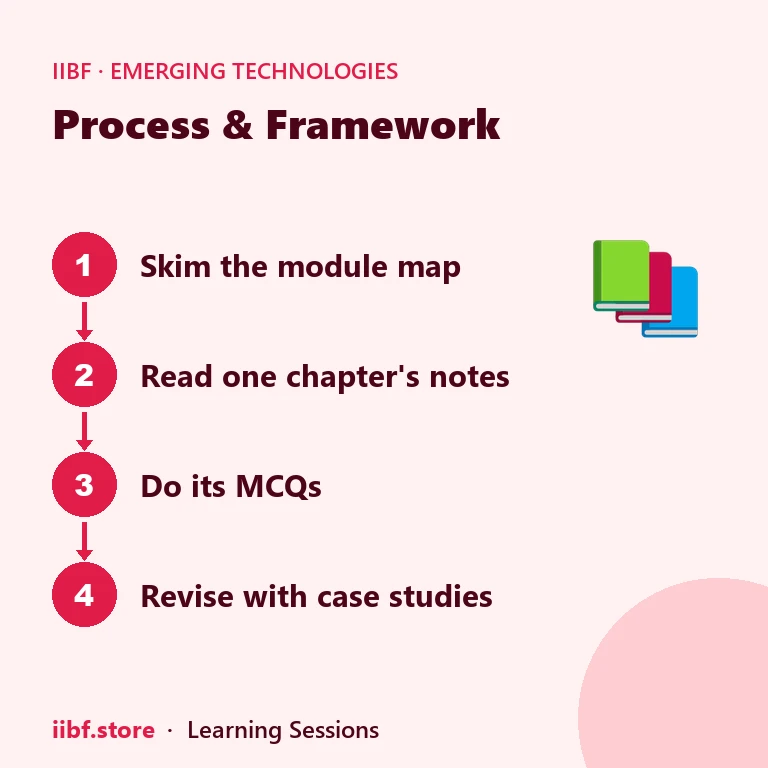
- Skim the module map (5 minutes). Read the chapter titles of the module you are on. Knowing where you are going lowers the anxiety.
- Read one chapter's notes (20 to 25 minutes). One chapter, no more. Underline the terms you could not explain to a colleague.
- Do its MCQs (15 minutes). Attempt them cold. Mark every miss.
- Revise with case studies (weekends). Once a module is done, attempt the related scenario questions to test application, not just recall.
At one chapter per evening, the 20 chapters fit into roughly four weeks of weeknights, leaving weekends for revision and mocks. Adjust to your own pace; the point is a rhythm you can actually keep, not a heroic plan you abandon by day four.
A sensible module order
Start with Module A, because it gives you the vocabulary of data that the later modules assume. Move to B and C, which are shorter at three chapters each and give quick confidence. Take Module D, the six-chapter machine learning block, when you have momentum, and finish with Module E on artificial intelligence, which builds naturally on the machine learning ideas you just learned.
Who gets the most out of this book
Being clear about fit saves you money and time. The book suits you well if:
- You are a working banker who prefers a printed book you can mark up on the commute or at home over scrolling screens.
- You are new to technology topics and want plain-language notes before attempting questions.
- You like a fixed structure of notes, key points and MCQs for every chapter.
- You want a large pool of practice questions, from chapter MCQs to case studies and mega tests, in one place.
It may be less useful if you already work in data science and only need a quick syllabus check, or if you want video lectures rather than reading. For an honest look before deciding, open the book page and read the free sample; it shows the layout I described above. The price listed there at the time of writing is ₹700 against an MRP of ₹2,398, but prices can change, so treat the book page as the current source. You can also browse the full range at iibf.store/books.
Final thoughts on the Emerging Technologies book
A technology paper stops feeling endless the moment you can see its edges: five modules, twenty chapters, a repeatable chapter routine and a clear set of practice questions. The Emerging Technologies book is built around exactly that idea. Use it as a map, one chapter an evening, test yourself after every chapter, and add timed mocks as the exam gets closer. Consistency beats intensity, especially when your day job already takes the best hours.
Frequently asked questions
How many chapters and questions does the book have?
The book has 20 chapters in 5 modules over 157 pages, with 300 MCQs in the 2026 edition. It also includes 30 case studies (120 questions) and 5 mega tests (500 questions).
Do I need a technical background to follow it?
No. The chapter notes are written to explain each topic in plain language, and every module ends with how the technology is used in banking, which connects the ideas to work you already know.
Is there a free sample before I buy?
Yes. The book page offers a free sample so you can check the layout and writing style first. Visit the Emerging Technologies book page to read it and to see the current price.
Is the book enough on its own?
It gives you notes, key points and a large question bank, but exam-hall speed comes from timed practice. Add mock tests, and check the official IIBF website for the schedule and syllabus of the upcoming exam cycle.
Prefer revising from a printed book?
Chapter-wise books with MCQs after every chapter — minimal pages, complete coverage, delivered anywhere in India. Every book has a free sample to read first.

















Practice this topic
Take a free mock test, download chapter PDFs, or watch a video class — all included on iibf.store.