Inside the Stressed Assets and IBC Book: A Chapter-by-Chapter Tour
It is 9:40 pm. You have closed the day, the branch is quiet, and somewhere on your phone is a syllabus on the Insolvency and Bankruptcy Code that looks like an ocean. You know stressed accounts from the NPA side of the desk. But sections, tribunals, moratorium, committee of creditors, waterfall? That is a different vocabulary, and nobody has given you a map. The Stressed Assets and IBC book is one such map.
This article walks through it. Even if you never buy anything, the way we break the topic into modules below will help you plan your own preparation. We will open the book from iibf.store, because the easiest way to see how a good study book is built is to open one and look at its parts.
The problem with studying IBC while working in a branch
Most working bankers do not fail the IBC paper because they are weak. They fail because the material arrives in the wrong order. A bare-act reading starts at definitions and jumps to procedures. A judgment summary assumes you already know the procedure. A mock test assumes you know both. By the third night you are rereading the same page.
What helps is a sequence: why the Code exists, how the institutions are arranged, how a resolution case moves from application to plan to liquidation, and only then the exceptions, case laws and recent changes. Before you spend money on anything, check the official scheme on the IIBF website and note what the upcoming exam cycle actually covers.
A simple test for any IBC study material
- Does it explain why before how? Without the reason, sections become rote.
- Does it keep the banker's seat in view, such as due diligence as a CoC member or as a lender reading a resolution plan?
- Does every chapter end with questions, so you find your gaps the same night?
- Is there a quick-revision layer for the week before the exam?
Keep these four questions handy. We will use them again when we look at how the book is organised.
How the Stressed Assets and IBC book is organised
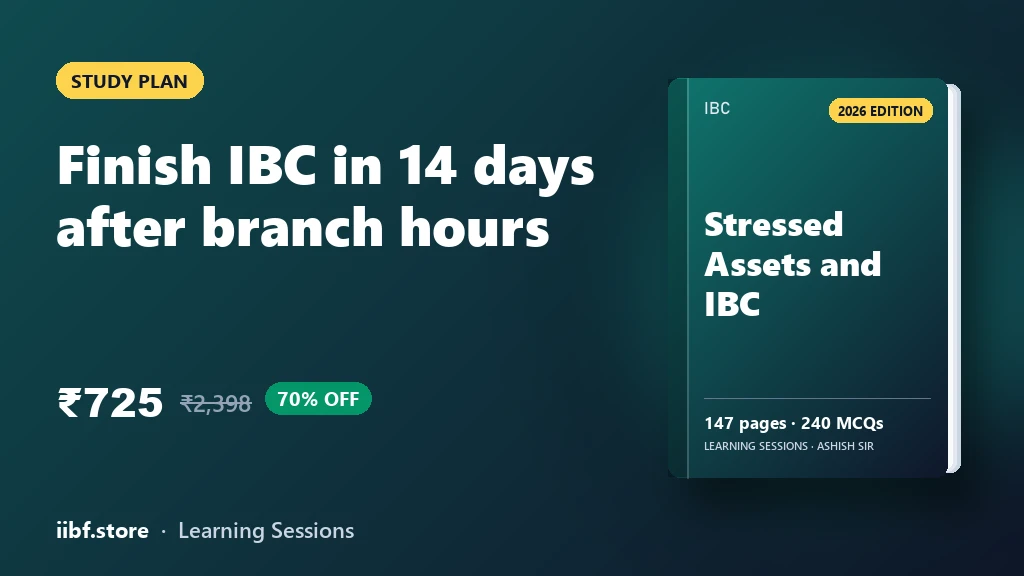
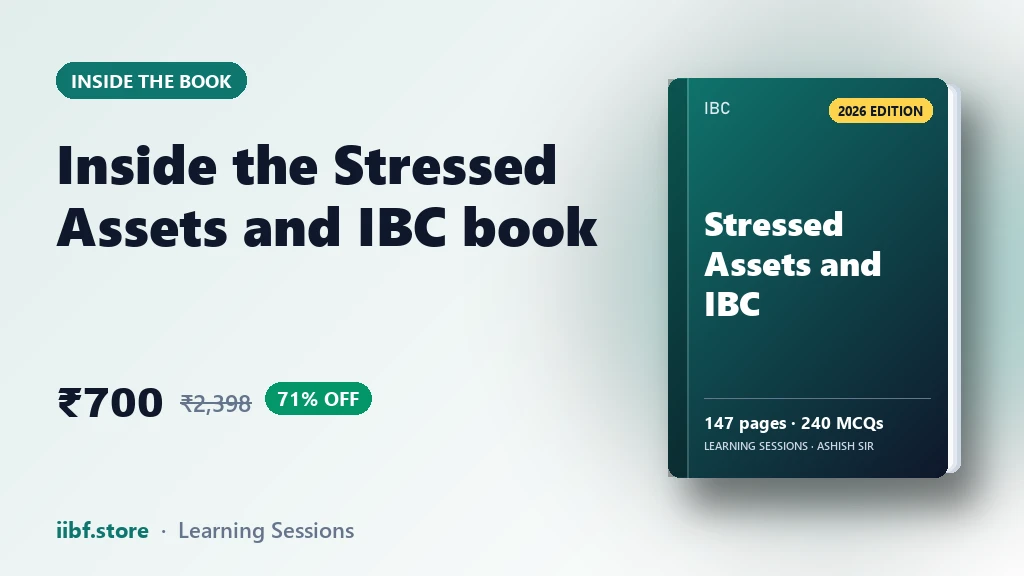
The Stressed Assets and IBC book is a 2026 edition running to 147 pages across 28 chapters, grouped into six modules, with 240 MCQs. Here is the shape of it, module by module.
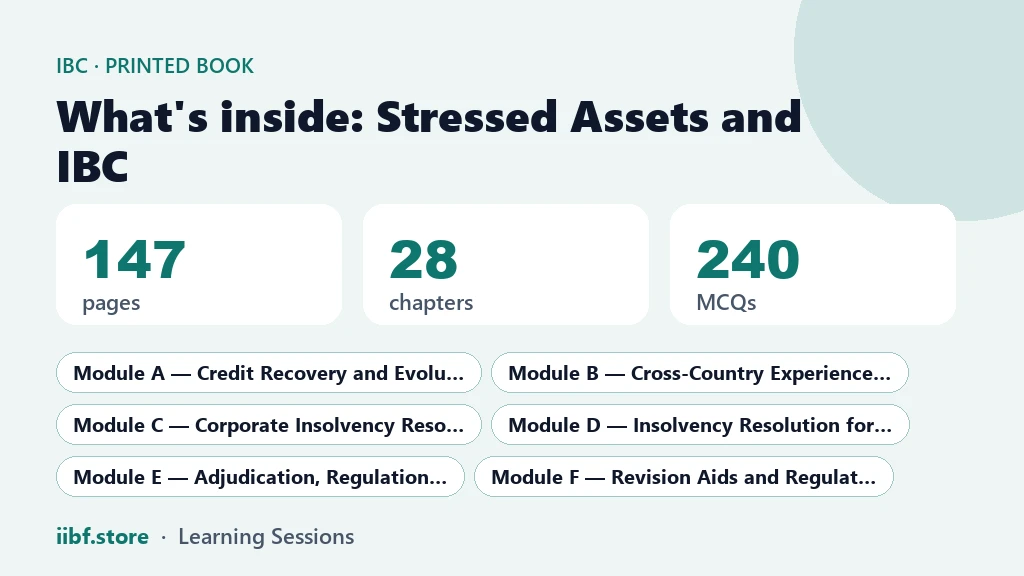
| Module | Theme | Chapters |
|---|---|---|
| A | Credit recovery and evolution of the IBC | 3 |
| B | Cross-country experience and structure of the IBC | 2 |
| C | Corporate insolvency resolution, pre-pack and liquidation | 13 |
| D | Insolvency resolution for individuals and firms | 2 |
| E | Adjudication, regulation and case laws | 4 |
| F | Revision aids and regulatory updates | 4 |
Notice where the weight sits. Module C, the corporate insolvency resolution process, holds 13 of the 28 chapters. That tells you where your nights will go, and it matches how a real case unfolds.
Modules A and B: the why and the architecture
Module A opens with choosing the right recovery route, moves to the RBI prudential framework and resolution discipline, and then explains why India developed the Code at all. Module B adds international restructuring lessons and the architecture of the IBC and its institutions. These five chapters are the ones most candidates skip, and they are the ones that make the rest easier to remember.
Module C: the long middle
This is the working core. It starts with debt, default, creditors and the gateway to CIRP, then takes you through applications under Sections 7, 9 and 10, commencement, moratorium, public announcement and claims. After that comes the Committee of Creditors, which gets two chapters: constitution and meetings first, voting thresholds and banker due diligence next. The module continues through the IRP and RP, the information memorandum and valuation, resolution plan design, plan approval and implementation, fast-track CIRP, pre-packaged resolution for eligible MSME companies, liquidation and the distribution waterfall, and voluntary liquidation.
Modules D, E and F: individuals, disputes, revision
Module D covers personal guarantors, repayment plans, fresh start and bankruptcy. Module E covers adjudication, appeals, offences and penalties, PUFE and avoidance transactions, regulation and cross-border assets, and finally important case laws with their banking applications. Module F is the revision layer: an application toolkit for choosing the correct form, an RBI 2019 framework appendix revision sheet, essential terms, and a chapter on IBC 2026 changes covering what was enacted and what commenced.
What one chapter looks like: notes, key points, MCQs
Every chapter follows the same rhythm, which is what makes a nightly habit possible. You get concise notes first, written for someone reading after a full day. Then key points, the short list you would want to glance at in the last hour before the paper. Then the MCQs for that chapter. Across the book there are 240 of them.
Picture a Tuesday night with the chapter on the Committee of Creditors. You read the notes in about twenty to thirty minutes. You copy the key points onto a single index card or into your phone. Then you attempt the chapter's questions without looking back. Wrong answers are not a failure; they are the cheapest feedback you will get. Mark them, reread only that paragraph, and stop for the night.
That loop, read, condense, test, is the real method. The Stressed Assets and IBC book simply puts all three steps on adjoining pages so you do not hunt for them.
A practical plan for a working banker
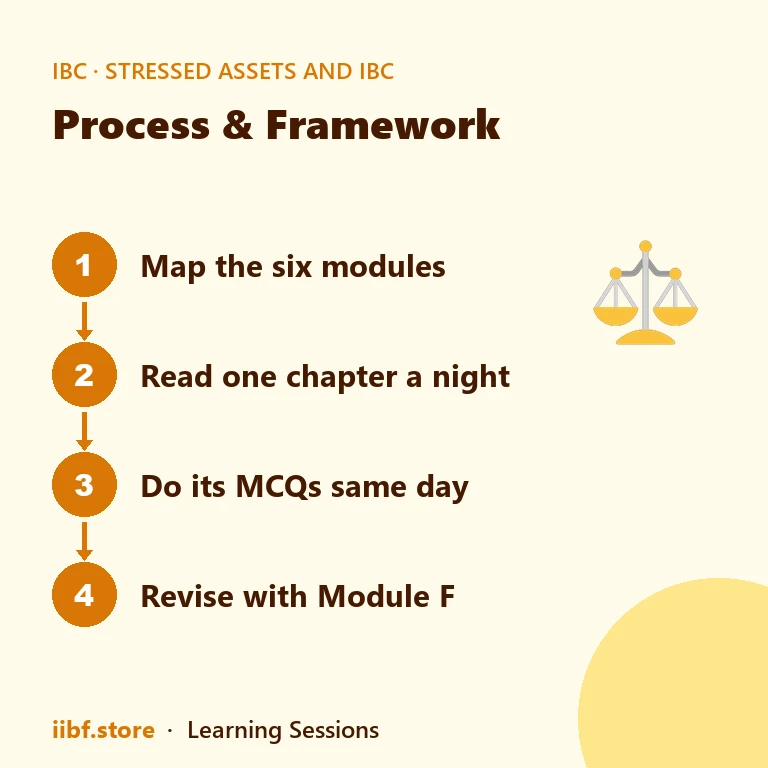
- Map first (one evening). Read only the module headings and chapter titles. Know where Module C starts and where Module F lives.
- One chapter a night. With 28 chapters, that is about four weeks at five nights a week, and some chapters are short enough to pair up.
- Questions the same day. Do the MCQs while the notes are fresh. Do not postpone them to the weekend.
- Revise from Module F. In the final week, the toolkit, appendix sheet and essential terms become your quick-reference set.
You can apply this schedule to any IBC material, but it fits this book's structure naturally.
The extras: case studies and mega tests
The book also lists two extras: 30 case studies with 120 questions, and 5 mega tests with 500 questions. Case-style questions matter for IBC because the exam likes to test whether you can apply a section to a situation, such as which application route fits a given default, or what a CoC member should verify before voting. Mega tests give you the stamina and timing that chapter-wise MCQs cannot.
An honest limit: a printed book will not give you exam-hall speed by itself. Pair it with timed practice. The free mock tests on iibf.store are a reasonable place to start, and the free study material library has PDFs you can read before deciding whether you need anything more.
Who gets the most out of the Stressed Assets and IBC book
Think of three readers. The first is the credit or recovery officer who handles stressed accounts daily and wants the legal framework organised in the order a case actually moves. The second is the branch manager preparing for the certificate who has read circulars but never read the Code in sequence. The third is the candidate in the last fortnight who needs Module F and the mega tests more than any other part.
Who gets less? Someone looking for a full commentary with every judgment reproduced. At 147 pages this is a focused exam-prep text, not a legal treatise. If you want depth on a single section, supplement it with the Code itself and the regulator's circulars.
Price, and where to check it
At the time of writing the book is listed at ₹700 against an MRP of ₹2,398. Prices can change, so treat the Stressed Assets and IBC book page as the current source. You can also compare other titles on the iibf.store books page.
A short conclusion for tired evenings
If you remember one thing, make it the sequence: why the Code exists, how the institutions fit, how a resolution case flows through Module C, then case laws and revision. That order works whether you use the Stressed Assets and IBC book or another source. If this book suits your style, the module layout above should now let you picture exactly how your evenings will look. If it does not, you still leave with a map and a four-step nightly plan.
How many chapters and questions does the book have?
It has 28 chapters in six modules, 240 MCQs and 147 pages in the 2026 edition. The extras listed are 30 case studies with 120 questions and 5 mega tests with 500 questions.
Which module should I spend the most time on?
Module C. It holds 13 of the 28 chapters and covers the corporate insolvency resolution process from application to liquidation, which is the heart of the subject.
Can I preview the book before buying?
Yes, a free sample is available from the book page. Also try the free mock tests and PDFs on iibf.store to judge your current level.
Where do I find the exam schedule?
This article does not quote dates or rules. Please check the official IIBF website for the schedule of the upcoming exam cycle.
Prefer revising from a printed book?
Chapter-wise books with MCQs after every chapter — minimal pages, complete coverage, delivered anywhere in India. Every book has a free sample to read first.










Quick quiz on this topic
5 exam-style questions from our free test bank — check yourself before you move on.
Practice this topic
Take a free mock test, download chapter PDFs, or watch a video class — all included on iibf.store.