Inside the Customer Service in Banks Book: 6 Modules, 33 Chapters
It is 9:40 pm. You have closed the branch, finished the day's reconciliation, and eaten something quick. Now there is a certificate exam on your calendar and a subject that looks easy and is not: customer service. Everyone in the bank thinks they already know it, which is exactly why candidates underprepare and then get surprised by regulatory and case-based questions.
If you are weighing up the Customer Service in Banks book, this article is a guided tour. We will open it up, show you how the six modules are laid out, what a single chapter looks like, and how to use it in the thirty or forty minutes a day you realistically have. Even if you never buy it, you will leave with a way to organise this subject.
Why customer service is harder to study than it sounds
Most of us learn customer service on the job, one difficult customer at a time. That is real experience, but an examination does not test experience. It tests whether you can name the right framework, recall the right regulatory expectation, and choose the best action in a short scenario.
Three things make this subject awkward for a working banker:
- It is wide. One day you are reading about banking channels and fintech partnerships, the next about emotional intelligence, and the day after about grievance redress and ombudsman remedies.
- It mixes soft and hard content. You need behavioural ideas (anger, negotiation, etiquette) and also regulatory ones (fair practices, KYC, consumer protection).
- Intuition misleads you. A reply that feels kind and practical may still be the wrong answer if it ignores a customer right or a policy requirement.
So the first job of any study material here is structure. You should always know which area you are in and what you are expected to be able to do when you finish it. That is how we approach the tour below.
How the Customer Service in Banks book is organised
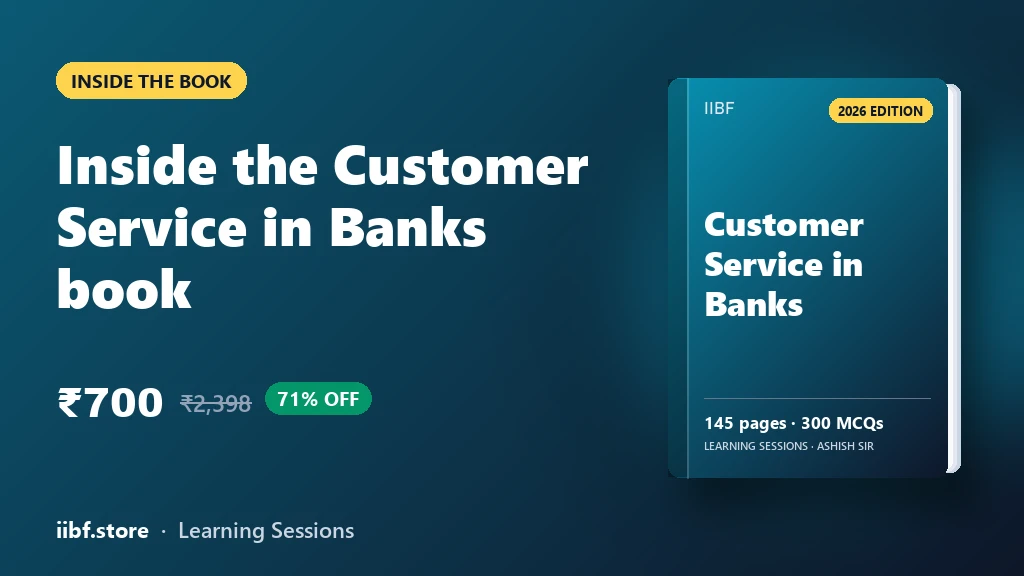
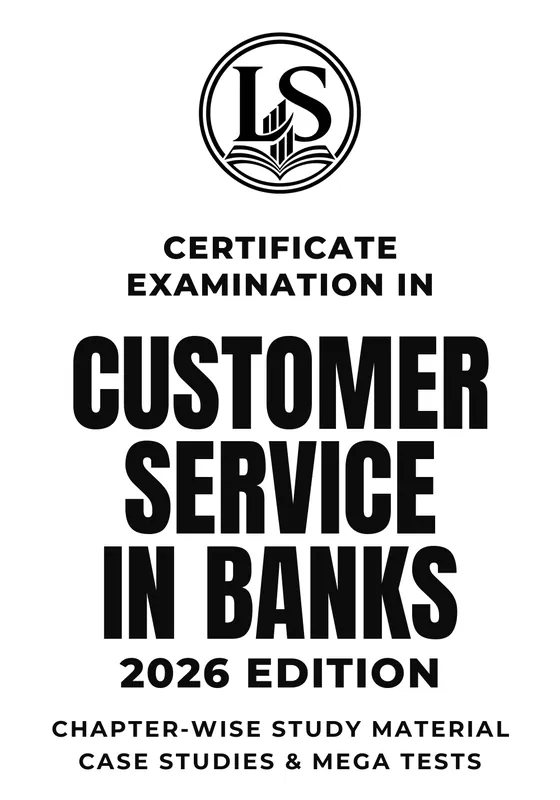
The Customer Service in Banks book runs to 145 pages in the 2026 edition and is split into six modules, A to F, holding 33 chapters in total. Think of the modules as six rooms, each with a clear purpose.
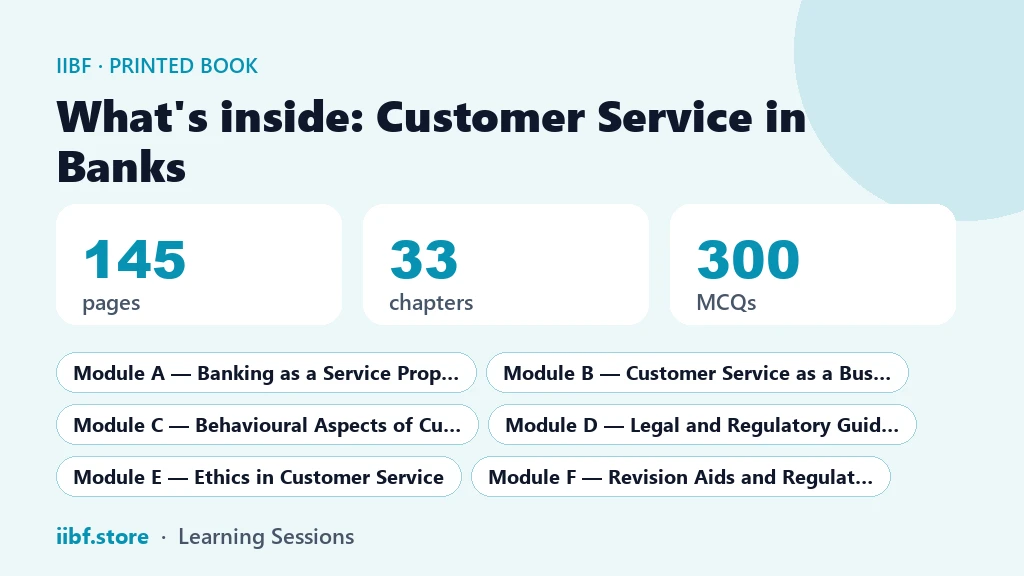
Module A: Banking as a Service Proposition (5 chapters)
This module sets the ground. It covers banking products and the customer promise, designing and delivering services, channels and customer touch points, banking as a service with fintech partnerships, and EASE 7.0 and customer delight. Read it as the vocabulary section: once these terms are comfortable, the later modules read much faster.
Module B: Customer Service as a Business Strategy (10 chapters)
The biggest module. It moves from the banker-customer relationship and CRM across the customer lifecycle to expectations and service-quality models, then AI and data analytics in CRM, communication, strategy and marketing, feedback and grievances across channels, digitised BFSI security, branch and controlling-office service, and financial inclusion. If you have limited time, this is where to spend it.
Module C: Behavioural Aspects of Customer Service (7 chapters)
Here the book turns to people skills: the customer-first approach, etiquette, grooming and time management, soft and hard skills with emotional intelligence, business communication, phone, online, in-person and GenAI interactions, difficult customers and stress, and conflict and complaint handling.
Module D: Legal and Regulatory Guidelines (6 chapters)
This is the module where guessing hurts. It covers customer-service reform, fair practices and customer rights, KYC and AML without unnecessary barriers, board policy and service committees, consumer protection in digital banking, grievance redress through the bank, the internal ombudsman and external remedies, and MSME initiatives.
Module E: Ethics in Customer Service (2 chapters)
Two short but important chapters: ethical dilemmas and reputation risk, and product suitability, mis-selling and integrated ethical cases. These are scenario-heavy, so read them slowly.
Module F: Revision Aids and Regulatory Updates (3 chapters)
The last room is for the final week: revision comparisons and service checklists, service terms and measurement in simple language, and a chapter on regulatory dates with a June 2026 study track and October 2026 practice.
What one chapter looks like
Long books lose tired readers. The design question for a working banker is simple: can you finish one chapter in a single sitting and know whether it stuck? In the Customer Service in Banks book each chapter follows the same rhythm, so after the first one you stop thinking about format and just study.
- Concise notes. The chapter explains the topic in short paragraphs, written for revision rather than for a library shelf.
- Key points. The essentials are pulled out so that you can re-read them in a minute before the exam.
- MCQs. The book carries 300 questions overall, so you test yourself while the material is fresh instead of hoping it stayed.
Take a chapter such as Grievance Redress: Bank, Internal Ombudsman and External Remedies from Module D. You read the notes, underline the sequence of remedies, glance at the key points, and then attempt the questions. If you miss one, you know exactly which paragraph to go back to. That feedback loop is what turns reading into preparation.
The extras: case studies and mega tests
Beyond the chapters, the book includes two practice extras, as listed on the book page:
- 30 case studies (120 questions). Scenario practice is where customer service marks are won or lost. A case study makes you apply the frameworks to a situation, which is a different skill from recognising a definition.
- 5 mega tests (500 questions). Full-length practice at the end, so you can check stamina and accuracy once you have covered the modules.
If you want to try the style of questions first, the book page has a free sample, and you can also practise on the free mock tests available on the site.
A four-step plan for using the Customer Service in Banks book
Here is a method that fits an evening routine. Adjust the pace to your own exam date, which you should confirm on the official IIBF website, since schedules change from one cycle to the next.
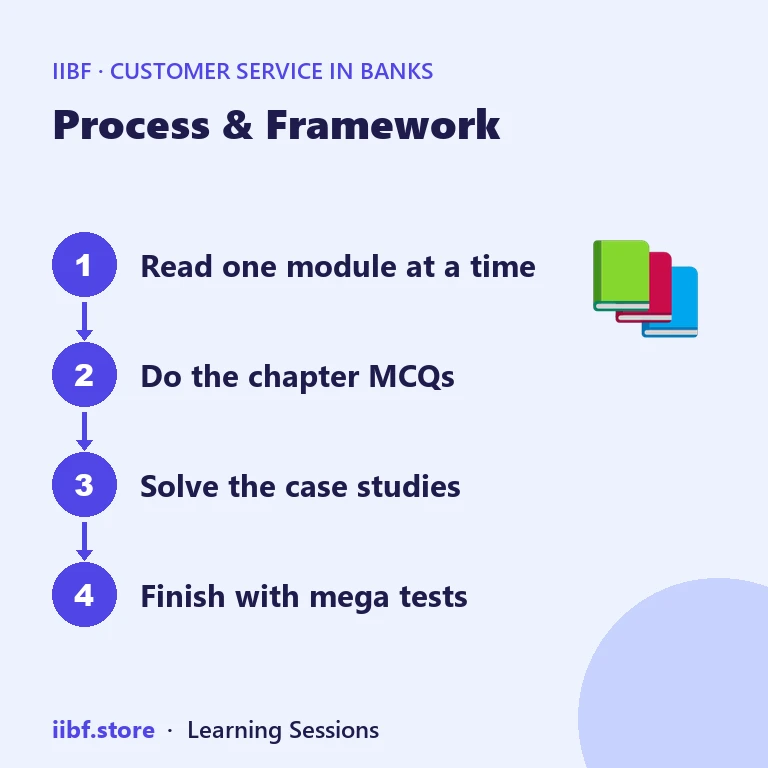
Step 1: Read one module at a time
Do not skip around. Start with Module A for vocabulary, then B, C and D. Aim for one or two chapters per sitting. Short chapters (Module E) can be paired.
Step 2: Do the chapter MCQs the same day
Do not postpone the questions to the weekend. Attempting them within hours of reading is what makes the content stay.
Step 3: Solve the case studies after each module
When a module ends, take the matching scenarios. Write down, in one line, why the correct option is better than the second-best one. That habit is worth more than extra reading.
Step 4: Finish with mega tests and Module F
In the last stretch, use the five mega tests for timing and use Module F's checklists and comparisons for quick revision. Note every wrong answer and revisit only those chapters.
| Module | Theme | Chapters |
|---|---|---|
| A | Banking as a Service Proposition | 5 |
| B | Customer Service as a Business Strategy | 10 |
| C | Behavioural Aspects of Customer Service | 7 |
| D | Legal and Regulatory Guidelines | 6 |
| E | Ethics in Customer Service | 2 |
| F | Revision Aids and Regulatory Updates | 3 |
| Total | 33 |
Who gets the most out of this book
Be honest with yourself about where you stand, because a book helps different people in different ways.
- Branch staff with strong field experience but weak theory. You already handle customers well; Modules A, B and D give you the frameworks and regulatory language that the exam expects.
- Back-office or ops staff. You may rarely face customers, so Module C and the case studies will feel most useful.
- Anyone short of time. A single 145-page book with the notes, key points and MCQs in one place is easier to carry through a busy month than several loose sources.
- Repeat candidates. If you have postponed before, the structured chapters and mega tests give you a clear, finishable path rather than an open-ended syllabus.
One honest limit: a book alone will not give you exam-hall speed. Pair it with timed practice from the free mock tests, and browse the free study material if you want extra reading on a weak area. Our full books collection lists other titles if you are preparing for more than one paper.
The bottom line on the Customer Service in Banks book
If you want one organised resource for this paper, the Customer Service in Banks book gives you 33 chapters across six modules, 300 MCQs, 30 case studies and 5 mega tests, in 145 pages. Pricing is ₹700 against an MRP of ₹2,398 at the time of writing; prices may change, so the book page always has the current figure, along with the free sample you can read before deciding.
Whatever you choose, start tonight with Module A, Chapter 1 and its questions. One chapter finished is better than a perfect plan.
Frequently asked questions
How many chapters and questions does the book have?
The book has 145 pages, 33 chapters in six modules (A to F) and 300 MCQs. It also lists 30 case studies with 120 questions and 5 mega tests with 500 questions.
Is there a free sample before I buy?
Yes. The book page offers a free sample so you can check the writing style and question format first.
Can I rely only on this book?
It is a structured base, but speed and accuracy come from practice. Add timed mocks and check the official IIBF site for the upcoming exam cycle and syllabus updates.
Which module should I read first?
Start with Module A for the core vocabulary, then move through B, C and D in order. Keep Module F for the final revision week.
Prefer revising from a printed book?
Chapter-wise books with MCQs after every chapter — minimal pages, complete coverage, delivered anywhere in India. Every book has a free sample to read first.


















Practice this topic
Take a free mock test, download chapter PDFs, or watch a video class — all included on iibf.store.