IT Security in Banks: ISO 27001 Guide 2026
IT Security in Banks is no longer a back-office concern; it is central to how customers trust the financial system. As digital banking, UPI, mobile apps and cloud services expand, so does the attack surface that criminals target. For candidates preparing for IIBF certificate examinations in 2026, understanding how banks protect information through frameworks such as ISO 27001 is essential. This article explains the Information Security Management System (ISMS), the CIA triad, key technical controls, penetration testing, encryption, SWIFT security and the RBI cyber framework in plain, exam-ready language.
ISO 27001 and the Information Security Management System
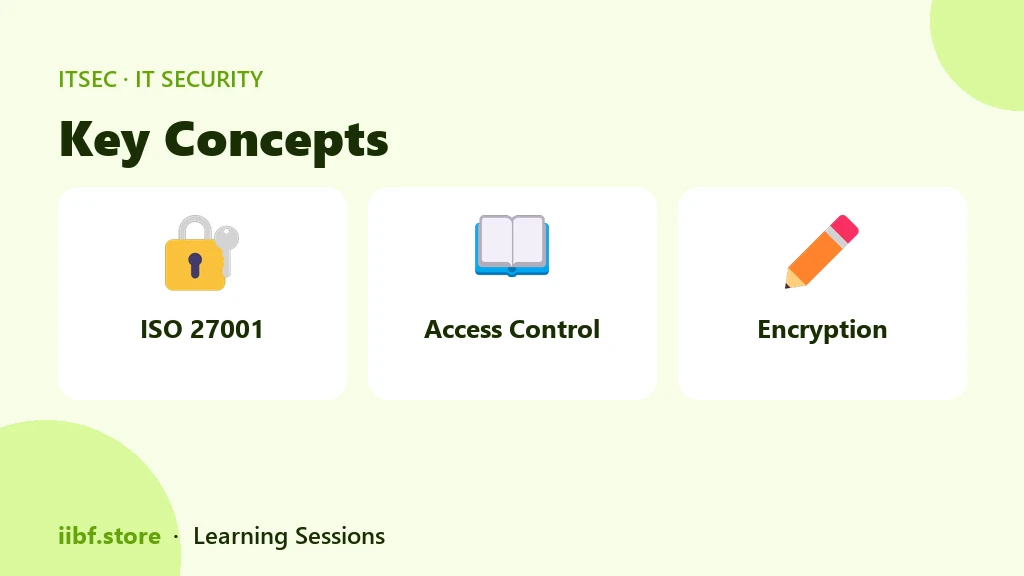
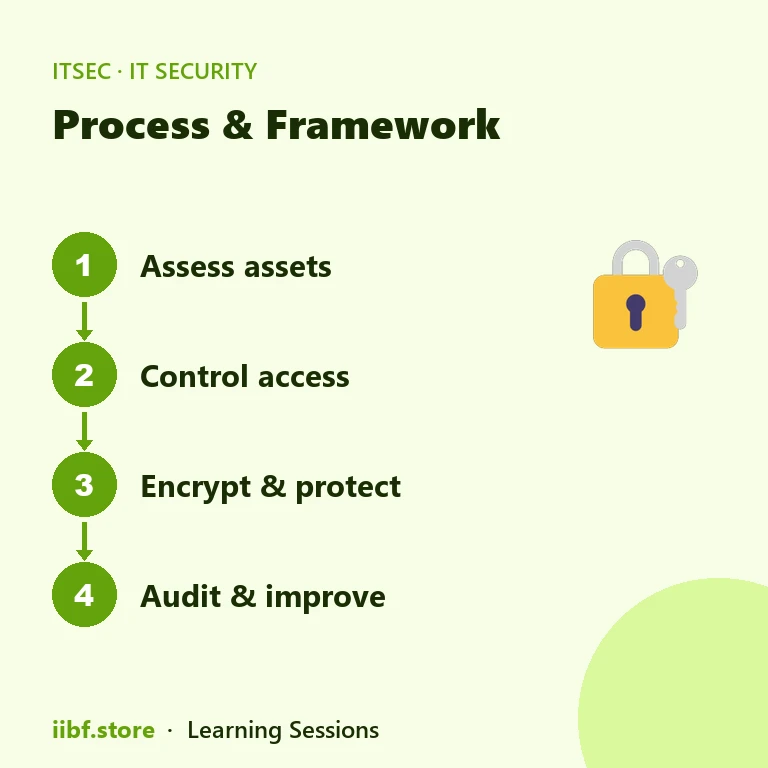
ISO 27001 is the international standard that defines how an organisation should build an Information Security Management System, or ISMS. Rather than prescribing a single tool, it sets out a management approach: identify information assets, assess the risks to them, apply proportionate controls, and continuously improve. Banks adopt ISO 27001 because it gives regulators, auditors and customers confidence that security is governed systematically rather than left to individual teams.
At the heart of the standard is a risk assessment. The bank lists assets such as customer databases, core banking systems and payment gateways, then evaluates threats and vulnerabilities against each. Controls are chosen from Annex A, which covers areas like access control, cryptography, physical security, supplier relationships and incident management. The system runs on a Plan-Do-Check-Act cycle, so policies are reviewed, tested and refined every year. Independent certification bodies audit the bank periodically, and non-conformities must be closed within agreed timelines. For an exam, remember that ISO 27001 certifies the management system, not a product, and that leadership commitment and documented risk treatment are its non-negotiable pillars. Candidates can deepen this foundation through structured preparation on the CAIIB course.
The CIA Triad and Core Security Principles
Every discussion of IT Security in Banks returns to the CIA triad: Confidentiality, Integrity and Availability. Confidentiality means that account balances, PINs and personal data are visible only to authorised people. Integrity ensures that a transaction of ten thousand rupees cannot be silently altered to one lakh in transit or storage. Availability guarantees that the net-banking portal and ATM network stay online when customers need them, even during a cyberattack or hardware failure.
These three goals shape almost every control a bank deploys. Confidentiality is protected through access controls, role-based permissions and encryption. Integrity relies on hashing, digital signatures, checksums and strict change management so that data cannot be tampered with unnoticed. Availability is defended with redundant data centres, backups, load balancing and disaster-recovery plans that are tested regularly. Two supporting principles often appear alongside the triad: authentication, which confirms who a user is, and non-repudiation, which prevents someone from later denying a transaction they authorised. A well-designed banking system balances all of these; over-securing availability at the cost of confidentiality, or vice versa, creates real business risk. Understanding this balance is a frequent theme in objective questions, and you can test your grasp on the practice tests.
VAPT, Network Security and Data Encryption
Knowing your defences works requires actively testing them, which is where Vulnerability Assessment and Penetration Testing, or VAPT, comes in. A vulnerability assessment scans systems to list known weaknesses, while penetration testing goes further, simulating a real attacker to see whether those weaknesses can be exploited. Indian banks run VAPT on internet-facing applications regularly and after every major change, and the RBI expects the findings to be tracked to closure.
Network security wraps the bank in layered defences. Firewalls filter traffic between trusted and untrusted zones, intrusion detection and prevention systems watch for malicious patterns, and network segmentation ensures that a breach in one area, such as a branch, cannot spread to the core payment systems. Data encryption is the final safety net. Data in transit is protected with TLS so that information moving between a customer and the bank cannot be read if intercepted, while data at rest is encrypted in databases and backups. Banks manage cryptographic keys carefully, often in hardware security modules, because a leaked key defeats the strongest algorithm. For candidates, the key exam point is that encryption protects confidentiality even when other controls fail, and VAPT provides the assurance that controls actually hold. Keep pace with regulatory expectations through IIBF news updates.
SWIFT Security, Cloud Security and the RBI Cyber Framework
The SWIFT network carries high-value international payments, so it is a prime target for attackers. After several global heists, SWIFT introduced its Customer Security Programme, a mandatory set of controls covering the messaging environment, access management, and detection and response. Banks must attest to compliance annually, isolating SWIFT terminals, enforcing multi-factor authentication and monitoring for unusual payment patterns.
Cloud security has become equally important as banks move workloads to cloud providers. The shared-responsibility model matters here: the provider secures the underlying infrastructure, but the bank remains responsible for configuring access, encrypting its own data and managing identities. Misconfigured storage and weak identity controls are leading causes of cloud breaches, so governance is vital. Overarching all of this in India is the Reserve Bank of India cyber security framework. Issued to banks, it mandates a board-approved cyber security policy, a Security Operations Centre for continuous monitoring, and prompt reporting of cyber incidents. The RBI publishes its master directions and circulars, which you can read on the official Reserve Bank of India website, and these form the compliance baseline every Indian bank must meet. Exam questions often test whether you know that the RBI framework is mandatory and incident-reporting is time-bound. Explore related study material on the iibf.store blog.
Conclusion: Build Your IT Security Foundation for 2026
IT Security in Banks blends governance frameworks like ISO 27001, the timeless CIA triad, and practical controls such as VAPT, encryption, SWIFT security and RBI-mandated cyber measures. Mastering how these pieces fit together not only helps you clear IIBF certificate examinations but also prepares you for real responsibilities in a modern bank. The safest banks treat security as a continuous discipline, not a one-time project, and the same steady approach works for your preparation. Start reinforcing these concepts today with focused mock exams on our practice tests, and give yourself the confidence to answer every information-security question in 2026 correctly.
Building a Culture of IT Security in Banks
Technology alone cannot secure a bank; people and processes complete the picture. The strongest firewalls and the best encryption fail if an employee clicks a phishing link or shares a password. That is why mature IT Security in Banks programmes invest heavily in awareness training, teaching staff to spot social engineering, report suspicious emails and follow clean-desk and least-privilege practices. Regular simulated phishing campaigns measure how well these lessons stick and highlight teams that need refresher sessions.
Processes matter just as much. A clear incident-response plan defines who does what when a breach is detected, from isolating affected systems to notifying the RBI within mandated timelines. Change management ensures that new software is tested and approved before it touches production, reducing the chance that a rushed update opens a fresh vulnerability. Vendor risk management extends the same discipline to third parties, since a weak supplier can become the bank's weakest link. Finally, board-level oversight keeps security funded and prioritised. For exam candidates, the takeaway is that governance, awareness and technology together create real resilience, and no single layer is sufficient on its own. Reinforce these ideas and track your progress with the structured CAIIB course and repeated practice tests before your 2026 attempt.
What is ISO 27001 in the context of banking?
ISO 27001 is the international standard for an Information Security Management System. It gives banks a risk-based, documented method to identify assets, assess threats, apply controls and improve continuously, and it can be independently certified.
What does the CIA triad stand for?
The CIA triad stands for Confidentiality, Integrity and Availability. These three principles guide almost every security control a bank uses, ensuring data stays private, accurate and accessible to authorised users.
What is VAPT and why do banks use it?
VAPT is Vulnerability Assessment and Penetration Testing. It first scans systems for known weaknesses, then simulates real attacks to confirm whether those weaknesses can be exploited, giving banks assurance that their defences actually work.
Is the RBI cyber security framework mandatory for banks?
Yes. The RBI cyber security framework is mandatory. It requires a board-approved cyber policy, a Security Operations Centre for continuous monitoring, and time-bound reporting of cyber incidents to the regulator.
Practice this topic
Take a free mock test, download chapter PDFs, or watch a video class — all included on iibf.store.