JAIIB IE IFS Study Plan for Working Bankers: 28 Days After Branch Hours
It is 9:40 pm. The branch closed late because of a cash mismatch, the commute took an hour, and dinner is still on the table. Somewhere in your bag is a JAIIB syllabus that looks endless: economy, finance, regulators, markets, derivatives, mutual funds. You tell yourself you will start properly on Sunday. Then Sunday has a family function.
If this is you, you do not need more motivation. You need a smaller plan. This article gives you a realistic JAIIB IE IFS study plan for Indian Economy and Indian Financial System that fits around a full-time bank job. It works in short sessions of 60 to 90 minutes, and it is built so that even a missed day does not break it.
Why IE & IFS feels harder than it is
Most working bankers do not fail this paper because it is difficult. They fail because it is wide. The paper moves from India's planning history to monetary policy, then to banking law, NBFCs, bond markets, derivatives and pension schemes. Each topic is individually simple. Together they feel like a mountain, and a tired mind avoids mountains.
Three habits make it worse:
- Starting with the biggest chapter. You open a heavy chapter at 10 pm, get stuck, and close the book feeling guilty.
- Reading without testing. You finish a chapter, feel good, and forget most of it in three days.
- Studying in the order of interest, not the order of the syllabus. Gaps appear in the topics you disliked.
The fix is boring but it works: fixed order, small daily load, questions on the same day you read. That is exactly what the plan below does.
The four modules, so you know what you are climbing
Before planning days, plan the territory. The paper has four modules and the chapter counts are very uneven, which matters for your schedule.
Module A: Indian Economic Architecture (11 chapters)
Starts with an overview of the Indian economy, economic planning, sectors, priority sector and MSME, infrastructure, globalisation, reforms, foreign trade policy, international economic organisations such as the World Bank and IMF, climate change and SDGs, and the issues facing the economy. This is mostly descriptive reading. Good for your lowest-energy evenings.
Module B: Economic Concepts Related to Banking (8 chapters)
Fundamentals of economics, supply and demand, money supply and inflation, theories of interest, business cycles, monetary and fiscal policy, national income and GDP concepts, and the Union Budget. This is the most conceptual module, so give it your fresher weekend hours.
Module C: Indian Financial Architecture (9 chapters)
The financial system overview, banking structure, the Banking Regulation Act, 1949 and RBI Act, 1934, development financial institutions, microfinance institutions, NBFCs, insurance companies, regulators and their roles, and banking sector reforms. You already know much of this from work, so you will move faster here.
Module D: Financial Products and Services (17 chapters)
The biggest module: financial markets, money and capital markets, bond markets, stock exchanges, forex, market interconnection, merchant banking, derivatives including credit default swaps, factoring, forfaiting and TReDS, venture capital, leasing and hire purchase, credit rating agencies, mutual funds, insurance products, pension funds including APY and NPS, para-banking guidelines, and REITs and InvITs. Almost half the chapters live here, so it gets almost half your days.
One honest note: syllabus and pattern details change between cycles. Always confirm the current curriculum on the official IIBF website before you finalise anything.
The book that anchors this plan
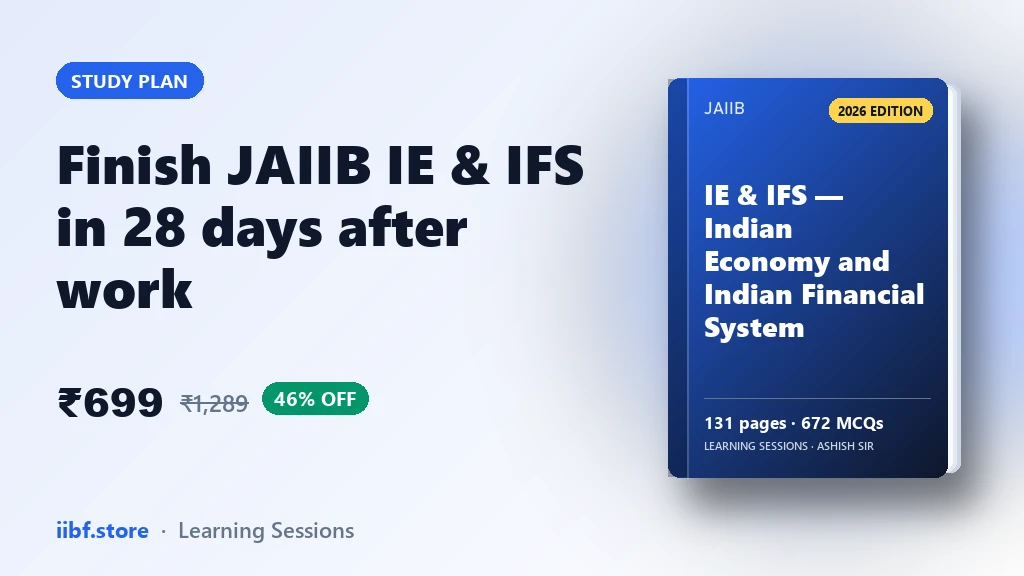
A plan needs a fixed set of pages to run on. If you jump between PDFs, notes from a colleague and videos, you lose the first twenty minutes of every evening deciding what to open. The JAIIB IE & IFS printed book is built for this situation: 131 pages across 45 chapters and the four modules above, with 672 questions, plus 50 case studies carrying 200 questions. It is the 2026 edition.
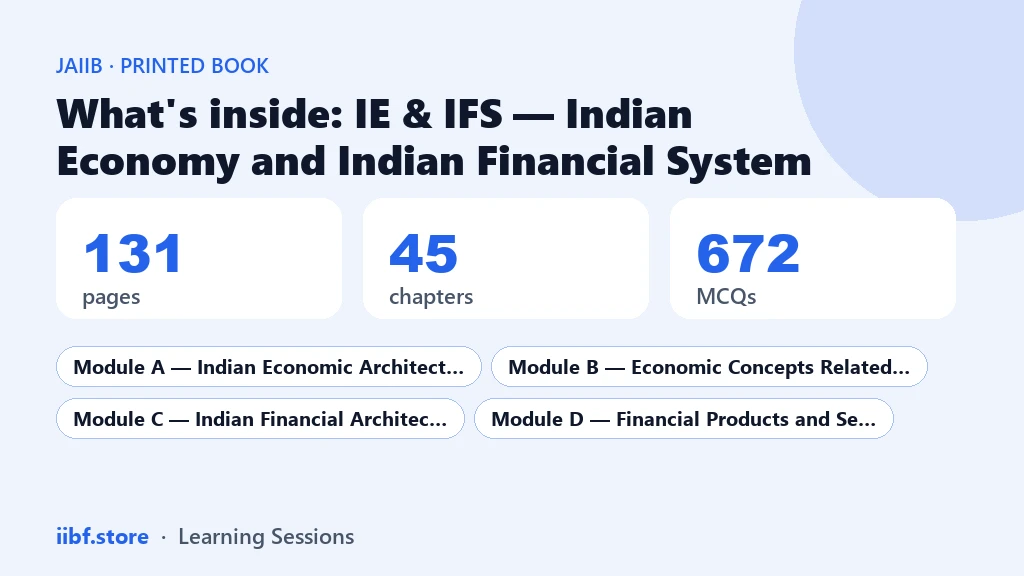
The practical advantage is the page count. At 131 pages, the whole paper is something you can physically hold and see the end of. That changes how the mind treats it. Reading 4 to 6 pages a night feels possible; "finish the syllabus" does not.
The price on the book page at the time of writing is ₹699 against an MRP of ₹1,289, which the site shows as 46% off. Prices can change, so treat the book page as the current source. There is also a free sample you can read before deciding.
The method: four rules for a tired brain
Whatever material you use, the same four rules keep a JAIIB IE IFS study plan alive for a working banker.
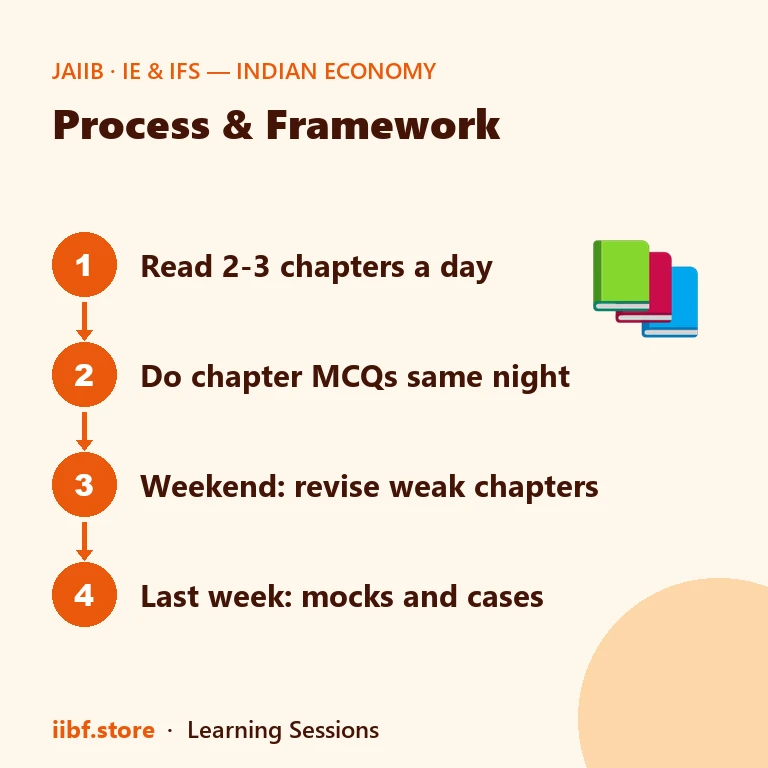
- Read two or three chapters a night, not ten. The chapters are short. Your target is one sitting, around 60 minutes, with the phone in another room.
- Do that chapter's MCQs the same night. Do not postpone. A question you get wrong tonight is worth far more than a page you merely read.
- Keep a one-line error log. For every wrong answer, write the fact that beat you, in one line. Revise this log, not the whole chapter.
- Protect one weekend slot. Two hours on Saturday or Sunday to revisit the error log and the heaviest chapters from the week.
If you miss a day, do not "make up" by doubling the next one. Slide the whole table forward by one day. A plan that punishes you for being human gets abandoned by day nine.
Your 28-day JAIIB IE IFS study plan, day by day
The table below spreads all 45 chapters over four weeks and keeps the last week for revision, case studies and mocks. Weekday sessions are 60 to 75 minutes; weekend sessions can go to two hours. Adjust the dates to your own calendar, not the other way round.
| Days | What to read | Questions to attempt |
|---|---|---|
| Days 1-4 | Module A, chapters 1-6: economy overview, planning, sectors, priority sector and MSME, infrastructure, globalisation | Each chapter's MCQs on the same night |
| Days 5-7 | Module A, chapters 7-11: reforms, foreign trade, international organisations, climate and SDGs, issues facing the economy | Chapter MCQs, then a short recap of Module A from your error log |
| Days 8-10 | Module B, chapters 1-4: economics fundamentals, supply and demand, money supply and inflation, theories of interest | Chapter MCQs; redo wrong ones the next morning |
| Days 11-12 | Module B, chapters 5-8: business cycles, monetary and fiscal policy, national income and GDP, Union Budget | Chapter MCQs; weekend recap of Modules A and B |
| Days 13-15 | Module C, chapters 1-5: financial system overview, banking structure, BR Act and RBI Act, DFIs, microfinance | Chapter MCQs the same night |
| Days 16-17 | Module C, chapters 6-9: NBFCs, insurance companies, regulators and their roles, banking sector reforms | Chapter MCQs; weekend recap of Module C |
| Days 18-20 | Module D, chapters 1-6: financial markets, money and capital markets, bond markets, stock exchanges, forex, market dynamics | Chapter MCQs; keep the error log growing |
| Days 21-23 | Module D, chapters 7-12: merchant banking, derivatives and CDS, factoring and TReDS, venture capital, leasing, credit rating agencies | Chapter MCQs the same night |
| Days 24-25 | Module D, chapters 13-17: mutual funds, insurance products, pension funds, para-banking, REITs and InvITs | Chapter MCQs; finish the first full pass |
| Days 26-28 | Revision week: error log first, then the 50 case studies and the weakest modules | Case-study questions, then full-length timed mocks |
Notice what this table does not ask for: no night over two hours, no giving up weekends entirely, no reading before dawn. It asks for consistency, and consistency is the only thing a person with a job can actually offer.
How to use the MCQs, case studies and mocks
The questions are where marks are won or lost, so treat them as the main course and the reading as the starter.
Chapter MCQs: the first pass
Attempt them without looking at the chapter. A wrong answer is information, not failure. Log it, check the explanation, move on. Do not re-read a whole chapter for one missed fact.
Case studies: the application pass
The book includes 50 case studies with 200 questions. Keep these for the revision week, when you know enough to apply ideas rather than just recall them. Reading a short scenario and picking the right regulatory or market concept is a different skill from recalling a definition, and it deserves its own practice.
Timed mocks: the exam-hall pass
Here is the limit of any book, including this one: pages and chapter questions will not give you exam-hall speed. For that you need timed practice. Use the free mock tests on iibf.store in the last three days, and note which module costs you the most time. If you want extra free reading, the free study material section is worth a look for revision.
Making the JAIIB IE IFS study plan survive real life
Plans fail in week two, not week one. A few small adjustments keep this one alive:
- Study at the same time daily. A fixed slot after dinner beats a heroic but irregular one.
- Use commute minutes for the error log. Photograph the log on your phone and read it on the way to work.
- Do Module A on your worst days. Descriptive chapters are forgiving when you are exhausted.
- Link chapters to your work. Priority sector, NBFCs, regulators and para-banking already appear in your branch life. Connecting a page to a customer you met this week makes it stick.
- Never skip the same-night MCQs. If time is short, shorten the reading, not the questions.
If you are starting from a very low base, stretch the table from 28 to 40 days. The order and the habits stay identical; only the daily load shrinks.
The last-week checklist
In the final three days, stop reading new material. Go through your error log twice, redo the case studies you got wrong, and sit at least one timed mock under exam conditions. Sleep properly the night before. A rested mind recalls more than an extra hour of panicked reading. For schedule, eligibility and any notice about the upcoming exam cycle, check only the official IIBF site.
If you want a fixed set of pages to anchor the routine, the IE & IFS book page has the chapter list and the free sample. You can also browse all titles at iibf.store/books, and the JAIIB course page lists the other papers. Whichever material you pick, the winning move is the same: begin tonight, with one chapter, and do its questions before you sleep.
Frequently asked questions
Can I really cover IE & IFS in 28 days while working full time?
For most people the first pass is realistic at 60 to 90 minutes on weekdays and about two hours on weekends, provided you do the same-night MCQs. If your base is weak or your branch hours are unpredictable, stretch it to 40 days. The sequence matters more than the number of days.
Which module should I study first?
Follow the syllabus order, starting with Module A. It is descriptive and eases you into the habit. Save the conceptual Module B for fresher weekend hours and give Module D the most days because it has the most chapters.
Is a book alone enough to clear the paper?
A book gives you structure and questions, but not exam-hall speed. Pair it with timed mock tests in the last week, and keep your error log. Also check the official IIBF website for the current syllabus and exam details before you plan.
How much does the printed book cost and can I see a sample first?
At the time of writing it is listed at ₹699 against an MRP of ₹1,289, but prices may change, so check the book page for the current figure. A free sample is available there to read before you order.
Prefer revising from a printed book?
Chapter-wise books with MCQs after every chapter — minimal pages, complete coverage, delivered anywhere in India. Every book has a free sample to read first.
131 pages · 672 MCQs
Learning Sessions · Ashish Sir
221 pages · 831 MCQs
Learning Sessions · Ashish Sir
128 pages · 524 MCQs
Learning Sessions · Ashish Sir
107 pages · 445 MCQs
Learning Sessions · Ashish Sir
148 pages · 478 MCQs
Learning Sessions · Ashish Sir
151 pages · 465 MCQs
Learning Sessions · Ashish Sir
148 pages · 375 MCQs
Learning Sessions · Ashish Sir
216 pages · 895 MCQs
Learning Sessions · Ashish Sir
109 pages · 300 MCQs
Learning Sessions · Ashish Sir
104 pages · 360 MCQs
Learning Sessions · Ashish Sir
82 pages · 297 MCQs
Learning Sessions · Ashish Sir
151 pages · 600 MCQs
Learning Sessions · Ashish Sir
98 pages · 282 MCQs
Learning Sessions · Ashish Sir
132 pages · 225 MCQs
Learning Sessions · Ashish Sir
188 pages · 435 MCQs
Learning Sessions · Ashish Sir
117 pages · 236 MCQs
Learning Sessions · Ashish Sir
Learning Sessions · Ashish Sir
118 pages · 299 MCQs
Learning Sessions · Ashish Sir
Learning Sessions · Ashish Sir
Learning Sessions · Ashish Sir
Learning Sessions · Ashish Sir
115 pages · 255 MCQs
Learning Sessions · Ashish Sir
Learning Sessions · Ashish Sir
334 pages · 936 MCQs
Learning Sessions · Ashish Sir
Learning Sessions · Ashish Sir
115 pages · 344 MCQs
Learning Sessions · Ashish Sir
107 pages · 240 MCQs
Learning Sessions · Ashish Sir
90 pages · 150 MCQs
Learning Sessions · Ashish Sir
Learning Sessions · Ashish Sir
Quick quiz on this topic
5 exam-style questions from our free test bank — check yourself before you move on.
Practice this topic
Take a free mock test, download chapter PDFs, or watch a video class — all included on iibf.store.
Keep reading