JAIIB GDP Numericals: IE and IFS Day 1 Revision
Seven days to finish Indian Economy and Indian Financial System sounds like a stunt until you look at what the paper actually rewards. Day 1 is not a tour of every chapter. It is the numerical core, and it is deliberate: if you can compute national income confidently, a whole block of marks stops being a gamble. That is why JAIIB GDP numericals belong on the first day rather than the last. They are formula-driven, they repeat with only the figures changed, and they are among the few questions in this paper where an answer is simply right or wrong, with no interpretation to argue about.
Here is the Day 1 session. Below it, the same ground is written out so you can revise without scrubbing through the video again.
IE and IFS in Just 7 Days · Day 1: Indian Economy and GDP Numericals · Watch on YouTube
Why the national income block is worth attacking first
Most candidates lose marks here for one reason: they memorise four similar-sounding terms and then meet a question that asks them to move between two of them. Gross Value Added, GDP at market prices, Net National Product, per capita income — each one differs from its neighbour by a single adjustment. Learn the adjustments and the whole family collapses into one chain you can walk in either direction.
The examiner exploits exactly this. A typical question gives you GVA at basic prices, product taxes and product subsidies, then asks for GDP at market prices. Another gives you nominal and real GDP and asks for the deflator. A third gives you national income and population and asks for per capita income. None of them are hard arithmetic. They are hard only if you are unsure which direction the adjustment runs.
The five measures you must be able to separate
Fix these in order. Every conversion is a single line, and once the order is in your head, the arithmetic follows itself.
| Measure | How you reach it | What it tells you |
|---|---|---|
| GVA at basic prices | Output minus intermediate consumption | Value actually added by producers |
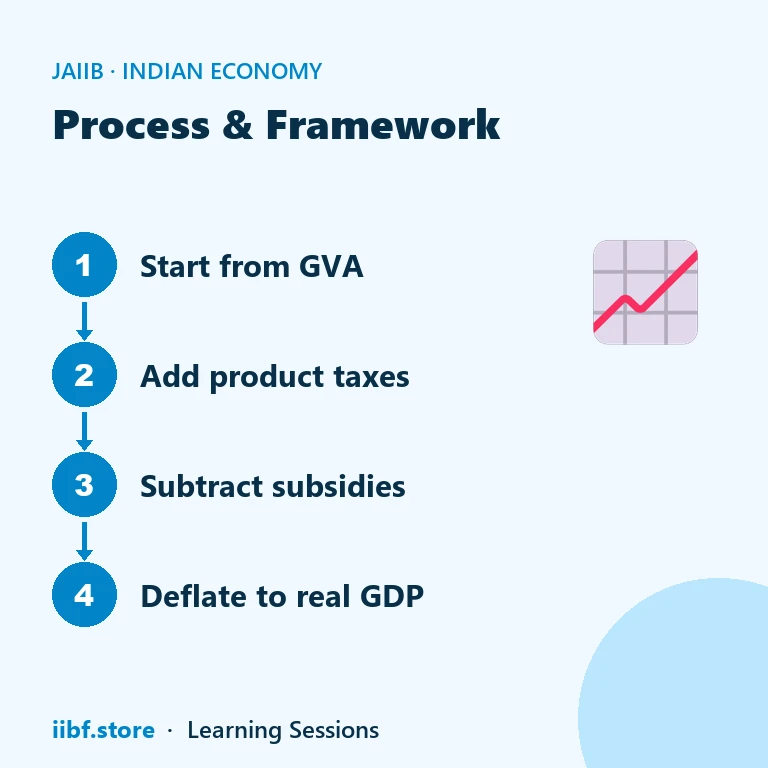
| GDP at market prices | GVA at basic prices + product taxes − product subsidies | Output valued at the prices buyers pay |
| GNP at market prices | GDP + net factor income from abroad | Income earned by residents, wherever earned |
| NNP at market prices | GNP − depreciation | Output after replacing worn-out capital |
| National income (NNP at factor cost) | NNP at market prices − net indirect taxes | Income actually accruing to factors of production |
Two traps live in this table. First, net factor income from abroad can be negative, and for India it usually is — do not assume GNP exceeds GDP. Second, depreciation always reduces, never adds; if your NNP comes out larger than your GNP, you have applied the sign backwards.
A worked example you can reuse
Suppose an economy reports GVA at basic prices of ₹250 lakh crore, product taxes of ₹30 lakh crore and product subsidies of ₹10 lakh crore. Net factor income from abroad is −₹5 lakh crore and depreciation is ₹20 lakh crore.
Step 1 — GDP at market prices. 250 + 30 − 10 = ₹270 lakh crore.
Step 2 — GNP at market prices. 270 + (−5) = ₹265 lakh crore.
Step 3 — NNP at market prices. 265 − 20 = ₹245 lakh crore.
Now add a price question on top, because that is how the paper stacks difficulty. If nominal GDP is ₹270 lakh crore and real GDP at base-year prices is ₹250 lakh crore, the GDP deflator is (270 ÷ 250) × 100 = 108. Prices have risen 8 per cent over the base year. Notice what the deflator is not: it is not the Consumer Price Index. The deflator covers everything produced domestically and its basket changes every year, while CPI tracks a fixed consumption basket. Questions that ask which measure is broader are asking about precisely this difference.
Finally, growth. Real growth is always computed on real GDP, never nominal. If real GDP moves from ₹250 to ₹267 lakh crore, growth is (267 − 250) ÷ 250 = 6.8 per cent. For context, the Reserve Bank has projected real GDP growth for 2026-27 at 6.9 per cent, a figure worth carrying into the exam hall because current-data questions do appear. Confirm the latest projection in the RBI Bulletin before your attempt.
How to fit this into 40 minutes a day
The seven-day plan only works if each sitting has a single job. Day 1 has two: build the chain above, then solve until the chain is automatic. Ten minutes writing the five conversions from memory, twenty minutes on mixed sums, ten minutes on the deflator and per capita variants. Do not read theory chapters on Day 1 — they will still be there on Day 3, and they are far easier to absorb once you know what the numbers mean.
Practice matters more than notes here. Work through a mixed set on the IE and IFS practice tests rather than re-reading solved examples, because recognition feels like knowledge and is not. If your revision is spread across subjects, build the week out in the study planner so Day 1 does not quietly become Day 4. And keep the current RBI rates page open while you revise, since policy figures date faster than anything else in this paper.
One last discipline. When you attempt JAIIB GDP numericals under time pressure, write the formula before you write any number. Candidates who plug figures straight into a half-remembered expression lose marks on sign errors, not on concepts. The full syllabus for this paper sits in the JAIIB course pages, and the official rules and syllabus document is published on iibf.org.in.
What Day 1 should leave you with
By the end of the session you should be able to do three things without hesitation: walk from GVA to national income in five lines, compute a deflator and say what it means, and calculate real growth without touching nominal figures. That is a narrow target, and that is the point. Seven days works only if each day closes one thing completely instead of half-opening four.
Come back to these JAIIB GDP numericals on Day 4 and Day 7 as a five-minute warm-up. Spaced repetition on a small, high-yield block beats one long session, and it costs almost nothing once the chain is built. The rest of the paper — financial markets, regulators, monetary policy — is far more forgiving of a rushed reading than this block ever is.
Frequently asked questions
Is GDP at market prices the same as GDP at factor cost?
No. GDP at market prices includes product taxes and excludes product subsidies, while factor-cost measures strip out net indirect taxes. India now headlines GVA at basic prices and GDP at market prices, so read the question wording carefully before converting.
Which is used for real growth, nominal GDP or real GDP?
Always real GDP. Nominal figures include price changes, so a nominal increase can occur even when output falls. Deflate first, then compute growth.
How many marks do these numericals usually carry?
IIBF does not publish a topic-wise breakup, so treat any specific count as an estimate. What is reliable is that national income appears in Module A of the paper every cycle, and the calculations are short enough to be worth full accuracy.
What is the pass requirement for this paper?
Per the IIBF JAIIB Rules and Syllabus, the minimum is 50 out of 100 in the subject. A candidate securing at least 45 in each subject with a 50 per cent aggregate across all subjects in a single attempt is also declared as having completed the examination.
Quick quiz on this topic
5 exam-style questions from our free test bank — check yourself before you move on.
Practice this topic
Take a free mock test, download chapter PDFs, or watch a video class — all included on iibf.store.
Keep reading