JAIIB PPB Module D: Customer Relations, GRO & Ombudsman
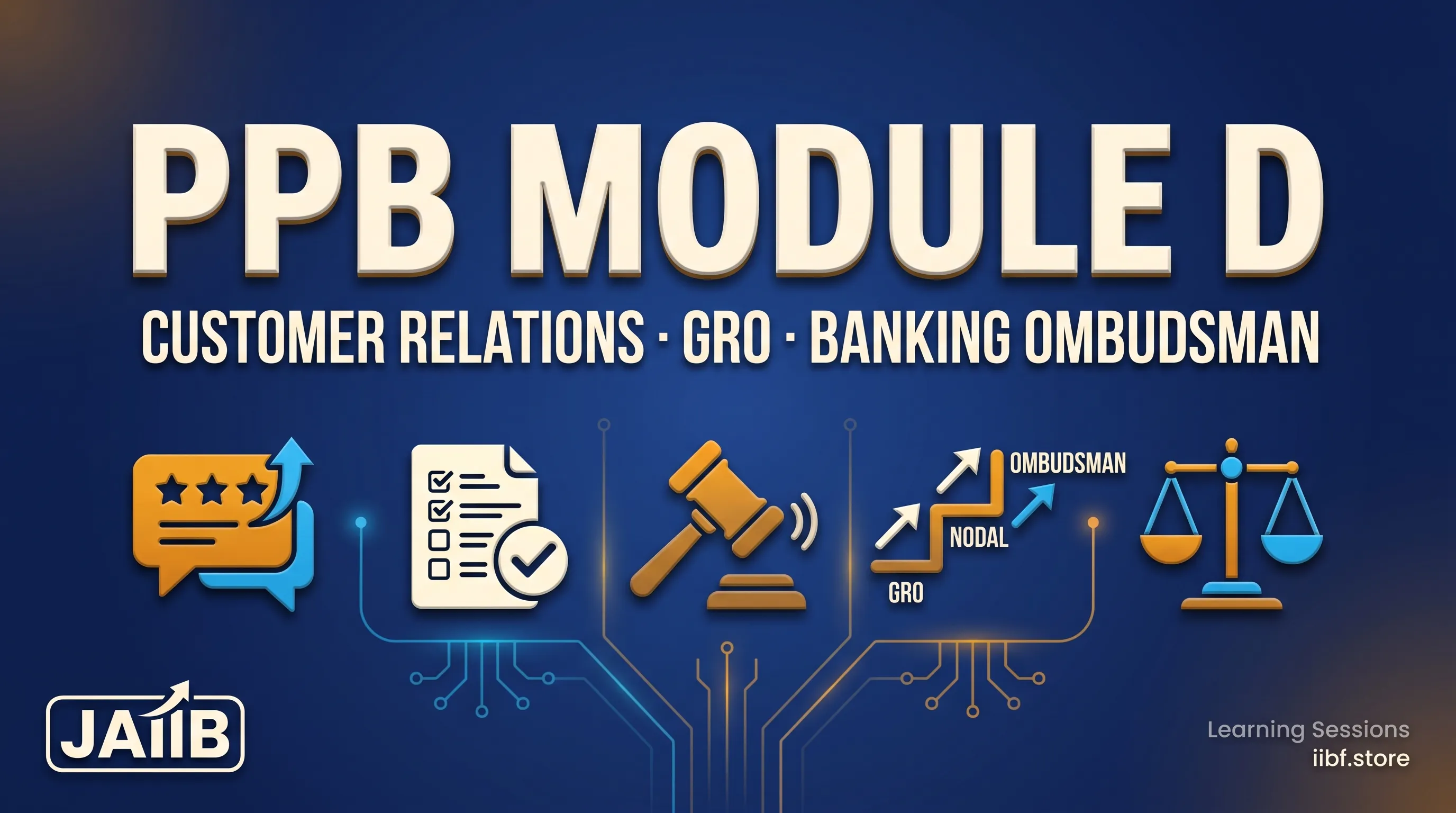
JAIIB PPB Module D: Customer Relations, GRO & Banking Ombudsman
JAIIB PPB Module D — Customer Relations, the Grievance Redressal Officer (GRO) and the Banking Ombudsman — is quietly one of the highest-yielding sections in the entire Principles and Practices of Banking paper. Most aspirants sprint through Modules A, B and C, then meet Module D in the final week and wonder why it carries so many questions. The reason is simple: this module covers the customer-protection and complaint-resolution machinery that makes the Indian banking system trustworthy, and almost every concept here is testable by pure recall.
The good news for a working banker is that this content is operationally familiar. You have already handled counter complaints, escalations and turnaround-time grievances on the job. The exam mostly asks you to attach the formal names to processes you already know. Read this guide once, drill a few chapter mocks, and Module D turns into the easiest scoring opportunity in the paper.
Key Takeaways
- JAIIB PPB Module D is high-recall, branch-familiar and worth roughly 8 to 12 marks for a single focused evening of revision.
- The GRO escalation ladder runs Branch staff → GRO → Regional Nodal Officer → Principal Nodal Officer → RBI Ombudsman.
- The RBI Integrated Ombudsman Scheme (RB-IOS) is a single “One Nation, One Ombudsman” framework, free to the customer, with an award binding on the bank but not on the complainant.
- Memorise the five Customer Rights and the BCSBI code names as ordered lists — that is exactly how they are examined.
- Compensation caps, filing windows and turnaround times are periodically revised by RBI — always confirm the current figure against the latest released IIBF notification and the RBI scheme circular.
Why Module D Is a High-Yield Section in JAIIB PPB
There are three structural reasons JAIIB PPB Module D rewards focused study far more than its page count suggests, and understanding them changes how you revise.
- Most questions are identification or definition format. “Which scheme covers digital-payment complaints?” or “Who is the first escalation point in a branch?” are pure recall. There is little numerical work and almost no interpretation — you either know the formal name or you do not.
- The content mirrors daily branch life. Acknowledging a complaint, escalating to a nodal officer, quoting a turnaround time — you have lived this. The syllabus simply formalises it.
- It reinforces adjacent modules. Customer-protection content overlaps with the KYC and conduct themes in Module A and the products and channels in Modules B and C, so you revise neighbouring material as you go. It also sits naturally alongside the cheque and instrument rules in the Negotiable Instruments Act chapter, where many service-deficiency complaints actually originate.
The GRO: First Line of Complaint Handling
Every bank branch designates a Grievance Redressal Officer (GRO), who in practice is usually the Branch Manager. The GRO is the customer’s first formal escalation route for any unresolved complaint or service issue. Under the bank’s Code of Commitment to Customers, a complaint is generally expected to be acknowledged quickly — commonly within about seven days — and resolved or escalated within the prescribed window of around 30 days, though you should treat exact figures as per the latest released IIBF schedule and the bank’s current charter.
What the exam really wants is the ordered escalation ladder. Learn it as a numbered sequence:
- Branch staff — for routine, over-the-counter issues.
- Branch Manager / GRO — for unresolved or formally lodged complaints.
- Regional / Zonal Nodal Officer (NO) — when the branch fails to resolve the matter.
- Principal Nodal Officer (PNO) at Head Office — for the final internal escalation.
- RBI Ombudsman — only once the bank’s internal grievance machinery is exhausted or has not responded within the prescribed time.
This five-step ladder is a near-guaranteed question. If you remember nothing else from Module D, remember this order. You can rehearse it in seconds with the 60-second drills in our JAIIB matching games.
The RBI Integrated Ombudsman Scheme: The Regulatory Backstop
When internal redress fails, the customer reaches the regulatory backstop. The Reserve Bank’s Integrated Ombudsman Scheme (RB-IOS), introduced in November 2021, merged the three earlier schemes — the Banking Ombudsman Scheme, the Ombudsman Scheme for NBFCs and the Ombudsman Scheme for Digital Transactions — into one unified framework built around a “One Nation, One Ombudsman” philosophy.
For JAIIB PPB Module D, focus on these working-banker essentials rather than fine print:
- Coverage: Scheduled Commercial Banks, Regional Rural Banks, Scheduled Primary (Urban) Co-operative Banks, eligible NBFCs, Payment System Operators (including prepaid wallet and UPI providers) and Credit Information Companies.
- Single window: Complaints are registered at one central point through the Complaint Management System (CMS) portal at cms.rbi.org.in, regardless of whether the grievance is against a bank, an NBFC or a digital-payment provider.
- Free of cost: There is no fee for a customer to file a complaint with the Ombudsman.
- Binding asymmetry: The Ombudsman’s award is binding on the bank but not on the customer — the complainant may reject it and pursue other remedies.
- Compensation: The scheme provides for compensation toward direct loss and a separate amount toward mental agony and harassment. The specific caps and the filing window are revised by RBI from time to time, so always confirm the current figures against the latest RBI scheme circular and the official IIBF notification.
Because students often confuse the parameters of the old and new schemes, the comparison below isolates exactly what changed under integration.
| Feature | Earlier Schemes (pre-2021) | Integrated Ombudsman Scheme (RB-IOS) |
|---|---|---|
| Number of schemes | Three separate schemes (Banking, NBFC, Digital Transactions) | One unified scheme |
| Complaint registration | Jurisdiction-based, scheme-specific | Single CMS portal, jurisdiction-neutral |
| Guiding principle | Multiple grounds listed per scheme | “One Nation, One Ombudsman” |
| Cost to customer | Free | Free |
| Award binding on | Bank (not customer) | Bank (not customer) |
For the authoritative wording of the current scheme, the safest source is always the regulator itself — see the official material on the IIBF website and the RBI scheme circular it references.
BCSBI Codes: Voluntary but Examined
The Banking Codes and Standards Board of India (BCSBI) was set up in 2006 as a self-regulatory body to oversee the adoption of voluntary customer-service codes by banks. Its operational role has evolved over the years, but the codes it championed remain widely referenced and continue to feature in IIBF exams, so you should recognise them by name.
- Code of Commitment to Customers — the general code for savings and current account customers. It sets out customer rights around transparent pricing, prompt service, complaint-resolution timelines and the privacy of customer information.
- Code of Commitment to Micro and Small Enterprises (MSEs) — tailored to MSE borrowers, covering sanction timelines, collateral discipline and restructuring options.
Both codes are voluntary, yet most public sector and major private banks have adopted them. The exam tests recognition of the code names and their broad scope — not section-by-section detail — so do not over-invest here.
The RBI Charter of Customer Rights
RBI has articulated five fundamental rights that every bank customer in India enjoys. These appear repeatedly in JAIIB PPB Module D as “which-of-the-following” questions, so learn them as a clean list.
- Right to Fair Treatment — no discrimination on grounds of gender, age, religion, caste or physical ability.
- Right to Transparency, Fair and Honest Dealing — all terms must be disclosed clearly and in an understandable form.
- Right to Suitability — products offered should suit the customer’s needs and risk appetite.
- Right to Privacy — customer information is held in strict confidence and shared only with consent or as required by law.
- Right to Grievance Redress and Compensation — an accessible complaint mechanism, time-bound resolution and compensation for proven deficiency.
Memory tip: Lock the five rights with the cue “Fair Treatment, Transparency, Suitability, Privacy, Redress”. Recite them in order until the sequence is automatic — examiners love to swap one genuine right for a plausible-sounding fake.
Deficiency in Service: The Legal Definition
Module D also draws on consumer-protection law. For these purposes, a deficiency in service by a bank broadly includes:
- Delay in service beyond the promised time.
- Failure to perform a service the customer is entitled to.
- Inadequate quality of service.
- Misleading information that leads to financial loss.
- Failure to honour written commitments.
Where a deficiency is established, the customer’s remedies span the District Consumer Disputes Redressal Commission, the State Commission and the National Commission, alongside the Banking Ombudsman or, in some cases, civil court action — the appropriate forum depends on the value and nature of the claim.
A Practical One-Evening Study Plan for Module D
You do not need a week for this module. A single disciplined evening, structured below, is enough to convert JAIIB PPB Module D into reliable marks.
- First 20 minutes — the ladder. Write the five-step escalation chain from memory three times: Branch staff, GRO, Regional NO, Principal NO, Ombudsman.
- Next 25 minutes — the Ombudsman. Learn the “One Nation, One Ombudsman” framing, the single CMS portal, the free-to-customer rule and the binding-on-bank-only asymmetry. Note the compensation and filing-window figures as ranges and verify the latest values against the RBI circular.
- Next 15 minutes — rights and codes. Drill the five Customer Rights and the two BCSBI code names until you can list them without prompts.
- Final 30 minutes — active recall. Attempt about 20 Module D questions on a timed mock. Hitting 75 percent or more on the first attempt confirms you are ready.
Put that plan into action straight away with a free JAIIB PPB mock test, and revisit the full syllabus and video classes on the JAIIB course hub or the dedicated Principles and Practices of Banking page. When the exam is close, slot Module D into your JAIIB last-week revision plan so it gets a dedicated recall pass rather than a rushed skim.
Common Mistakes Candidates Make in Module D
A handful of avoidable errors cost otherwise well-prepared candidates easy marks here. Watch for these traps.
- Skipping straight to the Ombudsman. Many assume a customer can approach the Ombudsman directly. In fact, internal redress must be exhausted first — a frequent trick question.
- Confusing old and new scheme parameters. Memorising figures from a pre-2021 scheme leads to wrong answers; anchor everything to the current Integrated Ombudsman Scheme.
- Treating the award as binding on both sides. The award binds the bank, not the customer — reversing this is a classic slip.
- Over-studying BCSBI detail. Recognition of code names is enough; do not waste hours on section-level text.
- Memorising stale figures. Compensation caps and turnaround times change — confirm current numbers against the official IIBF notification rather than an old PDF.
Frequently Asked Questions
Can a customer go directly to the Ombudsman without contacting the bank first?
No. The scheme requires the customer to first lodge a complaint with the bank and wait for its reply or the prescribed reply period. Only after the bank’s internal grievance mechanism is exhausted, or the reply is unsatisfactory, can the customer escalate to the Ombudsman. This sequencing rule is a favourite exam point.
Is the Ombudsman’s decision final?
For the bank, generally yes — once an award is passed and accepted by the customer, it binds the bank. For the customer, no — the complainant can reject the award and pursue other remedies such as a consumer commission or civil court. This asymmetry is examined repeatedly, so commit it to memory.
What is the time limit for a bank to respond to a customer complaint?
Under the bank’s Code of Commitment, a final reply is generally expected within about 30 days of receipt, with an acknowledgement issued earlier — commonly within seven days. Certain categories, such as failed ATM or digital transactions, carry shorter prescribed turnaround times under RBI’s framework. Confirm the exact periods against the current circular.
Does the Ombudsman scheme cover digital wallet and UPI complaints?
Yes. The Integrated Ombudsman Scheme covers Payment System Operators, which include prepaid wallet issuers and UPI providers. A single portal at cms.rbi.org.in handles bank, NBFC and digital-payment complaints, which is precisely why the “One Nation, One Ombudsman” description is used.
Who is the GRO in a bank branch, and what is the escalation order?
The Grievance Redressal Officer is usually the Branch Manager and is the first formal escalation point. The full ladder runs Branch staff, then GRO, then Regional or Zonal Nodal Officer, then Principal Nodal Officer at Head Office, and finally the RBI Ombudsman. Memorise this exact order as a numbered list.
How much is Module D worth, and how should I prioritise it?
Module D is high-recall and branch-familiar, and a focused evening of revision can secure roughly 8 to 12 marks in the PPB paper. Because the effort-to-reward ratio is excellent, treat it as a priority scoring zone rather than an afterthought in the final week.
Final Word
JAIIB PPB Module D is one of the most generous scoring opportunities in the whole JAIIB syllabus: high recall density, branch-familiar content and framework-driven memorisation. Lock in the GRO escalation ladder, the Integrated Ombudsman parameters, the five Customer Rights and the BCSBI code names, and you have banked a comfortable block of marks for an evening’s work.
Do the active part tonight — open a free chapter mock, attempt 20 Module D questions, and let your score confirm your readiness. Steady, deliberate revision of this module is one of the surest ways to push your PPB total over the line. For more chapter walkthroughs across all four papers, browse every JAIIB guide on Learning Sessions, and once PPB is locked, line up the RBWM retail-lending guide to keep your momentum going.
Related Guides
📚 Free Learning Sessions resources — connect & crack your exam
- 📝 Free mock tests — chapter-wise, exam-pattern, with instant solutions
- 🎮 Matching games — gamified revision of key terms & concepts
- 📄 Study notes & PDFs — downloadable chapter material
- 🎥 Video classes on YouTube — subscribe to @learningsessions
💬 Want the full course? WhatsApp your course name to 8360944207 and our team will set you up.
📱 Study on the go — get our iOS & Android app at iibf.store/app.
Prefer revising from a printed book?
Chapter-wise books with MCQs after every chapter — minimal pages, complete coverage, delivered anywhere in India. Every book has a free sample to read first.
131 pages · 672 MCQs
Learning Sessions · Ashish Sir
221 pages · 831 MCQs
Learning Sessions · Ashish Sir
128 pages · 524 MCQs
Learning Sessions · Ashish Sir
107 pages · 445 MCQs
Learning Sessions · Ashish Sir
148 pages · 478 MCQs
Learning Sessions · Ashish Sir
151 pages · 465 MCQs
Learning Sessions · Ashish Sir
148 pages · 375 MCQs
Learning Sessions · Ashish Sir
216 pages · 895 MCQs
Learning Sessions · Ashish Sir
109 pages · 300 MCQs
Learning Sessions · Ashish Sir
104 pages · 360 MCQs
Learning Sessions · Ashish Sir
82 pages · 297 MCQs
Learning Sessions · Ashish Sir
151 pages · 600 MCQs
Learning Sessions · Ashish Sir
98 pages · 282 MCQs
Learning Sessions · Ashish Sir
132 pages · 225 MCQs
Learning Sessions · Ashish Sir
188 pages · 435 MCQs
Learning Sessions · Ashish Sir
117 pages · 236 MCQs
Learning Sessions · Ashish Sir
Learning Sessions · Ashish Sir
118 pages · 299 MCQs
Learning Sessions · Ashish Sir
Learning Sessions · Ashish Sir
Learning Sessions · Ashish Sir
Learning Sessions · Ashish Sir
115 pages · 255 MCQs
Learning Sessions · Ashish Sir
Learning Sessions · Ashish Sir
334 pages · 936 MCQs
Learning Sessions · Ashish Sir
Learning Sessions · Ashish Sir
115 pages · 344 MCQs
Learning Sessions · Ashish Sir
107 pages · 240 MCQs
Learning Sessions · Ashish Sir
90 pages · 150 MCQs
Learning Sessions · Ashish Sir
Learning Sessions · Ashish Sir
Quick quiz on this topic
5 exam-style questions from our free test bank — check yourself before you move on.
Practice this topic
Take a free mock test, download chapter PDFs, or watch a video class — all included on iibf.store.