Cash Flow Statement for JAIIB AFM: Methods & Format (2026)
For JAIIB AFM candidates, the cash flow statement is one of the most scoring yet most misunderstood topics in the syllabus. While a profit and loss account tells you whether a bank or company earned a profit, it never tells you whether cash actually came in. A firm can show a healthy paper profit and still be unable to pay its staff — because profit and cash are two very different things. That single gap is exactly what this statement is built to reveal, and it is why examiners keep returning to it year after year.
In this guide we break down the cash flow statement as it is tested in the JAIIB Accounting and Financial Management for Bankers paper (2026 pattern) — the governing standard, the three activity buckets, the direct versus indirect debate, a clean format you can memorise, and five exam-grade MCQs. If you are comfortable with basic ledgers, you can master this topic in a single sitting.
📊 What a Cash Flow Statement Actually Shows
A cash flow statement is a financial report that explains the movement of cash and cash equivalents into and out of an entity over an accounting period. It reconciles the opening cash balance with the closing cash balance by grouping every inflow and outflow into three standard activities. In India, the statement is governed by Ind AS 7 (and the older AS 3 for entities still on the AS framework), which is why the topic sits alongside the accounting-standards portion of the syllabus. You can revise the standards background through the chapter on the definition, scope and accounting standards including Ind AS, which frames why this statement is mandatory for larger companies.
The key term to lock in is "cash equivalents" — these are short-term, highly liquid investments readily convertible to a known amount of cash, subject to insignificant risk of change in value, and with an original maturity of three months or less. Bank overdrafts repayable on demand can also form part of cash and cash equivalents. Getting this definition right earns easy one-mark questions.
💡 Exam Tip: Whenever a question mentions "cash equivalents", check the three-month maturity rule. Investments with a longer maturity are treated as investing activity, not cash equivalents.
🏦 The Three Activities: Operating, Investing, Financing
The heart of the topic is classifying each transaction into one of three buckets. Operating activities are the principal revenue-producing activities — cash from customers, payments to suppliers and employees, and for a bank, interest received and paid in its ordinary course. Investing activities cover the purchase and sale of long-term assets and investments, such as buying premises or selling shares held as investments. Financing activities relate to changes in the size and composition of owners' capital and borrowings — issuing shares, raising or repaying loans, and paying dividends.
The classic trap is interest and dividends. Under Ind AS 7 a financial enterprise like a bank classifies interest paid, interest received and dividends received as operating cash flows, whereas a non-financial entity has a policy choice. Strong command of debits, credits and ledger postings makes this classification intuitive; if that base is shaky, revise the chapter on basic accountancy procedures before attempting numerical sums.
⚠️ Common Mistake: Candidates routinely park "purchase of machinery" under operating activities. It is an investing outflow. Only day-to-day trading items belong in operating.
🔄 Direct Method vs Indirect Method
There are two ways to present operating cash flow, and JAIIB loves to contrast them. The direct method lists actual cash receipts and payments — cash received from customers, cash paid to suppliers, and so on. The indirect method starts from net profit before tax and adjusts for non-cash items (like depreciation), non-operating items, and changes in working capital. Both arrive at the same operating cash figure; only the presentation differs. The table below is the fastest way to remember which is which.
| Feature | Direct Method | Indirect Method |
|---|---|---|
| Starting point | Actual cash receipts & payments | Net profit before tax |
| Adds back depreciation? | ❌ No | ✅ Yes |
| Shows working-capital changes? | ❌ No (implicit) | ✅ Yes (explicit) |
| Easier for exams & most common in practice | ❌ | ✅ |
| Encouraged by the standard | ✅ (preferred) | ❌ (permitted) |
Notice the subtlety examiners exploit: the accounting standard prefers the direct method for its transparency, yet the indirect method is far more common in real financial statements and in exam sums because it links neatly to the profit and loss account. Non-cash charges such as depreciation are added back only under the indirect method — under the direct method they never appear because you are listing raw cash movements.
📌 Remember: Depreciation is a non-cash expense. In the indirect method you ADD it back to net profit; it never reduces cash.
📝 Format, Bank Relevance and Reporting Discipline
A standard indirect-method statement flows as: net profit before tax → adjust non-cash and non-operating items → operating profit before working-capital changes → adjust for changes in current assets and liabilities → cash generated from operations → less tax paid → net cash from operating activities. To this you add net cash from investing and financing activities, and the three totals together reconcile the opening and closing cash balances. For bankers, this reconciliation discipline mirrors the daily cash-book and ledger controls covered in the chapter on maintenance of cash, subsidiary books and ledgers.
Why does a lending banker care? Because when appraising a loan proposal, the cash flow statement reveals whether a borrower generates enough operating cash to service debt — something a profit figure alone can hide. It complements ratio work: pair this topic with profitability ratios and with the broader story told by ROCE, ROE and ROA to judge a firm's true health. It also connects to how the finished accounts are assembled, which you can revise through Trial Balance and Final Accounts. For candidates also sitting economics-heavy papers, the same "current vs capital" logic appears in the macro context of the balance of payments in India. For more chapter guides, browse our Accounting and Financial Management topic hub.
Practise a few full sums under timed conditions — the numbers reward pattern recognition. Free chapter-wise drills are available on our mock test platform, and structured revision is bundled in the JAIIB course.
🧠 Practice MCQs: Cash Flow Statement
Q1. Under Ind AS 7, an investment qualifies as a cash equivalent only if its original maturity is generally: (a) up to 12 months (b) up to 6 months (c) three months or less (d) more than one year
Answer: (c) — Cash equivalents must be short-term, highly liquid, and have an original maturity of three months or less.
Q2. Purchase of a building for the company's own use is classified as a cash flow from: (a) operating activities (b) investing activities (c) financing activities (d) non-cash activities
Answer: (b) — Acquiring a long-term asset is an investing outflow.
Q3. In the indirect method, depreciation is: (a) subtracted from net profit (b) added back to net profit (c) ignored entirely (d) shown as an investing outflow
Answer: (b) — Depreciation is a non-cash expense, so it is added back to net profit.
Q4. For a bank (financial enterprise) under Ind AS 7, interest received is normally classified under: (a) operating activities (b) investing activities (c) financing activities (d) it is excluded
Answer: (a) — For financial enterprises, interest and dividends received/paid are treated as operating cash flows.
Q5. Which method of preparing operating cash flow is encouraged by the accounting standard for its transparency? (a) indirect method (b) direct method (c) accrual method (d) reducing balance method
Answer: (b) — The standard prefers the direct method, though the indirect method is permitted and more common.
Want chapter-wise mock tests with 100+ MCQs? Start practising free →
❓ Frequently Asked Questions
Which standard governs the cash flow statement in India?
Ind AS 7 governs it for entities on the Ind AS framework, while AS 3 applies to entities still following the older Accounting Standards. Both classify flows into operating, investing and financing activities.
What is the difference between the direct and indirect methods?
The direct method lists actual cash receipts and payments; the indirect method starts from net profit before tax and adjusts for non-cash items and working-capital changes. Both give the same operating cash figure.
Why is depreciation added back in the cash flow statement?
Depreciation is a non-cash expense that reduced net profit but involved no outflow of cash, so under the indirect method it is added back to arrive at cash from operations.
How is the cash flow statement useful to a banker?
It shows whether a borrower generates enough operating cash to service debt — a truer test of repayment capacity than reported profit, which can include non-cash and accrual items.
Master the classification rules, memorise the indirect-method format, and the cash flow statement becomes a reliable source of marks in JAIIB AFM. Reinforce it with timed practice on our free mock tests and full chapter coverage in the JAIIB course — then move on to the next topic with confidence.
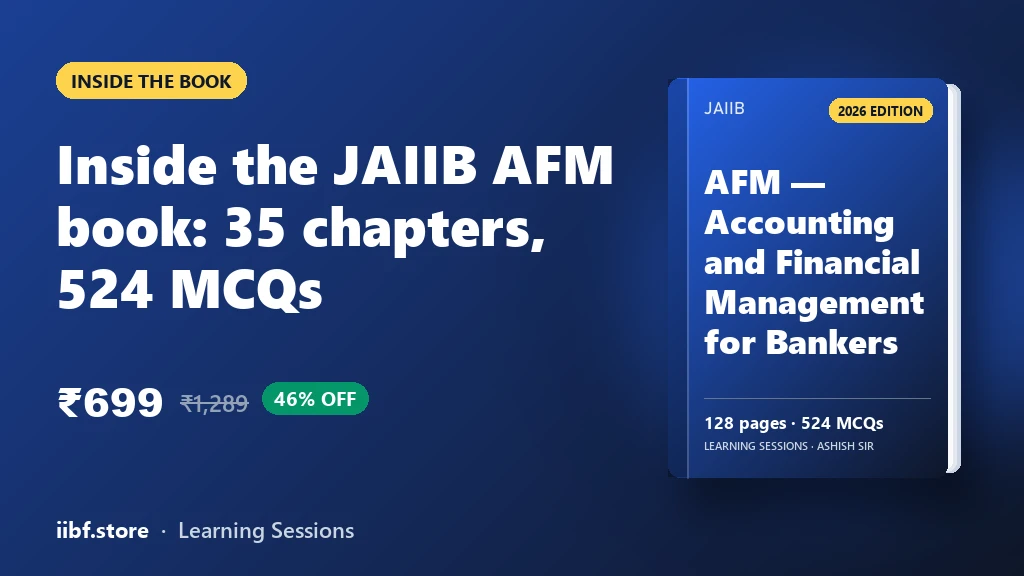
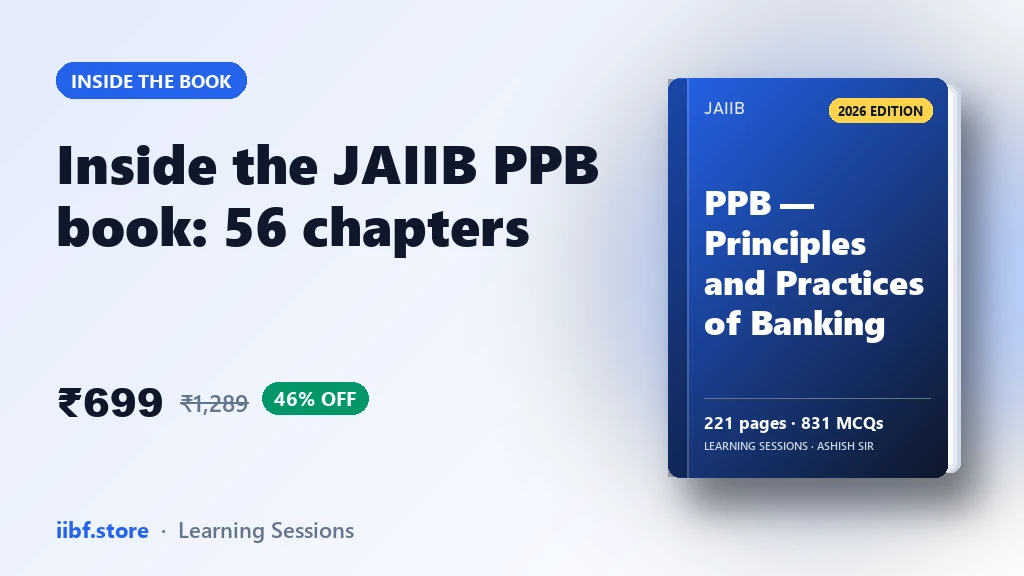
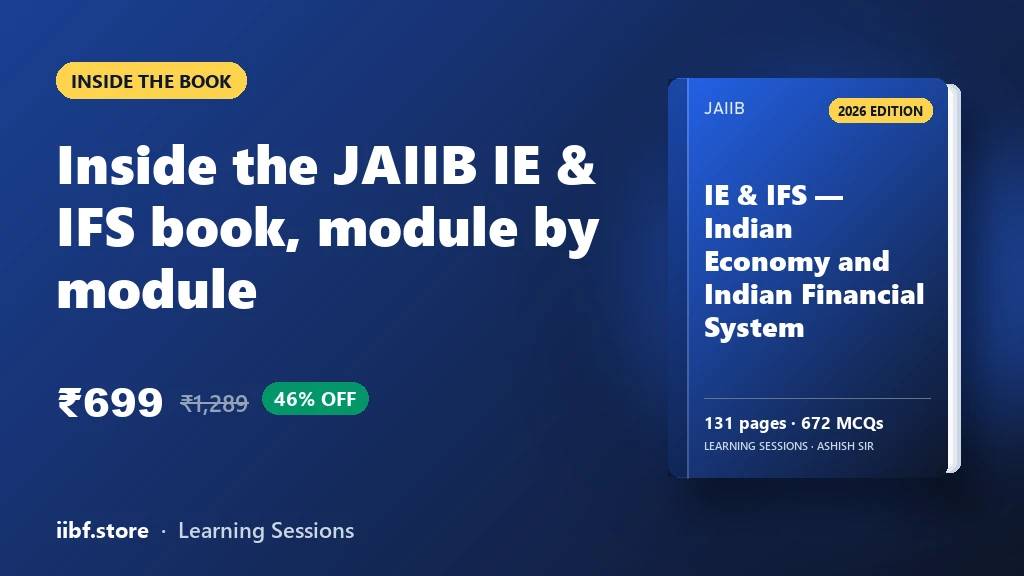
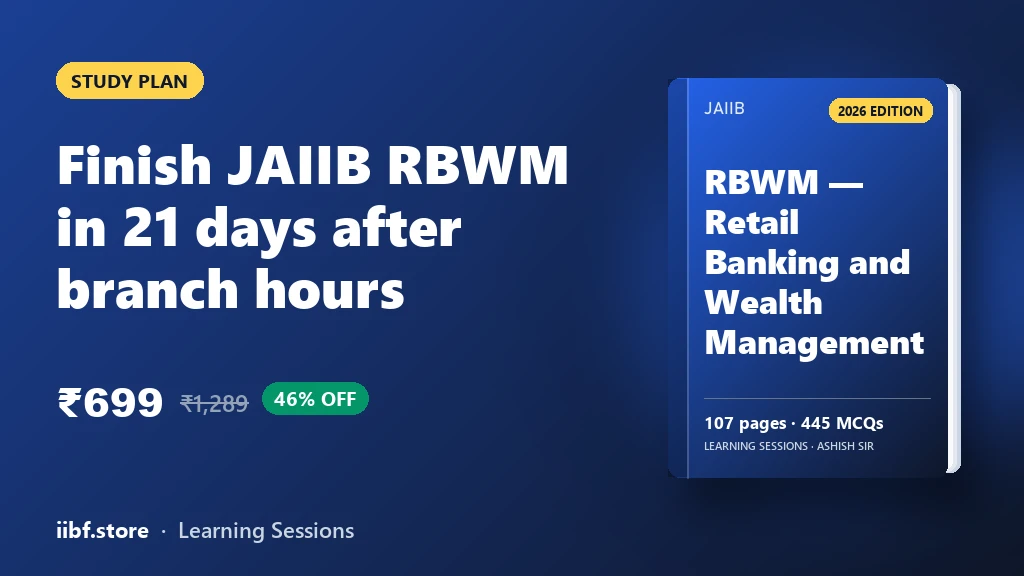
Prefer revising from a printed book?
Chapter-wise books with MCQs after every chapter — minimal pages, complete coverage, delivered anywhere in India. Every book has a free sample to read first.
128 pages · 524 MCQs
Learning Sessions · Ashish Sir
131 pages · 672 MCQs
Learning Sessions · Ashish Sir
221 pages · 831 MCQs
Learning Sessions · Ashish Sir
107 pages · 445 MCQs
Learning Sessions · Ashish Sir
148 pages · 478 MCQs
Learning Sessions · Ashish Sir
151 pages · 465 MCQs
Learning Sessions · Ashish Sir
148 pages · 375 MCQs
Learning Sessions · Ashish Sir
216 pages · 895 MCQs
Learning Sessions · Ashish Sir
109 pages · 300 MCQs
Learning Sessions · Ashish Sir
104 pages · 360 MCQs
Learning Sessions · Ashish Sir
82 pages · 297 MCQs
Learning Sessions · Ashish Sir
151 pages · 600 MCQs
Learning Sessions · Ashish Sir
98 pages · 282 MCQs
Learning Sessions · Ashish Sir
132 pages · 225 MCQs
Learning Sessions · Ashish Sir
188 pages · 435 MCQs
Learning Sessions · Ashish Sir
117 pages · 236 MCQs
Learning Sessions · Ashish Sir
Learning Sessions · Ashish Sir
118 pages · 299 MCQs
Learning Sessions · Ashish Sir
Learning Sessions · Ashish Sir
Learning Sessions · Ashish Sir
Learning Sessions · Ashish Sir
115 pages · 255 MCQs
Learning Sessions · Ashish Sir
Learning Sessions · Ashish Sir
334 pages · 936 MCQs
Learning Sessions · Ashish Sir
Learning Sessions · Ashish Sir
115 pages · 344 MCQs
Learning Sessions · Ashish Sir
107 pages · 240 MCQs
Learning Sessions · Ashish Sir
90 pages · 150 MCQs
Learning Sessions · Ashish Sir
Learning Sessions · Ashish Sir
Quick quiz on this topic
5 exam-style questions from our free test bank — check yourself before you move on.
Practice this topic
Take a free mock test, download chapter PDFs, or watch a video class — all included on iibf.store.