CRAR calculation for banks: IIBF RM Guide (2026)
Every question in the IIBF Risk Management certificate that touches capital adequacy ultimately comes back to one ratio, so mastering the CRAR calculation for banks is non-negotiable for exam success. CRAR — the Capital to Risk-weighted Assets Ratio, often written as CAR — measures how much of a bank's own capital stands behind the risks it carries. If losses hit, this cushion absorbs them before depositors are touched, which is exactly why the regulator watches it so closely.
This guide breaks down the CRAR calculation for banks the way IIBF actually tests it: the formula, what counts as Tier 1 and Tier 2 capital, how risk-weighted assets (RWA) are built, and the specific minimum thresholds the Reserve Bank of India enforces as of 2026. Get these numbers into muscle memory and you will clear the capital-adequacy questions without hesitation.
🏦 What CRAR Actually Measures
CRAR expresses regulatory capital as a percentage of risk-weighted assets. The logic is simple: a ₹100 loan to the Government of India is far safer than a ₹100 unsecured personal loan, so the two should not demand the same capital backing. Instead of measuring capital against total assets, the framework measures it against risk-weighted assets, where each exposure is scaled by a risk weight reflecting its likelihood and severity of loss.
The ratio answers a supervisory question: if this bank's risky exposures started defaulting, does it hold enough loss-absorbing capital to survive without failing? A higher CRAR means a thicker cushion. Under RBI norms, banks must publicly disclose their CRAR, and a falling ratio can trigger Prompt Corrective Action (PCA), restricting dividends, branch expansion and lending. Understanding why regulation demands this buffer is covered in depth in the chapter on why banks need regulation, which pairs naturally with capital-adequacy study.
💡 Exam Tip: CRAR and CAR are the same ratio — IIBF uses both terms interchangeably. Do not treat them as two different concepts in the exam.
🧮 The CRAR Formula and Its Components
The formula the exam expects you to reproduce is:
CRAR = (Tier 1 Capital + Tier 2 Capital) ÷ Risk-Weighted Assets × 100
The numerator is total regulatory capital, split into two quality tiers. Tier 1 (going-concern capital) absorbs losses while the bank keeps operating. It has two parts: Common Equity Tier 1 (CET1) — paid-up equity, statutory reserves and retained earnings — and Additional Tier 1 (AT1), mainly perpetual non-cumulative bonds. Tier 2 (gone-concern capital) absorbs losses only in liquidation and includes subordinated debt of at least five years, general provisions (capped at 1.25% of credit RWA under the standardised approach) and revaluation reserves taken at a 55% discount.
A rule candidates forget: Tier 2 capital counted towards CRAR cannot exceed 100% of Tier 1. So a bank with weak equity cannot simply issue subordinated bonds to fake a strong ratio. This quality hierarchy is reinforced across the regulatory capital and capital adequacy module, which is essential reading before the exam.
⚖️ Building Risk-Weighted Assets (the denominator)
RWA is the sum of three risk buckets: credit RWA + market RWA + operational RWA. Credit RWA dominates for most Indian banks. Under the standardised approach, each exposure is multiplied by a prescribed risk weight — 0% for central-government exposures, 20% for many bank claims, 35–75% for well-secured retail and housing, and 100% or more for unrated corporates. Market RWA captures trading-book price risk, while operational RWA is a charge for failures in people, processes and systems.
A worked example makes it stick. Suppose a bank holds ₹500 crore total capital (₹350 crore Tier 1, ₹150 crore Tier 2) against ₹4,000 crore of risk-weighted assets. CRAR = 500 ÷ 4,000 × 100 = 12.5% — comfortably above the regulatory floor. Note Tier 2 (₹150 cr) is under 100% of Tier 1 (₹350 cr), so all of it qualifies. Because operational RWA depends on clean incident records, disciplined collection of loss data feeds directly into the capital charge.
⚠️ Common Mistake: Candidates divide capital by total assets. CRAR uses risk-weighted assets — always apply risk weights before dividing.
📊 RBI Minimum Thresholds You Must Memorise (2026)
India applies stricter minimums than the global Basel baseline. The table below is high-yield exam material.
| Component | RBI Minimum | Global Baseline | Buffer Add-on? |
|---|---|---|---|
| Common Equity Tier 1 (CET1) | 5.5% | 4.5% | ✅ +2.5% CCB |
| Tier 1 Capital | 7.0% | 6.0% | ✅ |
| Total CRAR | 9.0% | 8.0% | ✅ 11.5% with CCB |
| Capital Conservation Buffer (CCB) | 2.5% (CET1) | 2.5% | ✅ fully phased in |
| Leverage Ratio | 3.5% (4% for DSIBs) | 3.0% | ❌ not risk-based |
So the effective minimum a well-run bank targets is 11.5% total CRAR (9% + 2.5% CCB), with domestic systemically important banks (DSIBs) carrying an additional surcharge on top. Breaching the CCB does not shut a bank down but restricts discretionary distributions like dividends and bonuses until it rebuilds. The leverage ratio acts as a non-risk-based backstop so a bank cannot game low risk weights to run thin on real capital.
📌 Remember: RBI's 9% is one percentage point above Basel's 8%. Add the 2.5% CCB and the working floor becomes 11.5%.
🔗 How CRAR Connects to the Wider Risk Syllabus
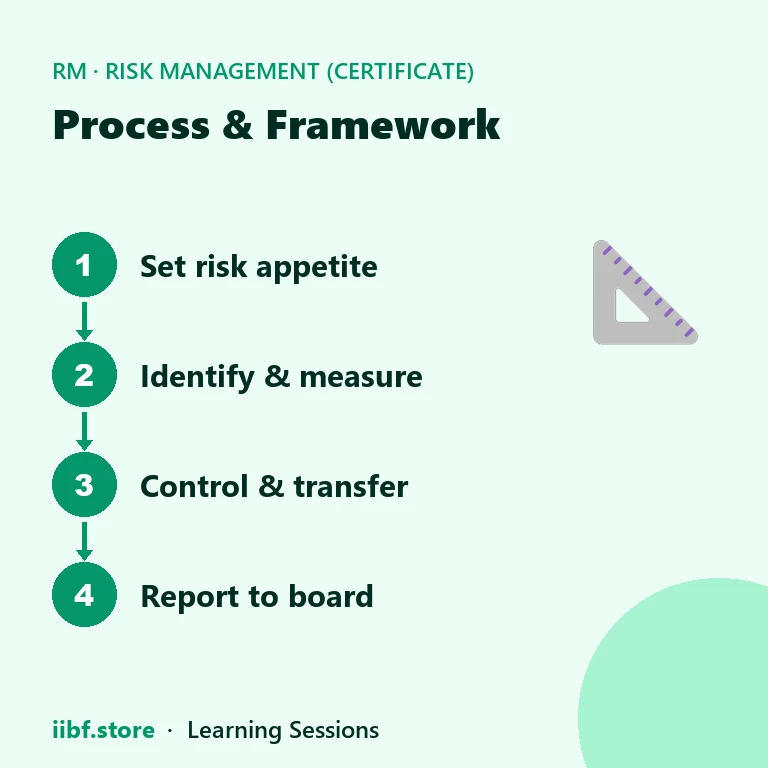
Capital adequacy does not sit in isolation. The size of operational RWA is shaped by the same discipline you study in operational risk management, while trading-book capital links to market-risk topics such as counterparty credit risk and CVA. Stress scenarios that erode the capital ratio are exactly what reverse stress testing in banks is designed to surface, and the funding side of resilience is examined under liquidity risk LCR NSFR. Seeing CRAR as the hub of this network, rather than a standalone formula, is how toppers structure their revision. For a full sweep of interlinked topics, browse the risk management certificate resource hub.
Governance matters too: a board that ignores capital planning invites supervisory action, a theme running through the corporate governance module. Practise applying these links under time pressure with the concept-matching game before your mock tests.
🧠 Practice MCQs: CRAR Calculation for Banks
Q1. A bank has Tier 1 capital of ₹300 cr, Tier 2 capital of ₹200 cr and risk-weighted assets of ₹5,000 cr. What is its CRAR? (a) 6% (b) 8% (c) 10% (d) 12%
Answer: (c) — (300 + 200) ÷ 5,000 × 100 = 10%.
Q2. Under RBI norms as of 2026, the minimum total CRAR (excluding CCB) that banks must maintain is: (a) 8% (b) 9% (c) 10.5% (d) 11.5%
Answer: (b) — RBI mandates 9%, one point above Basel III's 8%; adding the 2.5% CCB gives an effective 11.5%.
Q3. Tier 2 capital reckoned for CRAR is capped at what proportion of Tier 1 capital? (a) 50% (b) 75% (c) 100% (d) 150%
Answer: (c) — Tier 2 counted towards the ratio cannot exceed 100% of Tier 1 capital.
Q4. Which of the following is NOT a component of risk-weighted assets? (a) Credit RWA (b) Market RWA (c) Operational RWA (d) Liquidity RWA
Answer: (d) — RWA comprises credit, market and operational risk; liquidity is managed via LCR/NSFR, not an RWA charge.
Q5. The Capital Conservation Buffer must be met entirely with which type of capital? (a) Tier 2 (b) Additional Tier 1 (c) Common Equity Tier 1 (d) Subordinated debt
Answer: (c) — The 2.5% CCB is held in CET1, the highest-quality capital.
Want chapter-wise mock tests with 100+ MCQs? Start practising free →
❓ Frequently Asked Questions
Is CRAR the same as Capital Adequacy Ratio (CAR)?
Yes. CRAR (Capital to Risk-weighted Assets Ratio) and CAR (Capital Adequacy Ratio) are two names for the identical ratio of regulatory capital to risk-weighted assets.
What is the minimum CRAR for Indian banks in 2026?
RBI mandates a minimum total CRAR of 9%, plus a 2.5% Capital Conservation Buffer in CET1, making the effective working floor 11.5%. DSIBs carry an additional surcharge.
Why does CRAR use risk-weighted assets instead of total assets?
Because different exposures carry different loss potential. Risk weighting requires more capital against risky assets (e.g. unrated corporates at 100%) and less against safe ones (e.g. central government at 0%), aligning capital with actual risk.
What happens if a bank's CRAR falls below the minimum?
The bank faces restrictions such as Prompt Corrective Action, curbs on dividends, lending and expansion, and must raise fresh capital. Breaching only the CCB restricts discretionary distributions until it is rebuilt.
The CRAR calculation for banks is one of the most reliably tested topics in the IIBF Risk Management certificate, and the numbers rarely change year to year — making it a guaranteed scoring area. Lock in the formula, the two capital tiers and the 9%/11.5% thresholds, then test yourself with a full Risk Management mock test to convert this understanding into exam marks.
Prefer revising from a printed book?
Chapter-wise books with MCQs after every chapter — minimal pages, complete coverage, delivered anywhere in India. Every book has a free sample to read first.
Learning Sessions · Ashish Sir
132 pages · 225 MCQs
Learning Sessions · Ashish Sir
188 pages · 435 MCQs
Learning Sessions · Ashish Sir
117 pages · 236 MCQs
Learning Sessions · Ashish Sir
Learning Sessions · Ashish Sir
118 pages · 299 MCQs
Learning Sessions · Ashish Sir
Learning Sessions · Ashish Sir
Learning Sessions · Ashish Sir
Learning Sessions · Ashish Sir
115 pages · 255 MCQs
Learning Sessions · Ashish Sir
Learning Sessions · Ashish Sir
334 pages · 936 MCQs
Learning Sessions · Ashish Sir
115 pages · 344 MCQs
Learning Sessions · Ashish Sir
107 pages · 240 MCQs
Learning Sessions · Ashish Sir
90 pages · 150 MCQs
Learning Sessions · Ashish Sir
Learning Sessions · Ashish Sir
131 pages · 672 MCQs
Learning Sessions · Ashish Sir
221 pages · 831 MCQs
Learning Sessions · Ashish Sir
128 pages · 524 MCQs
Learning Sessions · Ashish Sir
107 pages · 445 MCQs
Learning Sessions · Ashish Sir
148 pages · 478 MCQs
Learning Sessions · Ashish Sir
151 pages · 465 MCQs
Learning Sessions · Ashish Sir
148 pages · 375 MCQs
Learning Sessions · Ashish Sir
216 pages · 895 MCQs
Learning Sessions · Ashish Sir
109 pages · 300 MCQs
Learning Sessions · Ashish Sir
104 pages · 360 MCQs
Learning Sessions · Ashish Sir
82 pages · 297 MCQs
Learning Sessions · Ashish Sir
151 pages · 600 MCQs
Learning Sessions · Ashish Sir
98 pages · 282 MCQs
Learning Sessions · Ashish Sir
Practice this topic
Take a free mock test, download chapter PDFs, or watch a video class — all included on iibf.store.
Keep reading