Mark to Market Valuation of Bank Investments: A TIRM Guide
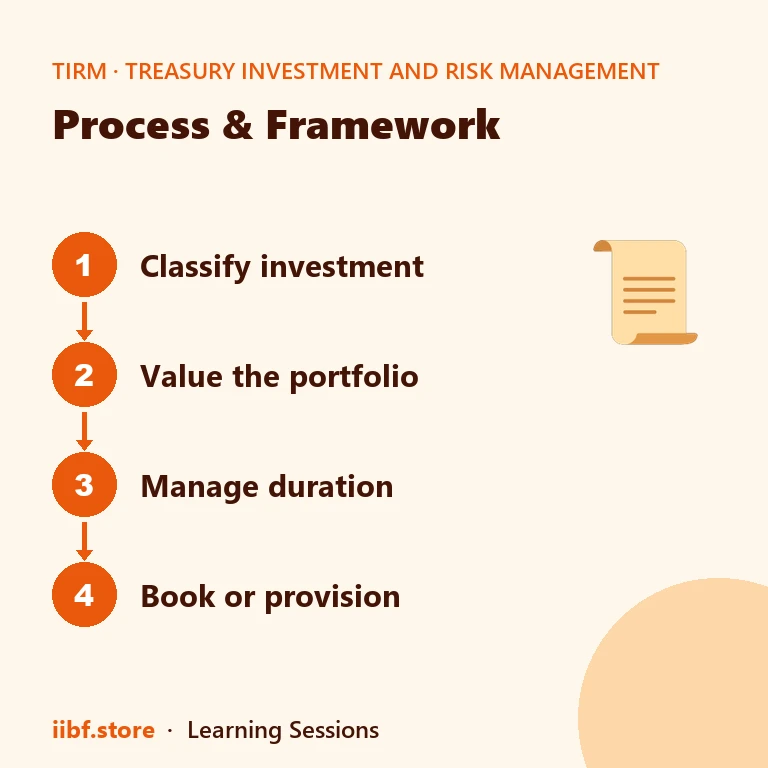
For candidates preparing IIBF's Treasury Investment and Risk Management (TIRM) certification, few topics carry as much weight as the mark to market valuation of bank investments. When a bank buys a government security or a corporate bond, its balance-sheet value does not stay frozen at cost. Instead, portions of the portfolio must be revalued at current market prices, and any resulting depreciation flows to the profit and loss account. Getting this mechanism right is central to how treasuries report earnings, manage capital, and stay within RBI's prudential guardrails. This guide breaks the subject down for the exam and for the desk.
The topic sits at the intersection of accounting, regulation, and risk. It links directly to the way investments are bucketed, the way yields move, and the way profit is recognised. Master it and a large slice of the TIRM syllabus becomes far easier.
Why mark to market matters for a bank treasury
Mark to market (MTM) is the practice of restating the carrying value of a financial instrument to its prevailing fair value rather than its original purchase price. For a bank treasury holding hundreds of crores in government securities, state development loans, and corporate bonds, this is not an academic nicety. Bond prices move inversely to yields: when market yields rise, the price of an existing fixed-coupon bond falls, and the bank sitting on that bond has an unrealised loss. MTM forces that loss into the open rather than letting it hide behind historical cost.
The discipline serves several purposes. First, it gives management and regulators an honest picture of portfolio worth on any given date. Second, it feeds directly into risk measures such as VaR and PV01, which quantify how much value the book could lose from a rate shock. Third, it interacts with capital adequacy, because depreciation and revaluation reserves affect the capital a bank must hold. A treasury that ignores MTM is effectively flying blind on interest-rate risk. This is precisely why the discipline is embedded in the broader framework of risk analysis and control that TIRM candidates must internalise. The valuation number is not just a report line; it is the trigger for hedging decisions, limit monitoring, and provisioning.
How classification decides what gets marked to market
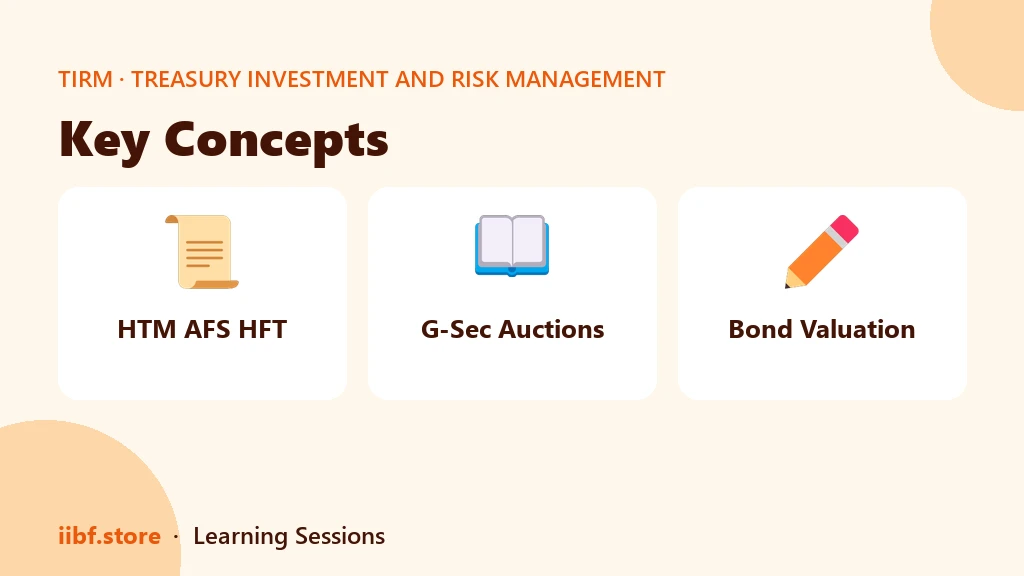
Not every security in a bank's book is revalued the same way, and that is where the RBI investment classification framework enters. Under the current master direction on investment in securities, banks classify most holdings into categories that determine accounting treatment. Broadly, securities a bank intends to hold to maturity are carried at acquisition cost (subject to amortisation of premium), so day-to-day price swings do not hit the books. Securities held to trade or that are available for sale are subject to fair valuation, with changes routed either through profit and loss or through a reserve, depending on the category.
The practical consequence is that classification is a strategic decision, not a clerical one. Placing a security in a fair-value bucket exposes reported earnings to market volatility; placing it in the hold-to-maturity bucket shelters earnings but limits the ability to sell freely. Treasuries therefore weigh liquidity needs, rate views, and capital impact when they classify. Movement of securities between categories is tightly governed to prevent gains-cherry-picking. Because valuation, provisioning, and category rules are audited closely, candidates should study these mechanics alongside regulations, supervision and compliance. Getting the bucket wrong is not just an exam error; on a real desk it can misstate capital and invite supervisory action.
Sources of the market price used for valuation
A valuation is only as credible as the price it uses. For central government securities, the most liquid instruments, prices and yields are readily observable from traded levels and from published curves. For less liquid paper such as state development loans, unlisted corporate bonds, and special securities, banks rely on prices and yield-to-maturity levels published by an approved valuation agency and on a mark-up over the base government yield curve to reflect credit and liquidity spreads. The Financial Benchmarks India Private Limited (FBIL) publishes reference rates and valuation inputs that banks widely use, and RBI's own regulatory framework specifies how these inputs feed the valuation process.
The valuation hierarchy generally runs: use the actual traded price where a reliable one exists; otherwise use the price or YTM put out by the approved agency; otherwise build the price off the sovereign curve plus a defined credit spread. Equity and units of mutual funds have their own rules, typically market price or net asset value. The key exam point is that valuation is rule-bound, not a matter of desk judgement, and that the same methodology must be applied consistently across reporting dates. This consistency is what makes period-to-period MTM comparisons meaningful and auditable. Traders, the mid-office, and the back-office each touch this process, which is why it maps to front, mid and back office operations.
Accounting for depreciation and appreciation
Once a market price is fixed, the arithmetic of MTM follows a prudence principle. Within a fair-value category, securities are compared with cost. Where market value is below cost, the resulting depreciation is recognised. Where market value is above cost, appreciation is generally not taken to profit in the same unrestricted way, reflecting the conservative bias in bank accounting. Net depreciation, if any, is provided for and charged to the profit and loss account, while any revaluation gains under the newer framework are parked in a reserve until realised.
The table below summarises how the common investment categories differ in valuation and where value changes land. Treat it as a quick-revision anchor; the exact provisioning nuances are governed by the prevailing RBI master direction, so always confirm figures against the current text.
| Category | Valuation basis | Where value change goes | Freedom to sell |
|---|---|---|---|
| Held to Maturity (HTM) | Acquisition cost, premium amortised | Generally not marked to market | Restricted |
| Available for Sale (AFS) | Fair value / market price | Revaluation reserve (unrealised) | Flexible |
| Held for Trading / FVTPL | Fair value / market price | Profit and loss account | Fully flexible |
Because these treatments feed capital and reported earnings, the interplay between MTM depreciation, provisioning, and disclosure is a frequent source of exam questions. Candidates should be comfortable explaining why a rise in yields can dent a bank's profit even when no security is actually sold. To go deeper on the market mechanics behind these price moves, revisit the wider treasury investment and risk management resources and the module on financial markets.
Frequently asked questions
What does mark to market mean in a bank treasury?
Mark to market is the practice of restating a security's carrying value to its current fair or market value rather than its original cost. For bank treasuries, it turns unrealised price movements into recognised gains or losses, giving a truthful picture of portfolio value on each reporting date.
Are all bank investments marked to market?
No. Securities a bank intends to hold to maturity are generally carried at cost with premium amortised and are not marked to market, while securities held for trading or available for sale are fair-valued. Classification therefore decides whether price swings affect reported value.
Where does mark to market depreciation get recorded?
Net depreciation on fair-valued securities is provided for and charged to the profit and loss account under the prudence principle. Unrealised appreciation is typically held in a revaluation reserve rather than booked as profit until it is actually realised.
Which price does a bank use to mark securities?
Banks use actual traded prices where reliable ones exist. For less liquid paper they use prices or yields published by an approved valuation agency such as FBIL, or build the price off the sovereign yield curve plus a defined credit and liquidity spread, applied consistently across dates.

Conclusion and next step
Mark to market is the mechanism that keeps a bank's investment book honest: it links yield movements to reported value, classification to accounting treatment, and unrealised losses to real provisions and capital. For TIRM, understanding it means you can answer a whole family of questions on valuation, categories, and risk in one stroke. Anchor the concept, memorise the category table, and practise the inverse yield-price logic until it is second nature. When you are ready to test yourself under exam conditions, attempt a full TIRM mock on iibf.store practice tests, reinforce concepts with the match-the-terms game, and keep an eye on live policy inputs through the RBI rates tracker. Consistent, targeted practice is what turns this dense topic into easy marks.
Practice this topic
Take a free mock test, download chapter PDFs, or watch a video class — all included on iibf.store.