Mergers and Acquisitions — CAIIB ABFM 2026 Guide

Mergers and acquisitions sit at the intersection of corporate strategy, valuation and law, which is exactly why the CAIIB Advanced Business and Financial Management paper returns to them so often. When one company absorbs another, or two combine to create a stronger whole, bankers must judge whether the deal creates value, how it is financed, and how it is regulated. In 2026, with Indian corporates increasingly using M&A to consolidate and go global, examiners expect you to explain the types, motives, valuation logic and the synergy arithmetic. This guide covers it in an exam-ready sequence.
Types of Combinations
The first task is classification, because the exam frequently asks you to identify a deal type from a description. In a merger, two companies combine and typically one ceases to exist, its assets and liabilities absorbed by the survivor. In an amalgamation, two or more companies combine to form a new entity. An acquisition (or takeover) is where one company buys a controlling stake in another, which continues to exist as a subsidiary.
By strategic direction, combinations are:
- Horizontal — between competitors in the same industry and stage, to gain market share and scale (two banks merging).
- Vertical — between firms at different stages of the same supply chain, to secure inputs or distribution.
- Conglomerate — between unrelated businesses, to diversify risk across sectors.
Understanding these distinctions matters because regulators treat them differently — horizontal deals attract the closest competition scrutiny. Candidates using the CAIIB course should be able to slot any described transaction into the right category instantly, as this underpins the harder valuation questions that follow.
Why Companies Do Deals: Synergy
The economic justification for any merger and acquisition is synergy — the idea that the combined entity is worth more than the sum of the two standalone firms. Synergy value equals the value of the combined firm minus the standalone values of both, and it is the pool from which any acquisition premium must be paid.
Synergies come in two broad forms:
- Operating synergy — economies of scale, elimination of duplicate functions, cross-selling, greater pricing power, and access to new markets or technology.
- Financial synergy — a lower cost of capital, tax benefits from carried-forward losses, greater debt capacity, and more stable combined cash flows.
The exam trap is assuming synergy is automatic. In reality, many deals destroy value because the acquirer overpays, integration falters, or projected synergies never materialise. A disciplined banker estimates synergies conservatively and compares them against the premium. Test your grasp of these motives on our CAIIB ABFM mock tests, where synergy-versus-premium numericals are common.
Valuation and the Exchange Ratio
Deciding how much to pay is the analytical core. Target companies are valued using the same toolkit as any business: discounted cash flow (present value of projected free cash flows plus terminal value), relative valuation using multiples like EV/EBITDA and price-earnings from comparable companies and precedent transactions, and asset-based methods for asset-heavy firms.
In a share-swap merger, the crucial output is the exchange ratio — how many shares of the acquirer are issued for each share of the target. It is commonly derived from the ratio of the two firms' per-share values (often on an earnings or market-price basis). A key exam concept is the effect on earnings per share: a deal is EPS-accretive if the acquirer's post-merger EPS rises and dilutive if it falls, which depends on the relative P/E ratios and the exchange ratio. The regulatory approval architecture for larger deals runs through the competition regulator and, for listed companies, the securities regulator — see the Securities and Exchange Board of India for the takeover code. Keep abreast of deal-related regulatory news via our IIBF news page.
Financing, Defences and Regulation
Deals are financed by cash, stock, debt, or a mix. A cash offer gives target shareholders certainty but loads the acquirer with financing; a stock offer shares the integration risk but dilutes existing owners. Leveraged buyouts use heavy debt secured against the target's own cash flows and assets — powerful but risky if projected cash flows disappoint.
Where a takeover is hostile, targets deploy defences you should recognise: the poison pill (issuing cheap shares to dilute the raider), the white knight (inviting a friendlier acquirer), the crown-jewel defence (selling the most prized asset), and the golden parachute (rich exit packages for executives). On the Indian regulatory side, the SEBI Takeover Regulations trigger a mandatory open offer once an acquirer crosses prescribed shareholding thresholds, protecting minority investors, while the Competition Commission clears deals above notification thresholds.
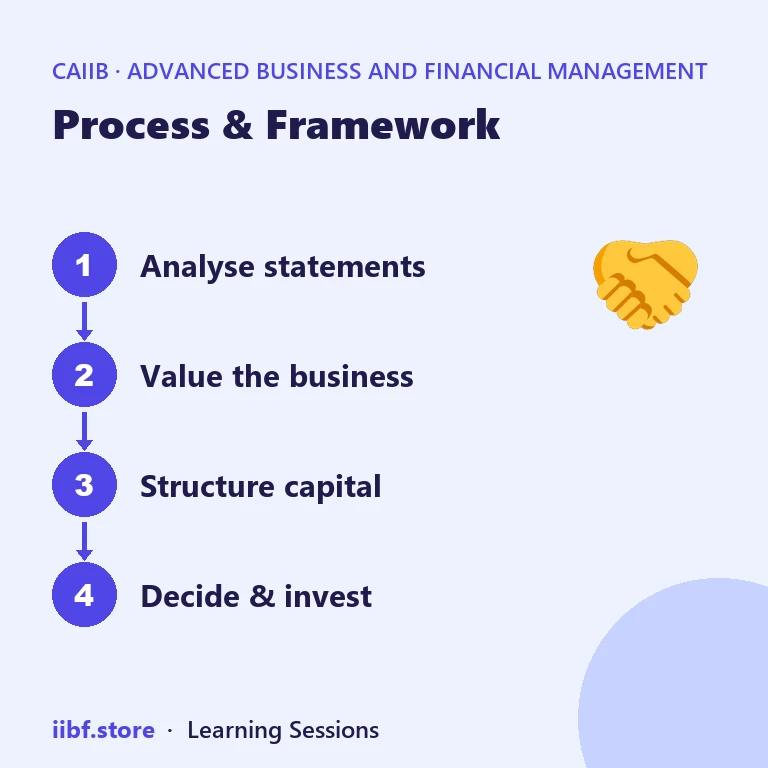
Bringing it together — classify the deal, justify it through synergy, value it and set the exchange ratio, then finance and clear it — gives you the full arc examiners test. Reinforce each stage with active recall on our concept match game and study solved deal cases on the exam blog to see the framework applied end to end.
Frequently Asked Questions
Related study material
Go deeper with the full chapter notes and the complete article hub for this subject:
What is the difference between a merger and an acquisition?
In a merger, two companies combine and usually one ceases to exist. In an acquisition, one company buys a controlling stake in another, which continues to exist, often as a subsidiary.
What is synergy in M&A?
Synergy is the extra value created when the combined firm is worth more than the two standalone firms. It arises from operating gains (scale, cross-selling) and financial gains (lower cost of capital, tax benefits) and funds any acquisition premium.
What is the exchange ratio in a share-swap merger?
It is the number of acquirer shares issued for each target share, usually derived from the ratio of the two firms' per-share values. It determines dilution and whether the deal is EPS-accretive or dilutive.
What is a poison pill?
A takeover defence where the target issues new shares cheaply to existing shareholders, diluting a hostile acquirer's stake and making the takeover far more expensive and difficult to complete.
Conclusion and Next Step
A confident command of mergers and acquisitions — from deal types and synergy through valuation, exchange ratios and regulation — unlocks a rich, recurring section of the CAIIB ABFM paper. The concepts reward both understanding and numerical practice. Put yours to the test now with a full-length CAIIB ABFM mock test and turn deal theory into exam marks.
Quick quiz on this topic
5 exam-style questions from our free test bank — check yourself before you move on.
Practice this topic
Take a free mock test, download chapter PDFs, or watch a video class — all included on iibf.store.
Keep reading