Mutual Funds Basics for JAIIB RBWM Aspirants

Mutual funds are a cornerstone of the JAIIB Retail Banking and Wealth Management paper, because they sit at the heart of how banks help customers grow their savings. In simple terms, mutual funds pool money from many investors and invest it, through a professional fund manager, in a diversified portfolio of shares, bonds or other securities. For a relationship banker guiding a customer's financial plan, understanding how these products work — their structure, categories, costs and risks — is essential. This guide explains the fundamentals exactly as the IIBF syllabus frames them, so you can advise customers responsibly and score confidently in the exam.
What Mutual Funds Are and How They Are Structured
A mutual fund collects money from a large number of investors with a common investment objective and deploys it across a basket of securities. Because the pool is diversified across many holdings, the risk attaching to any single security is reduced. Investors hold units, each representing a proportionate share of the fund's portfolio, and the value of one unit is the Net Asset Value (NAV) — the total value of the fund's assets minus liabilities, divided by the number of units outstanding.
In India the industry follows a three-tier structure prescribed by the regulator. The sponsor establishes the fund; a trust holds the fund's assets on behalf of investors; and an Asset Management Company (AMC) manages the investments for a fee. This structure is overseen by the Securities and Exchange Board of India (SEBI) under the SEBI (Mutual Funds) Regulations, ensuring investor protection, disclosure and fair valuation. Candidates should be able to recall this sponsor-trust-AMC arrangement and the regulator's role, as they are frequently examined.
Types of Mutual Funds
Mutual funds are classified along several dimensions. By structure, an open-ended scheme allows investors to buy and redeem units at any time at the prevailing NAV, whereas a close-ended scheme has a fixed maturity and a limited subscription window. By asset class, the main categories are equity funds (investing mainly in shares for long-term growth), debt funds (investing in bonds and money-market instruments for relative stability), and hybrid funds that blend the two.
Within these broad groups sit many sub-categories: large-cap, mid-cap and small-cap equity funds; liquid and short-duration debt funds; index funds and Exchange Traded Funds (ETFs) that passively track a benchmark; and Equity-Linked Savings Schemes (ELSS) that offer a tax deduction subject to a lock-in. A customer can invest as a lump sum or through a Systematic Investment Plan (SIP), which channels a fixed amount at regular intervals and benefits from rupee-cost averaging. Knowing which product suits which customer goal is the core advisory skill this subject tests.
Costs, Risks and the Role of the Banker
Every mutual fund carries costs and risks that a customer must understand. The recurring annual charge is the expense ratio, capped by SEBI, which covers management and administrative expenses and directly reduces returns. Some schemes may levy an exit load if units are redeemed within a specified period. Because returns are market-linked and not guaranteed, every recommendation must match the customer's risk appetite, time horizon and financial goal.
This is where the banker's fiduciary responsibility comes in. Selling a mutual fund is not a transaction to be pushed for commission; it is advice that must be suitable for the customer. A conservative retiree needs capital preservation and steady income, so a debt or conservative-hybrid fund may fit, while a young earner with a long horizon can tolerate equity volatility for growth. Mis-selling — recommending an unsuitable product — invites regulatory action and destroys trust, so the exam stresses suitability, disclosure and the risk-o-meter that classifies each scheme's risk level.
Fitting Mutual Funds into Wealth Management
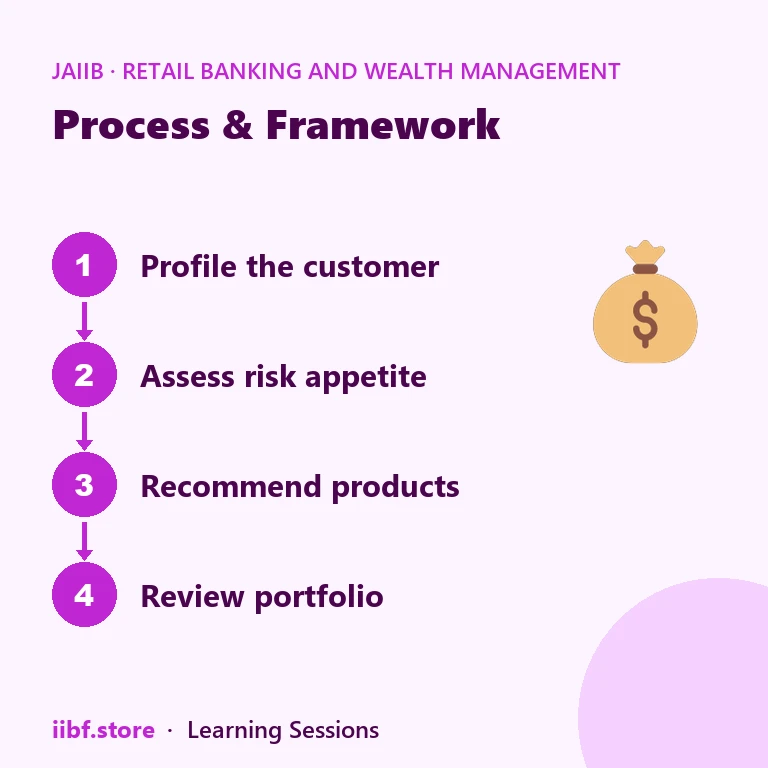
In wealth management, mutual funds are rarely the whole plan; they are one building block alongside insurance, the National Pension System, deposits and direct investments. A good banker looks at the customer's complete picture — income, liabilities, goals and risk tolerance — and uses funds to fill specific roles such as long-term wealth creation through equity or an emergency reserve through liquid funds. Asset allocation and periodic review keep the portfolio aligned with changing life stages.
To master this for the exam and the branch alike, ground your learning in primary sources and structured practice. Study investor material and regulations from the Securities and Exchange Board of India, then reinforce with our JAIIB course, read related explainers on our banking blog, and stay current with IIBF and banking news. Understanding both the products and the duty of suitable advice turns this into a confident, high-scoring topic.
Frequently Asked Questions
What is a mutual fund in simple terms?
A mutual fund pools money from many investors and invests it, through a professional fund manager, in a diversified portfolio of securities. Investors hold units whose value is the Net Asset Value (NAV) of the fund.
Who regulates mutual funds in India?
Mutual funds in India are regulated by the Securities and Exchange Board of India (SEBI) under the SEBI (Mutual Funds) Regulations. The industry follows a three-tier sponsor, trust and Asset Management Company structure.
What is the difference between open-ended and close-ended funds?
An open-ended fund lets investors buy and redeem units at any time at the prevailing NAV. A close-ended fund has a fixed maturity and a limited subscription window, after which units trade on an exchange.
What is a SIP in mutual funds?
A Systematic Investment Plan (SIP) invests a fixed amount at regular intervals rather than as a lump sum. It instils investing discipline and benefits from rupee-cost averaging across market ups and downs.
Conclusion: Advise Well and Score Well
A clear understanding of mutual funds makes you both a trustworthy adviser and a confident JAIIB candidate. Focus your revision on the sponsor-trust-AMC structure, the main fund categories, the role of NAV, expense ratios and the duty of suitable advice, and practise matching products to realistic customer profiles. Ready to test your grasp? Attempt a timed set on our JAIIB mock tests and sharpen your recall with our concept-matching game. Learn the products and the ethics together, and this topic becomes a genuine strength.
Quick quiz on this topic
5 exam-style questions from our free test bank — check yourself before you move on.
Practice this topic
Take a free mock test, download chapter PDFs, or watch a video class — all included on iibf.store.
Keep reading