Nayak Committee Working Capital Rule: The 25% Turnover Method

A small manufacturer walks into your branch and asks for a cash credit limit. Turnover last year: about four crore. He has no audited projections, no fund flow statement, no CMA data worth the paper it is typed on. You still have to arrive at a number, and it has to be defensible. This is the exact situation the Nayak Committee method was designed for, and it is why one small formula has survived three decades of banking reform.
Nayak committee working capital rule · Watch on YouTube
The short above gives you the rule in under a minute. What follows is the version that survives a case-let: where the numbers come from, the arithmetic worked out end to end, and the three places candidates lose the mark.
Where the rule came from
In the early 1990s the Reserve Bank set up a committee under P. R. Nayak to look at whether small-scale industry was actually getting the credit it was promised. The finding was uncomfortable but familiar: small units were being assessed with the same heavy machinery used for large corporates — projected balance sheets, MPBF computations, holding-period norms — and were losing out simply because they could not produce the paperwork.
The Nayak Committee proposed something blunt. For small borrowers, stop trying to model each current asset. Take the one number a small business actually knows — its turnover — and derive the limit from that. The Reserve Bank accepted it, and the turnover method has been the working default for small limits ever since. The RBI's own MSME FAQ page still states it in one line: working capital limits to small units are computed on the basis of a minimum of 20% of their estimated turnover, up to a credit limit of Rs 5 crore.

The 25 percent rule, decoded
The logic runs in three moves, and they are worth understanding rather than memorising.
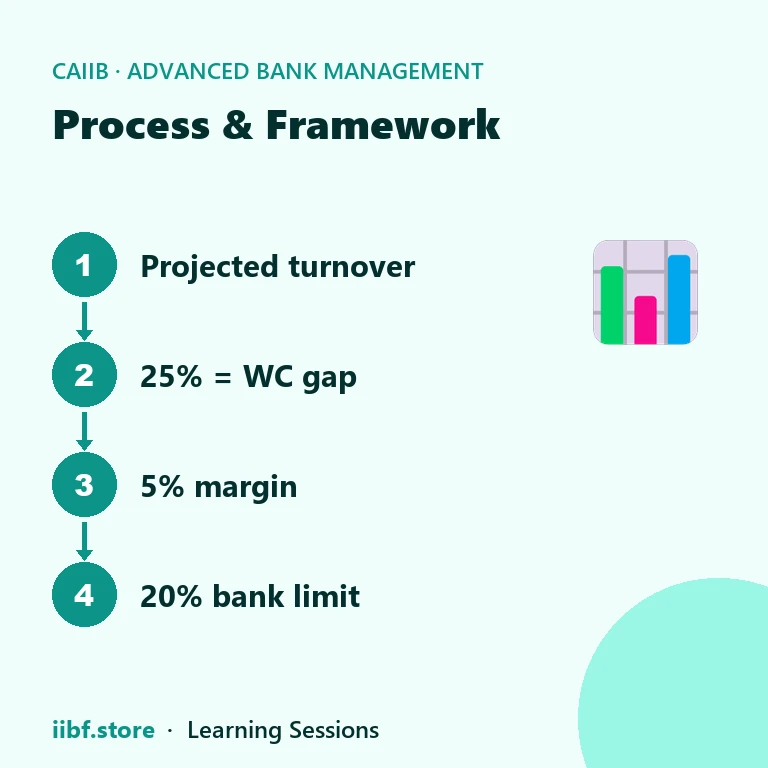
Move one. Assume a small unit turns its working capital over roughly four times a year — a three-month operating cycle. If that is true, then the working capital it needs at any moment is about one quarter of its annual turnover. So: working capital requirement = 25% of projected annual turnover.
Move two. The promoter must have skin in the game. The borrower is expected to bring at least 5% of projected turnover as margin, from long-term sources.
Move three. What is left is what the bank funds: 25% minus 5% equals 20% of projected annual turnover as the minimum bank finance.
Two words in that last sentence carry a lot of weight. Minimum means 20% is a floor, not a ceiling — if the borrower's genuine requirement is higher and the credit assessment supports it, the bank may sanction more. And projected means you work off the coming year's expected sales, not last year's audited figure, though a projection wildly out of line with past performance should not be accepted at face value.
The reverse case matters too. If the borrower can bring in more than 5% margin, the gap the bank has to fill shrinks accordingly. The 20% figure assumes a 5% contribution; a promoter contributing 10% needs correspondingly less bank finance.
A worked example
Take the manufacturer from the opening paragraph. Projected annual turnover: Rs 4,00,00,000.
| Step | Computation | Amount |
|---|---|---|
| Projected annual turnover | Given | Rs 4,00,00,000 |
| Working capital requirement | 25% of turnover | Rs 1,00,00,000 |
| Margin from borrower | 5% of turnover | Rs 20,00,000 |
| Minimum bank finance | 20% of turnover | Rs 80,00,000 |
| If borrower brings Rs 30,00,000 margin | Rs 1,00,00,000 less Rs 30,00,000 | Rs 70,00,000 |
Read the last row carefully, because that is the variant examiners use to separate the candidates who understood the logic from the ones who memorised "20 percent". When actual margin exceeds the assumed 5%, you deduct the actual margin from the 25% requirement. You do not mechanically apply 20%.
Nayak versus the other assessment methods
Working capital assessment in ABM is really a menu, and the exam wants you to pick the right item for the borrower in front of you.
| Method | Best suited to | Core idea |
|---|---|---|
| Turnover method (Nayak Committee) | Small units, fund-based limits up to Rs 5 crore | 25% of projected turnover; bank funds a minimum of 20% |
| MPBF / second method of lending (Tandon) | Larger borrowers with reliable financials | Current assets less current liabilities, with 25% of current assets from long-term sources |
| Cash budget method | Seasonal and construction-type activity | Month-by-month cash inflows and outflows; peak deficit funded |
One nuance that is easy to miss: since 1997 the RBI has given banks freedom to design their own working capital assessment methodology. The turnover method is therefore not a straitjacket. But it remains the prescribed benchmark for small limits, banks continue to use it as the base for MSE lending, and IIBF continues to test it — so the formula stays on your must-know list.
Three traps in the exam
Trap one: the ceiling. The turnover method applies to fund-based working capital limits up to Rs 5 crore. If the case-let says the sanctioned limit is Rs 8 crore, the turnover method is not the intended answer.
Trap two: 20 versus 25. Twenty-five percent is the assessed requirement. Twenty percent is the bank's share. Five percent is the borrower's margin. A question that asks for "working capital requirement" and gets 20% back has been answered wrong.
Trap three: minimum, not fixed. The RBI language is "minimum 20%". An option saying banks may sanction no more than 20% of turnover is false.
Once those three are locked in, the calculation itself takes twenty seconds. Drill it against timed questions on the IIBF mock tests, then read the surrounding credit-management chapters in the CAIIB Advanced Bank Management course, because turnover-method questions almost always arrive attached to something else — drawing power, stock statements, or the difference between sanctioned limit and drawing power.
If your December attempt is close, put the assessment methods early in your revision order on the study planner. They are cheap marks that reward practice rather than memory. For the full syllabus map, start at the CAIIB course page, and the rest of this revision series sits on the blog. The Nayak Committee formula is one of the few places in ABM where three numbers do all the work.
What exactly is the Nayak Committee turnover method?
It assesses working capital at 25% of a borrower's projected annual turnover, of which the borrower brings 5% as margin and the bank extends a minimum of 20% as fund-based working capital finance. It was designed so small units could be assessed without elaborate projections.
Up to what limit does the turnover method apply?
As stated by the RBI, working capital limits for small units are computed on the basis of a minimum of 20% of estimated turnover up to a credit limit of Rs 5 crore. Above that, banks typically move to the MPBF or cash budget approach.
What if the borrower can bring more than 5% margin?
Then the bank's share falls. Deduct the actual margin available from the 25% working capital requirement; the balance is the bank finance. The 20% figure is simply what remains when the margin is exactly 5%.
Is the turnover method still mandatory for banks?
Banks have had freedom since 1997 to decide their own working capital assessment methodology, so it is a benchmark rather than a straitjacket. In practice it remains the standard basis for small MSE limits and is regularly examined in CAIIB ABM.
Quick quiz on this topic
5 exam-style questions from our free test bank — check yourself before you move on.
Practice this topic
Take a free mock test, download chapter PDFs, or watch a video class — all included on iibf.store.
Keep reading