NBFC asset classification norms: RBI Rules for NPA Recognition
The NBFC asset classification norms decide the single most exam-heavy topic in the RBI's regulatory playbook for non-banking finance companies — and they are also the rule set examiners love to twist into tricky MCQs. Every NBFC, from a small Base Layer lender to a systemically important Upper Layer giant, must classify every loan account into Standard, Sub-Standard, Doubtful or Loss categories on a running basis, and the day-count triggers that move an account between these buckets are exactly what the NBFC asset classification norms paper tests candidates on. Get the day-counts wrong in the exam hall and you lose marks on what should be a guaranteed section.
This article breaks the framework down the way IIBF question-setters actually approach it: the classification ladder itself, the provisioning percentages attached to each bucket, the upgradation conditions that let an account climb back to Standard, and the compliance touchpoints an NBFC's operations team must keep clean. Along the way we link to the relevant study chapters so you can go deeper on any sub-topic without losing the thread of this overview.
📊 The Four-Bucket Classification Ladder
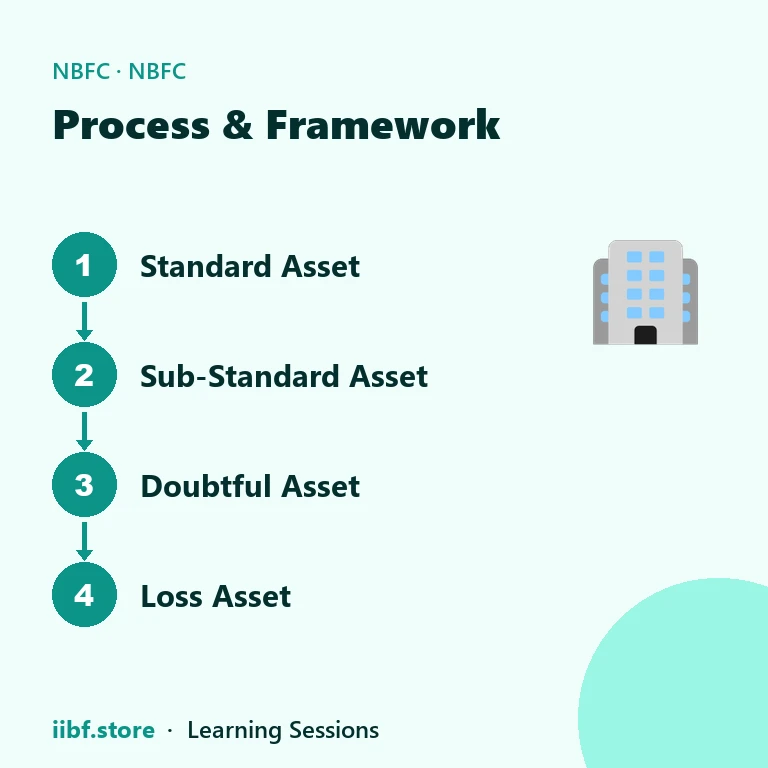
RBI's harmonised prudential framework requires every NBFC — deposit-taking or not — to slot each loan account into one of four categories based purely on the number of days the account has remained overdue, not on management's judgement of recoverability. A Standard Asset is one where interest and principal payments are not overdue, or are overdue by less than the trigger period for the entity's layer. Once an account crosses that trigger and stays overdue for up to 12 months, it becomes a Sub-Standard Asset. If it remains in that state for a further 12 months, it is reclassified as a Doubtful Asset, which is further split into Doubtful-1, Doubtful-2 and Doubtful-3 depending on how long it has stayed doubtful. Finally, a Loss Asset is one identified as uncollectible by the NBFC, its internal auditors, or the RBI's inspecting officers, even if it still carries some recovery value on paper.
The classification exercise is asset-wise, not borrower-wise in every case — restructured accounts and accounts with multiple facilities to the same borrower carry their own linkage rules that examiners frequently test. Candidates preparing this section alongside the NBFC types and roles chapter will notice that the classification trigger periods themselves are anchored to the layer the NBFC sits in under scale-based regulation, which is why this topic is best read together with the RBI's scale based regulation for NBFCs framework.
⏳ Day-Count Triggers Across NBFC Layers
The single biggest scoring opportunity — and the single biggest trap — in this topic is the day-count table. Base Layer and Middle Layer NBFCs largely align with the 90-day overdue trigger that banks already follow, while smaller, non-deposit-taking entities historically enjoyed longer look-back periods before RBI's harmonisation push closed most of that gap. Exam questions frequently ask candidates to match an NBFC's layer to its applicable overdue period, or to spot the odd one out in a list of trigger days. Because the classification norms sit inside the broader scale-based regulation architecture, revising the layer definitions first makes the day-count rules click into place rather than feeling like rote memorisation.
Interest and instalment overdue status is tracked automatically through the core banking or loan management system in any well-run NBFC, and this is exactly where the operational aspects of account opening chapter becomes relevant — the account-opening data captured at onboarding (repayment frequency, moratorium terms, disbursement date) directly feeds the ageing logic that later drives asset classification. Auditors reconcile this system-generated ageing against the NBFC's books every quarter, and mismatches here are one of the most common inspection findings RBI officers report.
💡 Exam Tip: When a question gives you an overdue period in days, convert it to months first — most classification triggers are expressed in the regulations as months, and day-count traps are a favourite way to test careless reading.
🚨 Provisioning Requirements and NPA Recognition
Classification is only half the story — each bucket carries a mandatory provisioning percentage that directly hits the NBFC's profit and loss account. Standard Assets typically require a modest general provision, Sub-Standard Assets require a flat percentage of the outstanding balance, and Doubtful Assets require provisioning on both the secured and unsecured portions separately, with the secured portion scaled by how long the account has stayed doubtful. Loss Assets must be written off in full or fully provided for — there is no partial provisioning option once an asset is classified as Loss. This cascading structure means an NBFC's provisioning coverage ratio is one of the first numbers a CAIIB or JAIIB examiner-style question will ask you to compute from a mini case study.
NPA recognition also interacts closely with the recent tightening RBI has pushed through its supervisory circulars, several of which are summarised in the recent RBI initiatives chapter — these cover clarifications on the exact day an account should be marked NPA (the day-end process, not a monthly batch run) and on how partial payments should be applied against overdue instalments before the ageing clock resets. A recurring theme across these circulars is that classification cannot be delayed for operational convenience, and every account must be evaluated at the close of business each day, not merely once a month. The full text of these prudential norms is published by RBI in its Master Directions on NBFC Income Recognition and Asset Classification, which remains the primary reference for any classification dispute.
⚠️ Common Mistake: Students often assume an NBFC can upgrade an account back to Standard the moment a borrower clears the overdue amount. In practice, RBI's norms require sustained regular repayment of the entire arrears — principal and interest — before upgradation is permitted, which candidates frequently get wrong in scenario-based questions.
🔍 Compliance Touchpoints and Governance Oversight
Asset classification does not happen in isolation from an NBFC's wider compliance machinery. The board-approved policy on classification and provisioning must be reviewed periodically, internal audit must independently verify the classification output before it feeds into financial statements, and statutory auditors examine the same trail during the year-end audit. Firms that fail to keep classification current expose themselves to RBI supervisory action, including directions under the regulator's risk-based supervision framework. The regulatory requirements and compliance chapter maps out exactly where asset classification sits inside an NBFC's overall compliance calendar, alongside reporting formats like the NBS returns that carry classification data back to RBI.
Because classification accuracy depends on clean customer and account data captured at origination, robust KYC and AML/CFT norms compliance indirectly supports good asset-quality reporting — an NBFC with weak customer due diligence often struggles to trace borrowers once accounts slip, which delays recovery action and inflates the Doubtful and Loss buckets over time. Governance norms for NBFCs under scale-based regulation also assign explicit board-level responsibility for asset-quality oversight, reflected in the level of scrutiny applied through corporate governance norms for NBFCs, which candidates should treat as a companion topic to this one.
📌 Remember: Classification, provisioning, and governance oversight form one continuous chain in the exam syllabus — a question on any one link often expects you to reference the other two.
🏦 How NBFC Norms Compare Across Related Frameworks
Candidates frequently confuse asset classification norms with adjacent regulatory concepts that sound similar but serve different purposes. The table below separates the most commonly mixed-up frameworks so you can anchor each one to its correct trigger and purpose before the exam.
| Framework | Purpose | Applies at Account Level? | Linked to Layer? |
|---|---|---|---|
| Asset Classification (IRAC) Norms | Flags overdue accounts as NPA and grades severity | ✅ Yes | ✅ Yes |
| Provisioning Norms | Sets the P&L charge for each classification bucket | ✅ Yes | ❌ No (bucket-based) |
| Principal Business Criteria | Decides if an entity qualifies as an NBFC at all | ❌ No | ❌ No |
| Scale-Based Regulation Layers | Sets the regulatory intensity applicable to the NBFC | ❌ No | ✅ Defines the layer |
| PCA-style Supervisory Action | Regulator intervention on breach of thresholds | ❌ No | ✅ Yes |
The row that trips up most candidates is the distinction between provisioning norms and classification norms — classification tells you which bucket an account belongs to, while provisioning tells you how much of that account's value must be set aside as a charge against profit. Both move together, but they answer different exam questions and should never be described as the same rule in a written answer.
🧭 Digital Lending and NPA Ageing in Practice
The rise of digital and co-lending disbursement channels has added new wrinkles to how NBFCs track overdue status. Automated repayment reminders, UPI-based auto-debits, and API-linked loan management systems mean that ageing calculations now run in near real time rather than through manual end-of-month reconciliation. This has actually tightened compliance — an NBFC using a modern loan management system has far less room to argue that a classification was "missed" due to manual error, because the system itself timestamps every overdue day. Examiners have started framing questions around this shift, asking candidates to identify how technology changes the operational risk profile of classification, even though the underlying RBI day-count rules themselves have not changed.
For borrowers with multiple facilities across co-origination arrangements, ageing must still be tracked separately for each lender's exposure share, reinforcing why this topic is best studied as one thread in a much larger NBFC prudential picture rather than as an isolated rule to memorise. Trade finance professionals studying adjacent instruments will find a useful parallel in how overdue recognition works for receivables-based lending, covered in the IIBF ITF material on export factoring and receivables finance, where a similar overdue-ageing logic governs when a factored receivable is treated as impaired.
🧠 Practice MCQs: NBFC Asset Classification Norms
Q1. Under RBI's harmonised norms, an account first becomes a Sub-Standard Asset when it has remained a Non-Performing Asset for a period of: (a) up to 6 months (b) up to 12 months (c) up to 18 months (d) up to 24 months
Answer: (b) — An account stays classified as Sub-Standard for up to 12 months from the date it is first recognised as NPA, after which it moves to the Doubtful category.
Q2. Which asset classification category requires full provisioning or write-off with no partial provisioning option? (a) Standard Asset (b) Sub-Standard Asset (c) Doubtful Asset (d) Loss Asset
Answer: (d) — A Loss Asset must be written off entirely or fully provided for, since it has been identified as uncollectible by the NBFC, auditors, or RBI inspectors.
Q3. For an account to be upgraded from NPA back to Standard classification, an NBFC must ensure: (a) the borrower promises future payment (b) only the overdue interest is cleared (c) the entire arrears of principal and interest are cleared with sustained regular repayment (d) 30 days have passed since the last instalment
Answer: (c) — RBI norms require clearance of the entire arrears along with demonstrated regular repayment behaviour before an NPA account can be upgraded to Standard.
Q4. Doubtful Assets are further sub-classified into Doubtful-1, Doubtful-2 and Doubtful-3 primarily based on: (a) the loan amount outstanding (b) the security coverage ratio (c) the duration the asset has remained in the Doubtful category (d) the borrower's credit score
Answer: (c) — The sub-classification of Doubtful Assets tracks how long the account has continuously remained in the Doubtful bucket, which determines the applicable provisioning percentage.
Q5. Asset classification in an NBFC must be carried out: (a) once a year at audit closing (b) once a quarter for board reporting (c) at the close of business on each day (d) only when RBI conducts an inspection
Answer: (c) — RBI's supervisory clarifications require classification status to be evaluated at the close of business each day, not on a delayed monthly or quarterly batch basis.
Want chapter-wise mock tests with 100+ MCQs? Start practising free →
❓ Frequently Asked Questions
What are the four categories under NBFC asset classification norms?
The four categories are Standard Asset, Sub-Standard Asset, Doubtful Asset (further split into Doubtful-1, Doubtful-2 and Doubtful-3), and Loss Asset, assigned strictly based on how long an account has remained overdue.
Do asset classification norms differ across NBFC layers?
The day-count triggers are largely harmonised across layers under RBI's scale-based regulation, though the intensity of supervisory follow-up and reporting obligations increases as an NBFC moves from the Base Layer toward the Upper Layer.
Can a downgraded account be reclassified as Standard again?
Yes, but only after the borrower clears the entire arrears of principal and interest and demonstrates sustained regular repayment, as required under RBI's upgradation conditions — a partial payment alone is not sufficient.
How often must NBFCs run their asset classification exercise?
RBI's supervisory guidance requires classification status to be assessed at the close of business on each day, ensuring that no account's NPA recognition is delayed for operational or reporting convenience.
✅ Conclusion
The NBFC asset classification norms are one continuous chain running from day-count triggers through provisioning percentages to board-level governance oversight, and IIBF exams test every link in that chain rather than any single fact in isolation. Anchor your revision in the layer definitions, memorise the upgradation conditions precisely, and practise scenario-based questions until the day-count math becomes automatic. Ready to test yourself under exam conditions? Attempt a full NBFC mock test and browse more coverage on the NBFC blog tag hub to round out your preparation.
Practice this topic
Take a free mock test, download chapter PDFs, or watch a video class — all included on iibf.store.