NBFC Outsourcing of Financial Services: RBI Rules Explained
Picture a mid-sized NBFC that wants to speed up collections and customer onboarding. The management outsources field visits to an agency, KYC document collection to a fintech and its call centre to a BPO. Then the CEO asks a simple question: can we also hand over loan sanctioning to the agency's team? The answer is a firm no, and the reason sits in the RBI rules on NBFC outsourcing of financial services. If you are preparing for the IIBF NBFC certificate, this is a topic where one wrong word in an option can cost you the mark.
In this article we go through the regulatory basis, what can and cannot be outsourced, the duties of the Board, due diligence, the written agreement, group arrangements, customer grievances and exit planning. We end with practice questions in the style IIBF uses.
What is outsourcing in the NBFC context?
Outsourcing means an NBFC uses a third party, which may be a group entity or an unrelated vendor, to perform an activity that the NBFC itself would normally carry out. Collections, document processing, data entry, call centres, valuation, even technology operations all fall here. The RBI does not stop NBFCs from doing this. It stops them from doing it carelessly.
The current rulebook is the Reserve Bank of India (Non-Banking Financial Companies - Managing Risks in Outsourcing) Directions, 2025, issued on 28 November 2025 under Section 45L of the RBI Act, 1934 and available on the RBI Master Directions page. It covers the NBFC categories including NBFC-ICC, NBFC-MFI, NBFC-P2P, Housing Finance Companies and Core Investment Companies. It splits the subject into financial services outsourcing and material IT outsourcing, and it applies in proportion to the NBFC's layer under scale-based regulation: Base Layer NBFCs follow the core chapters, while the Middle Layer and above carry the additional IT-related obligations.
The one principle behind every rule
Outsourcing does not move responsibility. The NBFC and its Board remain fully answerable for the activity, for compliance with RBI directions and for what happens to the customer. Whenever an exam option suggests that liability "passes to the service provider", you can strike it out.
Another practical point: an NBFC that wants to outsource financial services does not need prior approval from the RBI. The RBI can still inspect and monitor, and the burden of proving that risks are controlled stays with the company.
Core functions an NBFC cannot outsource
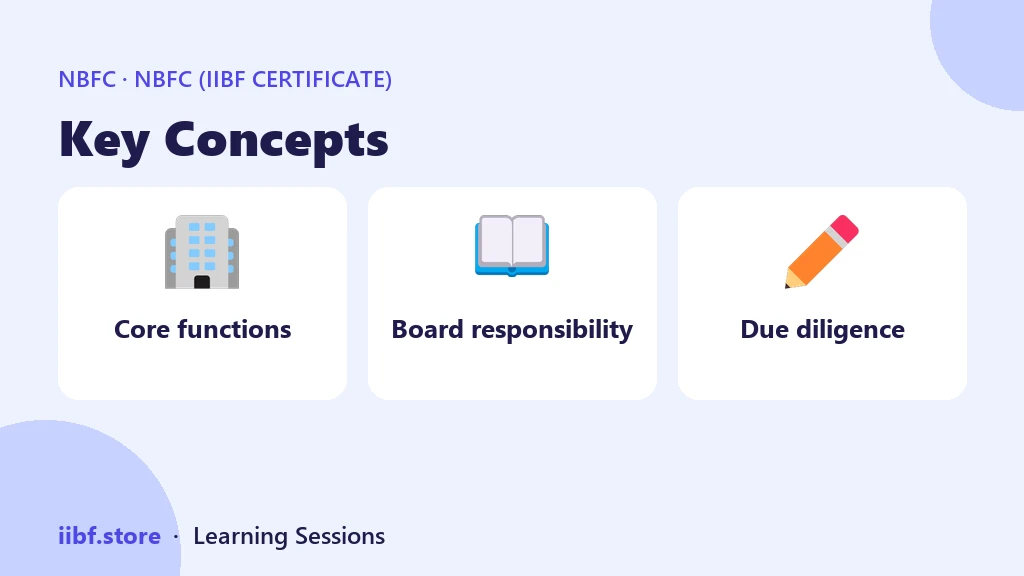
This is the most tested part. The Directions prohibit outsourcing of core management functions. The list is short and worth memorising:
- Internal audit, along with strategic and compliance functions.
- Decision-making functions such as determining compliance with KYC norms for opening deposit accounts, sanction of loans (including retail loans) and management of the investment portfolio.
The logic is simple. A company that hands over its judgement has stopped being the lender. The agency can collect papers, verify addresses, run a call centre or process data, but the decision to lend, the KYC determination and the oversight of the company stay inside.
A subtle point about internal audit
Internal auditors may be appointed on a contract basis. That is not outsourcing of the audit function, because the NBFC continues to direct and own the audit. Students often confuse "contract staff" with "outsourced function". Read the option carefully: hiring individual contract auditors is allowed, while transferring the audit function itself to an outside entity is the thing that is restricted.
The group exception
For NBFCs that belong to a group or conglomerate, the Directions allow these functions to be performed by group entities, but only with safeguards: a Board-approved policy, service level agreements, written agreements, and risk practices equal to those followed for unrelated parties. The NBFC must also be able to continue operations if the group's premises or services become unavailable. So the correct exam statement is that the ban is not absolute for groups, but the exception is conditional and the NBFC stays responsible.
Board and senior management responsibilities
The Board is not a spectator in NBFC outsourcing of financial services. It must approve a framework to evaluate the risks and materiality of outsourcing, fix who can approve which arrangement, and review arrangements regularly. For material activities, the Board decides whether outsourcing is permissible and approves the arrangement. Records of material outsourcing are reviewed by the Board at least half-yearly, and this review may be delegated to the Risk Management Committee. The Audit Committee watches the internal audit of outsourced activities and the ageing of reconciliation items.
Senior management turns the policy into practice: evaluating the risks, selecting the provider, monitoring performance and keeping a central record of material arrangements so that the RBI can see them on inspection.
Who should not be your service provider?
For a non-group provider, the Directions bar entities owned or controlled by a director, key managerial personnel, an approving officer of the NBFC or their relatives. Exceptions need approval from the Board or its committee, with disclosure and monitoring. This is a conflict-of-interest safeguard and a favourite one-line question.
Step-by-step: how an NBFC outsources an activity
Think of the flow as a checklist that a compliance officer would follow at the branch or head office. The following sequence reflects how the Directions expect the NBFC to proceed.
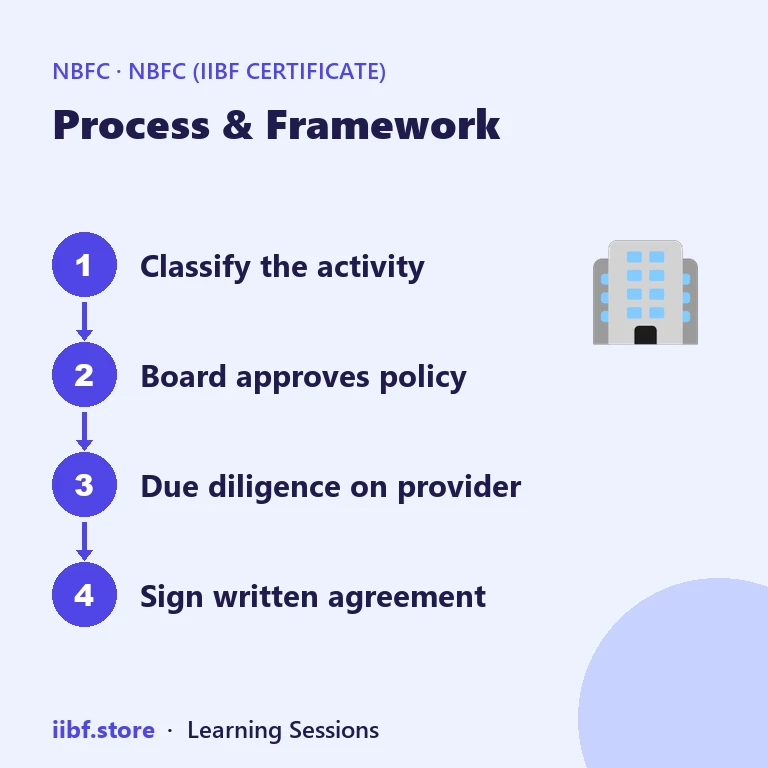
- Classify the activity. Is it a core function? If yes, stop (subject to the group exception). Is it material, meaning its failure could hurt operations, customers or reputation? Material activities attract stricter treatment.
- Get the Board policy in place. A Board-approved outsourcing policy and risk framework must exist before any arrangement is signed.
- Do due diligence. Before entering into or renewing an arrangement, assess the provider.
- Sign a written, legally vetted agreement. A verbal understanding or an email trail is not enough.
- Monitor and review. Review the provider's financial and operational condition at least annually, keep the central record, and report half-yearly to the Board.
- Plan the exit. Contingency plans, alternate providers or an in-house option must be ready before problems arise.
What due diligence looks at
The Directions list the factors: the provider's financial soundness, its experience and reputation, quality of subcontractors, concentration risk (too much dependence on one vendor), information security and the external legal and political environment. Where possible, independent reviews should be used. An NBFC cannot lean only on a vendor's own brochure.
What the agreement must contain
The agreement must be written, legally binding and vetted by legal counsel. It should cover, among other things, service standards, access of the NBFC to books and records, approval of subcontracting, confidentiality (including after termination), contingency plans, audit rights, the RBI's right to inspect, and a termination clause. IT outsourcing agreements carry further provisions, for example that data stays in India and that RBI inspection rights are preserved.
Customer protection, KYC and grievances
For a borrower, the NBFC's name is on the loan, so the NBFC answers for what the agent does. Three rules sum this up:
- The customer's rights against the NBFC do not reduce because an activity was outsourced.
- The NBFC remains responsible for grievances arising out of outsourced services and must publish its grievance procedure on its website.
- Where the complaint is not resolved, the customer can approach the RBI Ombudsman under the Reserve Bank - Integrated Ombudsman Scheme.
The NBFC also stays responsible for reporting cash and suspicious transactions linked to customer activities handled by a provider. If a collection agency or a digital partner sees something unusual, the reporting duty is still the NBFC's. This links with your study of Fair Practices Code and AML/KYC, which you can revise in our free material library.
Offshore outsourcing
If a service provider is located outside India, the NBFC must consider country risk, choose the governing law carefully, and ensure that records remain accessible to the NBFC and the RBI even if the provider is wound up. Original records are to be kept in India. The common trap is the idea that an offshore vendor can store everything abroad. It cannot.
NBFC outsourcing of financial services: comparison table
Use this table as a one-page memory aid for NBFC outsourcing of financial services.
| Question | Position under the 2025 Directions |
|---|---|
| Prior RBI approval to outsource? | Not required; RBI can inspect and monitor |
| Can loan sanction be outsourced? | No, it is a core decision-making function |
| Can internal audit be outsourced? | No, but contract-basis auditors are allowed |
| Can group entities do core functions? | Only under the conditional group exception |
| Who is responsible to the customer? | Always the NBFC, never the vendor alone |
| Board review of material outsourcing | At least half-yearly (may be delegated to Risk Management Committee) |
| Review of provider's condition | At least annually |
| Provider owned by a director's relative? | Barred unless Board or committee approves with disclosure |
| Offshore: where do original records stay? | In India |
Worked example from a branch
A vehicle-finance NBFC in Pune uses an agency for home visits and a fintech for document capture. A branch manager proposes that the agency's team also approve loans below a small threshold to cut turnaround. The compliance head objects. Loan sanction, even retail, is a core decision-making function and cannot be outsourced. The agency can collect documents and flag exceptions, but the credit officers of the NBFC must take the sanction decision.
Later the same NBFC discovers that the agency is owned by the spouse of one of its senior officers. Under the Directions this is a conflict of interest unless the Board or its committee has approved with disclosure and monitoring. The compliance head puts the matter to the Board, which asks for the due diligence file and a fresh review. This is exactly how the topic appears in case-style IIBF questions.
How IIBF tests this topic
Expect statement-based questions with an "which of the following is correct" format. The traps repeat: liability shifting to the vendor, prior RBI approval, confusion between contract staff and outsourcing, and the group exception. If you want to practise in the exam format, try the NBFC mock tests after finishing this chapter, and use the structured NBFC certificate course for the full syllabus. The NBFC printed book adds chapter-wise MCQs for revision on the train or after branch hours.
Practice question 1
Which of the following can an NBFC outsource? (a) Sanction of retail loans (b) Internal audit function (c) Collection of KYC documents from customers (d) Investment portfolio management. The answer is (c). Sanction, the audit function and portfolio management are core functions, while document collection is an operational task that the NBFC can outsource, as long as the KYC determination stays with the NBFC.
Practice question 2
An NBFC outsources collections to an agency that behaves improperly with a borrower. Who is responsible to the borrower? The answer is the NBFC. The Directions state that outsourcing does not diminish the NBFC's obligations, and grievances arising from outsourced services remain its responsibility. An option saying the agency alone is liable is wrong.
Practice question 3
True or false: an NBFC needs prior RBI approval for every outsourcing arrangement. The answer is false. No prior approval is needed to outsource financial services, but the arrangements must follow the Directions and are open to RBI inspection.
Quick revision points
- Source: RBI (NBFC - Managing Risks in Outsourcing) Directions, 2025, issued 28 November 2025.
- Core functions not to be outsourced: internal audit, strategic and compliance functions, and decision-making such as KYC determination, loan sanction and investment portfolio management.
- Contract-basis internal auditors are allowed.
- Group entities may do core functions only under the conditional group exception.
- Board approves the policy and reviews material outsourcing at least half-yearly.
- Written, vetted agreement; RBI inspection right must be preserved.
- NBFC keeps responsibility for customers, grievances and AML reporting.
- Provider owned by a director's relative: barred unless approved with disclosure.
- Offshore outsourcing: original records stay in India.
Frequently asked questions
Does an NBFC need RBI permission for outsourcing of financial services?
No. The Directions state that an NBFC does not need prior approval from the RBI to outsource financial services. It must still follow the Directions, keep records and allow RBI inspection.
Can an NBFC outsource loan sanctioning?
No. Loan sanction, including retail loans, is a core decision-making function that cannot be outsourced. Only supporting tasks such as document collection or data processing may be handed to a provider.
Can a group company perform core functions for an NBFC?
Yes, but only under the conditional group exception. The NBFC needs a Board-approved policy, service level agreements, written agreements and risk practices equal to those used for unrelated vendors.
Who is responsible if the outsourced vendor harms a customer?
The NBFC. Outsourcing does not reduce its obligations or the responsibility of its Board, and the NBFC must handle grievances arising from outsourced services.
Can an NBFC appoint contract internal auditors?
Yes. Internal auditors may be engaged on contract, which is different from outsourcing the internal audit function itself, a function that the Directions say cannot be outsourced.
Conclusion
The heart of NBFC outsourcing of financial services is balance: use vendors for execution, but keep judgement, accountability and customer responsibility in-house. If you can recall the banned core functions, the Board's role, due diligence, the written agreement, the group exception and the fact that responsibility never moves to the vendor, you will answer most questions from this area correctly. For the official text and the schedule of the upcoming exam cycle, check the RBI Directions and iibf.org.in.
Prefer revising from a printed book?
Chapter-wise books with MCQs after every chapter — minimal pages, complete coverage, delivered anywhere in India. Every book has a free sample to read first.


















































Practice this topic
Take a free mock test, download chapter PDFs, or watch a video class — all included on iibf.store.