Emerging Technologies Book: Is It Right for Your Attempt?
It is 10 pm. You have finished a full day at the branch, the dinner is cold, and a syllabus that includes Hadoop, blockchain, clustering and neural networks is waiting. Nobody told you, when you joined banking, that you would one day need to explain an LSTM. If this is you, you are not behind. You are simply studying a technology paper as a working banker, which is a different job from studying it as a student.
Before you spend money on anything, it is worth asking a plain question: is this particular Emerging Technologies book the right tool for your situation? This guide helps you decide, even if the answer turns out to be no. Whatever you choose, the study method in the later sections will work with any good material.
Why technology papers feel harder for bankers
Most of us learned banking by doing it. We know KYC, cheque clearing and credit appraisal because we handle them daily. A technology paper is different. There is no counter experience to lean on, and the vocabulary is new: MapReduce, side chains, PCA, expert systems.
The good news is that the paper tests understanding of concepts and their use in banking. It does not ask you to write code or build a model. That changes how you should study:
- Aim for the idea, not the mathematics. If you can say in two lines what a decision tree does and where a bank might use it, you are on the right track.
- Tie every topic to a banking use. Fraud detection, credit scoring, KYC, trade finance: attach each concept to one of these.
- Revise by comparison. Supervised versus unsupervised, public versus private blockchain, RNN versus CNN. Exams love these pairs.
For the official syllabus, eligibility and the upcoming exam cycle, always check the IIBF website. We deliberately do not quote dates or fees here because they change.
What the Emerging Technologies book actually contains
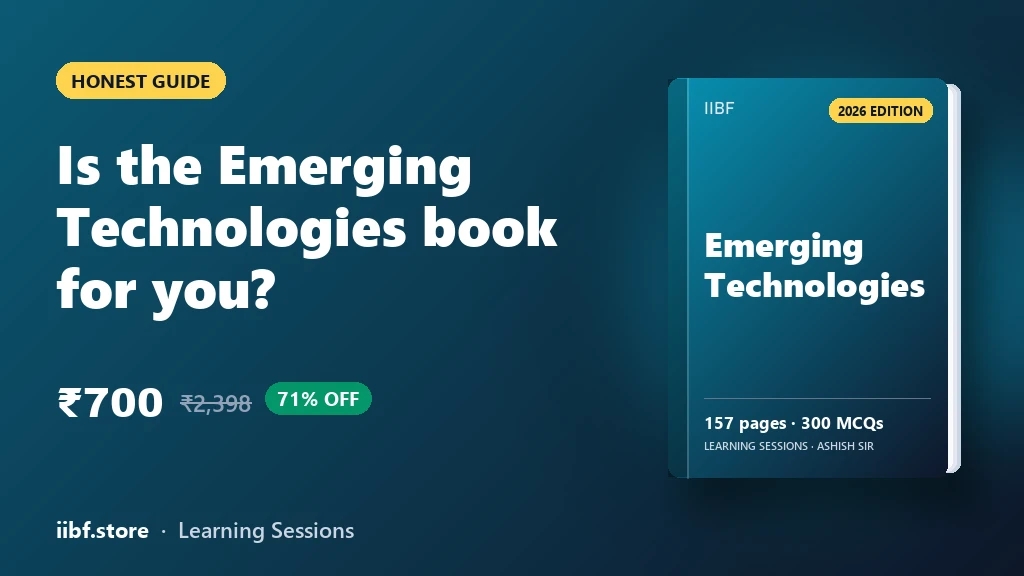
Let us stay with facts. The Emerging Technologies book (2026 edition) runs to 157 pages across 20 chapters, with 300 practice questions. The chapters are grouped into five modules:
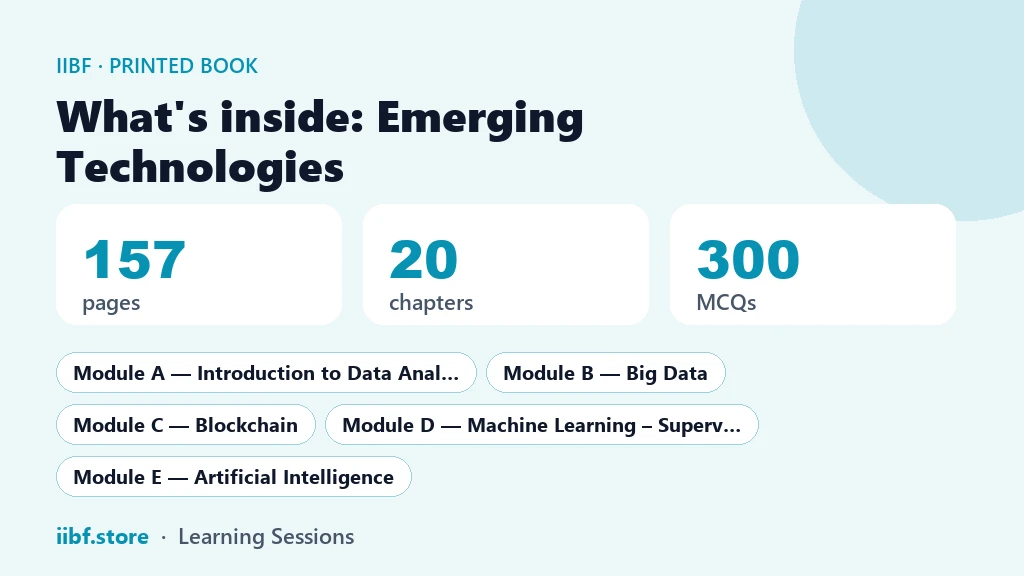
- Module A, Introduction to Data Analytics: 4 chapters, from the information value chain to analytics tools and their use in banking.
- Module B, Big Data: 3 chapters covering Hadoop and MapReduce, SQL and in-database analytics, and Apache Spark.
- Module C, Blockchain: 3 chapters on fundamentals, forks and distributed ledgers, and smart contracts.
- Module D, Machine Learning: 6 chapters, from mathematical foundations to regression, trees, clustering and graphical models.
- Module E, Artificial Intelligence: 4 chapters on neural networks, CNN, RNN and LSTM, NLP and expert systems.
It also lists 30 case studies (120 questions) and 5 mega tests (500 questions) as extras. The price at the time of writing is ₹700 against an MRP of ₹2,398, but prices may change, so treat the book page as the current source.
A 157-page book for 20 chapters is compact. That is a strength for a tired reader and a limit for anyone who wants exhaustive depth. Keep that in mind in the profiles below.
Four reader profiles: which one are you?
1. The first-attempt candidate
You have never seen this paper. Your biggest risk is not difficulty, it is overwhelm. A short, chapter-wise Emerging Technologies book helps because it gives you a finish line you can see.
How to use it: read one chapter per sitting, in module order, because later modules lean on earlier ones. After each chapter, close the book and write three lines from memory. Then attempt that chapter's questions.
When it is not enough: a first read gives you familiarity, not speed. Before the exam, you still need timed practice. The free mock tests are a sensible place to start before you decide on anything paid.
2. The repeat-attempt candidate
You have been here before, and probably left marks on the table in the same few areas. You do not need to start from page one. You need to find where you lost marks.
How to use it: take your previous result or recall, list the three modules that hurt you, and read only those first. Use the questions as a diagnostic: where you get them wrong, go back to the chapter, not to a new book.
When it is not enough: if your earlier attempt failed because of exam-hall time pressure or nerves, reading more will not fix it. Timed mock tests will. Be honest with yourself about which problem you actually have.
3. The candidate who is short on time
Maybe the exam cycle is closer than you hoped, and work is heavy. A compact book suits this situation, but only if you ruthlessly prioritise.
How to use it: spend your first evening skimming module headings only, so you know the map. Then give the most time to Module D (six chapters, the largest block) and Module A, and keep Modules B, C and E to steady, shorter sessions. Do not skip any module, because the paper spans all five.
When it is not enough: a very short runway means no time for a second pass. Pick fewer, higher-value things: the book, the questions, and one or two full mock tests. Skip anything else.
4. The reader who prefers paper over screens
If you stare at screens all day at the branch, the last thing you want at night is another one. A printed book lets you underline, fold pages and study on the commute or on a Sunday morning without notifications.
How to use it: keep a pencil with the book. Mark every comparison pair and every banking use case. Those marked lines become your last-week revision, so you can revise a whole module in twenty minutes.
When it is not enough: paper does not time you, score you or shuffle questions. Pair it with online practice for that.
A simple plan for the Emerging Technologies book
Whichever profile fits you, this four-step loop works well with the Emerging Technologies book, and it also works with any other material.
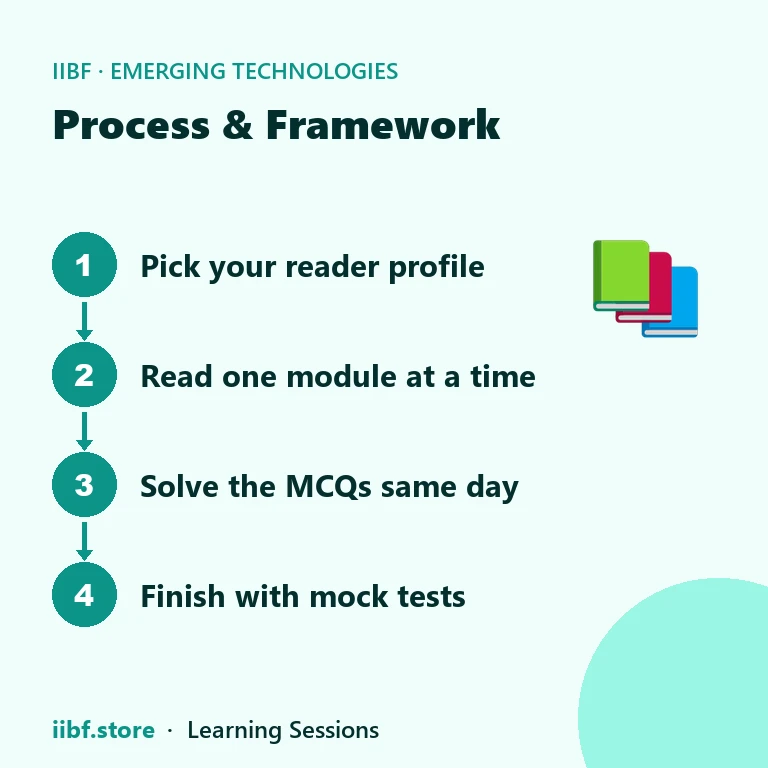
- Pick your profile. Decide whether you are in first-attempt, repeat, short-on-time or paper-first mode, and set your starting point accordingly.
- Read one module at a time. Finish a module before opening the next. Five modules are easier to track than twenty loose chapters.
- Solve the questions the same day. Memory fades fast. Attempting questions within hours of reading is far more effective than leaving them for the weekend.
- Finish with mock tests. In the last stretch, shift from reading to timed practice.
| Reader | Start with | Add alongside |
|---|---|---|
| First attempt | All modules in order | Free mock tests |
| Repeat attempt | Your weakest modules | Timed full-length mocks |
| Short on time | Module D and Module A first | One or two mock tests |
| Prefers paper | Marked-up chapters | Online questions for timing |
Where a book alone will not carry you
A book gives you the content. It cannot give you exam-hall speed, and it cannot tell you how you perform under a ticking clock. That is why we keep saying: pair it with mocks.
There is also a second limit. At 157 pages, this book is a focused study aid, not a replacement for every detailed reference. If you are curious about a topic, say Spark or LSTM, you may want to read further on your own. For free supporting PDFs, see the free material library, and for other titles, browse all books.
Finally, check your own situation. If you already work in a data or IT team and know most of this, the book may be more than you need. In that case, spend your money on practice tests instead. That is a perfectly good decision.
How to decide, in two minutes
Ask yourself three questions:
- Do I need a structured, chapter-wise path through all five modules? If yes, a book like this helps.
- Do I study better on paper? If yes, print is worth it.
- Will I actually attempt the questions and mocks, or only read? If only read, no book will rescue the attempt.
If you are leaning yes, read the Emerging Technologies book page and open the free sample first. Read two pages. If the language feels clear to a tired reader, that is your answer. Prices and availability can change, so always rely on the book page for the current details.
Whatever you decide, start small tonight: one chapter, three lines from memory, five questions. Consistency beats a heroic weekend, every time. Our blog has more plans like this for working bankers.
Frequently asked questions
Is the Emerging Technologies book enough to pass on its own?
It covers all five modules in 20 chapters with 300 practice questions, which is a solid base. But passing also depends on timed practice, so we recommend adding mock tests in the final weeks.
Do I need a technical background to use it?
No. The paper tests concepts and their use in banking, not programming. Read slowly, tie each idea to a banking example, and you can manage without a technical background.
Can I try before buying?
Yes. The book has a free sample on its page, so read a few pages and judge whether the style suits you. Also try the free mock tests to see where you stand.
Where do I find the exam dates and syllabus?
Always use the official IIBF website at iibf.org.in for the upcoming exam cycle and syllabus, since schedules and rules can change.
Prefer revising from a printed book?
Chapter-wise books with MCQs after every chapter — minimal pages, complete coverage, delivered anywhere in India. Every book has a free sample to read first.


















































Practice this topic
Take a free mock test, download chapter PDFs, or watch a video class — all included on iibf.store.
Keep reading