Is the IIBF Microfinance Book Right for You? An Honest Guide
It is 10 pm. The branch closed hours ago, the dinner plates are cleared, and you finally sit down with the Microfinance syllabus. Eighteen chapters, two modules, regulations you half remember from a circular you once skimmed. You have a fair guess that you will study for forty minutes before your eyes give up. If this sounds like you, the real question is not which resource is the best on earth. It is which one fits the hours you actually have.
That is the spirit of this guide. We will look honestly at the IIBF Microfinance book from Learning Sessions, who it suits, who needs something extra, and how to use it either way. You will get a usable plan from this page even if you never buy anything.
First, what you are really preparing for
The Microfinance certificate sits in the IIBF certification family, and its content is a mix of ideas and operations. On the idea side: why poor households struggle to get credit, why microfinance exists, how delivery methods such as group lending work, and how financial inclusion is measured. On the operations side: products, accounting and reporting, revenue models, risk management and regulatory compliance.
This matters because the exam rewards two different skills. One is clean recall of definitions, institutions and regulations. The other is applying that knowledge to a short scenario, such as deciding which risk a situation describes or which regulation applies. A candidate who only memorises will stall on scenarios. A candidate who only reads concepts will lose marks on facts.
For the official schedule and notices for the upcoming exam cycle, always check the IIBF website. Do not rely on anyone's summary of dates, including ours.
A quick self-check before you read further
- How many hours a week can you honestly protect, not hope for?
- Do you remember better from paper or from a screen?
- Have you attempted a certificate paper before?
- Do you already work in a rural, priority-sector or financial inclusion role?
Your answers decide which of the four profiles below is closest to you.
What is inside the book, in plain facts
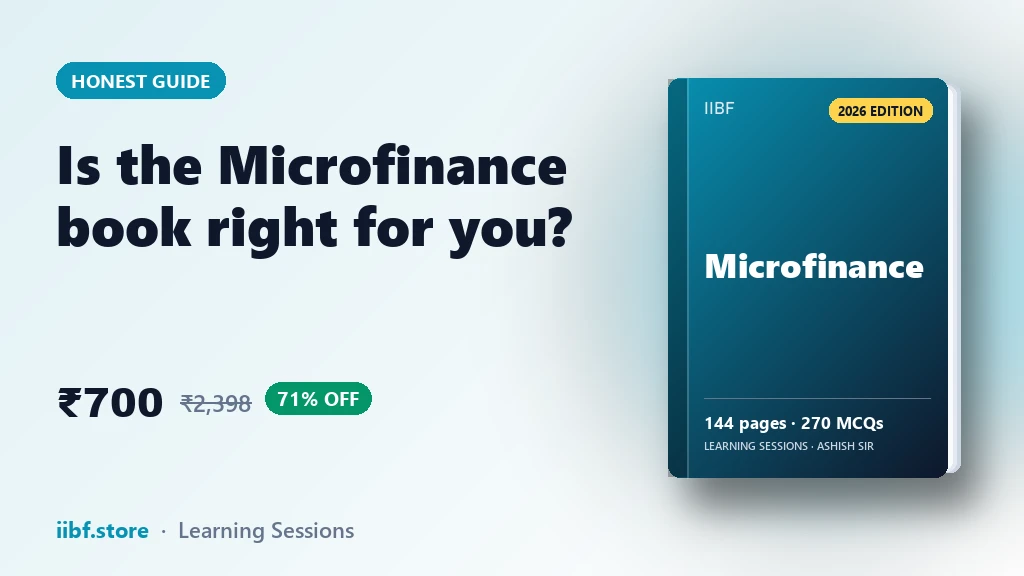
Before profiles, here are the facts so that nothing is oversold. The Microfinance printed book is the 2026 edition: 144 pages, 18 chapters and 270 questions. The chapters are arranged in two modules.
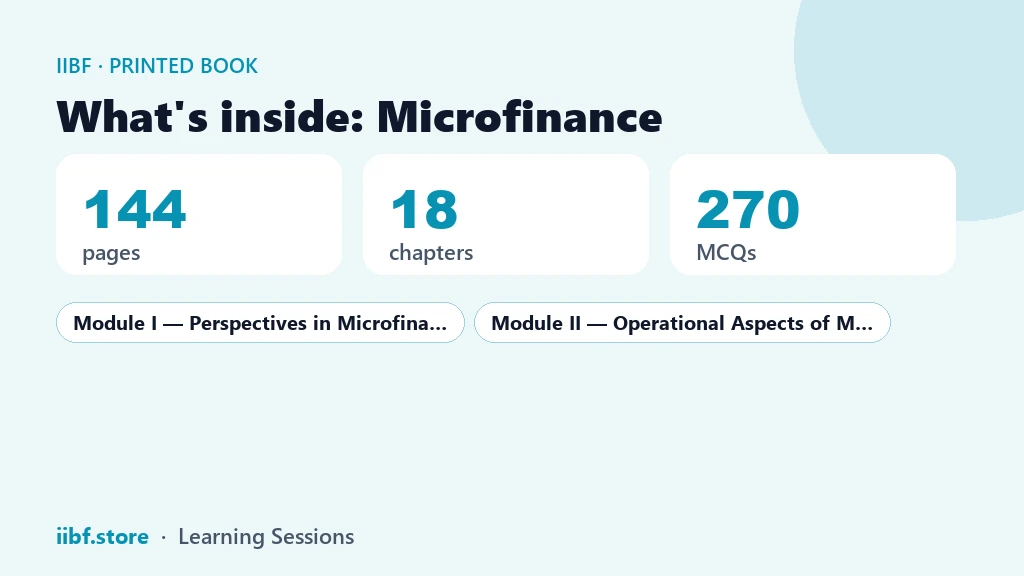
- Module I, Perspectives in Microfinance (10 chapters): poverty and rural credit, basics of banking, why and what is microfinance, delivery methodologies, the regulatory framework, evolution in India, recent developments, and financial inclusion across three chapters.
- Module II, Operational Aspects of Microfinance (8 chapters): financial products and services, financial accounting and reporting, revenue models and profitability, risk management, and compliance to various regulations.
- Extras: 30 case studies carrying 120 questions, and 5 mega tests carrying 500 questions.
At 144 pages for 18 chapters, it is a compact book. That is a strength if your problem is time, and a limit if you wanted every nuance of every regulation. We will come back to this.
Profile 1: you are attempting the paper for the first time
First attempt candidates usually make one of two mistakes: starting with the hardest chapter, or reading the whole syllabus once and calling it done. Neither works.
With a first attempt, the IIBF Microfinance book works well as your spine. Go in module order, because Module I builds the vocabulary that Module II quietly assumes. Read a chapter, close the book, and write five lines of what you remember. Then solve that chapter's questions the same day. Doing this for 18 chapters at one chapter every two or three days gives you a finished first pass without a single heroic weekend.
Where it is not enough on its own
Reading and chapter questions tell you whether you understand. They do not tell you whether you can finish a paper in the time given. Add the free mock tests at iibf.store/tests in the last two weeks so that you meet the exam format before the exam day does.
Profile 2: you have attempted before and want a different result
If you have been through this once, you already know the syllabus is not the enemy. The leak is usually somewhere specific: a module you skipped, regulations you could not hold in memory, or scenario questions where two options looked right.
For you, start from the back of the book, not the front. Take the case studies first, because they expose exactly where your understanding breaks. Mark every question you got wrong, go to the chapter it came from, and re-read only that chapter. Then attempt the mega tests that come with the IIBF Microfinance book, which are 500 questions across 5 papers, and compare your score from the first to the last.
Where it is not enough on its own
A book cannot tell you why you failed last time. Look at your previous scorecard if you have it. If most lost marks came from one module, give that module two thirds of your time. If they were spread evenly, your problem is likely exam-hall speed and nerves, and only timed practice fixes that.
Profile 3: you are short on time
Maybe the exam is closer than you would like, or branch work has swallowed your month. Here an honest answer matters more than a sales pitch. A compact book helps, but it cannot create hours that do not exist.
If you are short on time, use the Microfinance certificate book as a triage tool. Spend your first evening on the contents page and sort the 18 chapters into three piles: familiar from your daily work, half known, and new. If you work in a rural branch or deal with self-help group loans, the basics of banking and delivery methodology chapters may be quick for you. The regulatory and accounting chapters usually are not.
- Give the new pile your best, freshest hours, not the leftovers after dinner.
- Do the half-known pile with questions first, and read only where you fail.
- Do the familiar pile last, as a quick revision pass.
Where it is not enough on its own
Triage is a bet that you judged your own knowledge correctly. People tend to overrate what they know. Test it: attempt ten questions from a chapter you call familiar. If you score below what you expected, move it up the list. If the exam is only days away, this approach reduces risk but cannot guarantee a result, and it is fine to consider the next cycle.
Profile 4: you simply learn better on paper
Many working bankers spend all day on screens and want paper at night. If that is you, a printed book like the IIBF Microfinance book has real advantages: you can underline, add margin notes, fold a page before a regulation you keep forgetting, and revise on a train without battery or network worries. The Microfinance book was designed for exactly this kind of use.
Make the paper work harder with three habits. Use two colours of pen, one for definitions and one for things you got wrong. Keep a single page at the back for every regulation or institution name you confuse. Re-read that single page every morning in the last two weeks.
Where it is not enough on its own
Paper is silent. It will not tell you your accuracy rate or your speed. Pair it with screen-based mock tests, or you may feel prepared without being prepared.
A simple four-step plan that fits any profile
Whichever profile fits you, the same four steps keep the preparation honest. Adjust the time per step, not the order.
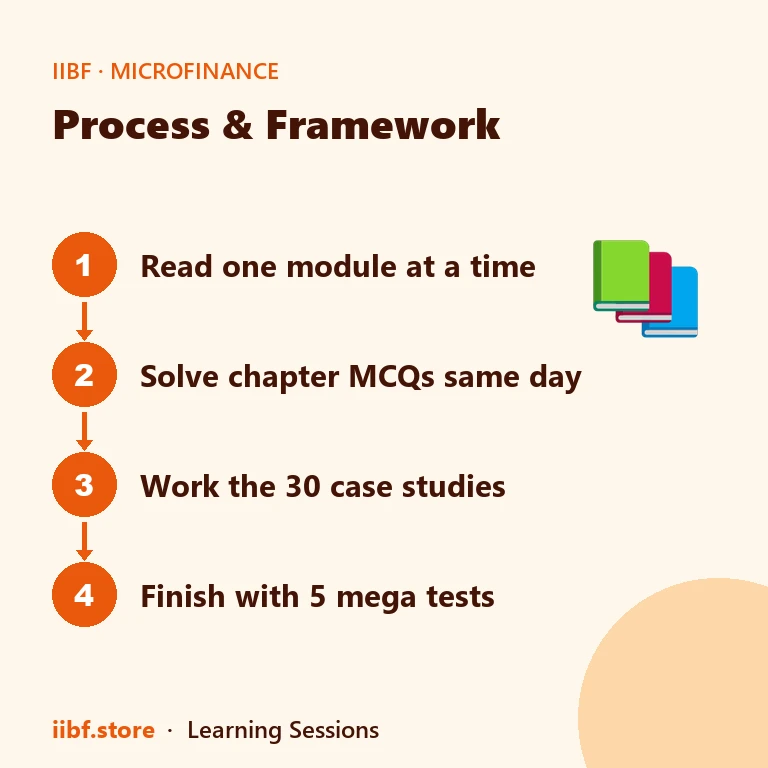
- Read one module at a time. Finish Module I before starting Module II.
- Solve chapter questions the same day. Memory fades fast, so test while it is warm.
- Work the 30 case studies. These build scenario thinking, which pure reading does not.
- Finish with the 5 mega tests. Attempt them in one sitting, timed, and review every wrong answer.
| Your situation | Start with | Add alongside |
|---|---|---|
| First attempt | Module I to Module II, in order | Free mock tests in the last two weeks |
| Repeat attempt | Case studies, then weak chapters | Your old scorecard and timed practice |
| Short on time | Three-pile chapter triage | Quick self-tests on chapters you call familiar |
| Prefers paper | Annotate and keep a mistakes page | Screen mocks for speed and accuracy |
Who should probably look elsewhere first
It is only fair to say when the IIBF Microfinance book is not your best first step. If you want free material to judge whether the topic suits you, start with the free PDFs and the free sample of the book. If you want a feel for the full range of titles, browse all printed books before you decide. And if you need the latest circular-level detail on a regulation, no printed book, ours included, is the final word. Regulations change, so confirm the current position on the official site.
On price: at the time of writing, the book is listed at ₹700 against an MRP of ₹2,398. Prices may change, so the book page is always the current source.
The bottom line
The IIBF Microfinance book is a compact, structured way to cover 18 chapters across two modules, with case studies and mega tests to turn reading into exam practice. It suits first-attempt candidates who want order, repeat candidates who want to find their weak spots, short-on-time candidates who triage well, and anyone who prefers paper. It does not replace timed mock practice, and it cannot decide your study hours for you.
Pick your profile, follow the four steps, and be honest with yourself after each test. That discipline matters more than any single resource. For more preparation guides, see the iibf.store blog.
Frequently asked questions
Can I clear the Microfinance certificate with only this book?
The book covers the syllabus in 18 chapters and gives you practice questions, case studies and mega tests. Most candidates still do better when they add timed mock tests and confirm current regulations on the official IIBF site. No book can promise a pass.
How long should I plan to study?
That depends on your background. A rough rule: one chapter every two or three days gives you a full first pass over about six weeks, followed by case studies and mega tests. If you already work with self-help groups or rural credit, you may move faster.
Is there a way to look inside before buying?
Yes, a free sample is available on the book page, so you can judge the writing style and question quality before you order.
Where do I find the official exam dates and rules?
Always use the IIBF website at www.iibf.org.in for schedules, eligibility and notices for the upcoming exam cycle. Treat any third-party summary as a pointer only.
Prefer revising from a printed book?
Chapter-wise books with MCQs after every chapter — minimal pages, complete coverage, delivered anywhere in India. Every book has a free sample to read first.


















































Practice this topic
Take a free mock test, download chapter PDFs, or watch a video class — all included on iibf.store.
Keep reading