Encryption Techniques in Banking: A CAIIB ITDB Guide
It is 4:30 pm and a customer asks you, quite seriously, whether it is safe to enter the PIN on a mobile app. You say yes, it is encrypted. Then she asks: encrypted how, and who holds the key? If you cannot answer in two plain sentences, this article is for you. Encryption techniques in banking are not only a CAIIB IT and Digital Banking (ITDB) topic. They sit underneath every UPI payment, every net banking login, every ATM transaction and every signed electronic document in your branch.
Below we cover the working idea, the three families you must know (symmetric, asymmetric and hashing), how TLS combines them, what the RBI says about cryptographic controls today, and how IIBF frames questions. Keep a pen handy: the table and the MCQs are the parts examiners love.
What encryption means in a bank
Encryption converts readable data (plain text) into unreadable data (cipher text) using a mathematical procedure called an algorithm and a secret value called a key. Only someone with the right key can reverse the process (decryption). The algorithm is usually public and well studied. The secrecy sits in the key, not in the algorithm. That single idea explains most exam questions.
Every information-security objective maps to a cryptographic tool:
- Confidentiality: nobody except the intended party reads the data. Tool: encryption.
- Integrity: the data has not been altered in transit or storage. Tool: hash functions and message authentication codes.
- Authentication: you know who sent or signed it. Tool: digital certificates and signatures.
- Non-repudiation: the sender cannot later deny having sent it. Tool: digital signatures.
Banks apply this in two places. Data in transit moves between your phone, the bank server, the payment switch and the other bank. Data at rest sits in databases, backups, laptops and removable media. Good encryption techniques in banking protect both.
Symmetric and asymmetric encryption: the core difference
Symmetric encryption
One shared secret key encrypts and decrypts. It is fast, so it is used for bulk data: database fields, backups, the data stream of a secure session. The weakness is key distribution. If two parties must first share the key, how do they pass it safely? Well-known symmetric algorithms are DES (an old 56-bit key standard, now considered weak), Triple DES (which applies DES three times and is being phased out) and AES, which works on 128-bit blocks with 128, 192 or 256-bit keys and is today's common choice.
Asymmetric encryption
Here there is a mathematically linked key pair: a public key that can be shared with anyone and a private key that the owner never reveals. What one key locks, only the other can unlock. RSA and elliptic curve cryptography are standard examples. It solves the key-distribution problem, but it is much slower than symmetric encryption, so it is rarely used for large volumes of data.
Hashing is not encryption
A hash function converts any input into a fixed-length output (the digest). It is one-way: you cannot get the original back from the digest, and a change of even one character produces a completely different digest. Banks use hashing to verify file integrity and to store passwords as digests instead of readable text. SHA-256 is a common example and produces a 256-bit digest. A favourite trap: students call hashing a type of encryption. It is not, because nothing is meant to be decrypted.
How the pieces work together: digital signatures and TLS
In practice, banks combine all three families. Two combinations are essential for ITDB.
Digital signature
The sender hashes the document, then encrypts that digest with the sender's private key. The result is the signature. The receiver decrypts it with the sender's public key and compares it with a fresh hash of the document received. If both match, the document is intact (integrity) and could only have come from the private-key holder (authentication and non-repudiation). Section 3 of the Information Technology Act, 2000 provides for authenticating an electronic record by a digital signature that uses an asymmetric crypto system and a hash function. You can read the statute on India Code. Notice that the signing key is private. Many students reverse this and lose a mark.
TLS: the padlock in your browser
When you open net banking, your browser and the bank server run a TLS handshake. The server proves its identity with a digital certificate issued by a trusted certificate authority. The two sides then use asymmetric cryptography to agree on a fresh session key, and the rest of the session is protected with fast symmetric encryption, with integrity checks added. That is why one secure session uses all three techniques. If a question asks why not use asymmetric encryption for the whole session, the answer is speed.
Certificate management is where PKI (public key infrastructure) comes in: certificate authorities, registration authorities and certificates that bind a public key to an identity. The chapters on security and digital signatures in the CAIIB IT and Digital Banking course go through these terms with diagrams.
Step by step: how an encrypted payment message travels
Take a customer paying from a mobile app. The sequence below is simplified but matches the logic examiners test.
- Plain text prepared. The app collects the instruction and credentials on the phone.
- Session secured. A TLS handshake authenticates the server by certificate and agrees a session key.
- Data encrypted. The message is encrypted with the symmetric session key, and sensitive values such as the PIN are protected further before leaving the device.
- Cipher text travels. Anyone intercepting the network sees only unreadable data.
- Receiver decrypts and verifies. The bank server decrypts and checks integrity before processing and logging.
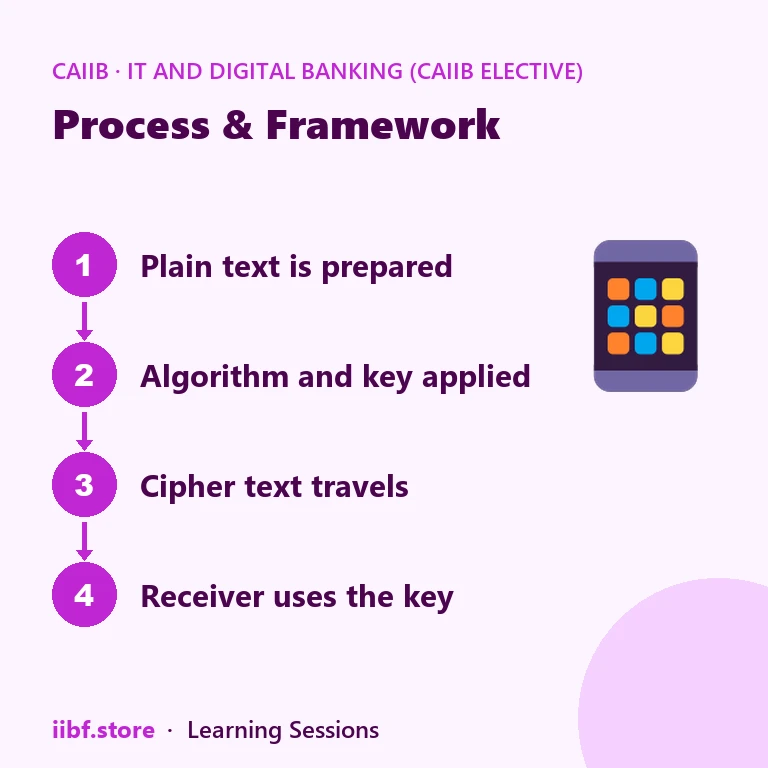
Notice that the message is protected on the wire, but it is readable inside the bank server once decrypted. That is why encryption in transit does not replace encryption at rest, access control and logging. A frequent exam theme is that cryptography is one control among many, never the only one.
Comparison table: symmetric, asymmetric and hashing
| Feature | Symmetric | Asymmetric | Hashing |
|---|---|---|---|
| Keys used | One shared secret key | Public and private key pair | No key |
| Reversible? | Yes, with the key | Yes, with the matching key | No, one-way |
| Speed | Fast | Slow | Fast |
| Main use | Bulk data, session traffic, data at rest | Key exchange, digital signatures, certificates | Integrity checks, password storage |
| Main weakness | Safe key sharing | Computational cost | Weak or unsalted passwords can be guessed |
| Examples | AES, Triple DES | RSA, elliptic curve | SHA-256 |
Key management: where banks actually lose control
Strong algorithms fail when keys are mishandled. A key written in a spreadsheet, shared by email or left unchanged for years defeats the purpose. A sound key lifecycle has these stages: generation, secure distribution, storage, use, periodic change (rotation), and destruction when no longer needed. High-value keys are normally kept inside a hardware security module (HSM), a tamper-resistant device designed so that keys never leave in readable form. This is standard security practice that you should know for the exam.
Also remember the separation of duties: the person who administers a database should not hold the keys that decrypt its sensitive columns, and key custodians should work under dual control so that no one individual can misuse a master key.
What the RBI says about cryptographic controls
Under the Reserve Bank of India (Commercial Banks - Cybersecurity, Technology: Risk, Resilience and Assurance Framework) Directions, 2026, issued on 31 July 2026 (RBI/DoS/2026-27/410), paragraph 140 deals with cryptographic controls. It requires that the key length, algorithms, cipher suites and protocols used in transmission channels, in processing of data and for authentication shall be strong. The bank must adopt internationally accepted and published standards that are not deprecated or demonstrated to be insecure, and the configurations must comply with extant laws and regulatory instructions. Paragraph 106 separately expects data at rest to be protected by encryption where the device supports it, and data in transit to be protected through VPN or other secure protocols. You can read the original text on the RBI notification page.
One caution for those who studied from older notes. The Directions of 2026 repeal the earlier cybersecurity and IT governance instructions applicable to commercial banks, so the cryptography wording you may have learnt from the 2023 IT Governance Master Direction now sits in this new instrument. Other categories of regulated entities have their own versions, so always read the one that applies to the entity named in the question. The practical lesson for exams and for branches is the same: pick standard, current algorithms, retire deprecated ones such as DES, and never design your own cipher.
Revising these provisions along with the chapter-wise MCQs in the ITDB printed book helps you hold the vocabulary without rote learning.
How IIBF tests this topic
IIBF questions on encryption are mostly conceptual and application based. Expect to be asked which key signs, which key verifies, which technique is fast, which is one-way, and what a certificate authority does. The official exam schedule and syllabus are always on the IIBF website; here we focus on understanding.
Common traps
- Calling hashing a form of encryption.
- Saying the receiver's private key is used to create the sender's signature.
- Believing the padlock in the browser means the bank's own server is secure, when it only shows the channel is protected.
- Assuming a longer key always fixes a badly managed key.
Practice MCQs
Q1. A bank wants to encrypt a large database backup quickly. Which technique is most suitable? (a) Asymmetric encryption (b) Symmetric encryption (c) Hashing (d) Digital signature. The answer is (b). Symmetric encryption is fast and suits bulk data, while asymmetric encryption is too slow for this job and hashing cannot be reversed.
Q2. In a digital signature, the sender signs the message digest using: (a) the sender's public key (b) the receiver's public key (c) the sender's private key (d) the receiver's private key. The answer is (c). Only the sender holds the private key, so verification with the matching public key proves origin.
Q3. Which statement about a hash function is correct? (a) It is reversible with a key (b) It produces a variable-length output (c) It is one-way and gives a fixed-length output (d) It needs a public key. The answer is (c). That is exactly why hashing is used for integrity and not for confidentiality.
To practise this style at speed, attempt the timed CAIIB mock tests after finishing the chapter, and note every question you got wrong because of a reversed key.
Quick revision points
- Symmetric: one shared key, fast, bulk data. Asymmetric: key pair, slower, key exchange and signatures.
- Hashing is one-way and gives integrity, not confidentiality.
- Digital signature: hash the document, then sign the digest with the private key. Verify with the public key.
- TLS uses certificates and asymmetric cryptography to set up a session key, then symmetric encryption for the data.
- Key management and HSMs decide whether the cryptography is actually secure.
- RBI paragraph 140 asks for strong, internationally accepted, non-deprecated cryptographic standards.
If you are building a complete preparation plan for the paper, the CAIIB offer page lists what is bundled, and the free study material section is a good place to start without spending anything.
Frequently asked questions
What are the main encryption techniques in banking?
The main families are symmetric encryption (one shared key, for bulk data), asymmetric encryption (public and private key pair, for key exchange and signatures) and hashing (one-way, for integrity). Real systems such as TLS combine all three.
Is hashing the same as encryption?
No. Encryption is designed to be reversed by someone holding the right key. Hashing is one-way and produces a fixed-length digest used to detect any change in the data.
Which key creates a digital signature?
The sender's private key signs the document digest, and anyone can verify it with the sender's public key. Section 3 of the IT Act, 2000 recognises authentication of electronic records by such a digital signature.
What does the RBI require on cryptographic controls?
Under paragraph 140 of the 2026 Cybersecurity, Technology: Risk, Resilience and Assurance Framework Directions for commercial banks, keys, algorithms, cipher suites and protocols must be strong and based on internationally accepted, non-deprecated standards, configured in line with existing laws and regulatory instructions.
Why is key management as important as the algorithm?
Because the algorithm is public and the secrecy rests on the key. If a key is leaked, shared carelessly or never rotated, even a strong algorithm gives no protection.
Conclusion
For the exam, hold on to a short mental picture: symmetric for speed, asymmetric for trust and key exchange, hashing for integrity, and key management to keep all of it honest. For the branch, remember that customers trust the padlock only because the bank applies these encryption techniques in banking correctly, from TLS sessions to HSM-protected keys. Revise the table above, solve the MCQs again without looking at the answers, and then move on to the next ITDB chapter with a firm base.
Prefer revising from a printed book?
Chapter-wise books with MCQs after every chapter — minimal pages, complete coverage, delivered anywhere in India. Every book has a free sample to read first.


















































Quick quiz on this topic
5 exam-style questions from our free test bank — check yourself before you move on.
Practice this topic
Take a free mock test, download chapter PDFs, or watch a video class — all included on iibf.store.
Keep reading