Risk Weighted Assets Calculation for Banks: Step-by-Step Guide
A branch manager sanctions a home loan and a corporate term loan of the same size on the same day. Both look like Rs 10 crore of lending on the balance sheet. Yet the bank has to keep very different amounts of capital behind them. The reason is risk weighted assets calculation, and it sits at the heart of the Risk Management certificate paper. If you understand it once, CRAR, Basel III buffers and capital planning all become easy to follow.
This guide explains how risk weighted assets calculation works, what the RBI actually prescribes, how to do a full worked example in the way the exam expects, and where candidates lose marks.
What are risk weighted assets and why do they exist?
A bank's assets are not equally risky. A Government of India security will be repaid; an unsecured loan to a stressed borrower may not be. If regulators asked every bank to hold the same capital per rupee of assets, safe banks would be punished and risky banks would be rewarded. Risk weighting fixes this by scaling every exposure according to its riskiness before capital is compared with it.
In RBI's standardised approach the idea is stated plainly: risk weighted assets (RWA) are the product of the standardised risk weight and the exposure amount. That one sentence is the whole formula for a single exposure. Everything else in risk weighted assets calculation is about deciding the right exposure amount and the right risk weight.
The capital ratio the RWA feeds
RWA is the denominator of the Capital to Risk-weighted Assets Ratio (CRAR). The numerator is the bank's eligible regulatory capital. Under the RBI Basel III framework, banks must maintain a minimum Pillar 1 CRAR of 9 per cent, and in addition a capital conservation buffer of 2.5 per cent of RWA made up of Common Equity Tier 1 capital. Taken together, that is the 11.5 per cent figure you will see in the exam. You can read the framework on the RBI Basel III capital regulations.
The ratio is simple: CRAR = Total eligible capital divided by Total RWA, expressed as a percentage. A bank can improve CRAR by raising capital or by reducing RWA, for example by shifting lending from high-weight to low-weight exposures. This is why risk weights influence what banks actually lend.
The three components of total RWA
Total RWA is not just about loans. Basel III Pillar 1 asks for capital against three risks, and each is converted into an RWA equivalent so they can be added together.
- Credit risk RWA: from loans, investments in the banking book, and off-balance-sheet items such as guarantees and undrawn limits. This is the biggest block for almost every Indian bank.
- Market risk RWA: from positions in the trading book, such as interest rate, equity and foreign exchange positions.
- Operational risk RWA: from losses due to failed processes, people, systems or external events.
For the market and operational parts, the bank first computes a capital charge, then converts it to an RWA equivalent so that the three can be added into one denominator. In this article we concentrate on credit risk, because the risk weighted assets calculation for loans and investments is what the examiner asks most often.
Key concepts you must be able to define
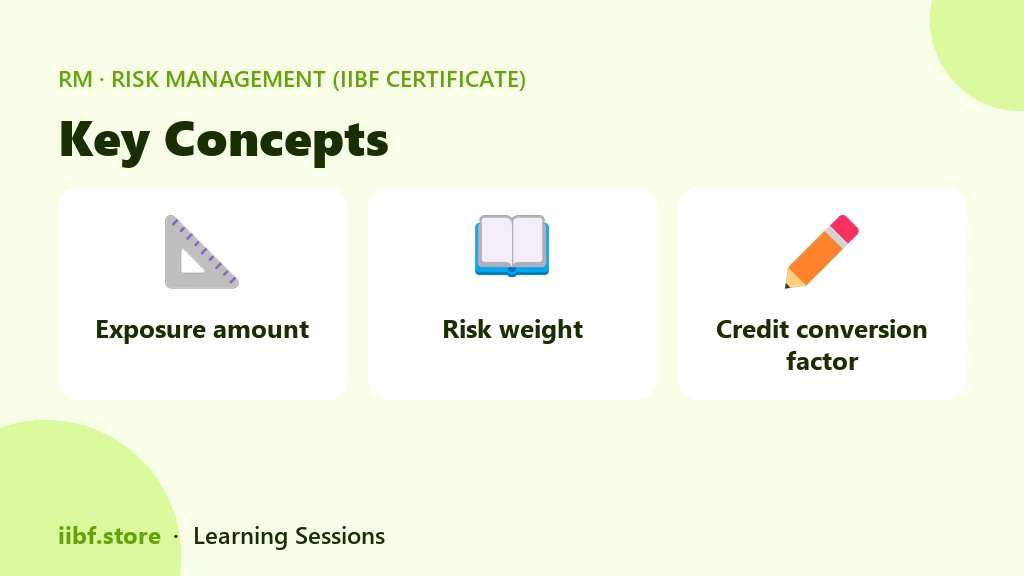
Exposure amount
This is what the bank is actually at risk for. For a funded loan it is the outstanding balance, measured net of specific provisions (including partial write-offs). Using the gross figure by mistake is a classic error, because provisions already absorb part of the expected loss and the regulator does not want capital charged on the same amount twice.
Risk weight
A percentage fixed by the regulator for each class of exposure. Claims on the Central Government carry 0 per cent, regulatory retail claims carry 75 per cent, and unrated corporate claims carry 100 per cent as the base weight, under the RBI standardised approach Directions of 2026. Rated corporate claims move up and down with the external rating.
Credit conversion factor (CCF)
Guarantees, letters of credit and undrawn commitments are not on the balance sheet as funded assets, but they can turn into real loans if the customer defaults or draws down. A CCF converts such a non-fund-based item into a credit equivalent amount first. The risk weight is applied only after that conversion. Candidates who apply the weight directly to the face value of a guarantee lose the mark.
Credit risk mitigants
Eligible collateral, guarantees and netting can reduce the exposure that attracts the weight. They must meet the RBI's eligibility and legal certainty conditions; a pledge that is not properly documented does not count.
Risk weighted assets calculation: the step-by-step method
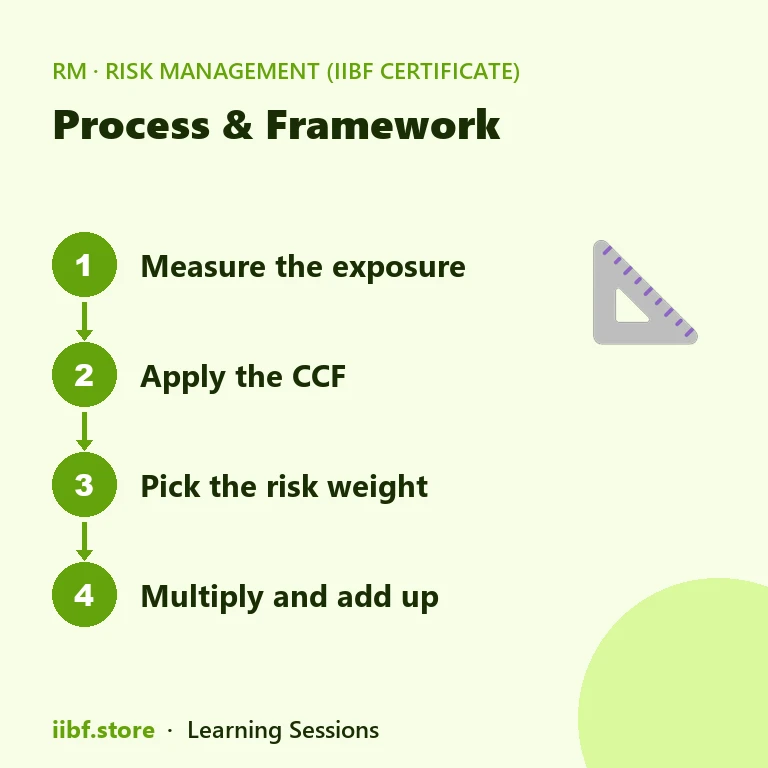
Follow the same order every time, in the exam and on the job. It prevents most arithmetic and conceptual mistakes.
- Measure the exposure. Take the outstanding amount for funded items, net of specific provisions.
- Convert off-balance-sheet items. Multiply the notional amount by the applicable CCF to get the credit equivalent.
- Apply credit risk mitigation. Reduce the exposure for eligible collateral or guarantees as the rules allow.
- Pick the risk weight. Choose it by asset class, and for corporates and banks by external rating or the prescribed unrated treatment. For residential housing loans the weight depends on the loan-to-value (LTV) ratio.
- Multiply, add, and divide. RWA for each exposure is exposure times weight. Add all credit RWA, then market and operational RWA, and divide eligible capital by the grand total to get CRAR.
RBI risk weights you should know (2026 Directions)
The Reserve Bank issued the Capital Charge for Credit Risk (Standardised Approach) Directions, 2026 on 27 April 2026, effective 1 April 2027. The text is on the RBI site: RBI Capital Charge for Credit Risk Directions, 2026. The table below gives the headline weights that appear in the Directions. Always cross-check the exact conditions in the source before applying a weight in real work.
| Exposure class | Risk weight | Note |
|---|---|---|
| Central Government claims | 0% | Fund-based and non-fund-based, including Central Government guaranteed claims |
| Regulatory retail portfolio | 75% | Must meet the retail criteria laid down in the Directions |
| Corporate rated AAA or AA | 20% | Long-term external rating |
| Corporate rated A | 50% | Long-term external rating |
| Corporate rated BBB | 75% | Long-term external rating |
| Corporate rated BB | 100% | Long-term external rating |
| Corporate rated below BB | 150% | Long-term external rating |
| Unrated corporate | 100% | 150% for unrated claims with aggregate banking-system exposure above Rs 500 crore |
| Residential housing, up to two loans | 20% to 40% | 20% up to 50% LTV; 25% above 50% to 60%; 30% above 60% to 80%; 40% above 80% to 90% |
| Residential housing, third loan onward | 30% to 60% | 30%, 35%, 45% and 60% for the same LTV bands |
For housing loans, 5 percentage points are added where the total loan outstanding is Rs 3 crore or more. Non-transactor credit card receivables fall outside the regulatory retail portfolio and are weighted at 125 per cent.
Which rules apply to which exam cycle?
The 2026 Directions take effect on 1 April 2027. Until then, banks continue to use the existing RBI Basel III capital adequacy norms, and several weights in them differ from the table above. The mechanics of risk weighted assets calculation do not change, only the numbers. In the exam, use the weights printed in your study material for the cycle you are appearing in, and in the answer always state the weights you assumed.
Worked example: from exposures to CRAR
Consider a small bank with the following credit exposures, all in Rs crore. We apply the weights from the 2026 Directions for illustration.
| Exposure | Amount | Risk weight | RWA |
|---|---|---|---|
| Central Government securities | 400 | 0% | 0 |
| Home loans, first or second loan, each below Rs 3 crore, LTV 70% | 200 | 30% | 60 |
| Regulatory retail loans | 300 | 75% | 225 |
| Unrated corporate loans (below Rs 500 crore banking-system exposure) | 500 | 100% | 500 |
| Corporate loans rated BBB | 100 | 75% | 75 |
| Total | 1,500 | 860 |
Credit RWA is Rs 860 crore, even though the bank has Rs 1,500 crore of exposures. The government securities add nothing to RWA, which shows how risk weights reward safe assets.
Suppose market risk RWA is Rs 90 crore and operational risk RWA is Rs 150 crore. Total RWA = 860 + 90 + 150 = Rs 1,100 crore. If eligible capital is Rs 130 crore, then CRAR = 130 / 1,100 = 11.82 per cent.
Now compare with the requirement. Minimum 9 per cent plus the 2.5 per cent conservation buffer is 11.5 per cent, which needs capital of 0.115 x 1,100 = Rs 126.5 crore. The bank has Rs 130 crore, so it is above the requirement by Rs 3.5 crore. If the bank now sanctions another Rs 50 crore unrated corporate loan, RWA rises by Rs 50 crore to Rs 1,150 crore, the requirement becomes Rs 132.25 crore, and the bank is short by Rs 2.25 crore. This is how risk weighted assets calculation translates directly into lending capacity.
A short off-balance-sheet illustration
Suppose the bank issues a guarantee of Rs 40 crore on behalf of an unrated corporate. If the applicable CCF is 50 per cent (assumed here for illustration), the credit equivalent is Rs 20 crore, and at a 100 per cent risk weight the RWA is Rs 20 crore, not Rs 40 crore. The order matters: CCF first, risk weight second.
How IIBF tests risk weighted assets calculation
The Risk Management certificate paper asks the topic in three forms: a definition or formula question, a numerical on CRAR, and a conceptual question on why risk weights differ. For numericals, the full course for the Risk Management certificate works through several of this type, and the Risk Management printed book carries chapter-wise practice questions.
Common traps
- Applying the weight to the gross exposure instead of the exposure net of specific provisions.
- Forgetting to apply the CCF to guarantees, LCs and undrawn limits before the weight.
- Dividing capital by total assets rather than by total RWA.
- Ignoring market and operational risk RWA when the question gives them.
- Mixing up the 9 per cent minimum with the 11.5 per cent figure that includes the conservation buffer.
Practice question 1
A bank has an eligible capital of Rs 90 crore and total RWA of Rs 900 crore. What is its CRAR, and does it meet the minimum including the conservation buffer? The CRAR is 90 / 900 = 10 per cent. It meets the 9 per cent minimum but not the 11.5 per cent that includes the 2.5 per cent buffer, so it would face restrictions on distributions until it rebuilds capital.
Practice question 2
Which asset adds the least to RWA per rupee of exposure: Central Government security, regulatory retail loan, or BB-rated corporate loan? The Central Government security, at a 0 per cent weight, adds nothing. The retail loan carries 75 per cent and the BB-rated corporate loan 100 per cent.
Practice question 3
A bank issues a Rs 100 crore guarantee with a 20 per cent CCF (assumed) for an unrated corporate carrying a 100 per cent weight. What is the RWA? Credit equivalent is 100 x 20 per cent = Rs 20 crore, and RWA is 20 x 100 per cent = Rs 20 crore.
You can test yourself on more of these with the Risk Management mock tests.
Quick revision points
- RWA for one exposure equals the standardised risk weight times the exposure amount.
- Total RWA adds credit, market and operational risk RWA.
- CRAR is eligible capital divided by total RWA; the Pillar 1 minimum is 9 per cent with a 2.5 per cent conservation buffer on top.
- Off-balance-sheet items go through a credit conversion factor before the risk weight.
- Exposure is measured net of specific provisions.
- Housing loan weights depend on LTV; retail is 75 per cent; Central Government claims are 0 per cent.
- The 2026 standardised approach Directions apply from 1 April 2027; follow your syllabus for the exam cycle.
Frequently asked questions
What is the formula for risk weighted assets calculation?
For each exposure, RWA is the exposure amount multiplied by its risk weight. Add up the credit, market and operational risk RWA to get total RWA, then divide eligible capital by total RWA to get CRAR.
Why do government securities have zero risk weight?
Claims on the Central Government are treated as free of credit risk in rupee terms, so the RBI assigns them a 0 per cent weight. They therefore need no regulatory capital under the credit risk framework, although interest rate risk in the trading book may still attract a charge.
What is the minimum CRAR for Indian banks?
The RBI requires a minimum Pillar 1 CRAR of 9 per cent, plus a capital conservation buffer of 2.5 per cent of RWA in Common Equity Tier 1, giving 11.5 per cent in total.
Is the exposure measured before or after provisions?
Under the standardised approach Directions, exposures are measured net of specific provisions, including partial write-offs, before the risk weight is applied.
Do I need to memorise every risk weight?
No. Learn the anchors: 0 per cent for Central Government, 75 per cent for regulatory retail, 100 per cent for unrated corporates, the rating ladder for corporates, and the LTV bands for housing. In numericals, the weights are usually given or clearly implied.
Conclusion
Risk weighted assets calculation is a short formula with a few rules around it: measure the exposure, convert off-balance-sheet items, pick the right weight, multiply and add, then divide capital by total RWA. Practise the worked example above until the order feels automatic. Then check the latest weights on the RBI Directions page, and keep an eye on the official schedule at IIBF for the upcoming exam cycle. For more practice, use the free resources in free study material.
Prefer revising from a printed book?
Chapter-wise books with MCQs after every chapter — minimal pages, complete coverage, delivered anywhere in India. Every book has a free sample to read first.


















































Practice this topic
Take a free mock test, download chapter PDFs, or watch a video class — all included on iibf.store.
Keep reading