NBFC Regulation 2026: RBI Scale-Based Rules, Types & NPA Norms

For any candidate sitting the IIBF Certificate in Non-Banking Financial Companies, a clear grasp of nbfc regulation is non-negotiable. Non-Banking Financial Companies (NBFCs) now hold a balance sheet large enough that the Reserve Bank of India treats their stability as systemic, and the rules governing them changed fundamentally when the Scale-Based Regulation (SBR) framework took effect on 1 October 2022.
An NBFC is a company registered under the Companies Act whose principal business is lending, investment in shares and securities, leasing, hire-purchase, or accepting deposits under a scheme, but which does not hold a banking licence. Crucially, an NBFC cannot accept demand deposits, is not part of the payment and settlement system, and its depositors do not enjoy DICGC insurance cover. Understanding these boundaries is the first step to mastering nbfc regulation for the exam.
This guide walks through the SBR layers, the categories of NBFC, and the tightened 90-day NPA recognition norm exactly as the RBI expects bankers to know them in 2026.
What Is Scale-Based Regulation (SBR)?
The SBR framework, issued by the RBI in October 2021 and effective from October 2022, replaced the older systemically-important/non-important split with a four-tier pyramid. The intensity of regulation now scales with the size, activity and perceived riskiness of the NBFC. The four layers are:
- NBFC - Base Layer (NBFC-BL): Non-deposit-taking NBFCs with asset size below Rs 1,000 crore, plus Peer-to-Peer lenders, Account Aggregators, NOFHCs and NBFCs not availing public funds.
- NBFC - Middle Layer (NBFC-ML): All deposit-taking NBFCs (irrespective of size), and non-deposit-taking NBFCs with assets of Rs 1,000 crore and above. Core Investment Companies, HFCs, IFCs, IDFs and SPDs also sit here.
- NBFC - Upper Layer (NBFC-UL): The top NBFCs specifically identified by the RBI as warranting enhanced regulation under a scoring methodology; at least the top ten by asset size are always here.
- NBFC - Top Layer (NBFC-TL): Ideally empty. An NBFC moves here only if the RBI judges a substantial increase in systemic risk from a specific Upper-Layer entity.
The higher the layer, the stiffer the norms on capital, governance and disclosure. Upper-Layer NBFCs, for instance, must maintain Common Equity Tier 1 capital of at least 9% and are subject to mandatory listing within three years of identification.
The Main Types of NBFC You Must Know
Beyond the SBR layers, the IIBF exam tests the activity-based classification of NBFCs. Knowing these categories cold is a reliable source of marks, so revise them alongside your broader CAIIB preparation.
- Investment and Credit Company (NBFC-ICC): The 2019 merger of the old Asset Finance Company, Loan Company and Investment Company into a single category.
- Infrastructure Finance Company (IFC): Deploys at least 75% of assets in infrastructure loans, with minimum NOF of Rs 300 crore.
- Infrastructure Debt Fund (IDF-NBFC): Channels long-term debt into infrastructure projects.
- Microfinance Institution (NBFC-MFI): Lends small, mostly collateral-free loans to low-income households under the RBI's 2022 microfinance directions.
- Core Investment Company (CIC): Holds at least 90% of net assets in group company equity and debt; a systemically important CIC has assets of Rs 100 crore or more and accesses public funds.
- NBFC-Factor, Mortgage Guarantee Company, and the Account Aggregator round out the specialised list.
Housing Finance Companies (HFCs) were brought under RBI regulation from the erstwhile National Housing Bank in 2019 and are now treated as a category of NBFC, a frequently examined fact.

The 90-Day NPA Norm and Asset Classification
One of the most important changes under nbfc regulation is the harmonisation of Non-Performing Asset (NPA) recognition with banks. Historically NBFCs enjoyed a relaxed 180-day overdue threshold. Under SBR this was tightened in a phased manner, and the standard NPA classification norm is now 90 days overdue for all NBFCs in the Base, Middle and Upper layers.
The RBI's November 2021 clarification (the well-known "IRACP" circular) also fixed two practices that some NBFCs had used to flatter their books:
- NPA classification must be made as part of the day-end process on the exact due date when an account becomes overdue beyond 90 days, not at month-end or quarter-end.
- An upgraded account can move back to standard only after the borrower clears all arrears of interest and principal, not merely the overdue instalment.
Standard asset provisioning, income recognition on accrual being barred for NPAs, and sub-classification into substandard, doubtful and loss assets all mirror the banking IRAC norms. For the exam, remember the progression: an asset is substandard for up to 12 months as an NPA, then doubtful, then loss. Test this knowledge with our IIBF mock tests before exam day.
Capital, Governance and Deposit Norms
NBFCs registering with the RBI must hold a minimum Net Owned Fund (NOF). Under SBR the floor was raised to Rs 10 crore for most NBFC-ICCs, MFIs and Factors, to be reached in a glide path by March 2027 (Rs 5 crore by March 2025, Rs 7 crore by March 2026, Rs 10 crore by March 2027). The capital adequacy requirement remains a minimum CRAR of 15%, with Tier-I capital of at least 10%.
Deposit-taking NBFCs (NBFC-D) face additional discipline: deposits are capped at 1.5 times NOF for rated companies, tenure is restricted to 12-60 months, and the interest rate ceiling is set by the RBI. Such NBFCs must maintain liquid assets and a Statutory Liquidity Ratio in approved securities. Governance is a pillar of nbfc regulation, so rules under the Middle and Upper layers mandate a Chief Compliance Officer, a board-approved risk framework, and ceilings on concentration of credit. Large Exposure norms and a leverage-style ceiling apply to Upper-Layer firms.
For a wider view of how these prudential ideas connect to banking law, candidates often revise SARFAESI 2002 - which NBFCs above a size threshold can now invoke - alongside the IBC 2016. A quick scan of the latest IIBF news and updates keeps your numbers current, since the RBI revises thresholds periodically.
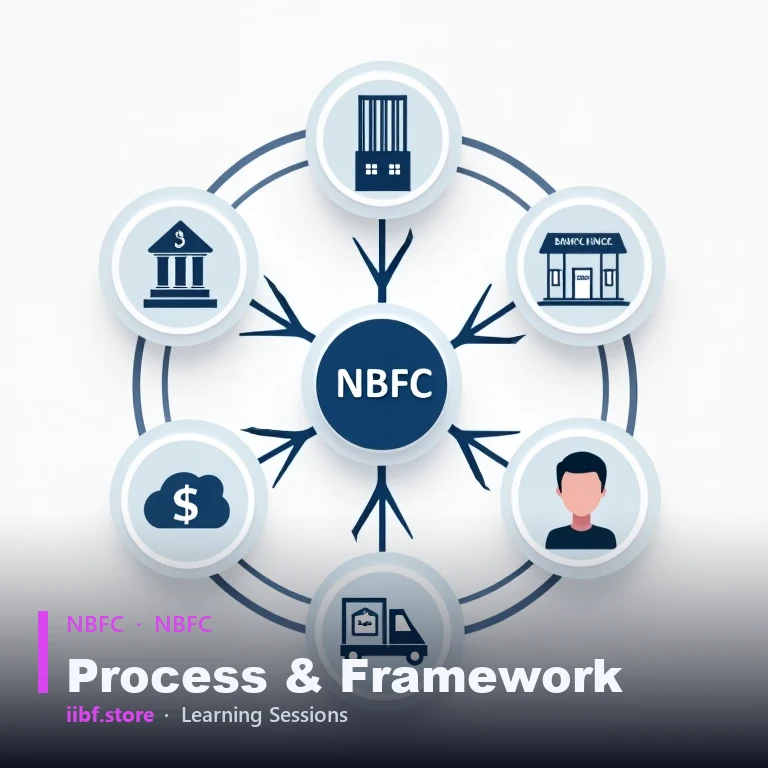
How NBFCs Differ From Banks
A staple exam question contrasts NBFCs and banks. NBFCs cannot accept demand deposits, cannot issue cheques drawn on themselves, are outside the payment and settlement system, and offer no deposit insurance. They are not bound by the Cash Reserve Ratio in the way scheduled commercial banks are, though deposit-taking NBFCs maintain their own liquidity buffers. Yet NBFCs play a vital role in last-mile credit - vehicle finance, gold loans, microfinance and infrastructure - reaching customers that banks often miss. The official rulebook lives on the RBI website, the primary source you should cite in descriptive answers.
Frequently Asked Questions
What is the NPA recognition norm for NBFCs in 2026?
Under RBI's Scale-Based Regulation, NBFCs in the Base, Middle and Upper layers classify a loan as a Non-Performing Asset once it is overdue beyond 90 days, harmonised with banks. The earlier relaxed 180-day norm has been phased out, and upgrades to standard require clearing all interest and principal arrears.
What are the four layers under Scale-Based Regulation?
The SBR framework, effective October 2022, has four layers: Base Layer for smaller non-deposit NBFCs, Middle Layer for deposit-taking and larger NBFCs, Upper Layer for the RBI-identified systemically significant firms, and a Top Layer that stays empty unless the RBI flags extreme systemic risk in a specific entity.
Can an NBFC accept deposits like a bank?
Only NBFCs holding a specific deposit-taking authorisation (NBFC-D) may accept public deposits, and even then they cannot accept demand deposits. Deposits are capped relative to Net Owned Fund, restricted to 12-60 month tenures, and carry no DICGC insurance, unlike scheduled commercial bank deposits.
What is the minimum Net Owned Fund for an NBFC?
Under SBR the NOF floor was raised to Rs 10 crore for most NBFCs, reached through a glide path: Rs 5 crore by March 2025, Rs 7 crore by March 2026 and Rs 10 crore by March 2027. Capital adequacy stays at a minimum CRAR of 15% with Tier-I of at least 10%.
Final Takeaways
Strong command of nbfc regulation - the four SBR layers, the activity-based types, the 90-day NPA norm, and capital and deposit rules - will carry you through a large slice of the IIBF NBFC paper. Pair concept revision with timed practice and active recall. Start now with our free IIBF practice tests, sharpen terminology using the match-the-pairs game, and explore more banking guides on the IIBF blog to walk into the exam hall confident.
Free Revision PDFs — One-Liners & True/False
Printable last-minute revision sheets for NBFC Regulation 2026: RBI Scale-Based Rules, Types & NPA Norms: 20 quick-fire one-liners and 20 true/false questions, each with answers & explanations. Free to download and share.
Practice this topic
Take a free mock test, download chapter PDFs, or watch a video class — all included on iibf.store.