
Net Interest Margin in Banks: Formula, Drivers and CAIIB BFM Questions

Your branch manager says the bank's margin has come under pressure after the last rate move. The treasury head nods. The ALCO note talks about "NIM compression". If you are preparing for CAIIB Bank Financial Management, you cannot afford to nod along; you must know exactly what that number is and why it moves. This guide explains net interest margin in banks the way a senior colleague would: definition, formula, drivers, a worked example and the traps IIBF likes to set.
What is net interest margin in banks?
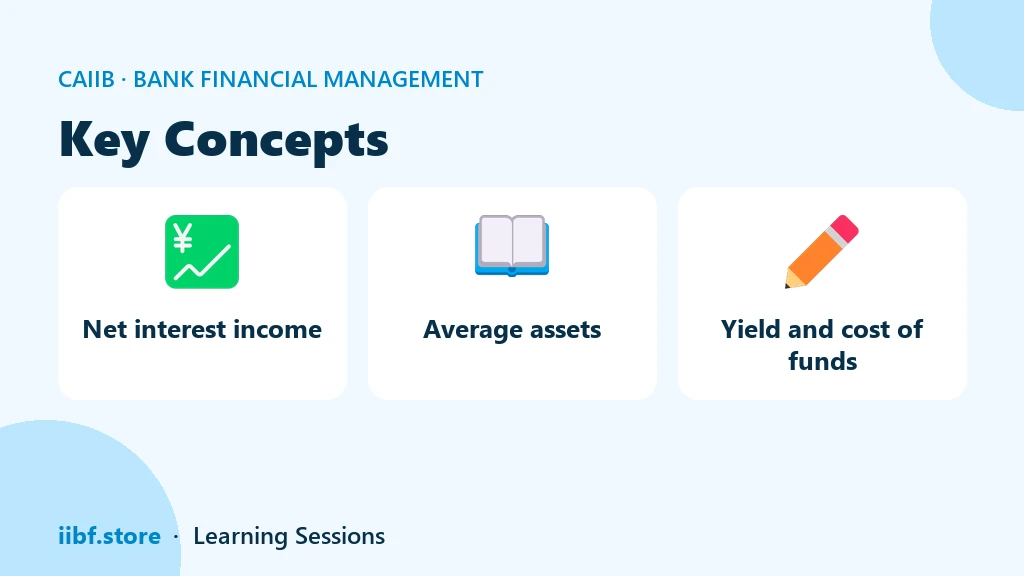
A bank earns money mainly by lending and investing at one rate and borrowing at a lower rate. The gap between the interest it earns and the interest it pays is called net interest income (NII). Net interest margin (NIM) expresses that gap as a percentage of the bank's average assets, so that a small bank and a large bank can be compared fairly. In short, NIM tells you how much interest profit the bank makes for every Rs 100 of assets it works with.
Why does this matter in BFM? Because NIM is the single most watched measure of core banking profitability. It strips out fee income, trading gains and provisions and focuses on the pure business of intermediation. When the examiner asks about bank profitability, the interest-rate cycle or asset-liability management, NIM is usually hiding in the question.
How the RBI defines it
In its publications, the Reserve Bank of India defines the margin as NII expressed as a percentage of average assets. You can see this in the RBI's Operations and Performance of Commercial Banks publication, and the older Reports on Trend and Progress of Banking in India use net interest income divided by average total assets as well. Many textbooks and analyst reports instead divide by average interest-earning assets. Both versions exist. For the exam, always read the question to see which denominator it gives you, and use that one.
The formula and its building blocks
The formula is simple, but every term has a meaning you must be able to explain.
- Interest earned: interest and discount on advances and bills, income from investments, interest on balances with the RBI and other banks.
- Interest expended: interest paid on deposits, interest on borrowings (including RBI refinance and market borrowings) and interest on subordinated instruments.
- Net interest income (NII): interest earned minus interest expended.
- Average assets: normally the average of opening and closing balances, so that a bank that grew fast during the year is not flattered or penalised by a single date.
Net interest margin = Net interest income / Average assets x 100.
NIM versus spread: not the same thing
Students often mix these up, and examiners know it. The spread is the difference between the average yield on earning assets (return on funds) and the average cost of funds. NIM, in contrast, is NII divided by assets. The two move together but are not equal, because part of a bank's assets is funded by its own capital and other non-interest-bearing sources. Equity and current account balances cost the bank nothing in interest, so NIM can be higher than the spread when a large share of funding is free money.
Why this matters to the CAIIB candidate
BFM looks at the bank as a business that must manage risk and return together. NIM sits exactly at that junction. Credit risk pushes yields up but brings write-offs. Liquidity needs push the bank to hold low-yield liquid assets. Interest rate risk decides how fast assets and liabilities reprice. All of it shows up in the margin. If you understand NIM, the chapters on asset-liability management, funds transfer pricing and interest rate risk begin to connect, and our full CAIIB Bank Financial Management course builds on that connection chapter by chapter.
What moves net interest margin in banks
Seven drivers explain nearly every NIM question you will meet, in the exam or in the ALCO room.
1. Repricing mismatch
If a bank's assets reprice faster than its liabilities, a rise in rates lifts interest income before it lifts interest cost, and NIM expands. If liabilities reprice faster, the opposite happens. This is the logic behind gap analysis. A loan book linked to an external benchmark reprices quickly, while a term deposit keeps its contracted rate until maturity, so the direction of the margin in a rate cycle depends on the bank's mix.
2. CASA share
Current and savings deposits are the cheapest funds. A higher CASA ratio lowers the average cost of funds and supports the margin. Banks with strong branch franchises therefore enjoy a structural advantage.
3. Asset mix
Retail, MSME and agriculture advances usually carry different yields from large corporate loans, government securities or balances with the RBI. A bank that shifts its book toward low-yield safe assets will see its margin fall even if all its individual rates are unchanged.
4. Non-performing assets
Interest on a non-performing asset cannot be recognised as income, and interest already accrued has to be reversed. A rise in NPAs reduces interest earned while the bank still pays interest on the deposits that funded those accounts. The result is a lower margin. The same issue is why you will see income recognition and asset classification discussed together in the RBI's prudential norms.
5. Regulatory reserves and liquidity holdings
Money that must be held as cash reserve with the RBI earns little or nothing for the bank, and statutory holdings of government securities earn a lower yield than loans. The larger the share of assets locked in these, the more the margin is squeezed.
6. Competition and pricing power
Deposit rate wars and thin lending spreads in prime corporate segments reduce the margin. Banks with pricing power in retail and small business lending can hold theirs better.
7. Capital and free funds
More equity means more assets funded without interest cost. All else equal, a better-capitalised bank can show a higher NIM, which is also why NIM should never be read in isolation from capital adequacy.
Computing net interest margin: step by step
Follow the same five steps each time and the numerical question becomes mechanical.
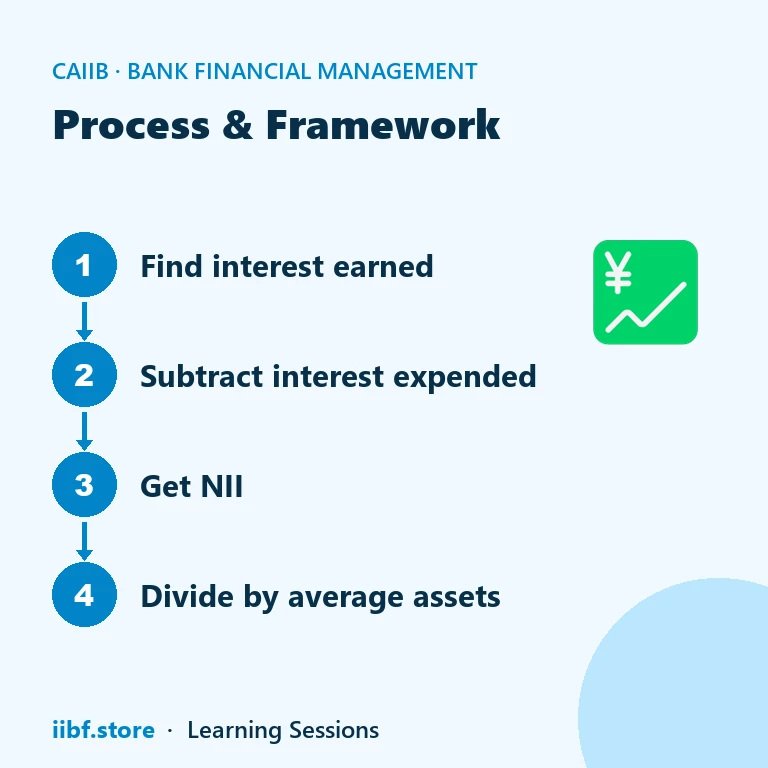
- Read the profit and loss account and note the interest earned for the year.
- Note the interest expended for the same year.
- Subtract the second from the first to get NII.
- Take the opening and closing balance of the denominator the question specifies (total assets or earning assets) and average them.
- Divide NII by that average and multiply by 100. Then compare with the previous year or with peers.
Worked example (illustrative figures)
Suppose a bank reports the following for a year. These numbers are made up only to practise the method.
| Item | Amount |
|---|---|
| Interest earned | 8,000 |
| Interest expended | 5,000 |
| Net interest income (8,000 - 5,000) | 3,000 |
| Total assets at start of year | 90,000 |
| Total assets at end of year | 110,000 |
| Average total assets | 100,000 |
| Average interest-earning assets (given) | 90,000 |
Using average total assets, NIM = 3,000 / 100,000 x 100 = 3.0%. Using average interest-earning assets, NIM = 3,000 / 90,000 x 100 = 3.33%. The same bank, the same NII, two honest answers. This is exactly why the question will always specify the base.
Now test the rate sensitivity. Say the bank's interest earned rises by 4% and interest expended rises by 6% over the next year because liabilities reprice faster. Interest earned becomes 8,320 and interest expended becomes 5,300, so NII is 3,020. If average assets have also grown to 108,000, NIM falls to about 2.8%. Notice that NII went up in rupee terms while the margin went down. That is a favourite exam twist: a growing NII does not guarantee an expanding NIM.
Reading the margin like a banker
A single NIM figure means little. Compare it across three lenses:
| Lens | What to ask | What it tells you |
|---|---|---|
| Over time | Is the margin rising or falling year on year? | Impact of the rate cycle, funding mix and NPAs |
| Across peers | How do public, private and foreign banks compare? | Franchise strength, CASA share and business model |
| Against other ratios | How do NIM, cost-to-income and credit cost move together? | Whether a high margin is earned at the cost of high risk |
The RBI's own commercial bank publication compares NIM across public sector, private and foreign banks and notes that the distribution differs widely by bank group, which is a reminder that one average hides a lot of dispersion. A high margin is not automatically good news either. A bank with a high NIM and high credit losses may simply be lending to riskier borrowers.
How IIBF tests net interest margin in banks
Expect three kinds of questions: a direct formula, a conceptual comparison of NIM with spread, and a scenario about rate movements. Common traps include:
- Using closing assets instead of average assets.
- Treating spread and NIM as identical.
- Assuming a rising NII means a rising NIM.
- Forgetting that a rate rise helps a bank only if it is asset-sensitive.
- Ignoring the effect of NPAs on interest earned.
Practising with chapter-wise questions is the fastest cure. The BFM printed book with chapter-wise MCQs and our CAIIB mock tests are built for this kind of repeated practice.
Practice MCQ 1
A bank earns interest of Rs 600 crore and pays interest of Rs 400 crore. Its average total assets are Rs 5,000 crore. What is the net interest margin on average total assets? Options: (a) 3%, (b) 4%, (c) 12%, (d) 8%. Answer: (b). NII is 600 minus 400, which is 200. Divide by 5,000 and you get 4%. Option (a) comes from using the wrong figure, and (c) and (d) confuse yield with margin.
Practice MCQ 2
Which of the following would most likely raise a bank's NIM? (a) Falling CASA share, (b) Rising NPAs, (c) A higher share of low-cost current and savings deposits, (d) A larger holding of idle cash. Answer: (c). Cheaper funding lowers the cost of funds. The other options reduce income or add idle, non-earning assets.
Practice MCQ 3
Interest rates rise sharply. A bank has more liabilities than assets repricing within one year. What is the likely first-round effect on its NIM? Answer: it narrows. Liabilities reprice up faster than assets, so interest expense rises faster than interest income. This is a negative-gap position.
Net interest margin and asset-liability management
NIM is the output; ALM is the control. Gap statements show how much of the balance sheet reprices in each time bucket. Duration measures price sensitivity of the portfolio. The bank's earnings view, which looks at the effect of rate shocks on NII over the next year or so, is simply a forecast of how NIM will behave. If your reading of the gap and duration chapters is solid, NIM questions become easy. If it is weak, revise those first, then return here. The CAIIB offer page shows the study packs available, and the free study material library has notes you can start with at no cost.
Quick revision points
- NII = interest earned minus interest expended.
- NIM = NII divided by average assets (RBI uses average assets; some sources use earning assets).
- Spread = yield on earning assets minus cost of funds. It is not the same as NIM.
- Repricing mismatch, CASA share, asset mix and NPAs are the main drivers.
- NII can rise in rupees while NIM falls if assets grow faster.
- A high NIM must be read together with credit cost and capital.
Frequently asked questions
What is net interest margin in banks?
It is the net interest income of a bank, that is interest earned minus interest expended, expressed as a percentage of its average assets. It shows how profitably the bank turns funds into interest-bearing assets.
How does the RBI define net interest margin?
In its commercial bank publications the RBI treats NIM as net interest income as a percentage of average assets. Always check the denominator given in an exam question, because some textbooks use average earning assets.
What is the difference between spread and NIM?
Spread is the average yield on earning assets less the average cost of funds. NIM is NII divided by average assets. NIM can exceed the spread when free funds such as equity and current deposits fund part of the assets.
Can NIM fall even when NII rises?
Yes. If average assets grow faster than NII, the ratio declines even though the rupee amount of NII is higher. This is a common numerical trap in BFM.
Is a higher NIM always better?
No. A high margin can come from lending to riskier borrowers, which brings higher credit losses later. Read NIM along with the NPA level, credit cost and capital adequacy.
Conclusion
Net interest margin in banks is a simple ratio with a deep story behind it: funding cost, asset mix, repricing speed, asset quality and capital all sit inside it. Learn the formula, remember that NII and NIM are different things, practise two or three numerical questions with both denominators, and link the idea to gap analysis. For the official exam schedule and syllabus, check the IIBF website for the upcoming exam cycle. Keep practising, and the margin questions will become your easiest marks.
Prefer revising from a printed book?
Chapter-wise books with MCQs after every chapter — minimal pages, complete coverage, delivered anywhere in India. Every book has a free sample to read first.


















































Quick quiz on this topic
5 exam-style questions from our free test bank — check yourself before you move on.
Practice this topic
Take a free mock test, download chapter PDFs, or watch a video class — all included on iibf.store.


