External Benchmark Linked Lending Rate (EBLR): Spread, Reset and Switching

A home loan customer comes to your counter and says: "The RBI cut its policy rate three months ago. Why has my EMI not changed?" Another says the opposite: "My rate went up even though nothing happened to my salary." Both are asking about the same machinery, the external benchmark linked lending rate, usually shortened to EBLR. If you are preparing for a bank promotion exam, this is one of those topics where the mechanism is simple, the rules are specific, and the question paper loves the details.
In this guide we cover what EBLR is, which loans must follow it, the benchmarks a bank can choose, how the spread is built and when it can be changed, the quarterly reset, and what happens to older MCLR-linked loans. We close with practice MCQs and a revision list.
Why the external benchmark linked lending rate exists
Before 2019, banks priced floating-rate loans on their own internal benchmarks: first the Base Rate, then the Marginal Cost of Funds based Lending Rate (MCLR). The trouble was that internal benchmarks moved slowly and opaquely, so when the RBI reduced its policy rate, the benefit often reached borrowers late or only partly. The answer was to peg floating-rate loans to a benchmark that the bank does not control. That is the idea behind the external benchmark linked lending rate: the borrower can see the benchmark moving in the market, and the bank adds a spread on top.
The current rules sit in the Reserve Bank of India (Commercial Banks - Interest Rates on Advances) Directions, 2025 (RBI/DOR/2025-26/161, dated 28 November 2025). They apply to commercial banks, which for this purpose exclude Small Finance Banks, Payment Banks and Local Area Banks, and they do not apply to foreign branches of Indian banks. Questions in promotion exams often use the older phrase "RBI circular on interest rate on advances", so recognise both.
Which loans must be linked to an external benchmark
Under the Directions, the following floating-rate loans by commercial banks must be linked to an external benchmark:
- floating rate personal or retail loans, such as housing and auto loans, and
- floating rate loans extended to micro and small enterprises and other MSMEs.
Banks are free to offer external benchmark linked loans to other types of borrowers as well, such as larger corporates, but they are not compelled to. Two further points are examined often. First, within one loan category a bank must adopt a uniform external benchmark; it cannot price some home loans on one benchmark and others on another. Second, banks may offer all categories of advances on either fixed or floating rates, so EBLR only applies where the loan is floating.
Which benchmarks are allowed
The Directions list the permissible external benchmarks. The bank chooses one of them:
- the RBI policy repo rate,
- the Government of India 3-month Treasury Bill yield published by the Financial Benchmarks India Pvt. Ltd. (FBIL),
- the Government of India 6-month Treasury Bill yield published by FBIL, or
- any other benchmark market interest rate published by FBIL.
If you want the complete bank promotion syllabus on advances and loan pricing in one place, the Bank Promotion course covers it chapter by chapter.
Key concepts behind EBLR
These are the five terms to fix in your head. Examiners recombine them to build look-alike options.
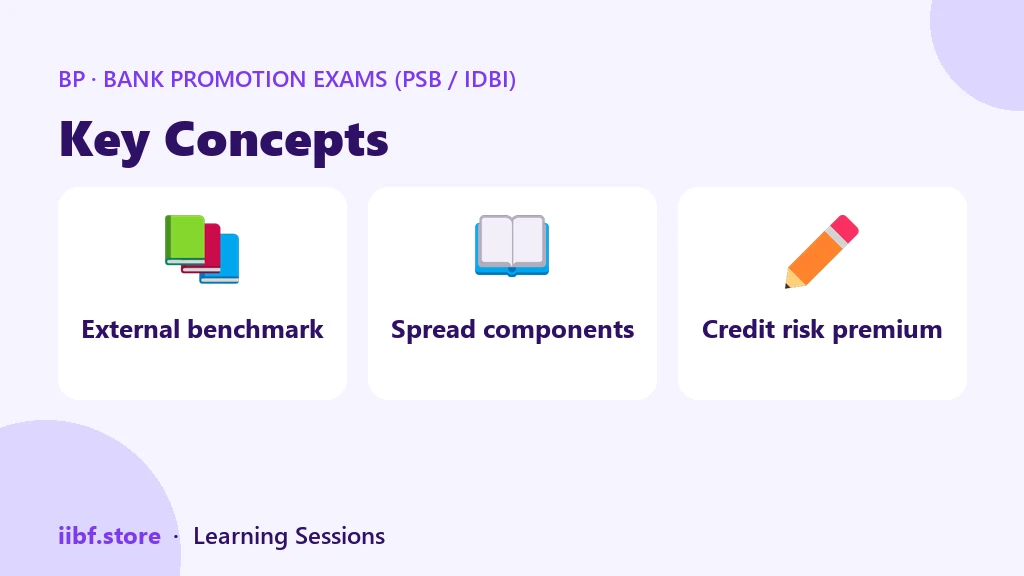
- External benchmark: a market rate outside the bank's control, as listed in the Directions.
- Spread: everything the bank adds to the benchmark. It includes an operating cost component, a credit risk premium and other components fixed by the bank's Board-approved spread policy.
- Lending rate: the reference benchmark plus the spread components.
- Reset: the periodic re-fixing of the loan rate as the benchmark moves, at least once in three months.
- Switching: the borrower's right, on prescribed terms, to move an older MCLR, Base Rate or BPLR loan to an external benchmark.
How an EBLR loan rate is built and reset, step by step
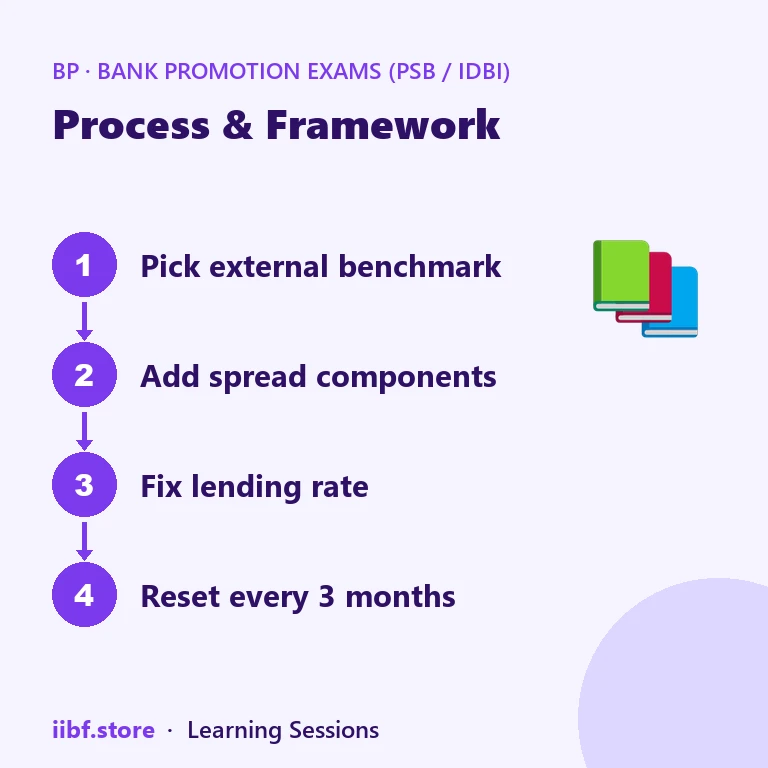
Step 1: The bank chooses the benchmark
The bank selects one of the permitted benchmarks for each loan category and keeps it uniform within that category. This choice is part of the bank's loan pricing policy.
Step 2: The bank adds spread components
The lending rate equals the benchmark plus the spread. The bank must have a Board-approved policy that explains how each spread component is determined, the range of each component for different borrowers or loan types, and who has delegated authority to price loans. The spread over the benchmark is otherwise at the bank's discretion.
Step 3: The bank fixes the rate and the borrower signs
The loan agreement records the benchmark and the spread. This is why transparency improves: the borrower can read both parts.
Step 4: The rate is reset at least every three months
Whenever the benchmark moves, the loan rate must reflect it at the next reset. The Directions say the rate must be reset at least once in three months. Banks may reset more often if their policy says so, but they cannot reset less often.
Step 5: Spread changes are restricted
A bank cannot keep nudging the spread. The rules distinguish two situations:
- Credit risk premium: it can change only when the borrower's credit assessment undergoes a substantial change, as agreed in the loan contract.
- Other spread components, including operating cost: they can be changed only once in three years. A bank may reduce them earlier to retain a customer, on justifiable grounds, in a non-discriminatory manner and under its policy.
This is a favourite exam trap. Many candidates remember "once in three years" and wrongly apply it to the credit risk premium as well. The premium is tied to a change in credit assessment, not to the calendar.
Table: EBLR rules at a glance
| Feature | Rule |
|---|---|
| Mandatory for | Floating rate personal or retail loans and floating rate loans to MSMEs |
| Optional for | Other borrower categories, at the bank's discretion |
| Benchmarks | Repo rate; 3-month or 6-month T-bill yield published by FBIL; other FBIL-published market rate |
| Uniformity | One external benchmark within a loan category |
| Lending rate | External benchmark plus spread components |
| Reset | At least once in three months |
| Credit risk premium | Changes only on substantial change in borrower's credit assessment |
| Other spread components | Can be changed once in three years; reduction earlier is allowed on justifiable grounds |
A worked example with illustrative numbers
Suppose a bank prices its housing loans on the policy repo rate. For an illustration only, assume the repo rate is 6.00% and the bank's spread for a salaried borrower is 2.50% (operating cost and other components 1.80% plus a credit risk premium of 0.70%). The lending rate is 6.00% + 2.50% = 8.50%.
At the next quarterly reset the repo rate falls by 0.25%. The borrower's rate becomes 8.25%, because the spread is untouched. Two years later the bank cannot raise its operating cost component, because it can be altered only once in three years. If the borrower's credit assessment weakens substantially, the bank may revise the credit risk premium, but only because the loan contract allows it. This is exactly how a question will be framed: a number, a reset event and a question on what the bank may or may not change.
Switching existing MCLR, Base Rate and BPLR loans
Older loans linked to the MCLR, Base Rate or the Benchmark Prime Lending Rate (BPLR) continue to run until repayment or renewal. The Directions give borrowers a route to move:
- Floating rate term loans of borrowers who are eligible to prepay without prepayment charges can switch to an external benchmark. The rate offered must be the same as the rate for a new loan of the same category, type, tenor and amount at the time of origination.
- Other existing borrowers may move to an external benchmark on mutually acceptable terms.
- A switchover is not treated as foreclosure of the existing facility, and eligible borrowers do not pay switching charges or fees apart from reasonable administrative or legal costs.
How promotion exams test this topic
Expect the topic in these shapes:
- Which loans? Floating rate retail or personal and MSME loans are mandatorily linked; other borrowers are optional.
- Benchmark list: repo rate, FBIL-published 3-month and 6-month T-bill yields, other FBIL-published market rates. Options that include the bank's own MCLR or Base Rate are wrong, because those are internal benchmarks.
- Reset and spread: three months for reset, three years for other spread components, credit assessment for the premium.
- Legacy loans: MCLR loans stay until repayment or renewal, with a switching route for borrowers.
Practise such statements regularly with the bank promotion mock tests. Keep the bank promotion printed books with chapter-wise MCQs beside you, and see what the plan includes on the Bank Promotion offer page.
Practice MCQ 1
Which of the following is NOT a permissible external benchmark for floating rate loans of commercial banks? (a) RBI policy repo rate, (b) Government of India 3-month T-bill yield published by FBIL, (c) The bank's own MCLR, (d) Any other benchmark market interest rate published by FBIL. The correct answer is (c). The MCLR is an internal benchmark of the bank, not an external one.
Practice MCQ 2
As per the RBI Directions, the interest rate on an external benchmark linked loan must be reset at least once in: (a) 1 month, (b) 3 months, (c) 6 months, (d) 12 months. The correct answer is (b). Three months is the maximum gap; a bank may reset more often.
Practice MCQ 3
A bank wants to raise the operating cost component of the spread on an EBLR housing loan after one year, although the borrower's credit assessment has not changed. Is this allowed? The answer is no. Components other than the credit risk premium can be changed only once in three years, and the credit risk premium itself can change only on a substantial change in credit assessment. Earlier reductions are permitted to retain the customer on justifiable grounds.
Quick revision points
- The external benchmark linked lending rate is mandatory for floating rate personal or retail and MSME loans of commercial banks.
- Benchmarks: policy repo rate; FBIL-published 3-month and 6-month T-bill yields; other FBIL-published market rates.
- Uniform benchmark within a loan category.
- Lending rate = benchmark + spread components; spread policy must be Board-approved.
- Reset at least once in three months.
- Credit risk premium changes only with a substantial change in credit assessment; other components once in three years.
- MCLR, Base Rate and BPLR loans continue till repayment or renewal; eligible borrowers can switch without charges beyond reasonable administrative or legal costs.
Frequently asked questions
What is the external benchmark linked lending rate?
It is the pricing method in which a bank's floating-rate loan rate equals a market-determined external benchmark, such as the RBI repo rate, plus a spread decided by the bank within the RBI's rules.
Which loans must be linked to an external benchmark?
Floating rate personal or retail loans such as housing and auto loans, and floating rate loans to MSMEs, extended by commercial banks. Other borrower categories can be linked at the bank's discretion.
How often is an EBLR loan rate reset?
At least once in three months. The bank can reset more frequently, but not less.
Can a bank change the spread whenever it likes?
No. The credit risk premium can change only on a substantial change in the borrower's credit assessment, and other spread components can be altered only once in three years, though reductions earlier are allowed on justifiable grounds.
Where can I check the latest rules?
Read the Directions on the RBI website and keep an eye on the Institute's notices at iibf.org.in for the upcoming exam cycle. RBI revises its directions from time to time, so quote the latest version in an answer.
Conclusion
The external benchmark linked lending rate comes down to a short chain: a benchmark the bank does not control, a spread the bank must justify through a Board-approved policy, a reset at least every three months, and tight limits on changing the spread. Add the legacy-loan switching route and you have almost every mark this topic can give you in a promotion paper. Learn the table above, practise a few reset numericals, and move on to the next advances topic with confidence.
Prefer revising from a printed book?
Chapter-wise books with MCQs after every chapter — minimal pages, complete coverage, delivered anywhere in India. Every book has a free sample to read first.


















































Quick quiz on this topic
5 exam-style questions from our free test bank — check yourself before you move on.
Practice this topic
Take a free mock test, download chapter PDFs, or watch a video class — all included on iibf.store.