NISM VII Study Plan for Working Bankers: 3 Weeks, One Book
It is 9:40 pm. The branch closed late, the day-end balancing took longer than it should, and your NISM Series VII material is still sitting where you left it last Sunday. You open it, read a page about trade settlement, realise you have no memory of the page before, and close it. Sound familiar?
If you are a clerk, an officer or a manager trying to clear a securities certification while doing a full-time job, the problem is rarely intelligence. It is structure. You do not need five hours a day; you need a NISM VII study plan that asks for ninety focused minutes, tells you exactly what to read tonight, and makes sure what you read tonight is still in your head next week.
This article gives you that plan. It works with any good material, but we have built it around one printed book so the day-wise table below is concrete rather than vague. Use it, adapt it, or ignore the book entirely. The method is the point.
Why a NISM VII study plan fails for working bankers
Most people who postpone this paper make the same three mistakes. Knowing them is half the fix.
- They study by mood, not by chapter. One night is clearing, the next is risk management, the third is a news article about something else. Nothing builds on anything.
- They read first and practise never. Reading feels productive. But the paper tests whether you can pick the right option among four, not whether you have seen the topic before.
- They have no revision loop. A topic read once on day 3 is mostly gone by day 12. Without a deliberate return visit, the first week of effort quietly evaporates.
A workable NISM VII study plan therefore does three things: it fixes the order, it attaches questions to every reading session, and it schedules a return to anything you got wrong. Everything else is decoration.
What the paper actually asks of you
Securities Operations and Risk Management is an operations paper. It is less about market opinions and more about how a trade travels: who takes the order, how it is margined, how it is cleared, how it settles, and what happens when an investor complains. If you work in a bank, parts of this will feel familiar from payments and reconciliation. Use that. Where a concept resembles something you already do at the counter or in back office, tie the two together in your mind and it will stick.
For the official syllabus, eligibility and the exam schedule for the upcoming exam cycle, always check the source at www.nism.ac.in rather than relying on any article, including this one.
What is inside the book we have used for this plan
The plan below follows the structure of NISM Series VII: Securities Operations and Risk Management, a printed book of 151 pages, 19 chapters and 285 questions, 2026 edition. The chapters are grouped into four modules, and that grouping is what makes a weekly rhythm possible.
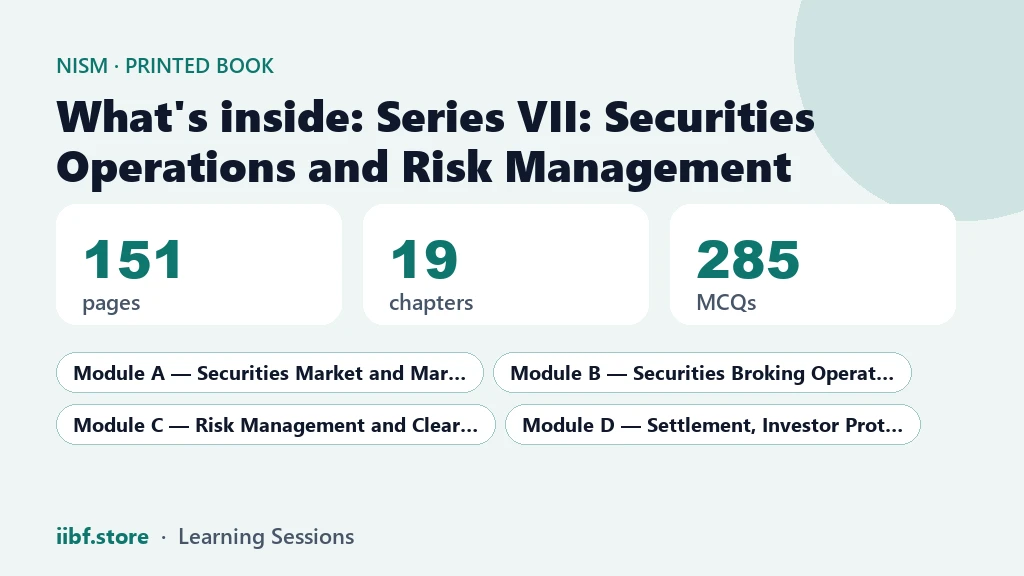
- Module A - Securities Market and Market Participants: Introduction to the Securities Market (2 parts) and Market Participants in the Securities Market (3 parts). Five chapters.
- Module B - Securities Broking Operations: Introduction to Securities Broking Operations, in 3 parts. Three chapters.
- Module C - Risk Management and Clearing: Risk Management (4 parts) and the Clearing Process. Five chapters.
- Module D - Settlement, Investor Protection and Other Broker Services: Settlement Process (2 parts), Investor Grievances and Arbitration (2 parts) and Other Services Provided by Brokers (2 parts). Six chapters.
Beyond the chapters, the book carries two extras: 30 case studies (120 questions) and 5 mega tests (500 questions). We will use both in the final stretch of the plan. At 151 pages, the volume itself is not the obstacle. The obstacle is doing it in small, repeatable pieces, which is exactly what the 19-chapter layout allows.
The three-week NISM VII study plan, day by day
The table assumes about 60 to 90 minutes on weekdays and a longer block on one weekend day. It gives you 21 days with one buffer day built into each week. Every row pairs reading with the end-of-chapter questions so that practice is never postponed. If you can only manage five days a week, stretch it to four weeks; the order does not change.
| Days | What to read | Questions to attempt |
|---|---|---|
| Days 1-2 | Module A: Introduction to the Securities Market (Parts 1 and 2) | End-of-chapter MCQs for both chapters, same night |
| Days 3-5 | Module A: Market Participants in the Securities Market (Parts 1 to 3) | End-of-chapter MCQs after each part |
| Day 6 | Revisit Module A notes and every wrong answer so far | Redo only the questions you missed |
| Day 7 | Buffer or rest | None, or a light skim of your error notes |
| Days 8-10 | Module B: Introduction to Securities Broking Operations (Parts 1 to 3) | End-of-chapter MCQs after each part |
| Days 11-12 | Module C: Risk Management (Parts 1 and 2) | End-of-chapter MCQs for both parts |
| Days 13-14 | Module C: Risk Management (Parts 3 and 4), then buffer | End-of-chapter MCQs; redo Module B misses |
| Day 15 | Module C: Clearing Process | End-of-chapter MCQs |
| Days 16-17 | Module D: Settlement Process (Parts 1 and 2) | End-of-chapter MCQs for both parts |
| Days 18-19 | Module D: Investor Grievances and Arbitration, Other Services Provided by Brokers | End-of-chapter MCQs; a few case studies |
| Day 20 | Case studies (120 questions) and your complete error list | Case-study questions, then redo every miss |
| Day 21 | Mega Tests (500 questions across 5 tests): start with one under timed conditions | One full mega test, review each wrong answer |
Notice what the table does not ask for: marathon sessions, re-reading the whole book twice, or memorising numbers you can look up. It asks for one chapter, one block of questions, and one return visit.
How to run a single weeknight session
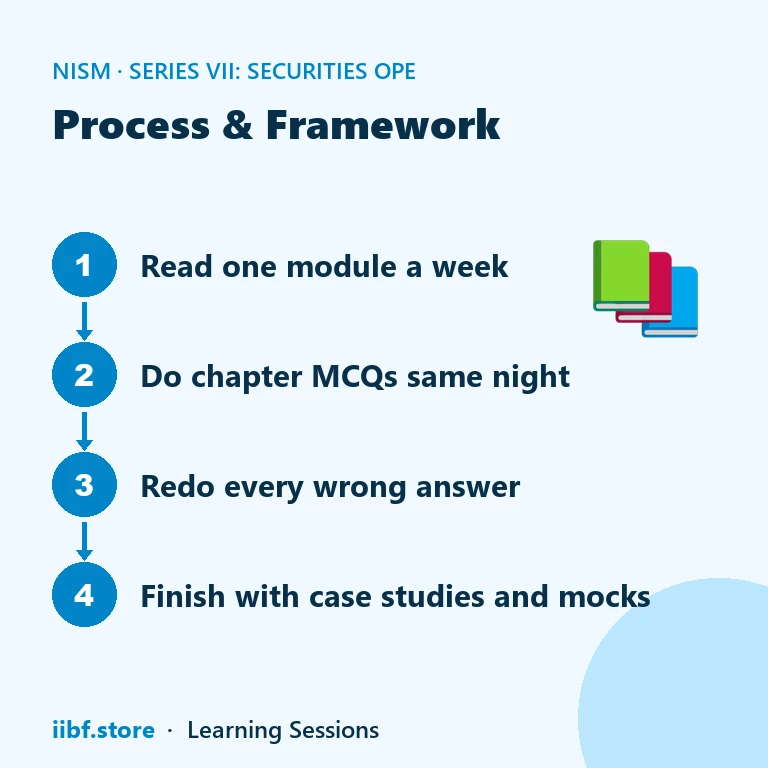
Having a table is easy. Sitting down on a tired Tuesday is harder. Here is a 75-minute template built for studying after work.
Minutes 0 to 10: warm up with yesterday
Open your error list from the last session and re-answer two or three questions without looking at the answer. It is a small act, but it is the cheapest revision you will ever do.
Minutes 10 to 45: read one chapter, pen in hand
Do not highlight everything. After each section, write one line in your own words. If you cannot write that line, you did not understand the section; read it once more before moving on. Operations topics like margining or settlement cycles make sense only as sequences, so draw the sequence: order, trade, margin, clearing, settlement, in your own handwriting.
Minutes 45 to 70: attempt the chapter questions
Answer every question before checking any. For each miss, note whether you did not know the concept, misread the wording, or fell for a close distractor. After a week you will see a pattern, and that pattern tells you what kind of mistakes to fix.
Minutes 70 to 75: write tomorrow's first line
Note the chapter you will open tomorrow. When you are tired, removing one decision is worth more than any study tip.
Using the questions the right way
With 285 questions in the book plus the case-study and mega-test material, the temptation is to treat practice as a scoreboard. Do not. Early in the plan your score does not matter; your error list does.
- Attempt without peeking. A question you answered with the explanation open is a question you did not practise.
- Keep one running error list. A page, not a notebook. Each entry is a single line: topic, why you missed it.
- Redo, do not re-read. Reviewing a mistake means answering the same question again two days later, then a week later.
- Treat case studies as a different skill. The 30 case studies are scenario-style. They train you to read a situation, find the rule that applies, and choose. That is a different muscle from recalling a definition.
If you want extra practice beyond what the book offers, there are free mock tests on iibf.store/tests and free PDFs on iibf.store/free-material. You do not need to buy anything to use them.
The honest limits of any one book
A book gives you structure and a bank of questions. It does not give you exam-hall speed. Speed comes from timed practice, and that is why the last two days of the plan are mock-heavy. Pair the book with at least a few full-length timed attempts, in one sitting, with your phone in another room. Also remember that regulations and procedures in securities markets change; before you sit the paper, check the official site for any updates to the syllabus or rules, and treat your printed material as a base to be verified rather than the last word.
You can browse the printed titles in the iibf.store books section. The book itself lists at the price shown on its page, which at the time of writing is ₹700 against an MRP of ₹2,398. Prices can change, so the book page is always the current reference.
What to do if you fall behind
You will. A relative's visit, a surprise audit, a week of festival rush. The plan survives this if you follow one rule: never try to catch up by doubling the next day. Instead, drop the buffer day first, then merge two light days, and only then extend the plan by a few days. A plan that bends is a plan that finishes.
If you slip by more than a week, restart from the last module you completed with questions, not from the first page. Your error list will tell you what needs a second look, and a short revision of Module A is usually faster than you fear.
Your first step tonight
Do not wait for Monday. Tonight, open Module A, read the first chapter on the securities market, and attempt its questions. That is Day 1 of your NISM VII study plan, and it is about seventy-five minutes. Tomorrow you do the second chapter. In three weeks you will have walked through all four modules, redone your misses, and sat at least one timed mega test. For deeper practice across other papers, the iibf.store blog carries more study guides in the same spirit.
Frequently asked questions
Can I really finish a NISM VII study plan in three weeks while working full time?
Three weeks works if you can give about 75 minutes on weekdays and a longer block on one weekend day. If your branch hours are heavier, stretch the same table over four weeks. The order of modules stays the same; only the calendar changes.
Should I read the whole book before attempting questions?
No. Attempt the end-of-chapter questions the same night you read each chapter. Early practice shows you what you actually understood, and it makes your revision targeted instead of general.
What if I only want free material first?
That is a sensible way to start. Try the free mock tests and free PDFs on iibf.store and see how you score. If you find you need a structured chapter-by-chapter source with a question bank, the book is built for exactly that, and the book page has a free sample you can read before ordering.
Where do I find the official exam dates and rules?
Always check the official website at www.nism.ac.in for the schedule of the upcoming exam cycle, eligibility and the latest syllabus. Dates and rules are set by the examining body, not by any study material.
Prefer revising from a printed book?
Chapter-wise books with MCQs after every chapter — minimal pages, complete coverage, delivered anywhere in India. Every book has a free sample to read first.


























Practice this topic
Take a free mock test, download chapter PDFs, or watch a video class — all included on iibf.store.