NISM Series VIII Study Plan for Working Bankers: 14 Days

It is 9:40 pm. The branch closed late, the day-end balancing took longer than it should have, and you still have a derivatives exam looming. You open a PDF, see words like put-call parity, open interest and clearing member, and your eyes glaze over. If that sounds familiar, you do not need more motivation. You need a NISM Series VIII study plan that fits into the two tired hours you actually have.
This article gives you exactly that: a 14-evening schedule, a way to split the syllabus into four manageable modules, and a simple rule for using practice questions so that you remember what you read. Use it with any material you like. At the end, we will also show how the Equity Derivatives printed book is organised, because its chapter order maps neatly onto the plan.
Why derivatives feels harder than it is
Most working bankers are comfortable with loans, deposits and compliance. Derivatives is different: the vocabulary is new, the payoffs are visual, and the rules are spread across trading, clearing, taxation and regulation. That mix makes the paper feel endless.
The truth is that the paper is built from four fairly separate blocks. Once you see the blocks, the fear drops. You are not learning one giant subject; you are learning four small ones in a sensible order.
The four blocks you are actually studying
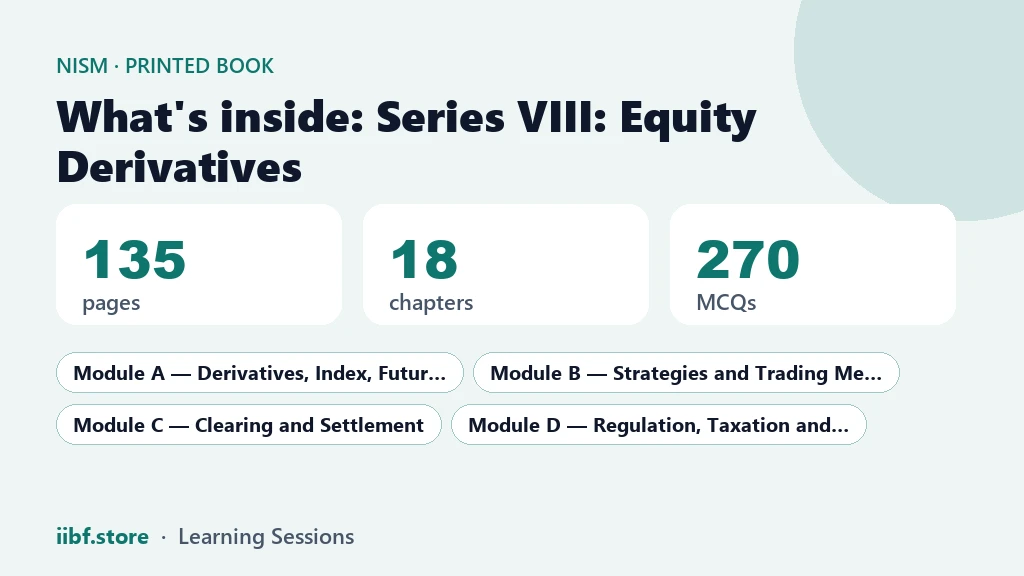
- Module A covers derivatives basics, indices, forwards, futures and options (6 chapters).
- Module B covers strategies, option pricing, Greeks, open interest and the trading mechanism (5 chapters).
- Module C covers the clearing and settlement system (3 chapters).
- Module D covers regulation, accounting and taxation, and sales practices with investor protection (4 chapters).
That is 18 chapters in total. If you can handle 18 short chapters over two weeks, you can handle this paper.
The ground rules of a NISM Series VIII study plan that survives a bank job
Before the table, five rules. They matter more than the schedule itself, because a plan that collapses on day four is worse than no plan.
- Study in the same slot daily. Even 75 to 90 minutes at the same time beats a heroic Sunday that you then cannot repeat.
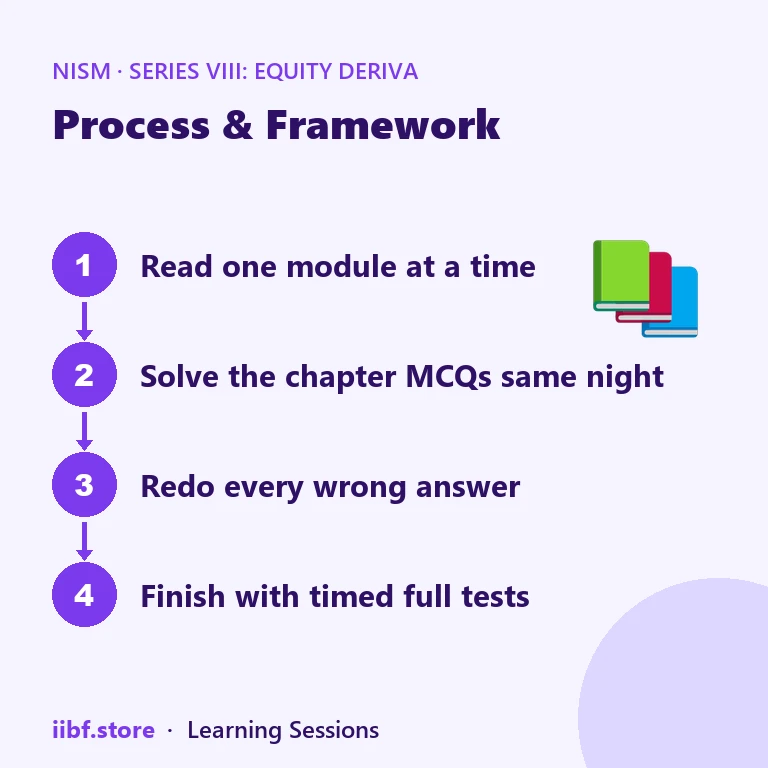
- Read first, then test the same night. Memory fades quickly. Questions on the chapter you just finished turn passive reading into recall.
- Keep a wrong-answer list. Write the question number and the reason you missed it: concept, number, or careless reading. Revisit this list every third day.
- Do the numbers by hand. Payoffs, margins and put-call parity are easy to nod along to and hard to compute under time pressure. Work every example on paper.
- Protect one free evening a week. If a branch audit or a festival rush eats a day, shift the plan by one day instead of abandoning it.
Official eligibility, syllabus weightage and the exam schedule can change, so always confirm the current details for the upcoming exam cycle on the official NISM website and the exam body's notices before you fix a date.
What the Equity Derivatives book gives you to work with
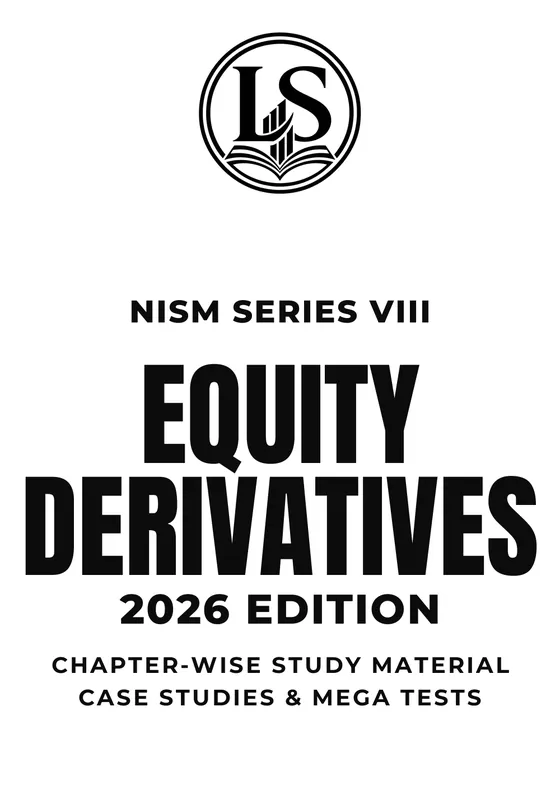
If you prefer one structured text over scattered notes, the NISM Series VIII: Equity Derivatives book is a compact option. It runs to 135 pages across 18 chapters, grouped into the same four modules described above, and carries 270 end-of-chapter MCQs. That works out to 15 questions per chapter, which is why the plan below is so easy to pace: one chapter, fifteen questions, done.
The book page also lists two extras: 30 case studies (120 questions) and 5 mega tests (500 questions). You do not need them in week one. Think of them as your second-pass material, used once the basic chapters are done. You can check the current contents and read a free sample on the NISM Series VIII book page before deciding.
Price, for the record: the book is listed at ₹700 against an MRP of ₹2,398. Prices can change, so treat the book page as the current source.
The 14-evening NISM Series VIII study plan, day by day
The table below assumes about 90 minutes a night. Chapters are not equal in length, so heavier ones get a full evening and lighter ones are paired. If you are a fast reader, compress it to ten days. If your branch is in a busy quarter-end, stretch it to three weeks. The order is what matters.
| Day | What to read | MCQs that night |
|---|---|---|
| 1 | Module A: Basics of Derivatives; Understanding Index | 30 |
| 2 | Module A: Forwards and Futures (Parts 1 and 2) | 30 |
| 3 | Module A: Introduction to Options (Parts 1 and 2) | 30 |
| 4 | Revision of Module A plus your wrong-answer list | Redo misses only |
| 5 | Module B: Hedging and speculation strategies; Option strategies | 30 |
| 6 | Module B: Option pricing, put-call parity, Greeks, open interest | 15 |
| 7 | Module B: Trading mechanism (Parts 1 and 2) | 30 |
| 8 | Revision of Module B; redo all misses from Modules A and B | Redo misses only |
| 9 | Module C: Clearing and settlement (Parts 1 and 2) | 30 |
| 10 | Module C: Clearing and settlement (Part 3); quick Module C revision | 15 |
| 11 | Module D: Legal and regulatory environment (Parts 1 and 2) | 30 |
| 12 | Module D: Accounting and taxation; Sales practices and investor protection | 30 |
| 13 | Full revision using the wrong-answer list; re-read only the hard topics | Redo misses only |
| 14 | Timed practice: mixed questions from all four modules, no notes | Mock-style set |
Why this order works
Module A builds the vocabulary: contracts, payoffs, long and short positions. Module B uses that vocabulary for strategies and pricing, so it should not be touched until A is solid. Modules C and D are more rule-based and read faster once you understand what is being cleared and regulated. The lighter days 4, 8 and 13 are deliberately revision-only. Skipping them is the most common reason people feel they have forgotten everything by day ten.
How to use the MCQs so they actually teach you
A question bank is not a test of what you know. In the first week it is a teaching tool. Here is a method that works when you are tired:
- Finish the chapter. Close the book.
- Attempt the chapter's MCQs without looking back.
- Check answers. For every miss, open the chapter and find the exact paragraph that answers it.
- Write one line in your wrong-answer list: what you thought, and what is correct.
This takes longer than just ticking options, but it is the single step that converts reading into marks. Fifteen questions a chapter is small enough to do properly even at 10 pm.
Where the harder topics hide
Three areas deserve extra time in almost any NISM Series VIII study plan. First, option pricing, put-call parity and the Greeks: do not memorise formulas, draw the payoff once and ask what happens when one input changes. Second, the strategies chapters: sketch each payoff and write the break-even in your own words. Third, the clearing and settlement chapters: these contain many small details on margins and settlement, so use short flash notes rather than long summaries.
Making your NISM Series VIII study plan flexible
Real life will interrupt. Here is how to adjust without losing the thread.
If you miss a day
Do not double up. Shift every later day by one. The only exception is revision days, which you may merge if you are short on time, but never skip a module's MCQs.
If you have only weekends
Two long sessions a week still works. Take one module per weekend, reading on Saturday and testing plus redoing misses on Sunday. You will finish in about four weekends, with a fifth for revision.
If you are short on time before the exam
Prioritise the chapters with the most definitions and rules that are easy to score on: the regulatory, taxation and sales practice chapters in Module D, and the basics in Module A. Then return to pricing and strategies with whatever time remains. Use the free mock tests at iibf.store/tests and the PDFs at iibf.store/free-material to add variety to your practice.
An honest word on limits
A book gives you structure and a bank of questions. It does not give you exam-hall speed. For that you need timed, mixed practice in the last three or four days, which is why day 14 is a no-notes session and why the extra case studies and mega tests exist. Pair any book with mocks, and keep an eye on current official notices. If you want to browse other certification and exam books, see all books on iibf.store.
Your first step tonight
Do not start by reorganising your notes or watching another overview video. Open Module A, read the first chapter, and attempt its 15 questions. That single evening is the whole plan in miniature. If you want the structured text behind this schedule, the NISM Series VIII Equity Derivatives book follows the same module order, and the free sample lets you judge the style first. A good NISM Series VIII study plan is simply 14 small, repeatable evenings, and you can begin tonight.
Frequently asked questions
Can I finish this paper in 14 days while working full time?
Yes, if you can give roughly 90 minutes a night and follow the read-test-correct loop. If your branch hours are unpredictable, stretch the same table to three weeks rather than skipping the MCQs.
How many questions does the book contain?
The Equity Derivatives book has 270 end-of-chapter MCQs across 18 chapters, which is 15 per chapter. The book page also lists 30 case studies (120 questions) and 5 mega tests (500 questions) as extras.
Is a book enough, or do I also need mock tests?
A book gives you structure, but it will not give you exam-hall speed on its own. Add timed mixed practice in the final days, such as the free mock tests on iibf.store/tests.
Where do I find the official exam dates and rules?
Always check the official site, www.nism.ac.in, and the exam body's notices for the upcoming exam cycle. This plan does not rely on any specific date.
Prefer revising from a printed book?
Chapter-wise books with MCQs after every chapter — minimal pages, complete coverage, delivered anywhere in India. Every book has a free sample to read first.






























Practice this topic
Take a free mock test, download chapter PDFs, or watch a video class — all included on iibf.store.