
NISM III-A Study Plan for Working Bankers: 4 Weeks, 24 Chapters
It is 9 pm. The branch closed late, the day-end mismatch took an hour, and now there is a securities-law syllabus waiting on your table. If you have ever opened a compliance paper, read two pages and fallen asleep, you are not lazy. You are a full-time banker doing a second job at night. What you need is not more hours; you need a realistic NISM III-A study plan that fits the hours you actually have.
This article gives you exactly that: a four-week routine for NISM Series III-A (Securities Intermediaries Compliance, Non-Fund), built around 24 chapters, four modules and end-of-chapter MCQs. Even if you never buy any book, the schedule, the method and the table below will work with whatever material you hold.
Why this paper feels harder than it is
Series III-A looks scary because it is a list of regulations: acts, rules, regulations, circulars, each with its own definitions and registration conditions. A working banker already understands compliance in spirit (KYC, AML, record keeping). The difficulty is the sheer number of separate documents to remember.
The fix is to stop treating it as 24 unrelated topics. Treat it as four families of rules that repeat the same questions: who must register, what conditions apply, what the intermediary must do, and what happens if it does not. Once you see that pattern, every new chapter is a variation on something you have already met.
What a tired brain can and cannot do
- After a full day at the branch, you can usually manage 60 to 90 focused minutes, not three hours.
- Reading new regulation text late at night works only in small doses; revising and answering MCQs works better than re-reading.
- Weekends are for the heavy chapters; weekday evenings are for one chapter or one revision block.
The NISM III-A study plan starts with the structure
Before you plan days, know what you are planning for. The NISM Series III-A printed book is organised into four modules covering 24 chapters over 177 pages, with 360 practice MCQs (about 15 per chapter) and extras: 30 case studies carrying 120 questions, plus 5 mega tests carrying 500 questions. The 2026 edition is the one listed on the book page.
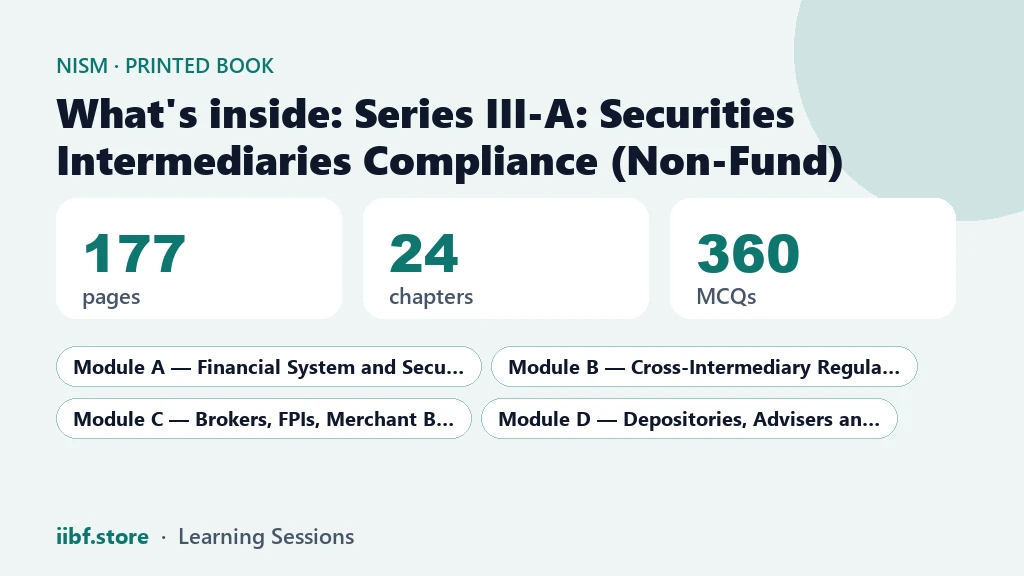
The four modules give you a natural way to cut the syllabus:
- Module A, Financial System and Securities Laws (5 chapters): financial system, regulatory framework, introduction to compliance, the SEBI Act 1992, and the SCRA 1956.
- Module B, Cross-Intermediary Regulations (5 chapters): Intermediaries Regulations 2008, insider trading, fraudulent and unfair trade practices, PMLA with AML/CFT guidelines, and KYC Registration Agency rules.
- Module C, Brokers, FPIs, Merchant Bankers and Issues (7 chapters): FPI regulations, stock brokers in two parts, merchant bankers in two parts, and ICDR 2018 in two parts.
- Module D, Depositories, Advisers and Other Intermediaries (7 chapters): depositories and participants, registrars and transfer agents, research analysts, investment advisers, debenture trustees, credit rating agencies, and custodians with proxy advisors.
Choose your material before you choose your days
A plan collapses when the material is scattered: one PDF here, a photo of notes there, a regulation downloaded from five websites. Pick one primary source for the whole four weeks and keep the official site, www.iibf.org.in, only for the current exam schedule and notices.
If you want a single printed source where chapters, MCQs and case studies sit in one order, the Series III-A book is built that way. At the time of writing it is priced at ₹725 against an MRP of ₹2,398 (about 70% off), but prices can change, so the book page is always the current reference. A free sample is available there if you want to judge the writing style before ordering.
Whatever you choose, free material is also worth using. Check the free study material section and the free mock tests so you are not paying for what you can get at no cost.
The four-week routine, day by day
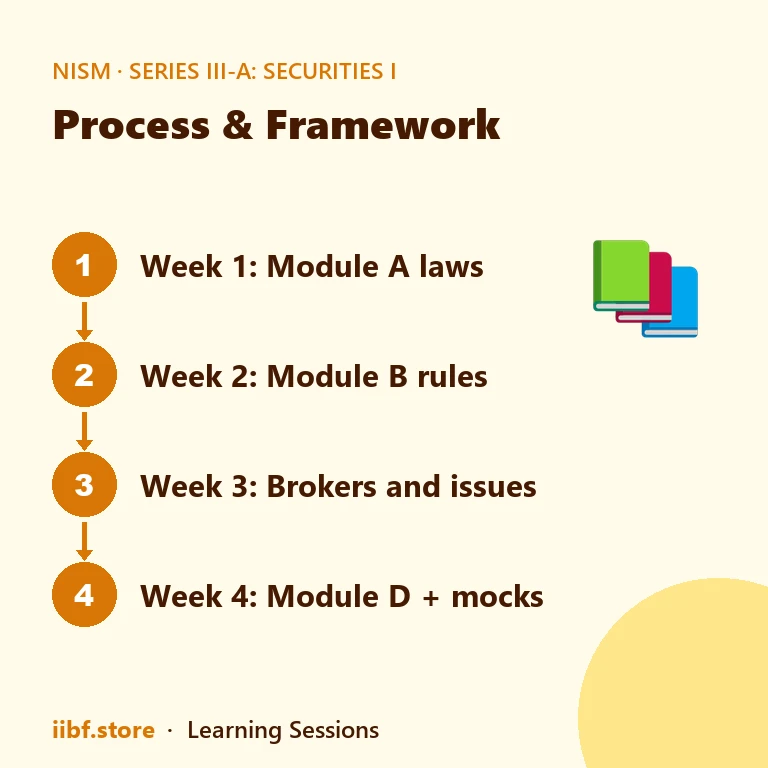
This NISM III-A study plan assumes 28 days, with 60 to 90 minutes on weekdays and a longer block on weekends. Each chapter gets one reading pass, then its MCQs the same night or next morning. With about 15 MCQs per chapter in the book, a chapter block takes roughly one evening.
| Days | What to read | MCQs to attempt |
|---|---|---|
| Days 1-5 | Module A: financial system, regulatory framework, compliance basics, SEBI Act, SCRA | About 15 per chapter, around 75 |
| Days 6-7 | Revise Module A; no new reading | Redo every wrong MCQ |
| Days 8-12 | Module B: Intermediaries Regulations, insider trading, fraud, PMLA/AML, KRA | About 15 per chapter, around 75 |
| Days 13-14 | Revise Module B; start a one-page cheat sheet | Wrong-answer review |
| Days 15-19 | Module C first half: FPI, Stock Brokers Part 1 and 2, Merchant Bankers Part 1 | About 15 per chapter, around 60 |
| Days 20-21 | Module C second half: Merchant Bankers Part 2, ICDR Part 1 and 2 | About 45 |
| Days 22-25 | Module D: depositories, RTAs, research analysts, advisers, trustees, rating agencies, custodians | About 15 per chapter, around 105 |
| Days 26-28 | Full revision, case studies, then mock tests | Case studies plus at least one mega test |
Notice that Module C and Module D carry seven chapters each, and Module C includes the heavy ICDR and Stock Brokers material. That is why they get the biggest day blocks. If you fall behind, do not skip the revision days; cut the new reading instead and catch up on a weekend.
A 90-minute weekday evening
- First 10 minutes: skim the headings and definitions of the chapter.
- Next 40 minutes: read once, underlining only registration conditions, time limits and penalties.
- Next 30 minutes: attempt the chapter MCQs without looking at the text.
- Last 10 minutes: write every wrong answer and the reason in your notebook.
How to use MCQs and case studies properly
MCQs are where this plan earns its marks. Reading feels productive but fades by morning; answering forces recall. In a compliance paper, the traps are usually small: a time limit, a threshold, who approves what, which authority is named. Your wrong-answer notebook is the most valuable page you will make.
Use case studies after the chapters, not before
The book carries 30 case studies with 120 questions. Keep them for the last week. A case study asks you to apply several chapters to one situation (a broker, an insider, a late disclosure), which is exactly how compliance work happens in real life. Attempt them only after Modules A to D are done, otherwise you will just feel lost.
Mega tests for exam-hall speed
The 5 mega tests (500 questions in all) are for the final days. A printed book will not give you exam-hall speed on its own, so pair it with timed practice. The free mock tests on iibf.store are a good way to add timing pressure without spending more.
Common mistakes bankers make with this paper
- Memorising section numbers first. Learn the purpose and the pattern; numbers stick later through MCQs.
- Skipping Module A. It looks like background, but the SEBI Act and SCRA are the base for everything after it.
- Reading Part 2 before Part 1. Stock Brokers, Merchant Bankers and ICDR are each split in two; read them in order.
- Studying only on weekends. A daily 60 minutes beats one 8-hour Sunday that you will dread all week.
- Never checking the official notices. Rules get amended; confirm the latest on the official site before the upcoming exam cycle.
If you are also thinking about longer-term certification paths, the books page lists other printed titles, and the blog has more planning articles written for working bankers.
Your first three nights
Do not wait for a perfect Monday. Tonight, read just the financial system chapter and answer its MCQs. Tomorrow, the regulatory framework chapter. The day after, introduction to compliance. Three evenings in, you will have momentum, a wrong-answer notebook and proof that the NISM III-A study plan fits inside your real life. A book is a tool, not a miracle: the pass comes from the 28 days you actually put in.
FAQ
Can I finish Series III-A in four weeks while working full time?
For most bankers, yes, if you give 60 to 90 minutes on weekdays and a longer block on weekends. The 24 chapters in the table above fit that pace, but if you are new to securities law, stretch it to five or six weeks rather than skipping revision.
How many MCQs should I do per chapter?
Attempt all of them. The book has 360 MCQs across 24 chapters, about 15 per chapter, which is one comfortable evening block. Redo only the ones you got wrong during revision days.
Where do I find the official exam schedule and rules?
Always check the official site at www.iibf.org.in for dates, eligibility and notices for the upcoming exam cycle. This article does not quote any dates or fees.
Is a book enough, or do I need mock tests too?
A book gives you structure and practice questions, but timed mocks build speed. Use the book for learning and the free tests at iibf.store/tests for the last week.
Prefer revising from a printed book?
Chapter-wise books with MCQs after every chapter — minimal pages, complete coverage, delivered anywhere in India. Every book has a free sample to read first.














Practice this topic
Take a free mock test, download chapter PDFs, or watch a video class — all included on iibf.store.