IBC Exam Study Plan: 14 Days with the Stressed Assets and IBC Book
It is 8:30 in the evening. The branch has finally emptied, you have eaten something quick, and the Insolvency and Bankruptcy Code is waiting. The Act feels endless: sections, thresholds, timelines, tribunals, case laws. You have also probably postponed this paper once already. If that is you, this IBC exam study plan is written for exactly your evenings, not for a full-time student with six free hours a day.
The plan below runs for 14 days. It assumes about 90 minutes on a weekday and a little more on weekends. It follows the order of one specific book, but the method works with any decent material: read in small modules, test yourself the same night, and revisit mistakes before they harden into habits.
Why most IBC preparation stalls in week one
The Code is not difficult because the ideas are hard. It is difficult because everything is connected. You cannot understand the Committee of Creditors without knowing how a resolution process starts, and you cannot follow liquidation without knowing what a failed plan looks like. Candidates who start with random chapters, or with case laws first, feel lost within a few days and quietly stop.
Three habits cause most of the damage:
- Reading without testing. You finish a chapter, feel good, and discover two days later that you cannot recall the sequence of events.
- Starting with the toughest topic. Tired brains reward easy wins. Begin with the background and the structure, then climb.
- No fixed finish line. "I will study IBC this month" is not a plan. "Module C done by day 9" is.
A good IBC exam study plan fixes all three: a fixed order, a daily MCQ target, and a date for every module.
The book we have built this plan around
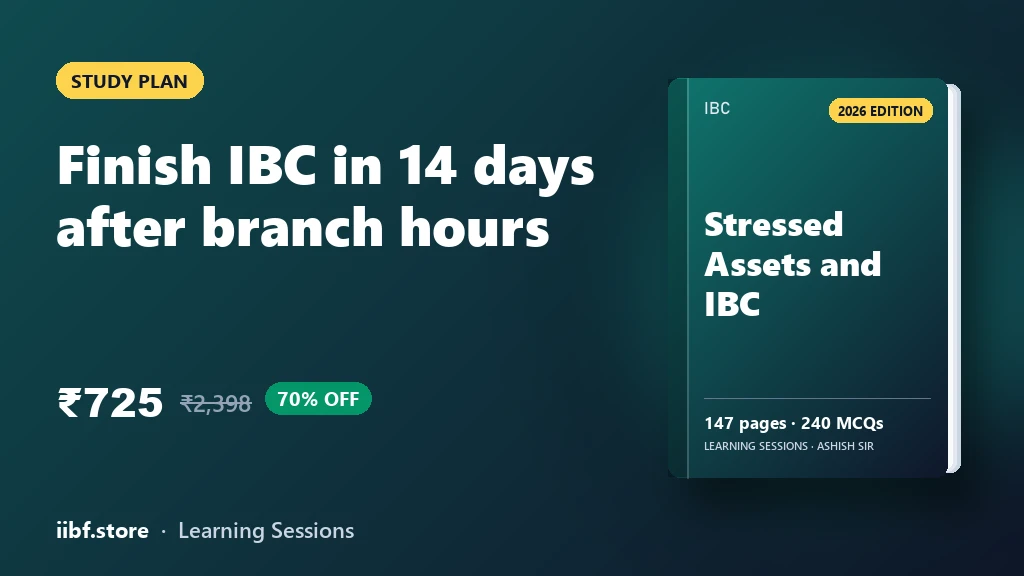
The plan follows the chapter order of the Stressed Assets and IBC book, a 2026 edition printed book for the Insolvency and Bankruptcy Code 2016 certificate. It has 147 pages, 28 chapters and 240 MCQs placed at the end of the chapters, so the testing habit is built into the reading itself. The 28 chapters sit in six modules, which is what makes a day-wise schedule easy to draw.
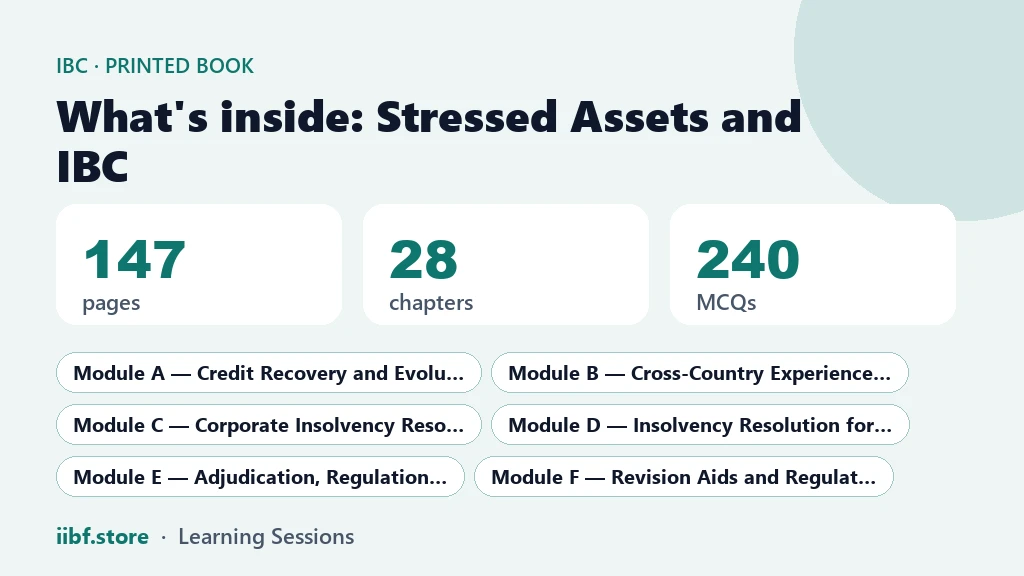
The six modules at a glance
- Module A covers credit recovery routes, the RBI prudential framework and why India needed the Code (3 chapters).
- Module B covers international restructuring lessons and the architecture of the Code and its institutions (2 chapters).
- Module C is the heart of the paper: default and the gateway to CIRP, Sections 7, 9 and 10, moratorium and claims, the Committee of Creditors, the IRP and RP, resolution plans, fast-track CIRP, pre-packaged resolution for MSMEs, liquidation and voluntary liquidation (13 chapters).
- Module D deals with personal guarantors, fresh start and bankruptcy (2 chapters).
- Module E covers adjudication and appeals, PUFE and avoidance, regulation and cross-border assets, and important case laws (4 chapters).
- Module F is the revision layer: application toolkit, the RBI 2019 framework revision sheet, essential terms, and the 2026 changes (4 chapters).
Notice that more than a third of the chapters sit in Module C. That is where your evenings should go.
The 14-day IBC exam study plan, table first
Here is the whole schedule on one screen. MCQ numbers are approximate: the book carries 240 MCQs over 28 chapters, which averages a little under nine per chapter, so use the count as a target rather than a hard rule.
| Days | What to read | MCQs to attempt |
|---|---|---|
| Day 1-2 | Module A: credit recovery, RBI prudential framework, why the Code was needed | About 25 |
| Day 3 | Module B: international lessons and architecture of the Code | About 17 |
| Day 4-5 | Module C, first four chapters: default and gateway, Sections 7, 9 and 10, CIRP commencement and moratorium, CoC constitution | About 34 |
| Day 6-7 | Module C, next four chapters: CoC decisions and voting, IRP and RP, information memorandum and valuation, designing a resolution plan | About 34 |
| Day 8-9 | Module C, last five chapters: plan approval, fast-track CIRP, pre-packaged resolution, liquidation, voluntary liquidation | About 43 |
| Day 10 | Module D: personal guarantors, fresh start and bankruptcy | About 17 |
| Day 11-12 | Module E: adjudication, PUFE and avoidance, regulation, case laws | About 34 |
| Day 13 | Module F: toolkit, RBI 2019 sheet, essential terms, 2026 changes | About 34 |
| Day 14 | Wrong-answer redo, case studies, one mega test | Case studies plus a full test |
How each evening should actually go
The table tells you what, not how. A 90-minute evening works best when it is split the same way every day, because a repeated routine costs no willpower.
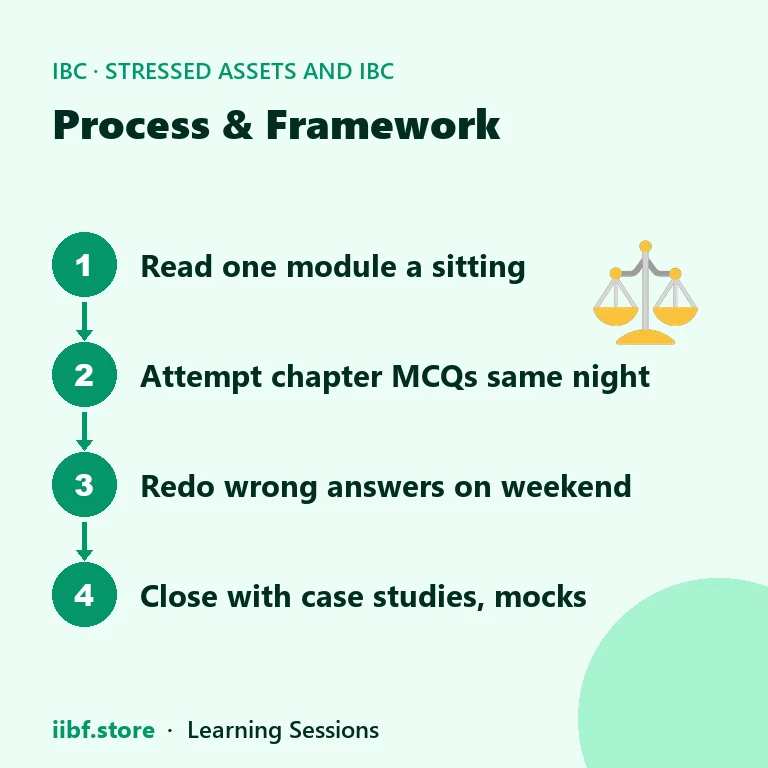
The 60-20-10 split
- 60 minutes: read. One module, or one half of a large module. Underline only the things that have numbers, timelines or named authorities. Do not highlight whole paragraphs.
- 20 minutes: MCQs. Attempt the chapter questions straight after reading, closed book. Mark every miss with a tick in the margin.
- 10 minutes: recall. Close the book and write the flow of the day in six lines, for example the steps from a default to the admission of an application.
Do not skip the recall step on tired days. It is the shortest and the most useful ten minutes of the evening.
Treat Module C as a story, not a list
The thirteen chapters of Module C follow the life of a company in trouble. Default happens, an application is filed, the process is admitted, a moratorium begins, claims are collected, the creditors decide, a plan is designed, approved and implemented, and if that fails, liquidation follows with a distribution waterfall. When you read it as one story, the sections stop being isolated facts. Before each Module C sitting, spend two minutes telling yourself where in the story the day's chapters sit.
What to do when you fall behind
You will. Branch audits, month-end targets and a sick relative do not respect a study calendar. Plan for this from the start instead of feeling guilty later.
- Lost one day: merge it into the next day by reading only the first half of the next module, and push the other half to the weekend.
- Lost three or more days: do not compress the plan. Shift the whole schedule forward and keep the daily MCQs. Speed comes from practice, not from skipping chapters.
- Never skip Module F. The revision sheets and the section on the 2026 changes are the cheapest marks in the paper, because they are short and heavily testable.
A realistic IBC exam study plan is one you can resume after a bad week, not one that breaks the first time life interferes.
Day 14 and beyond: where practice takes over
Reading gets you familiar with the Code. Exam-hall confidence comes from questions. The book includes extras for this stage: 30 case studies with 120 questions, and 5 mega tests with 500 questions. Use the case studies on day 14 and in the days after, because case-style questions are where candidates who only memorised definitions lose marks.
Add free practice on top. The free mock tests on iibf.store are a good way to check your speed, and the free material library has PDFs you can use for last-minute revision. If you are weighing options, the full books catalogue shows what else is available for other papers.
An honest word on limits
A book alone will not give you exam-hall speed. Fourteen days is a plan for completing the syllabus once and testing it, not a promise that one pass is enough for everyone. If you have a gap of a few weeks before the exam, repeat days 4 to 9 once more, and attempt a mock test every weekend. Always confirm the exam format, schedule and syllabus on the official IIBF website rather than relying on any third-party summary, including this one.
Is the book worth it for your IBC exam study plan?
The Stressed Assets and IBC book is priced at ₹725 against an MRP of ₹2,398 (about 70% off at the time of writing). Prices can change, so the book page is always the current source. If you want to see the writing style before deciding, the book page has a free sample you can read first. Whether you buy this or something else, the principles above stay the same: one module at a time, MCQs the same night, a weekly redo of mistakes, and case studies at the end.
You do not need a perfect month to clear this paper. You need fourteen ordinary evenings used well. For more preparation guides written for working bankers, browse the iibf.store blog.
Frequently asked questions
Can I really finish the IBC syllabus in 14 days while working full time?
You can complete one careful pass if you manage about 90 minutes on weekdays and a bit more on weekends. If your workload is heavier, stretch the same schedule to 21 days rather than cutting chapters.
Which module should I never skip?
Module C carries the largest number of chapters and covers the full resolution and liquidation process, so it deserves the most time. Module F is short and works as your revision layer, so do not skip it either.
How many MCQs should I attempt each day?
Roughly 17 to 25 on most days, which is about two to three chapters of end-of-chapter questions. The book has 240 MCQs in total, plus case studies and mega tests for later practice.
Where do I check the official exam schedule?
Use the upcoming exam cycle details on the IIBF website at www.iibf.org.in. This article deliberately avoids quoting dates, fees or attempt rules, since they can change.
Prefer revising from a printed book?
Chapter-wise books with MCQs after every chapter — minimal pages, complete coverage, delivered anywhere in India. Every book has a free sample to read first.






















Quick quiz on this topic
5 exam-style questions from our free test bank — check yourself before you move on.
Practice this topic
Take a free mock test, download chapter PDFs, or watch a video class — all included on iibf.store.