SMIB Study Plan: Finish Strategic Management in Banking in 30 Days
It is 9:30 at night. The branch closed late, the day-end figures took longer than planned, and now you are sitting with a syllabus that talks about business strategy, corporate governance, digital banking and ESG. You have told yourself this week that you will start. Last week too. If that sounds familiar, this SMIB study plan is written for you.
SMIB stands for Strategic Management and Innovations in Banking, one of the IIBF certificate papers. It is not a numerical paper, and that is both good and bad news. Good, because you do not need to sit with a calculator for hours. Bad, because the content is conceptual and wide, and concepts slip away if you read them in a rush on a Sunday and never touch them again.
Let us build a plan that respects your actual life: a full-time job, a tired brain after 7 pm, and maybe a family that also wants you at the dinner table. You can use this plan with any good material. Later in the article we will also show how it maps to one specific printed book, so you can judge for yourself whether it fits you.
Why a SMIB study plan must be small-block, not marathon
Most working bankers fail a conceptual paper for the same reason, and it is rarely lack of intelligence. They plan three-hour sessions, manage two of them, feel guilty, and quit. A better SMIB study plan is built on blocks you can actually finish on your worst day.
Here is the principle we will use throughout:
- One chapter a day, 45 to 60 minutes. That is one sitting, not a heroic effort.
- Practice the same night. Questions on a chapter you read an hour ago tell you immediately what stuck and what did not.
- One revision day per module. You revisit only your marked weak points, not the whole text again.
- Weekends are for catching up, not for extra load. If you missed two weekdays, Saturday absorbs them.
Notice what is missing: no all-nighters, no 5 am wake-ups you will not keep. A plan you follow at 70 percent beats a perfect plan you abandon on day four.
The tired-brain rule
If you are too exhausted to read, do only the questions for that chapter and the next morning read the explanation. Reading when you are half asleep gives you the feeling of studying without the learning. Ten honest minutes beat sixty distracted ones.
What the paper covers: four modules, twenty chapters
Before you plan days, you need to see the whole map. The paper breaks naturally into four modules, and each module has a different personality.
- Module A, Strategic Management: General Concept and Process. Strategy and strategic leadership, internal and external environment, business, corporate and global strategies, strategy vehicles, and strategic thinking in banking. This is the theory base, so read it patiently.
- Module B, Functional Application, General and Banking. Strategic finance, cost, credit and asset-liability management, marketing, HRM and business development. Here you apply Module A to everyday banking functions you already see at work.
- Module C, Corporate Governance in Banks. Introduction to governance, values, leadership, culture and ethics, governance in Indian banks, governance in regulations (Basel, SEBI LODR, Companies Act) and structures for public, private, small finance and payments banks.
- Module D, Innovation and Strategic Challenges. Innovation and technology management, digitalisation, financial innovation in retail and corporate banking, reinventing the business model, and sustainability, ESG and CSR.
Module B will feel familiar because it is your job. Module C is the one that trips people, because it mixes regulation names and structures. Give Module C a little extra patience in the plan below.
Where a printed book helps: the Strategic Management and Innovations in Banking book
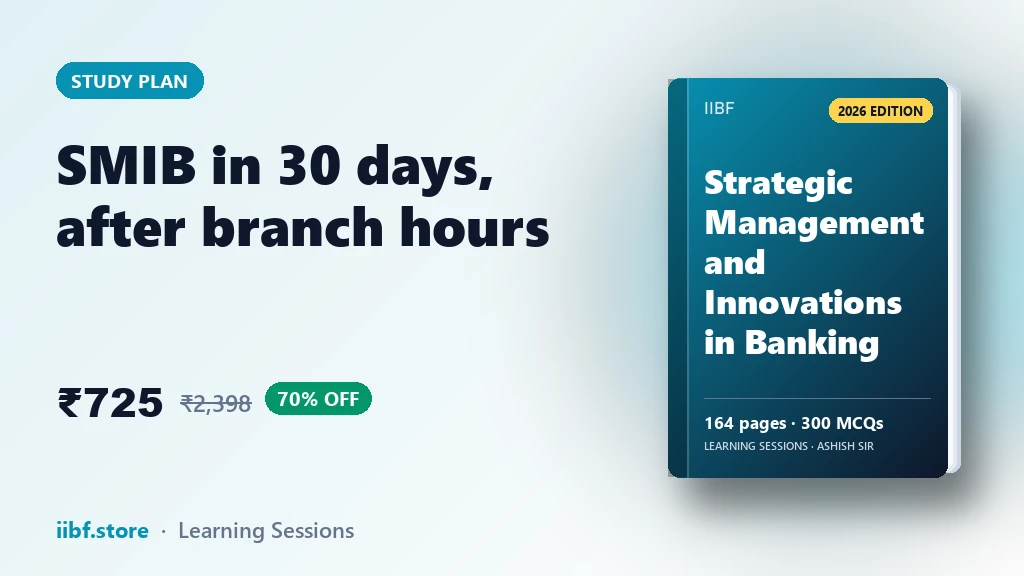
A plan needs material that matches its rhythm. The Strategic Management and Innovations in Banking printed book is a 2026 edition of 164 pages across 20 chapters, which means it is already cut into the one-chapter-a-day blocks we just discussed. It carries 300 questions in total, which works out to roughly 15 per chapter on average. That is enough to test each chapter the same evening without turning practice into another full-time job.
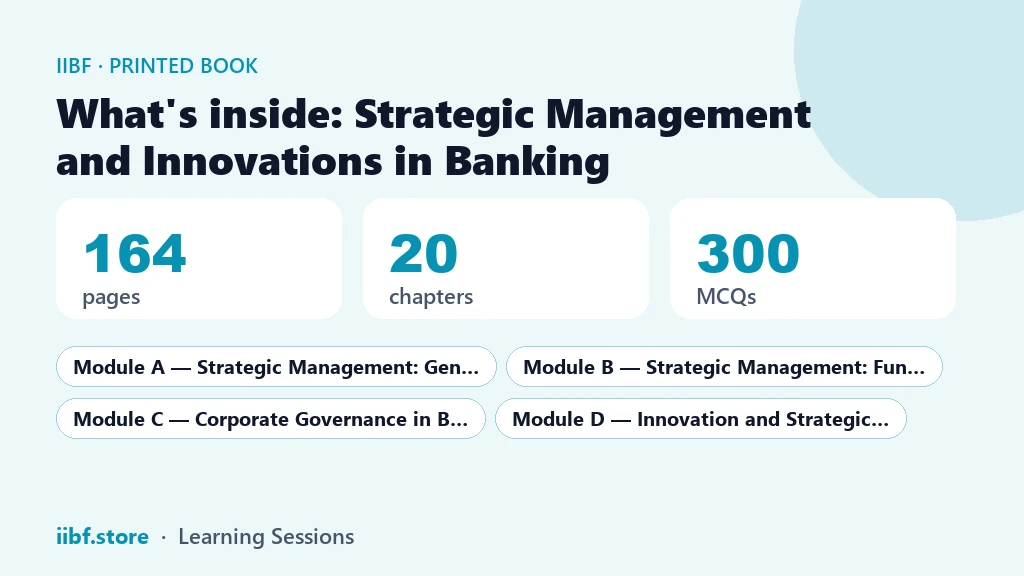
Beyond the chapters, the book also lists 30 case studies (120 questions) and 5 mega tests (500 questions). Case studies matter for a paper like this, because strategy and governance questions are often framed as short situations rather than plain definitions. The mega tests give you something to attempt once the reading is done.
There is also a free sample you can read first. Open the SMIB book page and look at the sample before spending anything. Prices can change, so treat the book page as the current source: at the time of writing it shows ₹725 against an MRP of ₹2,398.
The 30-day SMIB study plan, day by day
Here is the plan mapped to the book's order. It assumes you study on most weekdays for about an hour and use weekends partly for catch-up. If you have more time, compress it. If you have less, stretch it to 40 days; the order stays the same.
| Days | What to read | MCQs per day |
|---|---|---|
| Day 1 to 5 | Module A, one chapter a day (strategy and leadership, environment, business, corporate and global strategy, strategy vehicles) | All chapter MCQs of that day, around 15 |
| Day 6 | Strategic thinking in banking (last Module A chapter), then a short Module A recap | Chapter MCQs, plus re-attempt wrong ones from Days 1 to 5 |
| Day 7 | Buffer day. Catch up or rest. | None, or 10 re-attempts |
| Day 8 to 12 | Module B, one chapter a day (finance, cost-credit-ALM, marketing, HRM, business development) | All chapter MCQs of that day |
| Day 13 to 14 | Module B revision and Module A quick revisit | Only previously wrong MCQs |
| Day 15 to 19 | Module C, one chapter a day (governance basics, values and ethics, Indian banks, Basel-SEBI LODR-Companies Act, bank types) | All chapter MCQs of that day |
| Day 20 to 21 | Module C revision. Make a one-page note of regulation names. | Wrong MCQs, plus 10 fresh ones |
| Day 22 to 26 | Module D, one chapter a day (innovation, digital banking, financial innovation, business model, ESG and CSR) | All chapter MCQs of that day |
| Day 27 to 28 | Case studies from the book, two or three a day | Their questions |
| Day 29 to 30 | Mega tests, one a day, timed, then analyse mistakes | A full mega test |
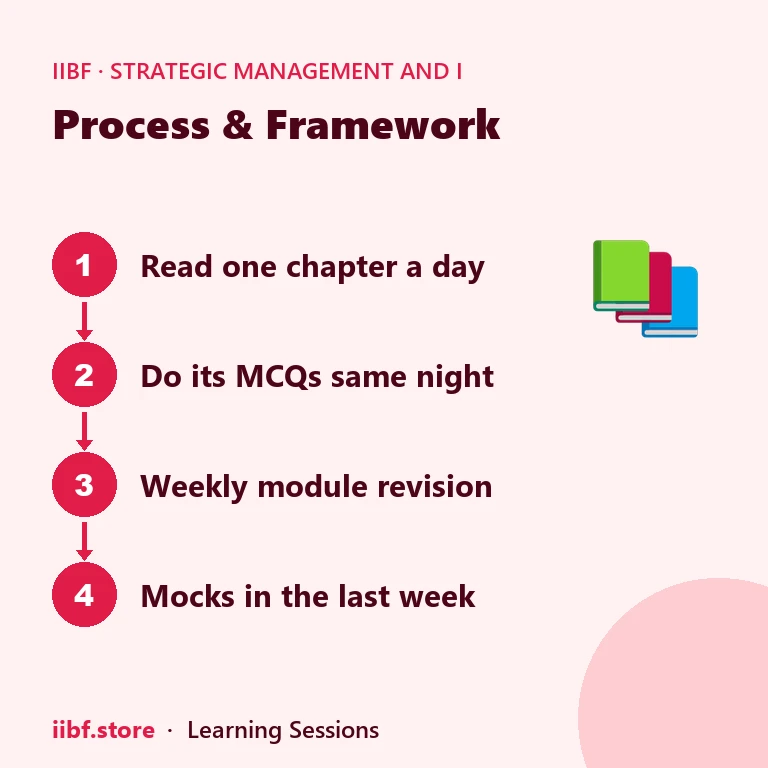
That is the SMIB study plan in one screen. If a day collapses because the branch audit ran late, do not try to double up tomorrow. Slide the whole schedule one day. The buffer days exist so you never have to feel behind.
How to read a chapter in 45 minutes
First, spend five minutes on the headings and any summary points so your brain has a skeleton. Then read the body once, with a pencil, marking only what you could not explain to a colleague. Finally close the book and say the chapter's three main ideas aloud. If you cannot, mark the chapter for the module revision day. Do not rewrite notes; rewriting feels productive and mostly is not.
Practice rhythm: how to use 300 MCQs without wasting them
Questions are where a conceptual paper is won. Many candidates read the whole text twice and meet questions for the first time in the exam hall. Reverse that habit. In this SMIB study plan, practice starts on day one.
- Attempt without peeking. A guessed answer that turns out right hides a gap. Mark guesses and treat them as wrong.
- Keep a wrong-answer list. One notebook page per module is enough. On revision days you work only from this list.
- Read the option you rejected. In strategy and governance papers, the wrong options are often half-true. Understanding why they fail teaches more than the right answer.
- Re-attempt after three days. If you get it right again, it is yours. If not, it goes back on the list.
The 120 case-study questions are worth saving until Module D is done, because the best case-study answers draw on several modules together, for example how a digital strategy interacts with governance and risk appetite.
Weekday and weekend schedule for a working banker
A plan only works if it fits an actual week. Here is a version you can copy.
- Monday to Thursday: 45 to 60 minutes after dinner. Chapter plus its questions. Switch off the phone in another room.
- Friday: Questions only, or rest if the week was heavy. Tired Fridays are normal.
- Saturday: Two hours at most, for the module revision or the buffer catch-up.
- Sunday: Half a day off. Come back fresh on Monday. Burnout is the real enemy of a thirty-day plan.
Commuters can use travel time for flashcard-style revision of the wrong-answer list. Reading new chapters on a crowded train rarely works; reviewing short notes does.
What this book will not do for you
An honest limit: a book alone will not give you exam-hall speed. Reading and chapter MCQs build understanding, but timing and nerves only improve with full-length practice under a clock. That is why Days 29 and 30 are mock days, and why we suggest you also try the free practice papers at iibf.store/tests and the free PDFs at iibf.store/free-material before the exam.
Also, please check the official syllabus, exam schedule and eligibility on the IIBF website for the upcoming exam cycle. Rules and notifications change, and the official site is the only authority. If you are exploring other certificate papers, you can compare options at iibf.store/books.
Your first three days, starting tonight
Planning is easy; starting is hard. So here is the smallest possible start for your SMIB study plan. Tonight, open Module A's first chapter and read only the opening pages. Tomorrow, finish the chapter and do its questions. The day after, do the second chapter. By day three you will have a rhythm, and rhythm is what clears conceptual papers while you hold down a bank job.
If you decide this printed book suits you, the Strategic Management and Innovations in Banking book is laid out exactly in this module order, so the plan above drops straight onto it. If you prefer other material, keep the plan anyway. The method matters more than the publisher.
Frequently asked questions
Can I really finish this paper in 30 days while working full time?
For many people, yes, if you protect one hour on most weekdays. The plan uses one chapter per day, a buffer day each week and mock tests in the last two days. If your job is unusually heavy, stretch it to 40 days and keep the same order.
How many chapters and questions does the SMIB book have?
The Strategic Management and Innovations in Banking printed book has 20 chapters in four modules over 164 pages, with 300 questions, plus 30 case studies (120 questions) and 5 mega tests (500 questions).
Which module should I give the most time to?
Most candidates find Module C, corporate governance, the hardest because of the number of regulations and bank structures. Module B feels easiest since it mirrors daily work. Give Module C the extra revision day in this SMIB study plan.
Is there a free way to check the book before buying?
Yes. The book page offers a free sample, and you can also try free mock tests and PDFs on iibf.store. Prices may change, so always confirm the current price on the book page.
Prefer revising from a printed book?
Chapter-wise books with MCQs after every chapter — minimal pages, complete coverage, delivered anywhere in India. Every book has a free sample to read first.
































Practice this topic
Take a free mock test, download chapter PDFs, or watch a video class — all included on iibf.store.